Functional Dependencies and Armstrong's Axioms MCQs: 12 Solved Questions with Explanations
Solve 12 functional-dependency questions with exact options, step-by-step closure checks, Armstrong rule proofs, counterexamples and a useful-FD count.
KnowledgeGate Team
Exam prep & CS education
12 Oct 20268 min read63 views
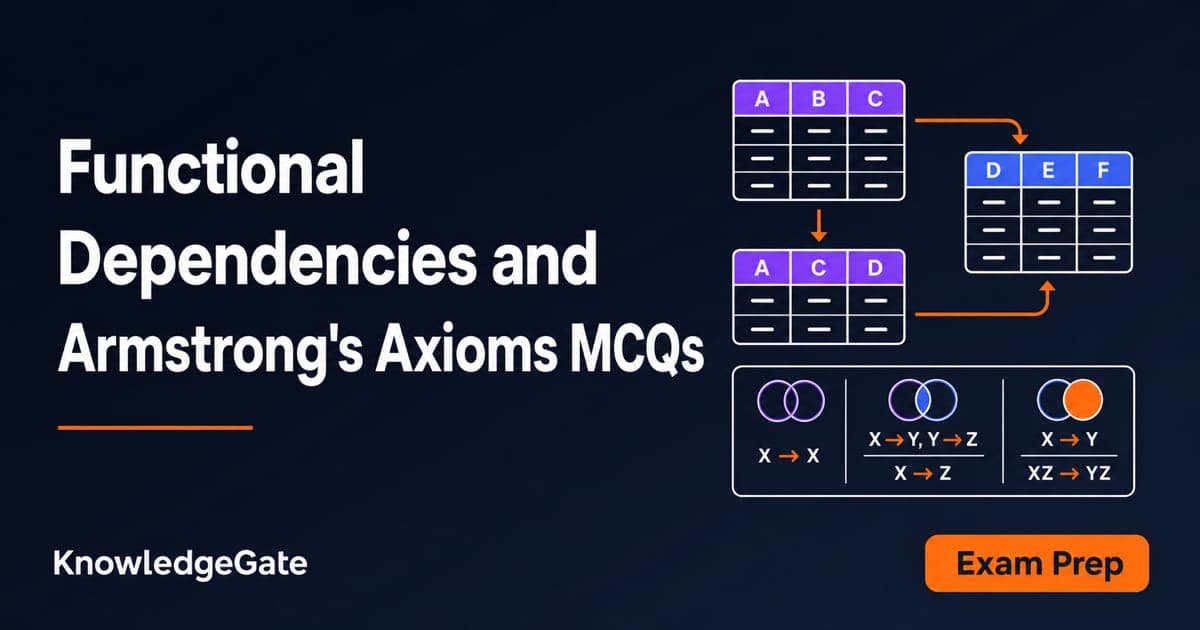
Functional-dependency problems can hide a closure, implication, counterexample or combinatorics task behind one symbol. Before calculating, classify the stem as a definition, axiom, derived rule, implication or count. That determines whether to test rows, apply a rule, compute closure or enumerate cases. Use GATE CS Exam Preparation as the broader route when you want to connect this practice to the rest of DBMS.
Functional dependency and full dependency
In Student(StudentID, Email, City) = {(101, asha@kg.ai, Delhi), (102, bharat@kg.ai, Delhi)}, StudentID -> Email passes the equal-ID test; City -> Email fails because Delhi has two emails. An FD constrains every legal instance, not one row.
Question 1
NIACL AO IT Specialist 2025.
What does a functional dependency represent in the context of relational databases?
A. A rule stating every table must include a primary key
B. A method for combining multiple relations into one
C. A technique used to transform an ER model into relational tables
D. A situation where one attribute uniquely determines another
Answer: D. A situation where one attribute uniquely determines another. Equal determinants require equal dependents; A, B and C concern keys, combining relations and mapping.
Full dependency needs the whole determinant. For (WarehouseID, ItemID) -> BinCode over {(W1, I1, B14), (W1, I2, B18), (W2, I1, B07)}, neither WarehouseID nor ItemID alone determines BinCode.
Question 2
ISRO 2018.
The set of attributes X will be fully functionally dependent on the set of attributes Y if the following conditions are satisfied.
A. X is functionally dependent on Y
B. X is not functionally dependent on any proper subset of Y
C. Both (a) and (b)
D. None of these
Answer: C. Both (a) and (b). Full dependency requires X to depend on Y, but on no proper subset of Y.
Armstrong's axioms and decomposition
Reflexivity says XY -> X; augmentation changes A -> B to AC -> BC; transitivity joins A -> B, B -> C into A -> C. Decomposition splits alpha -> beta gamma. Thus StudentID -> DeptID gives (StudentID, Semester) -> (DeptID, Semester); with DeptID -> HOD, it gives StudentID -> HOD. Each derived dependency follows from the given ones by rule application, not from any extra assumption about the data.
Question 3
ISRO 2011.
In functional dependency Armstrong inference rules refers to
A. Reflexivity, Augmentation and Decomposition
B. Transitivity, Augmentation and Reflexivity
C. Augmentation, Transitivity, Reflexivity and Decomposition
D. Reflexivity, Transitivity and Decomposition
Answer: B. Transitivity, Augmentation and Reflexivity. These are the sound, complete base axioms. Decomposition is derived.
Question 4
MPPSC Assistant Professor Computer Science Paper 2, 2025.
If alpha -> betagamma holds, then alpha -> beta and alpha -> gamma also hold. This rule is known as:
A. Union Rule
B. Decomposition Rule
C. Transitivity Rule
D. Reflexivity Rule
Answer: B. Decomposition Rule. It splits beta gamma without changing alpha. Union combines the two results instead.
Derived rules and implication proofs
Pair each rule name with its statement on scratch paper before you reveal the option.
Question 5
UGC NET 2013.
Armstrong (1974) proposed a systematic approach to derive functional dependencies. Match the following rules:
List I
a. Decomposition rule
b. Union rule
c. Composition rule
d. Pseudotransitivity rule
List II
i. If X -> Y and Z -> W, then {X, Z} -> {Y, W}
ii. If X -> Y and {Y, W} -> Z, then {X, W} -> Z
iii. If X -> Y and X -> Z, then X -> {Y, Z}
iv. If X -> {Y, Z}, then X -> Y and X -> Z
A. iii ii iv i
B. i iii iv ii
C. ii i iii iv
D. iv iii i ii
Answer: D. iv iii i ii. Splitting, joining, pairing and carrying W match decomposition, union, composition and pseudotransitivity respectively. The order is iv, iii, i, ii.
Question 6
GATE 2024.
The symbol -> indicates functional dependency in the context of a relational database. Which of the following options is/are TRUE?
A. (X, Y) -> (Z, W) implies X -> (Z, W)
B. (X, Y) -> (Z, W) implies (X, Y) -> Z
C. ((X, Y) -> Z and W -> Y) implies (X, W) -> Z
D. (X -> Y and Y -> Z) implies X -> Z
Answer: B, C and D. B is decomposition; D is transitivity. For C, augment W -> Y by X to get (X,W) -> (X,Y), then use (X,Y) -> Z. A fails on R(X,Y,Z,W) = {(x1,y1,z1,w1), (x1,y2,z2,w2)}: (X,Y) is unique, but x1 has two results.
Union proofs and trivial FDs
Question 7
GATE 2026.
In a relational schema, the closure F+ contains every functional dependency implied by F. Armstrong’s three axioms are:
Reflexivity: if Y is a subset of X, then X -> Y.
Augmentation: if X -> Y, then XZ -> YZ for any Z.
Transitivity: if X -> Y and Y -> Z, then X -> Z.
Union adds: if X -> Y and X -> Z, then X -> YZ.
Which combination of Armstrong’s axioms is both necessary and sufficient to prove the union rule?
A. Reflexivity, Augmentation, and Transitivity
B. Reflexivity and Augmentation
C. Transitivity
D. Augmentation and Transitivity
Answer: D. Augmentation and Transitivity. Proof:
From
X -> Y, augment by X to getX -> XY.From
X -> Z, augment by Y to getXY -> YZ.By transitivity,
X -> YZ.
Both rules are needed here; reflexivity is not.
Triviality has one test: RHS must be a subset of LHS. Membership in F+ is insufficient.
Question 8
GATE 2015.
Consider the relation X(P,Q, R, S, T,U) with the following set of functional dependencies F = { {P, R} -> {S, T}, {P, S,U} -> {Q, R} } Which of the following is the trivial functional dependency in F+, where F+ is closure of F ?
A. {P, R} -> {S, T}
B. {P, R} -> {R, T}
C. {P, S} -> {S}
D. {P, S,U} -> {Q}
Answer: C. {P,S} -> {S}. S is inside {P,S}, so the FD is trivial. B is implied but non-trivial because T lies outside {P,R}.
Relationships and implication by closure
In Employee(EmployeeID, DepartmentID) = {(E01,D10), (E02,D10), (E03,D20)} and Department(DepartmentID) = {D10,D20}, each employee reaches one department. D10 reaches two employees, disproving the reverse.
Question 9
UGC NET 2018.
A many-to-one relationship exists between entity sets r1 and r2 . How will it be represented using functional depedencies if Pk(r) denotes the primary key attribute of relation r ?
A. Pk(r1 ) -> Pk(r2 )
B. Pk(r2 ) -> Pk(r1 )
C. Pk(r2 ) -> Pk(r1 ) and Pk(r1 ) -> Pk(r2 )
D. Pk(r2 ) -> Pk(r1 ) or Pk(r1 ) -> Pk(r2 )
Answer: A. Pk(r1 ) -> Pk(r2 ). Each r1 entity reaches one r2 entity. D10 paired with two employees disproves the reverse.
Question 10
NIACL AO IT Specialist 2024.
In a schema with attributes A, B, C, D, and E, the following set of functional dependencies is given: A -> B, A -> C, CD -> E, B -> D, E -> A. Which of the following functional dependencies is NOT implied by the given set?
A. CD -> AC
B. BD -> CD
C. BC -> CD
D. AC -> BC
Answer: B. BD -> CD. The needed closures are:
Determinant | Closure | Result |
|---|---|---|
|
|
|
|
|
|
|
|
|
|
| C is absent, so |
This exact question also appears in Attribute Closure and FD-Set Equivalence MCQs: 12 Solved Questions, where it tests the full closure loop and FD implication. Here it separates Armstrong-rule implications from a determinant that stalls.
Use closure to find a failing dependency
Question 11
HPSC PGT Computer Science 2022.
If the following functional dependencies holds on a selection R: A -> B, A -> C, BC -> D, C -> F, B -> E, then which of the following dependency does not hold on R?
A. A -> DE
B. BC -> DEF
C. A -> EF
D. BD -> EF
Answer: D. BD -> EF. Compute:
A+ = {A} -> {A,B,C} -> {A,B,C,E,F} -> {A,B,C,D,E,F}.BC+ = {B,C} -> {B,C,D,E,F}.BD+ = {B,D} -> {B,D,E}.
BD+ stops without C, so C -> F cannot fire. The other closures prove A, B and C.
Count useful FDs without double-counting
Question 12
GATE 2024.
A functional dependency F: X -> Y is useful only when all three conditions hold:
X is not empty.
Y is not empty.
X and Y are disjoint.
For a relation R with four attributes, what is the total number of possible useful functional dependencies?
For this NAT item, Answer: 50. Non-empty, disjoint X and Y rule out |X|=4.
|X|=1:C(4,1)(2^3-1) = 4*7 = 28.|X|=2:C(4,2)(2^2-1) = 6*3 = 18.|X|=3:C(4,3)(2^1-1) = 4*1 = 4.
Total: 28+18+4 = 50. Cross-check X, Y or neither per attribute: 3^4 - 2*2^4 + 1 = 81-32+1 = 50. Empty X and Y are subtracted, then all-neither restored.
Functional-dependency traps, score and next step
Five-line check:
Equal determinant means equal dependent values.
A full dependency needs the whole determinant.
The base axioms are reflexivity, augmentation and transitivity.
Trivial means RHS is a subset of LHS.
Implication means the required RHS lies inside the determinant's closure.
Score one point for each numbered question; Question 6 earns its point only if all three true statements are selected. Use the pattern of misses: Questions 1-2 diagnose definitions, 3-8 axioms and derived rules, 9 relationships, 10-11 closure, and 12 counting. Rework the corresponding section before mixed practice. This is a study diagnostic, not a marks prediction.
If closure is weak, use the closure guide above. Then use DBMS Normalization MCQs: 12 Solved (1NF to BCNF) to connect dependencies to normal forms, or DBMS MCQs for mixed practice. GATE Guidance by Sanchit Sir is the full preparation route.
Keep learning

Safety of Expressions & Power MCQs: 10 Solved Relational Calculus Questions
Practise the active-domain test, De Morgan rewrites and the equivalence of relational algebra, safe TRC and safe DRC through ten fully explained questions.
Updated 20 Oct 20268 min readDBMS MCQs
Introduction to Query Languages MCQs: 8 Solved MCQs and 2 Concept Checks
Attempt eight published query-language MCQs, check each answer with a focused explanation, then use two written prompts to test recall of relational algebra.
Updated 16 Oct 20267 min readDBMS MCQs
SQL Datatypes, Operators and NULL MCQs: 12 Solved Questions with Explanations
Solve 12 SQL questions on datatypes, operators and NULL, then use one three-row trace to see exactly how TRUE, FALSE and UNKNOWN affect a WHERE clause.
Updated 8 Oct 20267 min readDBMS MCQs
SQL Library Functions MCQs: 12 Solved Math, Aggregate, String and Date Questions
Practise 12 solved SQL library function MCQs with inside-out calculations, exact intermediate values and clear explanations of the common traps.
Updated 3 Oct 20268 min readDBMS MCQs