Introduction to Query Languages MCQs: 8 Solved MCQs and 2 Concept Checks
Attempt eight published query-language MCQs, check each answer with a focused explanation, then use two written prompts to test recall of relational algebra.
KnowledgeGate Team
Exam prep & CS education
Updated 16 Oct 20267 min read
Query-language questions look definitional, but their options often mix rows with columns, procedural with declarative thinking, and basic operators with extensions. Query languages involve tuples, procedural and declarative models, expressive power, and basic and extended operators. Attempt Questions 1 to 8 before reading their explanations, then answer Questions 9 and 10 from memory. If you need the complete subject sequence first, use GATE Guidance by Sanchit Sir.
Use three checks before answering a query-language question
First identify the object: tuple, relation, operator or language. Next ask whether the language specifies how to obtain the result or only what result is wanted. Finally, decide whether the operation belongs to basic relational algebra or needs an extension such as aggregation.
Start with tuples, purpose and the procedural label
Question 1: A tuple is one row
Stem: What is a tuple in a relational schema?
A. A type of key
B. A set of relationships
C. A single row in a table
D. A single column
Answer: C. In EMPLOYEE(eid, name, deptno, salary), (101, Anu, 10, 60000) is one complete tuple. salary is an attribute or column, while eid = 101 may be a key value. Asked in: BELTRON Programmer 2025, Computer Science, Shift-1.
Question 2: What a DBMS query language supports
Stem: A DBMS query language is designed to
A. support end users who use English-like commands
B. support in the development of complex applications software
C. specify the structure of a database
D. all of the above
Answer: D. This question uses “DBMS query language” as the broad database-language interface. Readable commands assist users, applications send statements through database APIs, and data-definition statements such as CREATE TABLE EMPLOYEE (...) specify structure. This does not mean every individual query language includes every feature.
Question 3: Relational algebra is procedural
Stem: Relational Algebra is
A. Data Definition Language
B. Meta Language
C. Procedural query Language
D. None
Answer: C. Procedural means the expression supplies an operator sequence, for example select rows where salary > 55000, then project name. By contrast, declarative SQL in SQL Queries and Joins states the wanted result while the DBMS chooses an execution plan. Relational algebra remains the formal model for reasoning about that query.
Separate procedural form from expressive power
Question 4: Which statement is nearer to a programming language?
Stem:
Consider the following statement
S1: Relational Algebra is nearer to a programming language.
S2: Relational Calculus is nearer to programming language.
Which one of the following is true ?
A. S1 only
B. S2 only
C. Both S1 and S2
D. Neither S1 nor S2
Answer: A. Algebra specifies an operation sequence, so S1 is true in the procedural sense. Calculus states predicates that answer tuples must satisfy, not an evaluation order, so S2 is false. “Nearer to programming” describes form, not greater expressive power.
Question 5: Algebra and calculus can be equivalent
Stem: Relational algebra and the relational calculus are fundamentally
A. Linear to each other
B. Restricted to each other
C. Opposite to each other
D. Equivalent to each other
Answer: D. Relational algebra and safe, domain-independent relational calculus are equivalent in expressive power, although their forms differ. On the worked EMPLOYEE relation below, σ_salary>55000(EMPLOYEE) and {e | EMPLOYEE(e) and e.salary > 55000} both return Anu at 60000 and Charu at 70000. Asked in: MPPSC 2025, Computer Science.
Question 6: Match the language and modelling directions
Stem: Match the following:
List-1 | List-2 |
|---|---|
I) Relational Algebra | Q) Procedural Query Language |
II) Relational Calculus | P) Non-Procedural Query Language |
III) Generalization | S) Bottom-Up Approach |
IV) Specialization | R) Top-Down Approach |
A. I-Q, II-P, III-R, IV-S
B. I-Q, II-P, III-S, IV-R
C. I-P, II-Q, III-S, IV-R
D. I-P, II-Q, III-R, IV-S
Answer: B. Algebra maps to procedural, while calculus maps to non-procedural. SavingsAccount and CurrentAccount generalise bottom-up into Account; Account specialises top-down into those two types. Asked in: DSSSB 2018, Computer Science.
Recognise the basic operator family
Question 7: The basic manipulation framework
Stem: Which of these operations constitute a basic set of operations for manipulating relational data?
A. Predicate calculus
B. Relational calculus
C. Relational algebra
D. None of these
Answer: C. Relational algebra provides operators over relations, including selection, projection, union, set difference and Cartesian product. Calculus is also a query formalism, but “set of operations” points to algebra. Asked in: RSSB 2022, Computer Science, BCI-Paper2.
Use these relations for the next calculation:
EMPLOYEE(eid, name, deptno, salary) = {(101, Anu, 10, 60000), (102, Bharat, 20, 50000), (103, Charu, 10, 70000)}
DEPARTMENT(deptno, deptname, address) = {(10, Systems, Pune), (20, QA, Jaipur)}
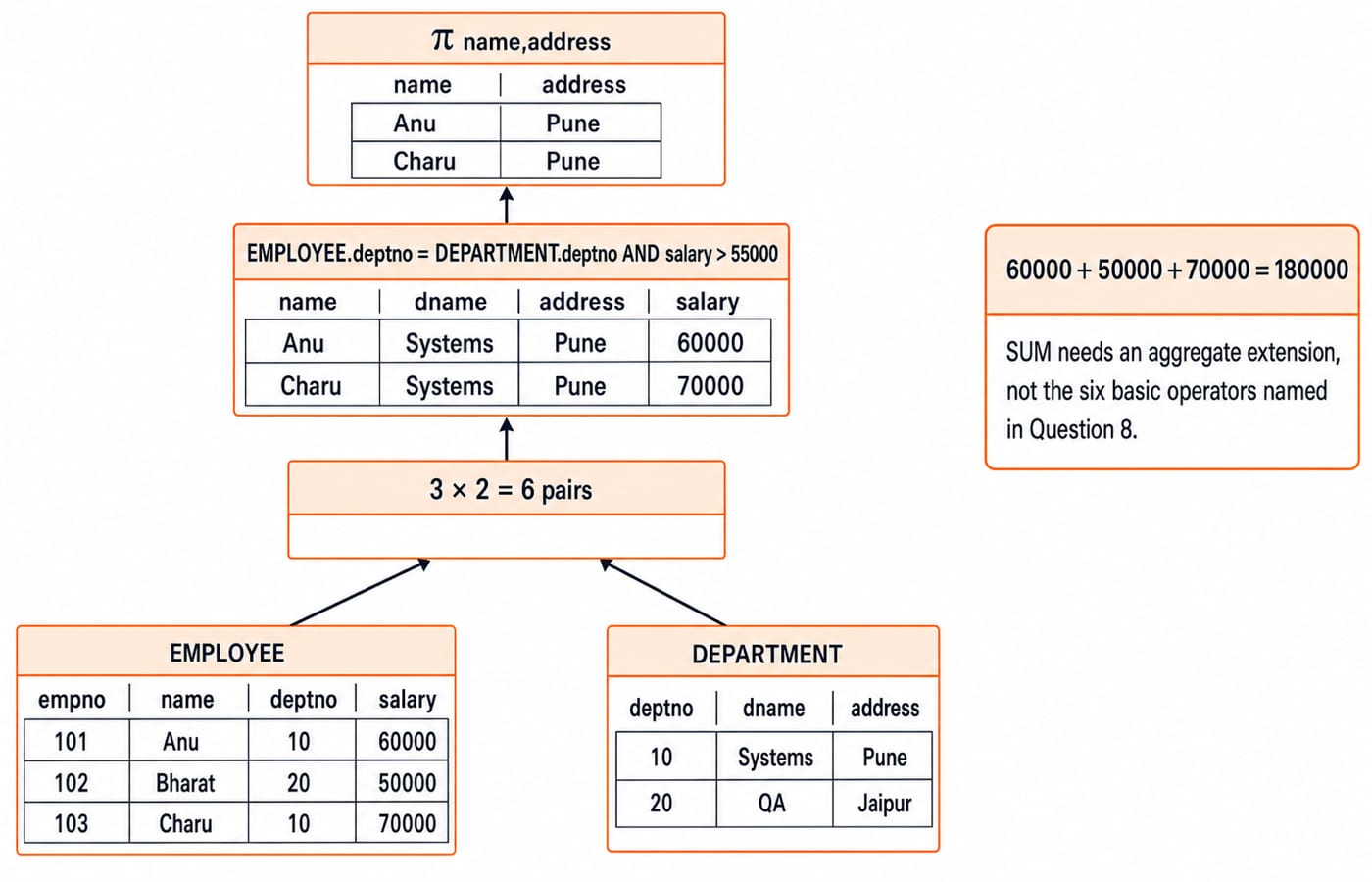
For π_name,address(σ_EMPLOYEE.deptno=DEPARTMENT.deptno AND salary>55000(EMPLOYEE × DEPARTMENT)):
Cartesian product gives
3 × 2 = 6tuple pairs.Department equality plus
salary > 55000keeps Anu with Systems, Pune, 60000 and Charu with Systems, Pune, 70000.Projection returns
{(Anu, Pune), (Charu, Pune)}.
This uses only product, selection and projection.
Question 8: Aggregation is outside the named basic set
Stem:
Given the relations
employee(name, salary, deptno) and
department(deptno, deptname, address)
Which of the following queries cannot be expressed using only the basic relational algebra operations: union (∪), set difference (-), Cartesian product (×), projection (π), selection (σ), and renaming (ρ)?
A. Department address of every employee
B. Employees whose name is the same as their department name
C. The sum of all employees’ salaries
D. All employees of a given department
Answer: C. Joins and projection can find addresses, while selection can isolate a department or compare names. But 60000 + 50000 + 70000 = 180000 requires SUM. The six listed basic operators contain no aggregate operator; extended relational algebra can add grouping and aggregation. Asked in: GATE 2000, Computer Science.
Use the two written prompts as concept checks
Questions 9 and 10 test written recall without options and are separate from the eight-MCQ score.
Question 9: Define relational algebra and its main characteristics
Stem: What is Relational Algebra in DBMS, and what are its primary characteristics and operators?
Options: none. Write your answer out in full, then check that it defines relational algebra and identifies its characteristics and operators.
Model-answer checklist: Relational algebra is a formal procedural query language. One or two input relations produce a new relation, demonstrating closure. Unary operators include selection σ and projection π; binary operators include product, union and set difference. A join can be expressed through product followed by selection. Here, σ_deptno=10(EMPLOYEE) gives Anu and Charu, then π_name gives {Anu, Charu}.
Question 10: Classify fundamental and derived operators
Stem: Relational Algebra is often described as the mathematical foundation of SQL. Define Relational Algebra and explain why it is considered a Procedural Query Language. Furthermore, classify its operators into Fundamental and Derived categories, providing a brief definition and the symbol for each.
Options: none. Write your answer out in full, then check that it explains the procedural model and classifies the operators.
Model-answer checklist: Procedural means specifying both the operations and their order. Selection σ filters rows, projection π keeps columns, union ∪ combines compatible rows, set difference - keeps first-only rows, Cartesian product × pairs rows, and rename ρ changes names. These six are fundamental here. Derived operators include intersection ∩ for common rows, theta or natural join ⋈ for related rows, and division ÷ for “all of” queries. A theta join is selection over a Cartesian product; a natural join also removes duplicate join columns. For union-compatible relations, R ∩ S = R - (R - S). SQL is largely declarative, while a DBMS can translate it into an internal algebraic plan.
Trap review: similar words, different ideas
Tuple means row, not column.
Relational algebra is procedural.
Relational calculus is declarative.
Different form does not imply different expressive power.
“Set of operations” points to algebra.
Aggregate functions are outside the basic operator list in Question 8.
Does π_name(σ_salary>55000(EMPLOYEE)) return Bharat? No, it returns Anu and Charu. Can the listed basic operators directly return 180000? No, because the total is an aggregate, not a selected or projected tuple value. For repeated row-versus-column choices and operator order, use the Unary Operators (Selection and Projection) MCQs; retain the trace above for procedural form and the boundary between basic and extended algebra.
Use each missed MCQ to choose the next step
Classify each miss before repeating the set. If you confused tuple with attribute, revise row-versus-column vocabulary. If you confused algebra with calculus, restate the procedural/declarative distinction. If aggregation looked basic, rewrite the six-operator list and explain why SUM needs extended algebra. Then retry only the missed questions and state each reason in one sentence.
Treat Questions 9 and 10 as a separate recall gate. You pass when you can reproduce the procedural definition, closure, all six fundamental operators, and at least two derived operators without looking.
Drill-ready readers can continue with more DBMS MCQ sets and the GATE Test Series. If the concepts are still weak, return to SQL Queries and Joins and structured GATE Guidance. The GATE CS category is the broader route for subject planning.
Keep learning
Safety of Expressions & Power MCQs: 10 Solved Relational Calculus Questions
Practise the active-domain test, De Morgan rewrites and the equivalence of relational algebra, safe TRC and safe DRC through ten fully explained questions.
Updated 20 Oct 20268 min readDBMS MCQs
Functional Dependencies and Armstrong's Axioms MCQs: 12 Solved Questions with Explanations
Solve 12 functional-dependency questions with exact options, step-by-step closure checks, Armstrong rule proofs, counterexamples and a useful-FD count.
12 Oct 20268 min read63 viewsDBMS MCQs
SQL Datatypes, Operators and NULL MCQs: 12 Solved Questions with Explanations
Solve 12 SQL questions on datatypes, operators and NULL, then use one three-row trace to see exactly how TRUE, FALSE and UNKNOWN affect a WHERE clause.
Updated 8 Oct 20267 min readDBMS MCQs
SQL Library Functions MCQs: 12 Solved Math, Aggregate, String and Date Questions
Practise 12 solved SQL library function MCQs with inside-out calculations, exact intermediate values and clear explanations of the common traps.
Updated 3 Oct 20268 min readDBMS MCQs