Global Environmental Conventions for UGC NET Paper 1: COP, Protocols and ISA Notes
Separate conventions, protocols, COP meetings and the International Solar Alliance. Use the official timeline, treaty families and two worked checks to avoid common UGC NET traps.
KnowledgeGate Team
Exam prep & CS education
Updated 25 Aug 20265 min read50 views

For UGC NET Paper 1, keep the ozone, climate, biodiversity and solar-cooperation families separate. Montreal concerns ozone; Kyoto and Paris sit under UNFCCC; COP is a governing forum; ISA is a solar alliance launched at COP21. In a matching question, first identify whether each name is a framework, instrument, forum or organisation. UGC NET Paper 1 vs Paper 2: What Each Tests places this topic in the common paper.
Convention, protocol, agreement, COP and alliance
Term | What it is | Example here | Exam-safe cue |
|---|---|---|---|
Convention | Broad treaty framework | Vienna Convention, UNFCCC | Find the parent framework |
Protocol | Specific related instrument | Montreal, Kyoto | Find its convention |
Agreement | May be a treaty | Paris Agreement | It may be legally binding |
COP | Conference of the Parties, a governing body or meeting | COP21 | Forum, not treaty |
Alliance | Intergovernmental organisation and platform | ISA | Not a protocol |
The UNEP Ozone Secretariat gives the ozone family: 1985 Vienna framework, then 1987 Montreal Protocol. The climate family is the 1992 UNFCCC, 1997 Kyoto Protocol and 2015 Paris Agreement. Legal effect comes from adopted text, ratification and entry into force, not the label alone.
The UNFCCC COP page calls COP the Convention’s supreme decision-making body. CMP serves Kyoto Parties; CMA serves Paris Parties. They are bodies, not treaties.
Global environmental conventions timeline
UGC NET Paper 1 Unit IX, People, Development and Environment, names Montreal, Rio, CBD, Kyoto, Paris and ISA in the University Grants Commission syllabus index. Chronology and entity-purpose matching therefore belong to Paper 1. Another teaching exam may define a different scope.
Date | Event | Main purpose | Official attribution |
|---|---|---|---|
1987 | Montreal Protocol | Ozone-depleting substances | Signed in 1987; force in 1989, says the UNEP Ozone Secretariat |
3-14 June 1992 | Rio Earth Summit | Environment and development | The UN record carries the Rio Declaration and Agenda 21, neither a protocol |
1992, in force 29 December 1993 | Convention on Biological Diversity | Conservation, sustainable use, fair and equitable benefit-sharing | Three objectives stated by the CBD Secretariat |
11 December 1997 | Kyoto Protocol | Greenhouse-gas commitments for specified developed Parties | Linked to UNFCCC; force on 16 February 2005, says the Kyoto source |
30 November 2015 | International Solar Alliance | Solar-energy deployment cooperation | India-France launch on COP21’s first day, according to ISA |
12 December 2015 | Paris Agreement | Global climate action | Adopted at COP21; force on 4 November 2016, says UNFCCC |
Use this recall spine: 1987 Montreal -> 1992 Rio and CBD -> 1997 Kyoto -> 2015 ISA and Paris.
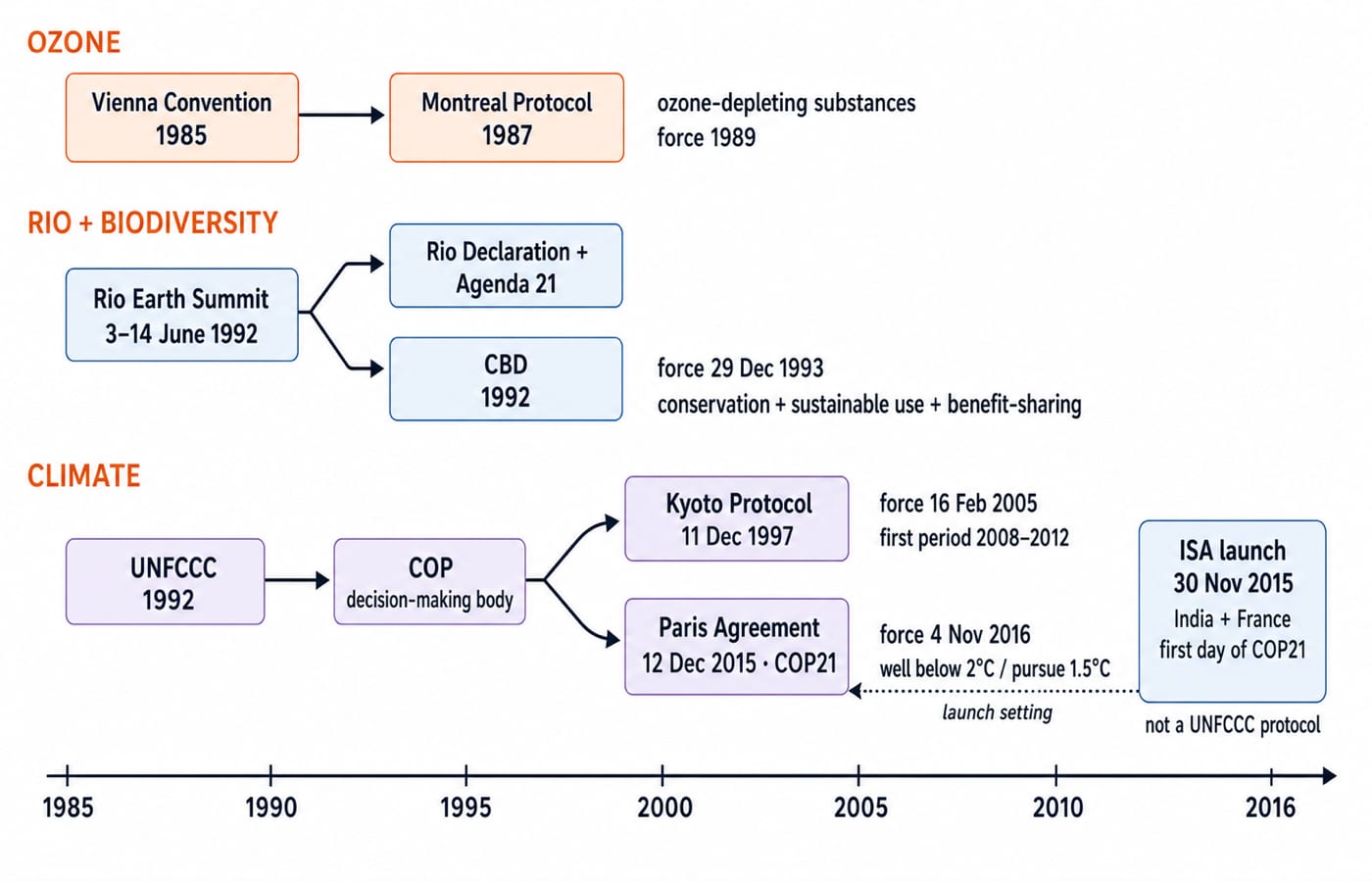
COP, Kyoto and Paris in one climate process
UNFCCC is the parent convention. COP reviews implementation and adopts decisions. Kyoto is its protocol; Paris is a legally binding treaty adopted at COP21. A conference number is neither the instrument’s name nor its entry-into-force date.
The official UNFCCC Kyoto account gives binding first-period targets for 37 industrialised countries and the European Community, averaging 5% below 1990 levels over 2008-2012. It was a collective average, not an identical target. The Paris Agreement (UNFCCC) uses nationally determined contributions on a five-year cycle, aiming for well below 2°C while pursuing 1.5°C, not one uniform percentage.
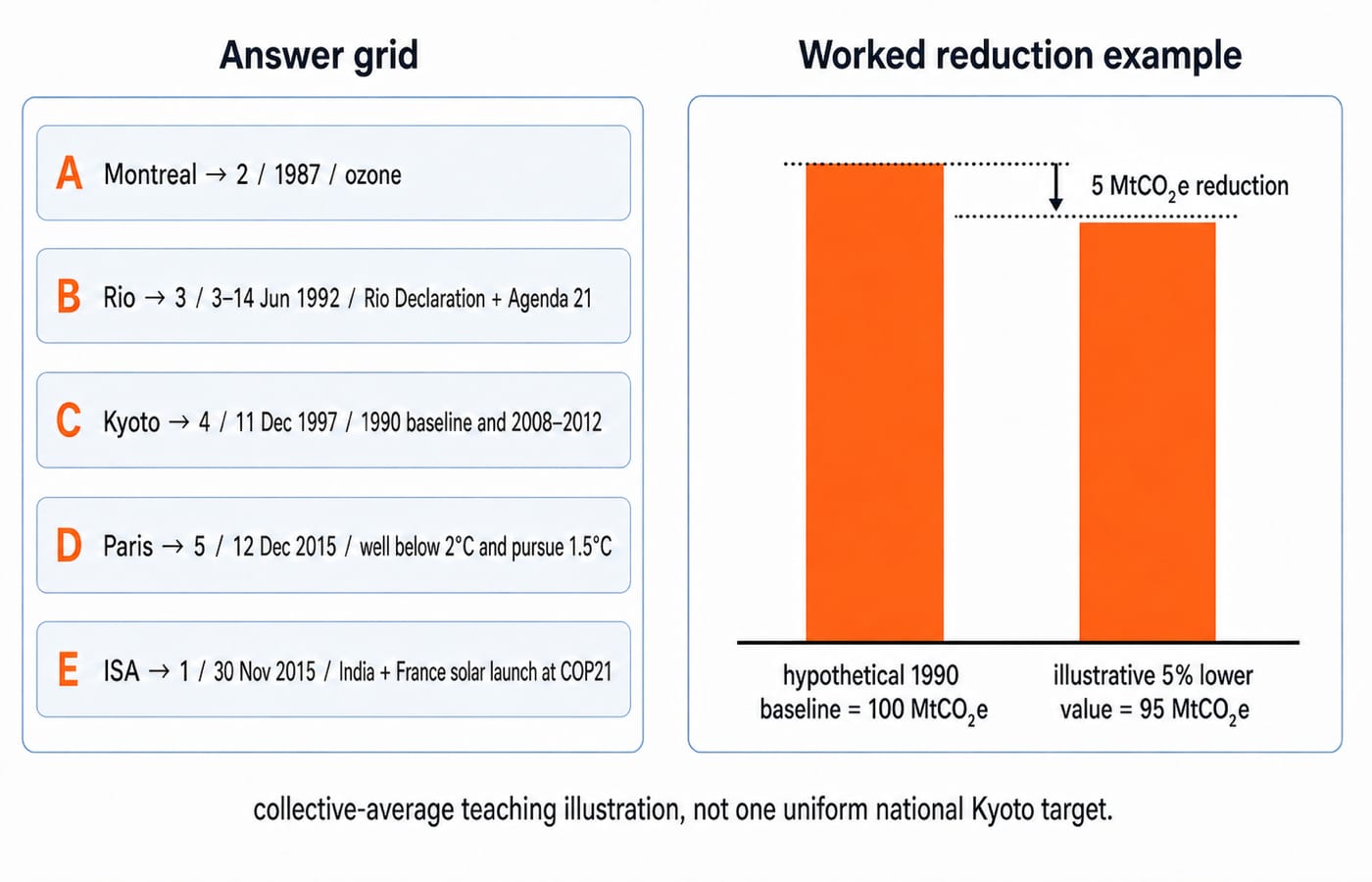
Worked match and the 100-to-95 Kyoto calculation
Match List I with List II.
List I: A. Montreal Protocol; B. Rio Earth Summit; C. Kyoto Protocol; D. Paris Agreement; E. International Solar Alliance.
List II: 1. India-France solar initiative launched at COP21 on 30 November 2015; 2. Ozone agreement signed in 1987; 3. UN conference held from 3-14 June 1992 whose outputs include the Rio Declaration and Agenda 21; 4. Climate protocol adopted on 11 December 1997 with an average 5% reduction against 1990 levels over 2008-2012 for its first commitment period; 5. Climate agreement adopted on 12 December 2015 with the well-below-2°C and 1.5°C temperature formulation.
Correct match: A-2, B-3, C-4, D-5, E-1.
Ozone fixes Montreal. Rio Declaration plus Agenda 21 fixes Rio. The 1990 baseline and 2008-2012 commitment period fix Kyoto. Entity and date then separate ISA’s 30 November launch from Paris adoption on 12 December. Each clue identifies one event without relying on the answer options.
Illustration, not a country’s assigned amount: from 100 MtCO2e, 100 x (1 - 0.05) = 100 x 0.95 = 95 MtCO2e. Reduction: 100 - 95 = 5 MtCO2e. Kyoto commitments differed, so 95 is not a universal Party target.
International Solar Alliance and the COP21 confusion
The International Solar Alliance background page describes a joint India-France solar platform conceptualised at COP21 in Paris. ISA history dates its launch to 30 November 2015.
ISA is not the Paris Agreement.
ISA is not a protocol under UNFCCC.
ISA is not another name for COP21. COP21 was the setting for its launch.
Check: Which description is correct? A. ISA is the enforcement protocol of Paris; B. ISA is the UNFCCC’s COP body; C. ISA is an India-France solar initiative launched at COP21; D. ISA is the biodiversity treaty opened at Rio.
Answer: C. A invents a protocol, B confuses ISA with a UNFCCC body, and D confuses solar cooperation with biodiversity.
Global environmental convention traps
Trap | Why it fails | Correction |
|---|---|---|
Montreal and climate change | Its primary treaty focus is not climate emissions | Montreal addresses ozone-depleting substances |
Kyoto and ozone | Kyoto belongs to the climate family | Kyoto addresses greenhouse gases under UNFCCC |
COP21 as a treaty | COP21 was a conference | Paris was adopted at COP21 |
Rio Summit as a protocol | Rio was a UN conference | Its outputs included the Rio Declaration and Agenda 21 |
ISA as Paris Agreement | One is a solar organisation, the other a climate treaty | Keep the entities separate |
Adopted and entered into force | These are distinct legal milestones | Learn both only when the question needs both |
Official pages place the ISA launch on 30 November before Paris adoption on 12 December 2015. Their shared year does not merge them. Sequence: Montreal 1987, Rio and CBD 1992, Kyoto 1997, ISA and Paris 2015.
How teaching exams can test COP and protocols
Four defensible stems are entity-purpose matching, chronology, parent-convention matching, and assertion-reason or odd-pair selection. UGC NET scope follows Paper I Unit IX. For other teaching exams, check the current official syllabus.
Rapid checks: Vienna Convention -> Montreal Protocol and UNFCCC -> Kyoto Protocol and Paris Agreement are correct. COP21 -> ISA as a protocol is wrong because COP21 was the launch setting.
In 60 seconds, circle the problem, identify the entity, attach the year, find the parent, then check adoption against entry into force. See UGC NET Preparation Courses & Test Series for wider NET context.
Global environmental conventions: the short version
Recall the sequence and distinctions: Montreal = 1987 + ozone; Rio = 1992 + Rio Declaration and Agenda 21; CBD = biodiversity’s three objectives; Kyoto = 1997 + differentiated developed-Party commitments; ISA = 30 Nov 2015 + India-France solar launch; Paris = 12 Dec 2015 + well below 2°C / pursue 1.5°C. COP remains the decision-making forum, not another treaty.
Recreate A-2, B-3, C-4, D-5, E-1. Recompute 100 x 0.95 = 95 and explain why it is illustrative. If either is missing, redraw the timeline before more acronyms.
For optional structured study, use the NTA UGC NET Paper 1 Course. For optional practice, use the UGC NET Paper 1 Test Series.
Keep learning
Function Keys F1-F12 Explained: Uses, Worked Shortcut Map and Exam Traps
Learn what F1 through F12 do in named Windows and Microsoft application contexts, then solve a nine-command classification and avoid common modifier traps.
Updated 20 Oct 20266 min readUGC NET Computer Science
E-Waste Management Explained: Lifecycle, Worked Recovery Example and Exam Traps
Learn how e-waste moves from use to reuse, recycling and controlled residue. A hypothetical 600 kg batch shows how to close the mass balance and avoid denominator traps.
Updated 16 Oct 20266 min readUGC NET Computer Science

Data Protection, IPR and Open Source Explained: Two Worked Cases and Exam Traps
Separate privacy from security, match IP rights to software assets, and solve two numerical cases on data minimisation and mixed-licence releases.
Updated 12 Oct 20266 min readUGC NET Computer Science

Common Software & Tools MCQs: 12 Solved ICT Questions Explained
Attempt 12 previous-year ICT MCQs before reading concise explanations that separate applications, hardware, web tools, abbreviations, malware and operating systems.
8 Oct 20267 min readUGC NET Computer Science