Research Ethics, Writing and Publication for Teaching Exams: Concepts, Traps and Worked Examples
Connect research ethics, academic writing and publication through clear distinctions, two worked cases and quick checks for common exam traps.
KnowledgeGate Team
Exam prep & CS education
Updated 24 Aug 20267 min read

Consent, plagiarism, authorship, citation and journal metrics can look like unrelated definitions when you revise them separately. Exam questions make them harder by placing two close-looking ideas inside one scenario: a study that is confidential but not anonymous, a similarity score that is not a misconduct verdict, an author metric quoted where a journal metric belongs. Each of those pairs separates on one detail, and the detail is usually a number you can check. Research Aptitude is a UGC NET Paper 1 unit; CTET, state TET and other teaching-recruitment syllabi differ, so check the current syllabus for your paper. NET aspirants can start with the UGC NET preparation hub.
1. Research ethics, writing and publication as one chain
Research ethics governs how a study treats participants, data and the scholarly record. Research writing makes the question, method, evidence and limitations inspectable. Publication adds duties around authorship, peer review, disclosure and correction.
Remember the chain: plan -> consent -> collect -> analyse -> write -> cite -> submit -> revise -> correct. An ethical failure can occur at any arrow, not only while collecting data. Four recurring principles help you reason through cases: respect and voluntary participation, minimising harm, fairness in selection and treatment, and honesty and accountability in the record. Where a principle and your institution's written policy point in different directions, the policy governs the paperwork and the principle still tells you what the paperwork is for. The Research Aptitude study path carries recorded classes and unit-wise tests across all ten Paper 1 units.
2. Participant and data ethics: distinctions exam questions exploit
Informed consent is an understandable process covering purpose, procedures, foreseeable risks or discomforts, expected benefits, voluntariness, withdrawal conditions and contact routes. With minors or other vulnerable participants, guardian consent and the participant's own assent are both required, one on top of the other rather than one instead of the other. Consent alone cannot make a harmful design ethical.
In an anonymous poll of 80 teachers, researchers collect no names, email addresses or recoverable codes. In a confidential study of the same 80 teachers, records use IDs T001 to T080, while a separate encrypted file maps IDs to names. The team can re-identify records, so the study is confidential, not anonymous.
Privacy concerns access to people and their information. Data security protects stored or transmitted records. Collect only needed fields, restrict access by role, separate the linkage key, report aggregates, and retain or delete records according to the approved protocol.
3. Worked ethics case: recruitment to reporting
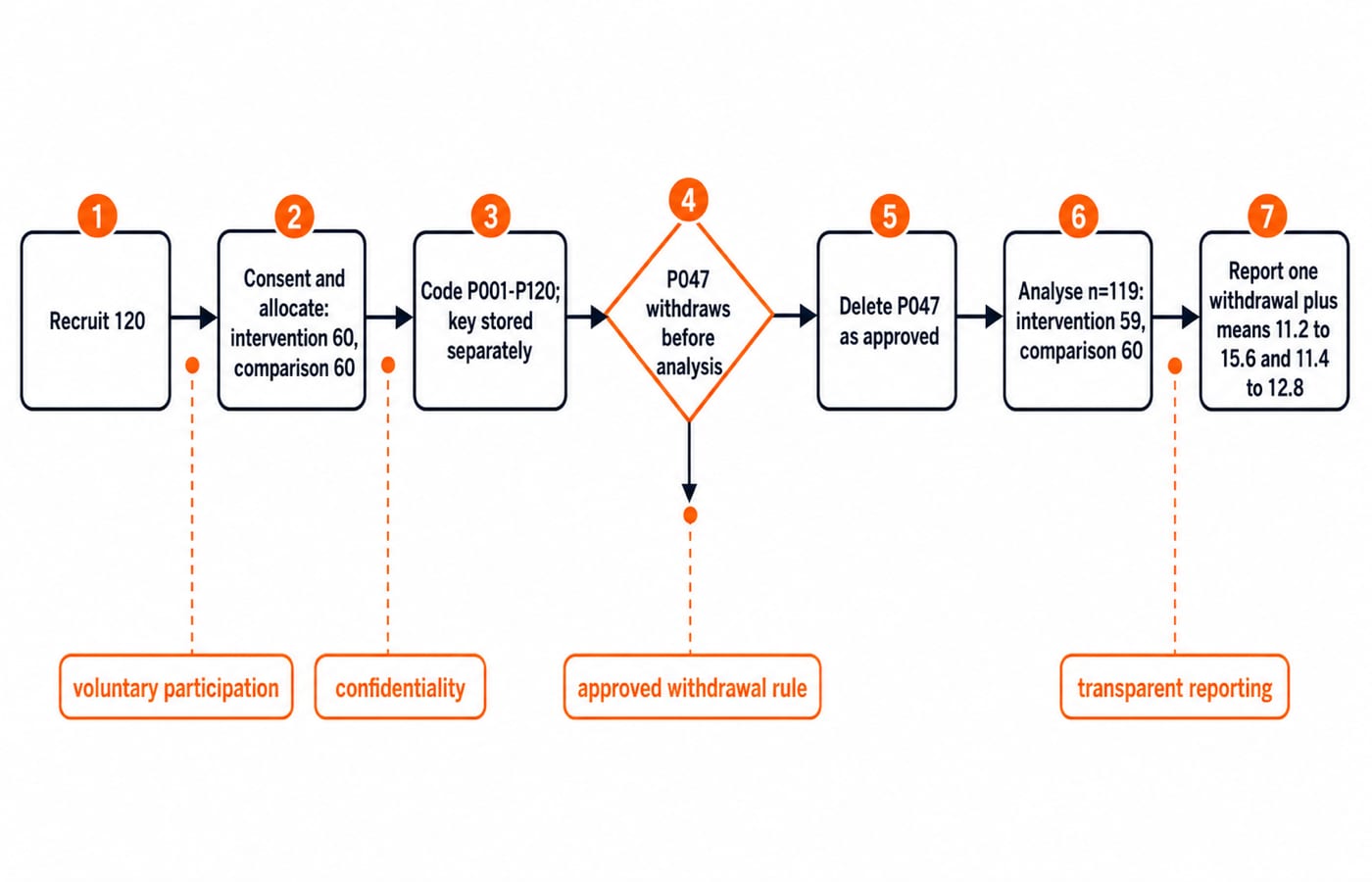
Suppose 120 B.Ed. trainees take 20-point pre-tests and post-tests, then enter a feedback intervention (60) or comparison group (60). Codes P001 to P120 replace names; the identity key stays separate. P047 is in the intervention group and withdraws before analysis. The approved plan requires deletion.
Obtain ethics approval before recruitment.
Use a neutral recruiter, so lecturers do not pressure their own students.
Explain allocation, data handling and withdrawal before consent.
Delete P047's record under this case's approved plan.
Calculate the analysed sample as
120 - 1 = 119, with60 - 1 = 59in the intervention group and60in comparison.Report
n = 119and one withdrawal. Do not replace P047 silently or claim that all 120 completed the study.
A different approved protocol might instead retain data collected before the withdrawal, so read the consent form's withdrawal clause before deciding: that clause, not a general rule, fixes what happens to P047's pre-test. If the intervention mean moves from 11.2 to 15.6 and the comparison mean from 11.4 to 12.8, report those observed values and the analysis honestly. Do not claim universal effectiveness without addressing design, uncertainty and limitations.
4. Fabrication, falsification, plagiarism and publication problems
Fabrication means inventing data or cases. Falsification means manipulating materials, procedures or records so the evidence is misrepresented. Plagiarism means presenting another person's words, ideas, structure or work without proper acknowledgement. If a researcher records 12, 14, 15, 17, then adds invented scores 18, 19, that is fabrication. Changing the recorded set to 16, 17, 18, 19 is falsification.
Plagiarism is not identical to copyright infringement or to a similarity score. Assume the exclusions listed in the UGC's 2018 regulations have already been applied. A document has 3,150 countable matching words among 21,000 analysed words:
similarity = (3,150 / 21,000) x 100 = 0.15 x 100 = 15%
Under those regulations, above 10% through 40% is Level 1. This is a classification under that framework, not a universal safe percentage. A software report is a screening input, not an automatic misconduct verdict. Institutional academic-integrity processes assess allegations.
Other problems also pair with practical repairs. Submit to one journal at a time to avoid duplicate submission. Disclose related manuscripts to address redundant publication. Publish a coherent research question instead of slicing one study artificially. Declare relevant interests rather than concealing conflicts. Assign credit from actual contributions under the journal's policy, avoiding both gift authorship and ghost authorship.
5. Research writing: structure, paraphrase and reference integrity
A typical report has preliminary matter: title page, required declaration, abstract and contents. Its main body covers the question, literature, method, results and discussion, followed by conclusion, references and appendices. In the running case, Methods states 120 recruited, Results states 119 analysed, and the reporting note records 1 withdrawal.
Consider this hypothetical source sentence, not a real publication: “Among 240 trainee teachers, 156 preferred written feedback combined with a short discussion.” The percentage is:
156 / 240 x 100 = 0.65 x 100 = 65%
Compare three uses:
Unacceptable copy: repeat it without quotation marks or citation.
Patchwriting: “Out of 240 trainee teachers, 156 preferred written comments together with a brief discussion.” Token synonym swaps remain too close, even with a citation.
Acceptable paraphrase: “In the hypothetical sample, nearly two-thirds of participants (156 of 240, or 65%) favoured feedback delivered in writing and then discussed [source citation].” In your own writing that bracket carries the actual author, year and locator in the style your department requires.
An in-text citation points to a reference. Quotations use exact words; paraphrases restate ideas and still cite them. Match citations and references, verifying names, years, titles, identifiers and required page locators. Do not mix styles unless instructed.
6. From manuscript to publication: authorship, review and metrics
A term paper demonstrates course learning. An original article reports a new study, a review synthesises research, and a thesis or dissertation presents degree work. The contrast worth memorising is who judges each one: a term paper is graded by the course teacher, an article is refereed by external peer reviewers, and a thesis is examined by an appointed board.
A typical route is: choose a scope-matched journal, check instructions and ethics policy, submit to one journal, complete editorial screening, peer review and point-by-point revision, receive a decision, check proofs and publish. Correct or retract if needed. Warning signs include an unverifiable editorial board, guaranteed acceptance and hidden processes. A fee alone proves nothing.
Asha designs, analyses 119 records and drafts the manuscript. Bilal recruits, documents the method and revises it critically. Charu supervises, validates analysis and revises the final text. Decide authorship and order transparently under journal or institutional criteria, recording contributor roles. Status or supervision alone does not settle authorship.
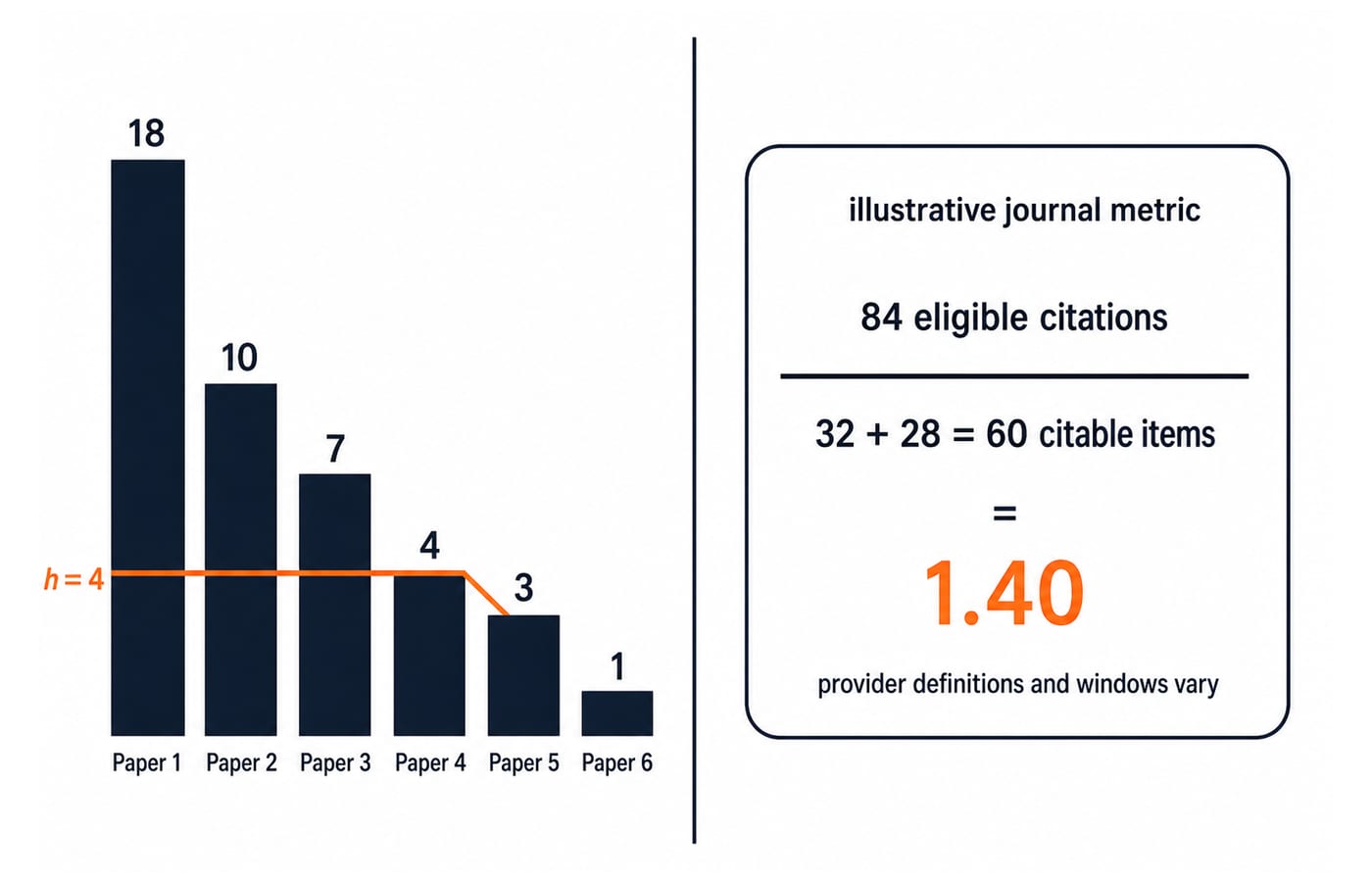
For an author with six papers cited [18, 10, 7, 4, 3, 1] times, the counts are already ranked. Papers 1 to 4 each have at least four citations. Paper 5 has only three, so five papers do not each have five citations. Therefore, h-index = 4.
A journal-level metric divides the citations received in one year by the citable items the journal published over a fixed preceding window. Suppose 84 eligible citations against 32 + 28 = 60 citable items:
84 / 60 = 1.40
This is illustrative because databases define windows and item types differently. The h-index here describes an author, while the second calculation describes a journal-level metric.
7. How exams turn these concepts into traps
Questions can test misconduct classification, anonymity versus confidentiality, report order, author versus journal metrics, withdrawal, authorship or citation defects. About 50 Research Aptitude questions under Research Ethics, Writing and Publication are available for practice.
Use a four-step elimination routine:
Underline the actor and action.
Identify the harm: participants, data or the scholarly record.
Compare exact definitions, not moral tone.
Reject absolutes such as “always”, a universal similarity percentage or guaranteed confidentiality.
Recall that P047 changes 120 to 119, while [18, 10, 7, 4, 3, 1] gives h = 4. Check your current official syllabus and notification. Use NTA's official UGC-NET portal for scope and UGC regulations for similarity bands. The Paper 1 versus Paper 2 explainer gives context, while UGC NET mock-test strategy moves definitions into practice.
8. The short version and next step
Consent must be informed and voluntary.
Anonymity means there is no recoverable identity link.
Confidentiality protects an identity link that exists.
Fabrication invents, falsification distorts, and plagiarism misappropriates.
Cite and reference consistently.
Disclose contributions and conflicts.
Interpret each metric at the correct level.
Redraw the recruitment-to-reporting flow and the citation bar chart from memory. Re-solve why P047 changes 120 to 119, then recompute why the citation list gives h = 4. Use the UGC NET Paper 1 Test Series when you want to move from recall to practice.
Keep learning
Function Keys F1-F12 Explained: Uses, Worked Shortcut Map and Exam Traps
Learn what F1 through F12 do in named Windows and Microsoft application contexts, then solve a nine-command classification and avoid common modifier traps.
Updated 20 Oct 20266 min readUGC NET Computer Science

E-Waste Management Explained: Lifecycle, Worked Recovery Example and Exam Traps
Learn how e-waste moves from use to reuse, recycling and controlled residue. A hypothetical 600 kg batch shows how to close the mass balance and avoid denominator traps.
Updated 16 Oct 20266 min readUGC NET Computer Science

Data Protection, IPR and Open Source Explained: Two Worked Cases and Exam Traps
Separate privacy from security, match IP rights to software assets, and solve two numerical cases on data minimisation and mixed-licence releases.
Updated 12 Oct 20266 min readUGC NET Computer Science

Common Software & Tools MCQs: 12 Solved ICT Questions Explained
Attempt 12 previous-year ICT MCQs before reading concise explanations that separate applications, hardware, web tools, abbreviations, malware and operating systems.
8 Oct 20267 min readUGC NET Computer Science