HCLTech Placement Preparation: 6-Week, 84-Hour Test Plan
Build your HCLTech test preparation around 84 planned hours, measurable diagnostics, timed practice and a recovery rule that survives missed days.
KnowledgeGate Team
Exam prep & CS education
Updated 26 Oct 20265 min read
Searching for an HCLTech pattern often produces copied section lists, although the route can change by programme, role or drive. This plan matches the stages HCLTech currently publishes without treating a third-party pattern as permanent. It gives you six weeks, 84 hours, a diagnostic, exact allocations, simulations and a missed-day rule. Every performance number is a self-set practice target, not an official cutoff. Preparing for several recruiters? Start with Company-Specific Placement Courses.
Start with HCLTech's current test map, not a recycled pattern
The current HCLTech campus-hiring page says its AMP Ascend route has a cognitive test covering numerical, verbal and reasoning for about 90 minutes, then a 60-to-90-minute coding or technical test. It describes a speaking-and-listening Versant stage, labels 46-56 as B1, and says technical and HR interviews follow for candidates who clear the assessment route.
This current map is not a promise for every role or college drive. Before week 1, save the role notice, recruiter instructions and test-platform email. Recheck them and overwrite this plan wherever they differ. Accenture, Capgemini, Cognizant Placement Prep Compared shows why one service-based recruiter's route should not be copied onto another.
The six-week HCLTech study plan uses 14 hours a week
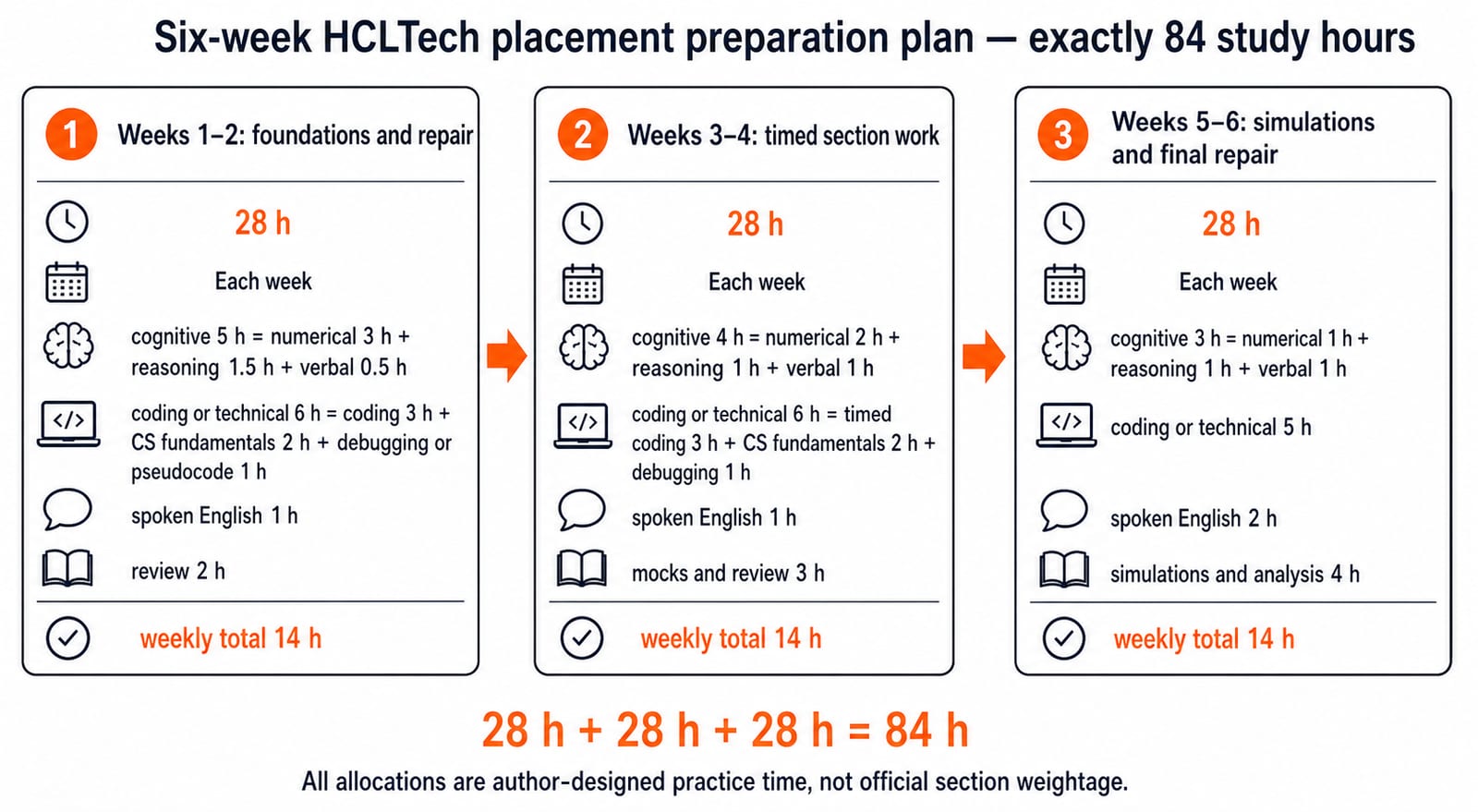
Checksum first: 6 weeks x 14 hours = 84 hours. Weeks 1-2 give 28 hours to foundations and diagnostic repair, weeks 3-4 give 28 to timed section work, and weeks 5-6 give 28 to simulations, review and final repair.
Weeks 1-2 each have 5 cognitive hours (3 numerical + 1.5 reasoning + 0.5 verbal), 6 coding or technical (3 coding + 2 CS fundamentals + 1 debugging or pseudocode), 1 spoken English and 2 review. Weeks 3-4 use 4 + 6 + 1 + 3 = 14 hours for cognitive, coding or technical, spoken English, and mocks with review. Weeks 5-6 use 3 + 5 + 2 + 4 = 14 hours for those areas and simulations. This author-designed split moves towards performance, not official weightage.
Day 1 diagnostic turns raw attempts into priorities
Take 30 author-written questions in 45 minutes: 10 numerical, 10 reasoning and 10 verbal. Suppose 24 are attempted, with 18 correct, 6 wrong and 6 skipped. Attempted-question accuracy is 18 / 24 x 100 = 75%; attempt rate is 24 / 30 x 100 = 80%; correct-answer pace is 18 / 45 = 0.40 per minute. None is an HCLTech cutoff.
Area | Wrong | Skipped | Repair items |
|---|---|---|---|
Numerical | 3 | 4 | 7 |
Reasoning | 2 | 2 | 4 |
Verbal | 1 | 0 | 1 |
Round the 7:4:1 repair ratio into 3 hours numerical, 1.5 hours reasoning and 0.5 hours verbal. The total remains 5 hours.
For coding, attempt two author-written problems in 75 minutes. Finish A in 32 minutes, then reach 7 of 10 tests on B by minute 75. Log empty input, duplicate value and largest allowed value as its three failures. Start the next block with those boundaries.
Weeks 1-2 build accuracy before full mocks
Use this rhythm:
Day | Work |
|---|---|
Monday | 90 min numerical + 30 min error-log review |
Tuesday | 90 min coding + 30 min debugging |
Wednesday | 90 min reasoning + 30 min spoken English |
Thursday | 90 min coding + 30 min debugging |
Friday | 90 min numerical + 30 min error-log review |
Saturday | 120 min CS fundamentals + 30 min verbal + 30 min spoken English |
Sunday | 60 min weekly audit |
Checksums: daily 2 + 2 + 2 + 2 + 2 + 3 + 1 = 14 hours; buckets 5 cognitive + 6 coding or technical + 1 spoken English + 2 review = 14 hours.
Keep evidence: 10 untimed concept questions, a saved coding solution with three edge cases, a CS recall sheet, or a spoken recording with transcript.
Aptitude for Placement covers aptitude, reasoning and verbal; Coding For Placements supports coding. Neither is HCLTech-official. For aptitude alone, use Aptitude for Placements: Section Topics and Weekly Plan.
Weeks 3-4 practise timed switching and analyse every loss
Weekly, take an author-designed 45-minute cognitive set with 30 mixed questions, a 75-minute two-problem coding simulation, and a 60-minute technical block with 20 CS recall prompts plus 2 pseudocode traces. The coding rehearsal fits the current official page's 60-to-90-minute range, but its problem count is your design. Recheck drive instructions.
Mock A has 28 attempted, 22 correct and 6 wrong, giving 22 / 28 x 100 = 78.6%. Mock B has 27 attempted, 24 correct and 3 wrong, giving 24 / 27 x 100 = 88.9%. One fewer attempt produced two more correct answers, showing better selection, not just speed.
Keep a four-column loss ledger:
Item | Lost because | Repair | Retest date |
|---|---|---|---|
Ratio question 18 | correctly converted 12.5% to 0.125, then used 0.125 incorrectly in the ratio | rewrite percentage-fraction table | Thursday |
Without a completed ledger, the mock does not count.
Weeks 5-6 simulate stages and repair weak evidence
Run two weekly simulations. Cognitive gets 90 minutes, with checkpoints at minutes 30, 60 and 80, then 10 minutes for flagged items. Coding gets 5 understand + 45 implement + 20 test and repair + 5 submit = 75 minutes. Live instructions override these self-designed checkpoints.
Personal targets are two consecutive cognitive mocks at 85% attempted-question accuracy or above, with no practice section below 75%; two coding simulations with one problem at 10 of 10 local tests and the other at least 8 of 10; five restart-free, 60-second spoken responses; and a 90-second summary of a two-minute audio clip. They are not HCLTech qualifying scores and cannot certify B1.
Spend the final four-hour simulation-and-analysis budget on the weakest evidence. If cognitive is 87%, spoken has five clean recordings and coding is 10/10 + 6/10, repair those four failed tests first.
A missed day changes the route, and sometimes the total
Miss a two-hour Tuesday block? Add 30 minutes to the next four sessions. Since 30 x 4 = 120 minutes = 2 hours, Wednesday avoids becoming a four-hour session.
If six hours are missed, recover one 90-minute cognitive simulation, one 90-minute coding simulation and one 60-minute analysis block: 90 + 90 + 60 = 240 minutes = 4 hours. Drop two hours of new content. If the test date cannot move, record 82 executed hours. If it can move, add a separate two-hour day and restore 84.
Evidence matters more than the timetable. For TCS, use the TCS Placement Preparation: 6-Week 84-Hour Study Plan, but keep separate company trackers.
Final readiness check and the hand-off after the test
Write a four-line evidence card:
cognitive = last two accuracy values + weakest sectioncoding = tests passed + named failing casesspoken English = five recordings + one listening summaryofficial check = current role notice and HCLTech page re-read
A blank line becomes the final repair priority. The current official HCLTech page places technical and HR interviews after the assessment route, so recheck it and your drive notice. In 30 minutes, explain a project in 90 seconds, answer a technical follow-up in 3 minutes and give a 60-second reason for wanting the role. This bridges into interview preparation.
Run the day-1 diagnostic, record both percentages plus pace, then tackle the highest-loss block. Weekly evidence matters more than the timetable.
Keep learning
Wipro Drive Mistakes: Stage-by-Stage Rejection Traps and Fixes
Preventable execution errors can waste solid preparation. Diagnose the risk at each Wipro drive step and replace it with a checkable habit.
25 Oct 20265 min readCompany-Specific Prep
HCLTech Recruitment Process and Test Pattern: Build Your Drive Map
Build a source-controlled HCLTech drive map from the current role page and invitation, then use worked diagnostics to prepare for each assigned stage.
Updated 23 Oct 20265 min readCompany-Specific Prep
Capgemini Coding Questions: 4 Patterns with Step-by-Step Solutions
Learn four transferable coding patterns through constructed Capgemini preparation examples. Each solution includes an invariant, complete trace, complexity and edge-case checks.
Updated 19 Oct 20266 min readCompany-Specific Prep
Capgemini Placement Preparation: An 8-Week Test-Matched Study Plan
Build an eight-week Capgemini preparation timetable from the route you are actually invited to take. Use two baselines and an error log to decide where every study hour goes.
Updated 15 Oct 20265 min readCompany-Specific Prep