C Programming for GATE: A 6-Week Topic-by-Topic Plan
Turn C revision into a 48-hour subject sprint. This plan moves from expressions and control flow to pointers, recursion, PYQ review, and timed mixed drills.
KnowledgeGate Team
Exam prep & CS education
Updated 31 Aug 20265 min read
C looks compact in notes, but recall is not enough. You must trace operator effects, pointer movement, loop state and recursive calls under time pressure. A six-week, 48-hour sprint turns those skills into a repeatable part of your wider GATE plan.
Set the finish line and the 48-hour study budget
The finish line is observable: trace a short program, explain every value change, solve relevant previous-year questions without notes, and label each miss as a concept, trace or time error. Prioritize focused revision over every possible C feature.
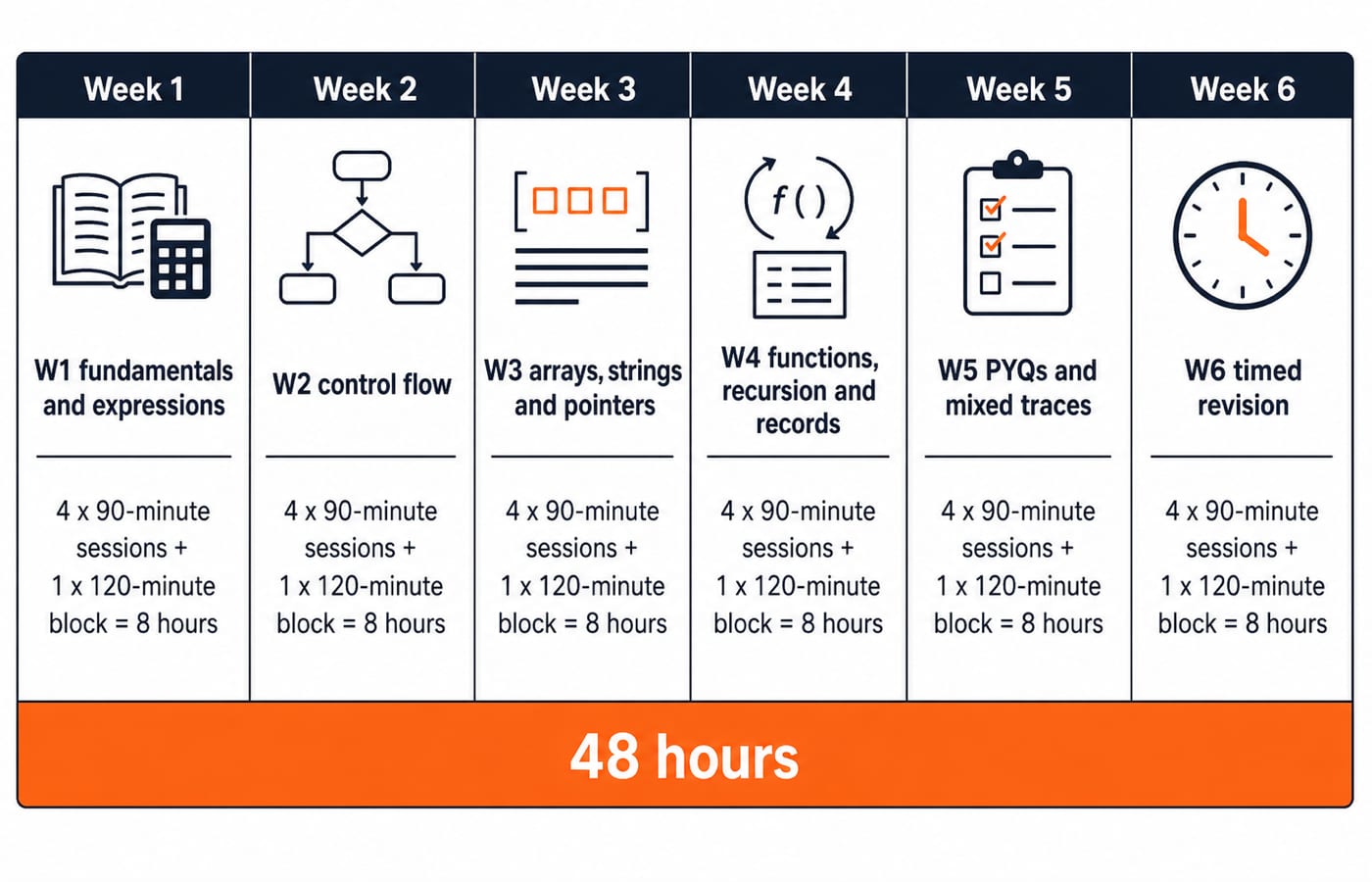
Use four 90-minute sessions and one 120-minute weekend block. That is 4 x 90 + 120 = 480 minutes = 8 hours weekly, and 6 x 8 = 48 hours overall. Split each session into 45 minutes of concepts, 35 of hand tracing and 10 of error logging. Split the weekend 75 minutes for questions and 45 for review.
Browse the GATE preparation courses and test series when you need the wider route. The full six-month GATE CS plan shows how this C sprint fits as one subject lane rather than taking over the whole schedule.
Rank C topics with your errors and PYQs
Begin with 15 questions: five on types, operators and control flow; five on arrays, strings and pointers; and five on functions, recursion, storage classes and structures. Score concept gap and trace gap from 0 to 2, then count up to three PYQ misses:
priority = 2 x concept gap + 2 x trace gap + capped PYQ misses
Pointers at 2, 2, 3 score 2(2) + 2(2) + 3 = 11. Loops at 1, 1, 2 score 2 + 2 + 2 = 6. Structures at 1, 0, 1 score 2 + 0 + 1 = 3. Give pointers two sessions, loops one, and structures a short review. Recalculate after Week 4.
Start with C Programming for GATE: Tested Areas and Prep Order to map syllabus scope and question emphasis, then turn that map into a six-week schedule of topic sessions, traces and readiness checks. Practice volume cannot establish a fixed weightage for pointers, loops or recursion.
Weeks 1 and 2: trace expressions and control flow
In Week 1, spend 2 hours on types and conversions, 2 on operators, 2 on assignments and increments, 1.25 on questions, and 0.75 on review. Total: 8 hours.
Trace int a=7, b=3; int q=a/b; int r=a%b; ++a; int s=a+b;. Integer division gives 7/3 = 2, the remainder is 7%3 = 1, then a = 8 and s = 8 + 3 = 11. Therefore printf("%d %d %d", q, r, s); prints 2 1 11.
In Week 2, allocate 2 hours each to selection, loops and nested traces, then 1.25 to questions and 0.75 to error logging. Start x = 19, count = 0. While x > 1, halve an even value or subtract 3 from an odd one, then increment count. The states 19 -> 16 -> 8 -> 4 -> 2 -> 1 give count = 5.
Reproduce both traces by hand, then confirm with a compiler. Log the first mismatched state.
Week 3: connect arrays, strings and pointers
Allocate 2 hours to arrays, 1.5 to strings, 2.5 to pointers, and 2 to mixed review. Treat them as one memory story: array elements have addresses, and pointers can move between them.
Trace int a[4] = {3, 1, 4, 1}; int *p = &a[1]; p++;. The pointer starts at index 1 and advances to index 2. Thus *p is a[2] = 4, *(p+1) is a[3] = 1, and p-a is 2 elements. The output is 4 1 2. No byte address or assumed int size is needed.
For strings, char s[] = "GATE"; s[2] = 'I'; makes the writable array GAIE. Do not apply the same mutation to a string literal.
![An array a[0]=3, a[1]=1, a[2]=4, a[3]=1 with pointer p moving from a[1] to a[2], where *p is 4, *(p+1) is 1 and p-a is 2 elements.](https://cdn.knowledgegate.ai/blog-assets/blog_asset_1784218891132_mcxt5h.jpg)
Week 4: connect functions, recursion, scope and records
Use 1.5 hours for calls, 2 for recursion, and 1.5 each for scope/storage classes, structures/unions and mixed review. Learn returns before call stacks; trace storage duration separately from structure membership.
Trace int next(void) { static int n = 1; return n++; }: two calls return 1 and 2 because the static local retains state; an automatic local would restart at 1. Structure membership does not make p.x static.
For int f(int n) { if (n <= 1) return 1; return n * f(n-2); }, expand first: f(5) = 5 * f(3) = 5 * 3 * f(1). Return next: 5 * 3 * 1 = 15. Also test the boundary, f(0) = 1.
Trace struct Pair { int x; int y; }; struct Pair p = {4, 6}; p.x += p.y;. The update 4 + 6 = 10 produces 10 6. Later, classify names as local, static or structure members.
Week 5: build a diagnose-and-repair PYQ loop
Use two 90-minute topic sets, one 120-minute mixed set, and 3 hours of review: 3 + 2 + 3 = 8 hours. For each set, record topic, approach, time, result and error type. Re-solve errors after a gap before adding fresh questions.
Suppose a 12-question set has 8 correct, 2 wrong and 2 unanswered. Ten were attempted, so attempted accuracy is 8/10 = 80%; completion is 10/12 = 83.3%. If both errors are pointer traces and one skip is recursion, use the next 90 minutes for 45 minutes of pointer state tables, 25 minutes re-solving the two errors, and 20 minutes tracing one recursion question.
After three sets, group errors such as losing the old value after post-increment. Trust your records, not the number of questions available for each topic.
Week 6: test retention and set a readiness rule
Run two 60-minute, 20-question custom drills, then spend 2 hours each on analysis, closed-book re-solving and repair. Total: 8 hours. Custom drills test topic retention; use full-length GATE mocks for paper-level simulation.
In Drill A, 11 correct, 5 wrong and 4 skipped means 11/16 = 68.75% attempted accuracy. In Drill B, 15 correct, 3 wrong and 2 skipped means 15/18 = 83.3%. If pointer errors fall from 3 to 1, improvement is real, but one pointer recheck still belongs in the plan. Do not turn these results into predicted marks, rank or cutoff.
Exit only after you re-solve every error following a gap, explain each state change aloud, and avoid repeating one conceptual error twice. Otherwise, add a repair block.
Use a minimum viable week, then take the next step
If only 4 hours remain, use four 60-minute blocks: concept repair, hand tracing, PYQs and error review. A 90, 90, 60, 60 split totals 300 minutes, or 5 hours, so it cannot fit. Move at most one unfinished 90-minute session forward; reduce new content before review.
Prioritize expressions, control flow, arrays and pointers, functions and recursion, PYQ repair, then timed drills. KnowledgeGate's C Programming question bank adds practice beyond GATE PYQs.
If needed, build or repair the C language foundation, or place C inside a wider GATE CS learning path. Now run the diagnostic, calculate three priority scores, and schedule four 90-minute sessions.
Keep learning
C Operators and Expressions Explained: Precedence, Types and Worked Traces
Learn a repeatable way to parse and evaluate C expressions. Follow typed calculations, bitwise and short-circuit traces, and common exam traps.
Updated 22 Oct 20266 min readC Programming & Data Structures
Introduction to Flowcharts: Symbols, a Worked Example and Exam Traps
Learn how flowchart symbols express sequence, decisions and loops. Then trace a complete even-sum example, translate it into C and repair common logic defects.
Updated 18 Oct 20266 min readC Programming & Data Structures
Undefined Behavior in C: Common Causes, Examples, and Fixes
Learn to find the first undefined operation in common C programs, repair the missing invariant, and verify the corrected result with worked examples.
Updated 14 Oct 20266 min readC Programming & Data Structures
Structures in C: Syntax, Member Access and Worked Examples
Learn how C structures group related values, then trace object and pointer access through complete, implementation-safe examples.
Updated 10 Oct 20266 min readC Programming & Data Structures