Operating System for GATE: An 8-Week Topic-by-Topic Preparation Plan
Build OS preparation around dependencies, visible calculations and an error log. This eight-week timetable includes weekly hour splits, worked checks and a practical recovery rule.
KnowledgeGate Team
Exam prep & CS education
Updated 25 Oct 20265 min read

Operating System looks like one subject, but it mixes definitions, state traces, algorithms and arithmetic. Reading chapters in textbook order can leave scheduling, synchronisation and virtual memory under-practised. Core topics receive fixed hours, worked checks and a missed-session recovery rule. Basic computer-organisation vocabulary is enough; prior command of OS numericals is unnecessary. Check topic weightage against the official notification.
Operating System for GATE: build an honest 96-hour plan
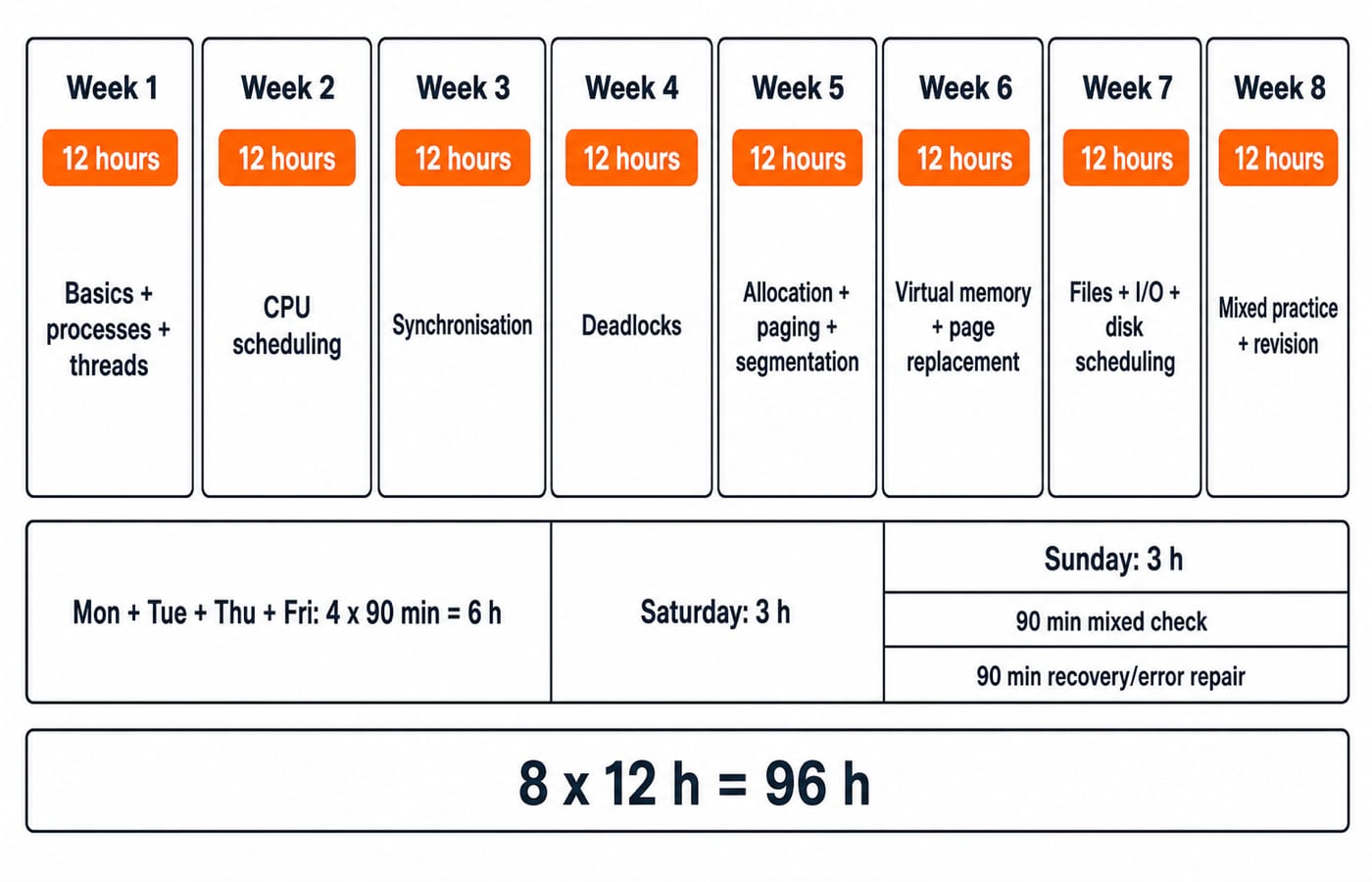
Budget: 8 weeks x 12 hours = 96 hours. Monday, Tuesday, Thursday and Friday each use 35 minutes for concepts, 40 for solving and 15 for recall plus error logging: 4 x 90 minutes = 6 hours. Saturday has 60 minutes of repair, 90 of timed practice and 30 of review. Sunday has a 90-minute mixed check plus 90-minute recovery. Weekly total: 6 + 3 + 3 = 12 hours.
Week | Topic | Hours |
|---|---|---|
1 | Basics, processes and threads | 12 |
2 | CPU scheduling | 12 |
3 | Synchronisation | 12 |
4 | Deadlocks | 12 |
5 | Allocation, paging and segmentation | 12 |
6 | Virtual memory and page replacement | 12 |
7 | File systems, I/O and disk scheduling | 12 |
8 | Mixed practice and revision | 12 |
Use Operating Systems for GATE: Deadlocks, Scheduling, Memory for concept-first teaching and deeper numericals. Then use the eight-week sequence below to place those lessons on a calendar and recover missed sessions. GATE CS Exam Preparation connects OS to the wider syllabus. Dependency order, problem complexity and review load determine these hours; confirm official topic weightage separately.
Week 1: OS basics, process states and threads
Spend 3 hours on OS goals, services, system calls, modes and interrupts; 4 on processes, PCB fields, schedulers, context switches and states; 3 on threads, creation and concurrency; and 2 on retrieval and correction. Make a one-page glossary: one definition, contrast and example per entry, no copied paragraphs.
Exit with P: admitted at t=0 (new -> ready), dispatched at t=2 (ready -> running), requests I/O at t=5 (running -> waiting), completes it at t=9 (waiting -> ready), runs at t=11, and exits at t=14 (running -> terminated). 0-2 and 9-11 are queueing time. I/O completion makes P ready; scheduling makes it running.
Weeks 2 and 3: trace scheduling and synchronisation
Week 2 assigns 3 hours to criteria and Gantt conventions, 5 to FCFS, SJF, SRTF, priority and Round Robin, 2 to arrival-time variations, and 2 to correction. Use CPU scheduling: FCFS, SJF and Round Robin with Gantt charts for deeper algorithm comparisons.
For SRTF, take P1(0,6), P2(1,3) and P3(2,1), with arrival and burst time. Gantt chart: P1 0-1 | P2 1-2 | P3 2-3 | P2 3-5 | P1 5-10. Completion is 10, 5, 3. Turnaround = completion - arrival gives 10, 4, 1; waiting = turnaround - burst gives 4, 1, 0. Average waiting is (4+1+0)/3 = 1.67; average turnaround is (10+4+1)/3 = 5. Check: 6+3+1 = 10 executed units.
Week 3 uses 3 hours for races and critical-section requirements, 4 for locks and semaphores, 3 for Peterson's algorithm and classic problems, and 2 for interleaved questions. With binary semaphore S=1, P1 runs wait(S), makes S=0 and enters. P2 attempts wait(S) and blocks. After P1 runs signal(S), P2 may enter. Trace ordering and exclusion, not isolated pseudocode.
Week 4: deadlock policies and a safe-state check
Allocate 2 hours to graphs and the four necessary conditions, 3 to prevention and detection, 4 to avoidance and Banker's algorithm, and 3 to mixed correction. Prevention breaks a condition; avoidance rejects an unsafe move; detection checks after allocation. Unsafe does not necessarily mean already deadlocked.
With Available=[1,0], compute Need = Max - Allocation: P0: [1,1]-[0,1]=[1,0]; P1: [1,1]-[1,0]=[0,1]; P2: [2,2]-[1,1]=[1,1]. P0 can finish and return [0,1], so Available becomes [1,1]. P1 then returns [1,0], making it [2,1]. P2 can finish next. The safe sequence is <P0, P1, P2>.
Weeks 5 and 6: memory management with checked calculations
Week 5 spends 2 hours on contiguous allocation and fragmentation, 4 on paging and translation, 2 on segmentation, 2 on TLB method, and 2 on correction. With 4 KiB = 4096-byte pages and address 26,500, page number is floor(26,500/4096)=6; offset is 26,500 - 6 x 4096 = 1,924. If page 6 maps to frame 19, physical address is 19 x 4096 + 1,924 = 79,748. Check 0 <= 1,924 < 4,096.
Week 6 uses 3 hours for demand paging, 5 for FIFO, Optimal and LRU, 2 for working sets and thrashing, and 2 for mixed questions. With three empty frames and 1, 2, 3, 1, 4, 2, 5, FIFO faults on 1,2,3,4,5: 5 faults. LRU faults on 1,2,3,4,2,5: 6 faults. Record frames, hit or fault, and running count. Never assume one algorithm always wins.
Week 7: file systems and disk-head movement
Use 3 hours for files and directories, 3 for allocation and free-space management, 2 for I/O and disk structure, and 4 for disk traces. Study allocation methods and SCAN/C-SCAN comparisons in File systems and disk scheduling in OS: 4 algorithms worked, then keep one FCFS/SSTF trace in Week 7 for timed practice.
From head 50 and queue 82, 170, 43, 140, 24, 16, 190, FCFS movement is 32+88+127+97+116+8+174 = 642 cylinders. SSTF chooses 50 -> 43 -> 24 -> 16 -> 82 -> 140 -> 170 -> 190, giving 7+19+8+66+58+30+20 = 208. Write the sequence first. The smaller total does not make SSTF universally fair.
Week 8: turn mistakes and missed days into revision
Split 12 hours equally: 3 for a timed set, 3 for review, 3 for closed-book reconstruction of scheduling, deadlock, paging and disk, and 3 for re-solving. If 24 attempts contain 5 wrong and 3 correct guesses, review 5+3=8. For 3 memory, 2 scheduling, 2 deadlock and 1 file-system error, assign four 90-minute blocks to memory, scheduling, deadlock, then the remaining memory and file-system items.
One missed 90-minute session uses Sunday's recovery block. For two, recover one Sunday and replace the next Saturday timed block with the other, moving that practice forward. For three or more, delay one week or drop optional note rewriting, but protect 6 hours of Week 8 practice and review. Record ten honest hours as ten.
The short version
Follow dependencies, show calculations, tag patterns and revise from error logs. GATE Guidance by Sanchit Sir is an optional structured route for a broader subject plan. It works with linked lessons and your own previous-year-question source.
Keep learning

Operating Systems Semester Guide: Learn Theory, Solve Numericals and Practise Labs
Connect OS concepts to semester calculations and programs through scheduling, Banker's Algorithm, paging, storage, and five lab checks.
Updated 24 Oct 20266 min readOperating Systems

Critical Section in Process Synchronization: Race Conditions and Correctness Worked Step by Step
See how two sensible updates to x can finish at 6, 7, or 8. The worked trace connects race conditions to mutual exclusion, progress, bounded waiting, and safe synchronization choices.
Updated 21 Oct 20266 min readOperating Systems

System Calls and Dual Mode in OS: Mode-Bit Trace, Worked Example and Exam Traps
Follow one read() call across the user-kernel boundary, calculate its stated overhead, and learn the distinctions that make system-call questions easier.
Updated 17 Oct 20265 min readOperating Systems
Semaphores and Process Ordering in OS: P/V Traces, Worked Examples and GATE Traps
Learn one consistent semaphore convention, then trace ordering constraints, shared-variable updates, bounded-buffer permits, rendezvous, and deadlock step by step.
Updated 13 Oct 20265 min readOperating Systems