HR Interview: Why This Company and Why This Role Answer Framework
Build a specific HR interview answer from employer research, role requirements, project evidence and one realistic learning edge.
KnowledgeGate Team
Exam prep & CS education
Updated 3 Sep 20265 min read
"It is a respected company and I want growth" could be said in almost any interview. It proves neither research nor fit. The interviewer is checking whether you investigated this employer, understand the role's daily work, and can support your motivation with past evidence. A strong answer connects those checks without inventing enthusiasm. A perfect speech is unnecessary. Build a defensible chain from employer research to work you can do.
Separate "Why this company?" from "Why this role?"
Build an evidence chain instead of listing compliments: 1 company fact + 2 fit proofs + 1 learning goal. The fact answers why here, the proofs show why this work fits, and the learning goal explains why now.
Reject this opening: "Your company is reputed and gives freshers good growth."
Keep this kind of opening: "Your small-retailer invoicing product interests me because I have worked on transaction-heavy backend APIs, and this role would let me apply Java and PostgreSQL while learning queue processing."
The employer there is a sample, chosen so the wording stays concrete. Notice the split inside that one sentence: the product clause answers why this company, and the skills clause answers why this role. Your self-introduction is a separate answer that sets up who you are rather than why you chose this employer, and Tell Me About Yourself in 60 Seconds covers that one.
Research the employer in 15 minutes
Make this three-row sheet:
Source | Exact detail | Why it matters to me |
|---|---|---|
Employer product or About page | Product and customer problem | Connection to work I value |
Employer careers or engineering page | Named engineering practice | Connection to how I want to work |
Exact job description | Responsibility and required skill | Connection to evidence I can prove |
Fifteen minutes covers the first two rows: about eight on the product or About page and seven on the careers or engineering page. The job-description row is filled in the next section, where you annotate the listing itself.
Attribute details naturally: "The product page explains..." or "The role description asks for..." Avoid aggregators, vague rankings, copied mission statements and unsupported claims.
Keep one answer-changing fact. A product, customer problem, engineering practice or role responsibility qualifies. "Global company", "great culture" and "market leader" do not, unless the employer makes them concrete and you can explain your connection. The Resume & Interview Preparation resources provide a broader preparation path.
Decode the role into work, skills and outcomes
Take this sample listing: Junior Backend Engineer at BluePeak Labs.
Work: build REST endpoints, review pull requests, diagnose slow queries and support asynchronous invoice processing.
Skills: Java, Spring Boot, PostgreSQL, JUnit and Git.
Outcome: make invoice reconciliation reliable for small retailers.
Annotate the listing with W for work you want, E for evidence you already have and L for a learning edge. REST endpoints and PostgreSQL are W+E. Queue processing and production monitoring are W+L. The outcome shows what those tasks should change. A strong answer connects all three, not only the skills list. An honest partial match is more credible than claiming every keyword. It separates what you can contribute now from what you want to learn.
Build a role-to-evidence map
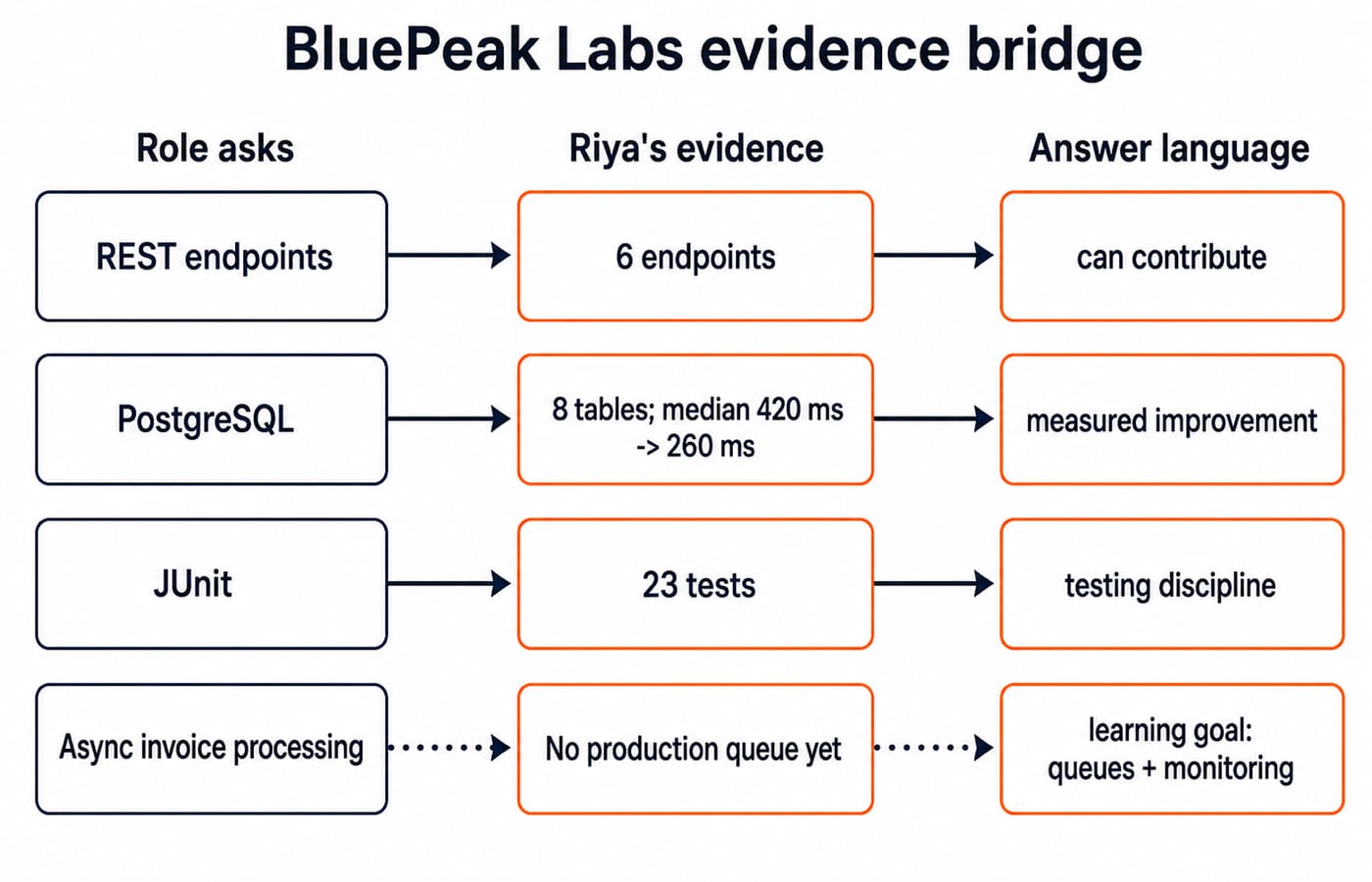
Riya, the candidate in that sample, built a Java and Spring Boot campus-library API with 6 REST endpoints, 8 PostgreSQL tables and 23 JUnit tests. After measuring a slow book-search query, she added an index and reduced median response time in her test setup from 420 ms to 260 ms, a 160 ms improvement. She has not used a production queue, so asynchronous jobs and monitoring are her learning goal.
Map each requirement to what it proves:
REST API work to 6 endpoints, proving implementation practice.
Database work to 8 tables and the 420 ms to 260 ms result, proving schema and query awareness.
Testing to 23 JUnit tests, proving testing discipline.
Queue processing and monitoring to an honest learning goal.
Explain what each number proves. The fresher resume guide shows how to turn the same evidence into resume bullets.
Turn the map into a five-sentence answer
Give five sentences these jobs: company reason, project, measurable proof, learning edge, then contribution and growth. Keep it at 110 to 130 words and speak calmly for 60 to 75 seconds.
Riya's answer:
I want to join BluePeak Labs because its invoice-reconciliation product solves a concrete problem for small retailers, and I like that its engineering brief makes peer review part of everyday delivery. The junior backend role fits the work I have already started doing: I built a Spring Boot library API with 6 REST endpoints, 8 PostgreSQL tables and 23 JUnit tests. I also reduced the test API's median response time from 420 ms to 260 ms by adding an index after measuring the slow query. That gives me useful evidence for Java, APIs, databases and testing, while the role's queue-processing and monitoring work is the next area I want to learn. I can contribute from the fundamentals I have practised and grow through production feedback.
Use HR interview questions and answers for freshers to practise follow-ups on strengths, goals and fit.
Tailor the answer without sounding scripted
Prepare three speaking cards, not one memorised paragraph: company fact, two proof points, and learning goal. Run the answer at 45, 75 and 90 seconds. Keep the evidence stable but change the wording. This tests real understanding instead of recitation.
Prepare for three probes. "What do you know about our product?" needs the researched customer problem. "Which part of the role suits you?" needs the endpoint and database evidence. "What do you still need to learn?" needs queues and monitoring plus your first learning step. Avoid flattery, culture claims based only on social media, and false certainty about daily work.
Use a 90-minute per-company routine
Spend 15 minutes on official company and product pages, 15 annotating the job description, 20 building the evidence map, 15 drafting, 15 on three five-minute aloud runs, and 10 revising. That totals 90 minutes. For three target companies, the weekly total is 270 minutes, or 4.5 hours. Use a separate sheet per company so details do not leak.
If you miss a day, use a 45-minute minimum pass: 10 research + 10 role + 10 evidence + 10 draft + 5 speak. Keep research and the aloud run, and do not double the next day's load. Return to 90 minutes for the next application. A generic answer fails when an interviewer asks for specifics.
Final answer check and next step
Before the interview, answer yes or no:
One named product or customer problem?
One role responsibility?
Two matched skills?
One project example?
At least one exact value?
One honest learning goal?
No unsupported employer claim?
No sentence reusable for another company?
If a check fails, revise evidence, not adjectives. The short version: one fact, two proofs, one learning edge, spoken in 75 seconds. Use the Interview & Resume Preparation Course for guided resume, technical interview and HR interview preparation.
Keep learning
Advanced DP Interview Questions and Answers: Four Worked Patterns
Work through four advanced dynamic programming patterns with exact states, transitions, reconstructions, proof hooks, and interview-ready explanations.
Updated 21 Oct 20266 min readInterview Corner
Algorithm Interview Questions and Answers: Cross-Concept DSA Problems
Practise cross-concept DSA questions with defensible answers, complete dry runs and the follow-ups that change which algorithm you should choose.
Updated 17 Oct 20266 min readInterview Corner
Backtracking Technique Interview Questions and Answers: Trace, Prune and Explain
Learn to explain backtracking through exact traces, safe pruning, clean state restoration, N-Queens constraints, complexity derivation and interview follow-ups.
Updated 12 Oct 20266 min readInterview Corner

Algorithm Analysis Interview Questions and Answers: Big-O, Loops and Recurrences
Learn how to answer algorithm analysis interviews by defining the input, counting real work, tracing recurrences, and defending time-space tradeoffs.
Updated 8 Oct 20266 min readInterview Corner