One-Page Fresher Resume: Keep, Cut and Reorder Every Section
Use an evidence-first edit to turn a crowded fresher resume into a readable page, following Riya's complete budget and section decisions.
KnowledgeGate Team
Exam prep & CS education
Updated 4 Sep 20266 min read
Education, skills, projects, an internship and certificates can feel too important to cut, so a fresher's resume reaches two pages or tiny type. An evidence-first edit prioritises every line for one target role without hiding useful proof.
1. Rank every line by hiring value before changing the layout
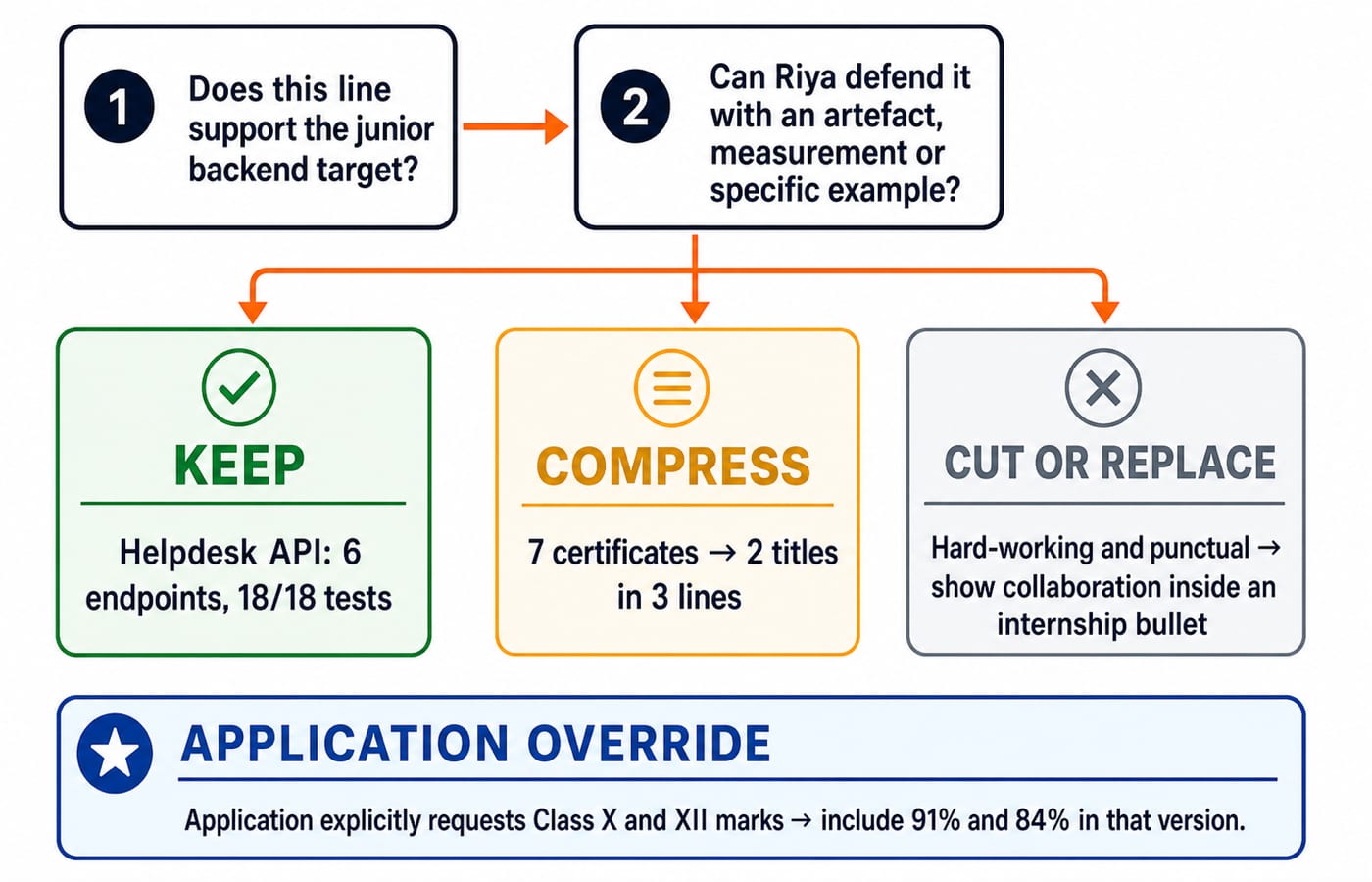
Use this working heuristic, not a recruiter formula: role relevance 0-2, concrete proof 0-2, and interview defensibility 0-1, maximum 5. Keep a 4-5, compress a 2-3, and cut or replace a 0-1; application instructions override it.
Hypothetical candidate Riya Sharma is a B.Tech CSE student graduating in 2026 with an 8.1 CGPA, targeting a junior backend role. She has an 8-week web-development internship, a Node.js helpdesk API, a Java expense tracker, 12 technical skills, 7 certificates, Class XII at 84%, Class X at 91%, generic interests and references.
Draft item | Score | Editing decision |
|---|---|---|
Internship bullet with measured work | 5/5 | Keep |
Helpdesk API with tests | 5/5 | Keep |
Java certificate with no assessed project | 2/5 | Compress |
Class X marks | 1/5 | Remove for this role unless requested |
"Hard-working and punctual" | 0/5 | Replace with evidence |
See Resume for Freshers: Clear the First Screen for the wider first-screening approach.
2. Reorder sections around the target role
Riya's order is Contact and links -> Education -> Technical skills -> Internship -> Projects -> Achievement -> Certifications. Education stays high for a 2026 fresher; internship and projects get more backend-proof lines.
Strong campus academics: Education -> Skills -> Experience -> Projects, because academic performance is the candidate's strongest opening evidence.
Substantial internship: Experience -> Projects -> Education -> Skills, because relevant work deserves the recruiter's attention first.
Two deployed self-taught projects: Projects -> Skills -> Education, because the candidate can lead with proof of building.
None is an employer-wide rule. Riya's five-line objective only asks for a "challenging role", so it does not earn that space. It can return only as a differentiated two-line summary supported later on the page.
For help with the resume and the interview work around it, continue with the Placement Preparation category, which also covers aptitude, company-specific preparation and IT recruitment exams.
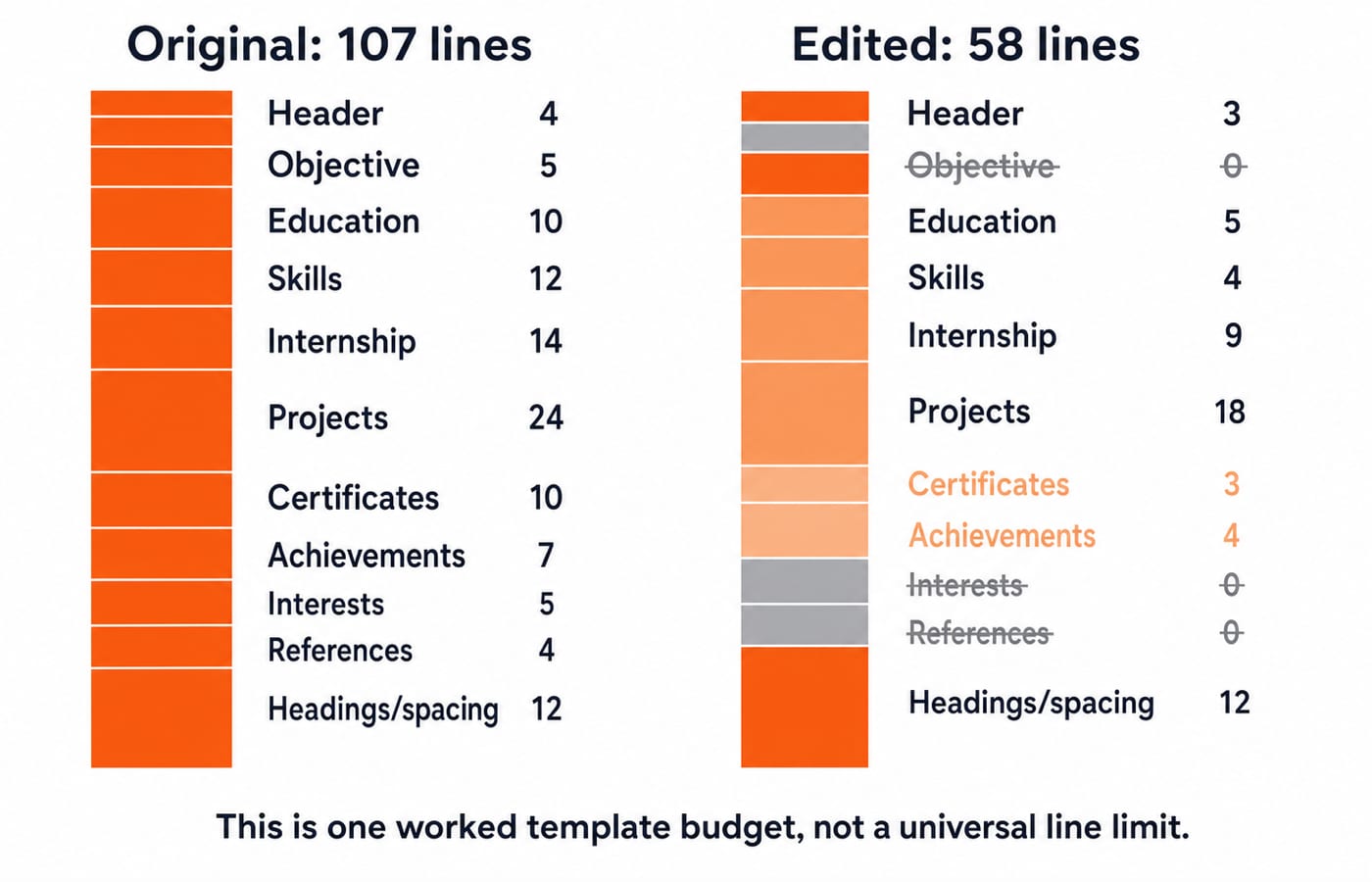
3. Worked example: compress 107 lines into a 58-line page
Each retained line must justify its place. The 58-line result is an example, not a universal limit.
Section | Original | Edited |
|---|---|---|
Header | 4 | 3 |
Objective | 5 | 0 |
Education | 10 | 5 |
Skills | 12 | 4 |
Internship | 14 | 9 |
Projects | 24 | 18 |
Certificates | 10 | 3 |
Achievements | 7 | 4 |
Interests | 5 | 0 |
References | 4 | 0 |
Headings plus spacing | 12 | 12 |
Total | 107 | 58 |
The edited total is 3 + 0 + 5 + 4 + 9 + 18 + 3 + 4 + 0 + 0 + 12 = 58.
For a backend-targeted fresher, a generic objective drops from 5 lines to 0 because it adds no evidence. Education still keeps the degree, institute, year and 8.1 CGPA. The 12 skills move into 4 labelled lines, making them easier to scan without losing the relevant terms.
Projects deserve more room because they show what Riya built, so they are tightened to 18 evidence-led lines rather than removed. Certificates fall from 10 lines to 3, keeping the two that matter with their issuers. Interests and "References available on request" earn nothing on this role-specific page.
4. Compress bullets without deleting the evidence
A useful pattern is action + scope + evidence + context, using only defensible facts.
Replace "Worked on frontend pages and fixed various bugs" with two hypothetical bullets:
Built 3 React admin screens for an internal ticketing tool used by 38 pilot users.
Fixed 14 UI defects and reduced dashboard load time from 3.8 s to 2.1 s by lazy-loading charts.
Rewrite vague internship lines using specific actions, scope, evidence and context. Apply the same action + scope + evidence + context pattern to Riya's projects.
Built a Node.js and Express helpdesk API with 6 endpoints and role-based access for student and admin accounts.
Seeded 500 test tickets and wrote 18 API tests, with 18 passing.
Built a Java expense tracker that imports a 250-row CSV and reports totals across 8 spending categories.
Keep two projects with two or three bullets, not four thin ones. Riya must trace 38, 14, 3.8, 2.1, 500, 18, 250 and 8, or recount, remeasure or remove them. A truthful unquantified bullet beats an invented metric.
5. Decide section by section: keep, compress or cut
Section | Riya's evidence | Decision | Space |
|---|---|---|---|
Education | B.Tech CSE, 2026, 8.1 CGPA | Keep | 5 lines |
Skills | 12 named tools and languages | Group | 4 lines |
Internship | 8 weeks, 3 screens, 14 fixes | Keep | 9 lines |
Projects | 2 role-relevant builds | Keep | 18 lines |
Certificates | 7 completed | Keep 2, list only issuer and title | 3 lines |
Class X and XII | 91% and 84% | Remove from this version unless requested | 0 lines |
Interests | Reading, music, cricket | Cut | 0 lines |
References | Available on request | Cut | 0 lines |
Keep the header to three lines, cut the generic objective and compress one defensible achievement to its result, context and evidence. Turn soft skills into bullet proof, retain only role-relevant responsibilities, and omit unrequested declarations, full address and personal details.
If a campus cell or form requests marks, declarations or other fields, create a separate compliant version.
6. Protect readability after the content edit
Riya's example uses A4, 0.65-inch margins, 10.5-point body text, 12-point headings, 1.05 spacing, one column, right-aligned dates and no skill-rating bars. Together, these choices keep the page compact without making it tiring to read.
The page must remain comfortable at 100% zoom, while links and headings must stay distinct when printed in black and white. After PDF export, the text must still be selectable and the links must work. Follow the portal's format instructions when submitting it.
If the edges feel crowded, cut a low-score line before shrinking the body below 10-point. Keep two font sizes, month-year dates, grouped text instead of icons or bars, and one bullet indent so the compressed page remains orderly.
7. Make every high-value line interview-defensible
Proof-card every key claim: What was the context? What did you personally do? Where did the number come from? What trade-off did you make?
For "reduced dashboard load time from 3.8 s to 2.1 s", Riya must name the measurement, charts, her change and the trade-off of loading later.
Use the 60-second rehearsal as a structure: 10 seconds for the problem, 20 for architecture and personal contribution, 20 for 6 endpoints, 500 tickets and 18/18 tests, then 10 for a limitation or improvement. Replace Riya's facts with your own.
Use Technical Interview: OS, DBMS, CN & OOP Prep for technical follow-ups and HR Interview Questions for Freshers & Answers for introductions, strengths and project stories. The resume selects evidence; the interview tests ownership.
8. The one-page short version and next action
One target role.
Sections ordered for that role.
Every retained line scores for relevance and proof.
Two strongest projects, not every project.
Every number verified.
Requested fields restored in application-specific versions.
PDF and links tested.
Duplicate the resume as "backend-one-page-v1", score each line out of 5, and apply Riya's process until it is readable without hiding evidence. Keep the master so no useful fact is lost.
The Interview & Resume Preparation Course combines resume work, one-to-one review, technical and HR preparation, and a mock interview. It supports preparation but cannot guarantee a shortlist or placement.
Keep learning
Advanced DP Interview Questions and Answers: Four Worked Patterns
Work through four advanced dynamic programming patterns with exact states, transitions, reconstructions, proof hooks, and interview-ready explanations.
Updated 21 Oct 20266 min readInterview Corner
Algorithm Interview Questions and Answers: Cross-Concept DSA Problems
Practise cross-concept DSA questions with defensible answers, complete dry runs and the follow-ups that change which algorithm you should choose.
Updated 17 Oct 20266 min readInterview Corner
Backtracking Technique Interview Questions and Answers: Trace, Prune and Explain
Learn to explain backtracking through exact traces, safe pruning, clean state restoration, N-Queens constraints, complexity derivation and interview follow-ups.
Updated 12 Oct 20266 min readInterview Corner

Algorithm Analysis Interview Questions and Answers: Big-O, Loops and Recurrences
Learn how to answer algorithm analysis interviews by defining the input, counting real work, tracing recurrences, and defending time-space tradeoffs.
Updated 8 Oct 20266 min readInterview Corner