Programming Languages MCQs: 12 Solved Questions on Definition and Purpose
Build the foundations behind basic programming-language questions, then solve 12 published MCQs on translators, errors, pseudocode, parameters and language quality.
KnowledgeGate Team
Exam prep & CS education
Updated 30 Aug 20267 min read
Basic programming-language questions look like vocabulary tests, but they mix language purpose, translation, program structure and error classification. Memorising compiler alone can leave you confusing an assembler with an interpreter, a formal parameter with an argument, or syntax with wrong logic.
Work through language purpose, translation, program structure and error classification. Choose each answer before reading its explanation, then use the 7 x 5 trace in Section 1 to test syntax, runtime and logic.
1. What a programming language is and what it does
A programming language is a formal notation for data, operations and control. Syntax defines legal symbol sequences; semantics defines what they mean. A compiler, interpreter or assembler helps make execution possible, but each has a different role.
Consider this algorithm: read length; read width; area = length * width; print area.
SET length = 7
SET width = 5
SET area = length * width
PRINT area
The trace is direct: length: 7, width: 5, area: 7 * 5 = 35, so the output is 35. Here is the equivalent Python:
def area(length, width):
    return length * width

area(7, 5)
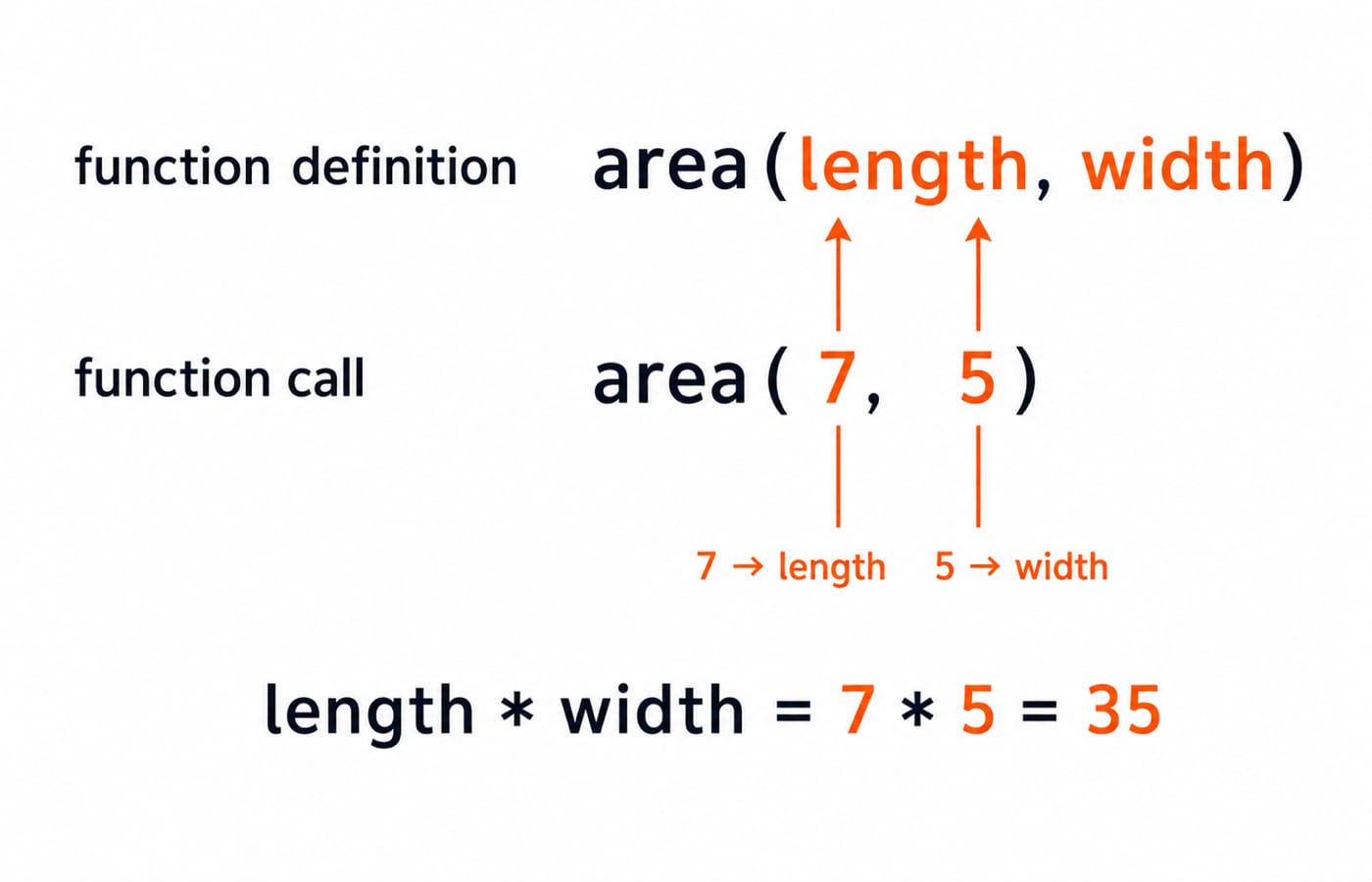
In the definition, length and width are formal parameters. In the call, 7 and 5 are actual arguments. The returned value is 35.
The calculation also separates three errors. area = 7 * is syntactically incomplete. area = 7 / 0 is valid syntax but fails during execution. area = 7 + 5 returns 12 but is logically wrong because the intended area is 7 * 5 = 35. For a deeper treatment of grammar, types, bindings and runtime choices, continue with Language Design: Syntax, Types, Scope, Worked Example.
2. MCQs 1-3: translators, language quality and syntax
Question 1
Source: DSSSB 2021, Computer Science, PGT.
Which translator is used to convert assembly language to machine language?
A. Assembler
B. Compiler
C. Interpreter
D. Linker
Answer: A. Assembler. An assembler maps assembly instructions to machine representation. A compiler translates higher-level source, an interpreter evaluates source, and a linker combines object modules and resolves external references. Review Introduction to Programming Languages: Definition and Purpose for related practice.
Question 2
Source: DSSSB 2021, Computer Science, PGT.
Which of the following is NOT an attribute of good programming languages?
A. Clarity, simplicity and unity
B. Support for abstraction
C. Ease of program verification
D. Non portability
Answer: D. Non portability. Portability lets source and design ideas move across conforming implementations with limited change. Clarity supports reasoning, abstraction manages complexity, and verifiability checks a program against its specification. See the exact solved question.
Question 3
Source: DSSSB 2021, Computer Science, PGT.
When the rules of the programming language are not followed it gives ____ errors.
A. Syntax
B. Logical
C. Run time
D. Printing
Answer: A. Syntax. Syntax controls legal statement and expression forms, so area = 7 * breaks its rules. 7 + 5 can run with a logically wrong result; a runtime error occurs after execution begins. Open the exact solved question.
3. MCQs 4-6: execution environments, language history and subprograms
Question 4
Source: DSSSB 2021, Computer Science.
_____ is a way of providing controlled execution environment for extracted programs.
A. Sandboxing
B. Spoofing
C. Honeypot
D. Payloads
Answer: A. Sandboxing. A sandbox restricts program access, perhaps allowing /workspace/input.txt while denying /etc/credentials and network calls. Spoofing impersonates a source, a honeypot is a decoy, and a payload is delivered content or action. See the exact solved question.
Question 5
Source: DSSSB 2021, Computer Science, TGT - Shift 5.
What is the full form of FORTRAN computer programming language?
A. Formula Translation
B. First Translation
C. Formula Transition
D. First Transition
Answer: A. Formula Translation. FORTRAN derives from Formula Translation. The distractors substitute First or Transition; neither names the language. Check the exact solved question.
Question 6
Source: DSSSB 2021, Computer Science, TGT - Shift 4.
Which of the following is a type of subprogram?
I. Functions
II. Subroutines
A. Only I
B. Only II
C. Both I and II
D. Neither I nor II
Answer: C. Both I and II. Functions and subroutines are named units for reusable operations. area(length, width) has formal parameters; area(7, 5) invokes it with actual arguments. Terminology and return rules vary, but both fit this broad classification. Visit the exact solved question.
4. MCQs 7-9: interactivity, pseudocode and parameters
Question 7
Source: Kendriya Vidyalaya Sangathan 2017, Computer Science.
A multimedia project is said to be ______ and user-interactive when users are given navigational control.
A. secure
B. hypertext
C. linear
D. non-linear
Answer: D. non-linear. With Home -> Video, Home -> Quiz and Quiz -> Review, a user chooses Video or Quiz from Home. A linear project fixes Home -> Video -> Quiz -> Review. See the exact solved question.
Question 8
Source: Beltron Programmer 2025, Computer Science, Shift-3.
What is the primary role of pseudocode in programming?
A. To represent the program's logic in a clear and simple way
B. To convert the program into machine language
C. To manage data storage during program execution
D. To create the executable code that computers run
Answer: A. To represent the program's logic in a clear and simple way. Section 1 sets 7 and 5, calculates 7 * 5, and outputs 35 without using Python, Java or C syntax. Pseudocode is not a translator, memory manager or executable generator. Use the exact solved question, then try Infosys Pseudocode Questions.
Question 9
Source: Beltron Programmer 2025, Computer Science, Shift-3.
Which of the following statement best defines a formal parameter in programming?
A. A constant defined outside the function
B. A temporary value passed by reference only
C. A value assigned to a global variable
D. A variable listed in the function declaration to receive arguments
Answer: D. A variable listed in the function declaration to receive arguments. In area(length, width), the names receive values; in area(7, 5), the numbers are actual arguments. Formal parameters need not be passed by reference and are not globals or external constants. See the exact solved question.
5. MCQs 10-12: evaluation criteria and language classification
Question 10
Source: UGC NET 2016, Computer Science, June.
Which of the following is false regarding the evaluation of computer programming languages ?
A. Application oriented features
B. Efficiency and Readability
C. Software development
D. Hardware maintenance cost
Answer: D. Hardware maintenance cost. It concerns physical equipment, not language evaluation. Application fit, readable and efficient programs, and support for software development are relevant considerations. This is a category distinction, not a universal ranking. Review the exact solved question.
Question 11
Source: Coal India 2020, Mechanical.
_______ Language is also called programming language.
A. Low Level
B. Operator
C. High Level
D. Machine
Answer: C. High Level. In this elementary classification, a high-level language expresses algorithms through abstractions beyond machine instructions. More broadly, programming language can include low-level notations, so the stem is not an exhaustive modern definition. Continue with the related practice questions linked under Question 1.
Question 12
Source: UGC NET 2014, Computer Science, June.
Code blocks allow many algorithms to be implemented with the following parameters :
A. clarity, elegance, performance
B. clarity, elegance, efficiency
C. elegance, performance, execution
D. execution, clarity, performance
Answer: B. clarity, elegance, efficiency. A structured block can be clear, elegant and resource-efficient. In the area example, one function receiving 7 and 5 and returning 35 is clearer than scattered inputs and calculations. See the exact solved question.
6. Four traps that make basic programming-language MCQs harder
Treating every translator as a compiler. Ask for the source form. Assembly to machine representation points to an assembler. High-level source translated as a unit points to a compiler. Source evaluated during execution points to an interpreter. Object modules combined into an executable point to a linker. Lexical Analysis in Compiler Design is the next step for understanding how a compiler recognises tokens and lexemes.
Calling every wrong output a syntax error.
7 *is incomplete,7 / 0fails during execution, and7 + 5 = 12runs but violates the intended calculation7 * 5 = 35.Swapping formal parameters and actual arguments. Put
area(length, width)abovearea(7, 5), then map7 -> lengthand5 -> width. The body calculateslength * width = 35.
Treating language qualities as synonyms. Readability asks whether a person understands
area = length * width. Abstraction names it asarea(7, 5). Portability asks whether the source idea moves across conforming environments. Efficiency concerns implementation resources. No language must maximise all four.
7. Programming languages in the short version, then the next practice step
A language expresses an algorithm.
Syntax controls legal form.
Semantics supplies meaning.
Translators connect source forms to execution.
Subprograms package reusable logic.
Use this rapid revision key: Assembler, Non portability, Syntax, Sandboxing, Formula Translation, Both I and II, non-linear, clear program logic, declaration variable, not hardware maintenance cost, High Level, clarity/elegance/efficiency. Revisit the explanations instead of memorising option letters.
For a concrete 10-minute revision, rewrite area(7, 5) once in pseudocode and once in any language. Label the formal parameters and actual arguments. Then deliberately create the syntax, runtime and logical variants from Section 1, classify all three, and only then compare your classifications with the explanations above.
Continue with Coding for Placements: C, C++, Java, Python for multi-language, placement-oriented practice. Use the 10-minute rewrite above to decide which language features you need to revise first.
Keep learning
Classes and Objects MCQs: 12 Solved OOP Questions with Explanations
Solve 12 classes and objects MCQs, check each explanation, and use a worked Java trace to separate instance state, constructors, overloading and nested classes.
20 Oct 20267 min readProgramming Languages Survey
Programming Language Syntax MCQs: 12 Solved Questions on Grammar, Tokens and Semantics
Solve 12 MCQs on syntax, tokens, pseudocode, C grammar and runtime behaviour. Each explanation identifies the rule and applies it.
Updated 16 Oct 20268 min readProgramming Languages Survey
Imperative Programming Structure and Flow Control MCQs: 12 Solved Questions
Test whether you can trace changing state, choose the right loop, read a flowchart, and follow event-driven or exceptional control paths through 12 solved MCQs.
12 Oct 20267 min readProgramming Languages Survey
Static vs Dynamic Binding MCQs: 11 Solved Questions on Scope, Aliasing and Dispatch
Solve 11 binding questions from GATE and UGC NET papers by tracing lexical scope, runtime call chains, declared types and shared storage cells. Each answer shows why the tempting shortcuts fail.
Updated 8 Oct 20267 min readProgramming Languages Survey