JavaScript Prototypes and Inheritance: Tutorial with Runnable Examples
Understand how JavaScript finds inherited properties, shares methods, and implements constructor and class inheritance. Trace the chains, fix common mistakes, and test yourself.
KnowledgeGate Team
Exam prep & CS education
Updated 1 Sep 20265 min read
JavaScript makes three ideas look more mysterious than they are: an object's hidden prototype link, a constructor function's public prototype property, and class with extends. JavaScript inheritance is property lookup through linked objects, and class syntax still uses that machinery. In a browser console or Node.js, trace a prototype chain, diagnose common failures, and practise with exercises.
Start with the prototype chain, not class syntax
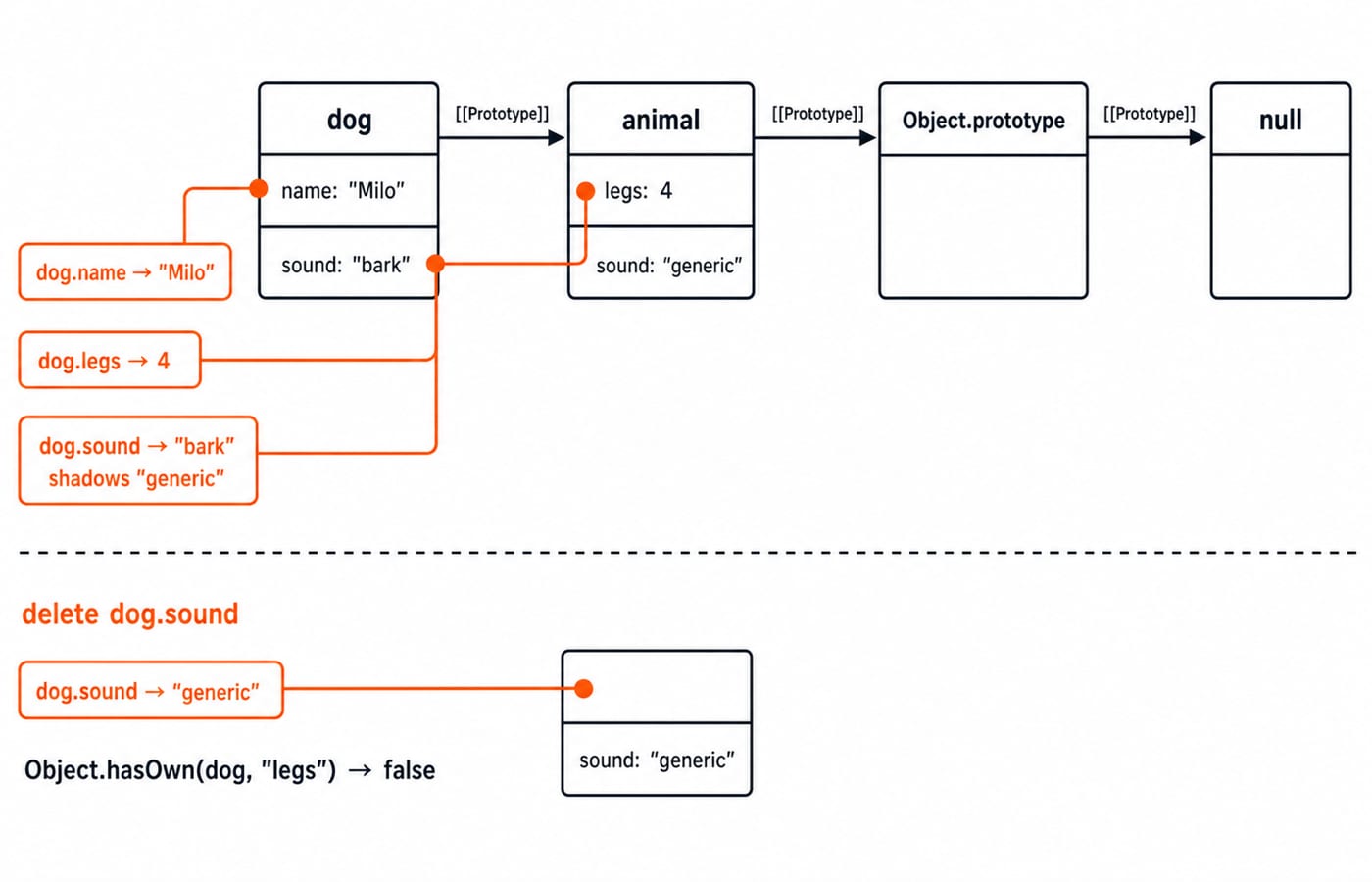
Every ordinary object has an internal [[Prototype]] that refers to another object or null. For a property read, JavaScript checks the receiver, follows [[Prototype]], and repeats. Reaching null without a match produces undefined.
This internal link differs from a constructor function's public .prototype object. Inspect it with Object.getPrototypeOf, and create one with Object.create. Reserve Object.setPrototypeOf for labelled demonstrations. You may encounter the legacy __proto__ accessor.
const animal = { legs: 4, sound: "generic" };
const dog = Object.create(animal);
dog.name = "Milo";
dog.sound = "bark";

dog.name === "Milo";
dog.legs === 4;
dog.sound === "bark";
Object.hasOwn(dog, "legs") === false;
Object.getPrototypeOf(dog) === animal;

delete dog.sound;
dog.sound === "generic";
dog.sound initially shadows animal.sound. Deleting it removes only the own property, so the next lookup finds "generic" on animal. For broader study, explore the Coding & Skill Development Courses.
See what constructor functions do with .prototype
A constructor function is a function intended for use with new. Conceptually, new Dog("Rex", "Indie") creates an object, sets its [[Prototype]] to Dog.prototype, calls Dog with this bound to the object, and returns that object unless the constructor explicitly returns another object. .prototype belongs to constructor functions. An instance such as rex does not normally have its own .prototype property.
function Animal(name) {
  this.name = name;
}

Animal.prototype.describe = function () {
  return `${this.name} is an animal`;
};

const a1 = new Animal("Asha");
const a2 = new Animal("Bunty");

a1.describe() === "Asha is an animal";
a2.describe() === "Bunty is an animal";
a1.describe === a2.describe;
Object.hasOwn(a1, "describe") === false;
Both instances reuse one function on Animal.prototype; lookup does not copy it. Their name values remain own properties. Keep per-instance state in the constructor and shared methods on the prototype.
Build inheritance by linking Dog.prototype to Animal.prototype
Dog inherits Animal's state and methods through a prototype link. The order matters because replacing Dog.prototype discards anything previously attached to that object.
function Dog(name, breed) {
  Animal.call(this, name);
  this.breed = breed;
}

Dog.prototype = Object.create(Animal.prototype);
Dog.prototype.constructor = Dog;
Dog.prototype.speak = function () {
  return `${this.name} barks`;
};

const rex = new Dog("Rex", "Indie");

rex.name === "Rex";
rex.breed === "Indie";
rex.speak() === "Rex barks";
rex.describe() === "Rex is an animal";
rex instanceof Dog === true;
rex instanceof Animal === true;
Object.getPrototypeOf(rex) === Dog.prototype;
Object.getPrototypeOf(Dog.prototype) === Animal.prototype;
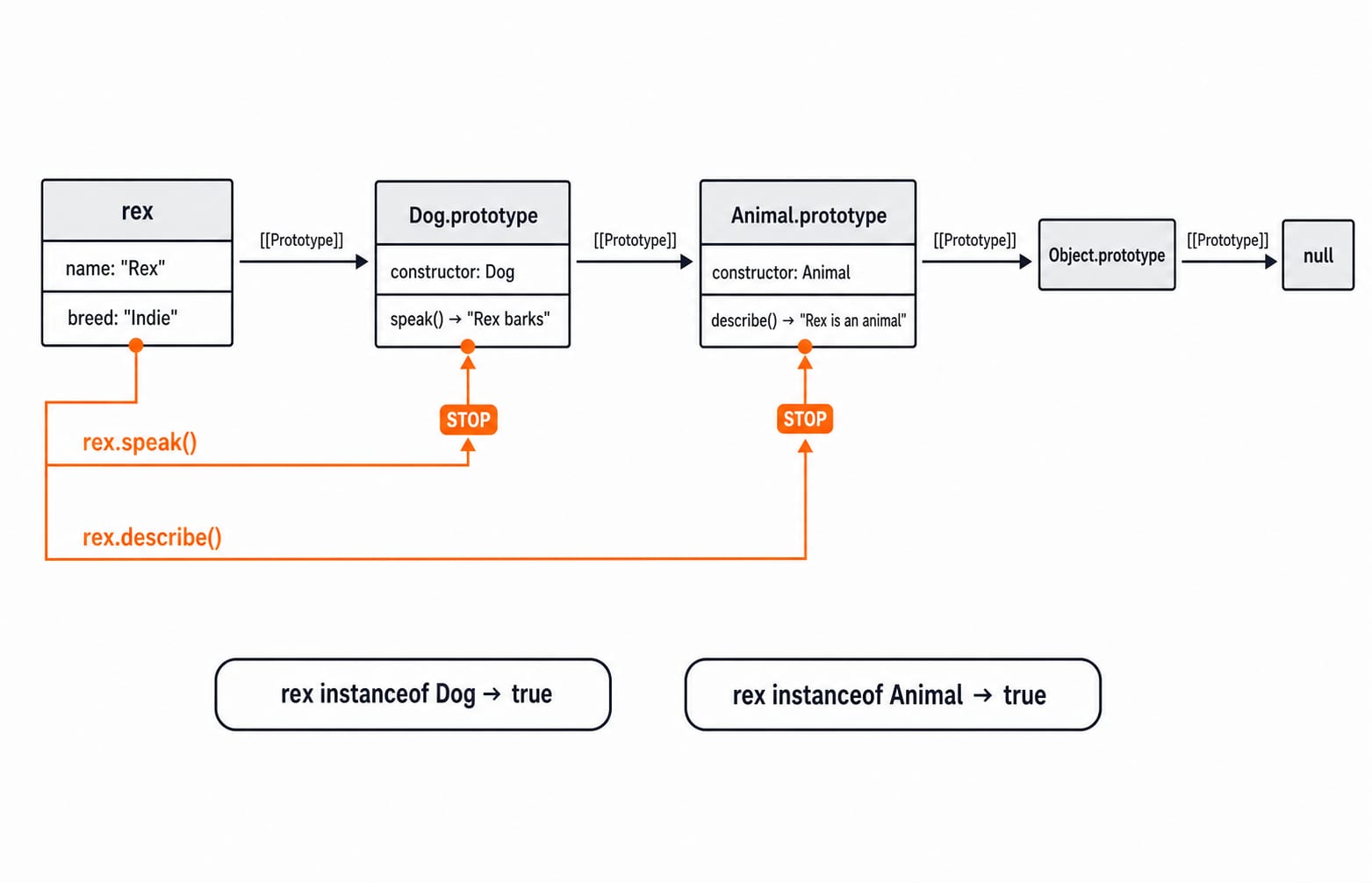
The two key lines do separate jobs. Animal.call(this, name) initialises the base object's own state on rex. Object.create(Animal.prototype) links method lookup from Dog.prototype to Animal.prototype. Neither substitutes for the other.
Replacing the default prototype also changes its conventional constructor reference, so Dog.prototype.constructor = Dog repairs that convention. Do not treat constructor as a secure type check. Here, instanceof is the useful chain check: it asks whether Dog.prototype or Animal.prototype occurs in rex's prototype chain.
Translate the same model into class and extends
Run this version in a fresh console session or a separate file because it reuses the names Animal, Dog, and rex.
class Animal {
  constructor(name) {
    this.name = name;
  }

  describe() {
    return `${this.name} is an animal`;
  }
}

class Dog extends Animal {
  constructor(name, breed) {
    super(name);
    this.breed = breed;
  }

  speak() {
    return `${this.name} barks`;
  }
}

const rex = new Dog("Rex", "Indie");

rex.name === "Rex";
rex.breed === "Indie";
rex.speak() === "Rex barks";
rex.describe() === "Rex is an animal";
Object.getPrototypeOf(rex) === Dog.prototype;
Object.getPrototypeOf(Dog.prototype) === Animal.prototype;
super(name) calls the base constructor and must run before a derived constructor uses this. Class syntax does not remove prototypes. It makes the intended relationship easier to read. Prefer class in application code, but retain the chain model for debugging and interviews.
Concern | Constructor syntax | Class syntax |
|---|---|---|
Instance state |
|
|
Shared method |
|
|
Inheritance link |
|
|
Base initialisation |
|
|
Avoid four prototype mistakes that produce misleading code
Mistake | Symptom | Correction |
|---|---|---|
Add | A later | Link first, then add child methods |
Omit |
| Initialise the base with |
Put | After | Put |
Treat inherited as own |
| Choose the check that matches the question |
The first error comes from code such as Dog.prototype.speak = ...; Dog.prototype = Object.create(Animal.prototype);. The second assignment replaces the object that held speak. Runtime prototype changes can also complicate reasoning and performance. Build the intended chain when creating objects with class, new, or Object.create.
Practise the output questions interviews and assessments use
Assessments and interviews can test lookup order, shadowing, own versus inherited properties, constructor setup, and instanceof reasoning. Trace each read and write instead of guessing. If those foundations feel uncertain, review JavaScript Basics: Types, Functions, Arrays and Async before attempting the output trace below.
const base = { score: 10 };
const child = Object.create(base);
child.score += 5;
console.log(base.score, child.score); // 10 15
The right-hand read finds inherited 10. Adding 5 produces 15, and assignment creates the child's own score, so the base stays 10. Therefore Object.hasOwn(child, "score") === true. After delete child.score, lookup reaches the base again, so child.score === 10 and Object.hasOwn(child, "score") === false.
From the shared model, Object.hasOwn(rex, "speak") is false because lookup finds speak on Dog.prototype. Object.hasOwn(Dog.prototype, "speak") is true because that object stores the method. "describe" in rex is true because in searches the full chain and finds it on Animal.prototype.
Solve two exercises, then choose the next JavaScript step
First, run this code and predict four results before checking them:
const vehicle = {
  wheels: 4,
  start() { return "started"; }
};
const bike = Object.create(vehicle);
bike.wheels = 2;
For bike.wheels, vehicle.wheels, bike.start(), and bike.wheels after delete bike.wheels, the answers are 2, 4, "started", and 4.
Second, reproduce the constructor chain with const luna = new Dog("Luna", "Indie"). Check that luna.describe() gives "Luna is an animal", luna.speak() gives "Luna barks", and both instanceof checks are true. The solution needs Animal.call(this, name) for base state and Dog.prototype = Object.create(Animal.prototype) for lookup.
The short version
Instances hold changing state, prototypes hold shared behaviour, inheritance is a lookup chain, and class is clearer syntax over that model. Build the full foundation with the Complete JavaScript course. Move to the React and Redux course after your JavaScript fundamentals are firm.
Keep learning

Classes and Objects MCQs: 12 Solved OOP Questions with Explanations
Solve 12 classes and objects MCQs, check each explanation, and use a worked Java trace to separate instance state, constructors, overloading and nested classes.
20 Oct 20267 min readProgramming Languages Survey
Programming Language Syntax MCQs: 12 Solved Questions on Grammar, Tokens and Semantics
Solve 12 MCQs on syntax, tokens, pseudocode, C grammar and runtime behaviour. Each explanation identifies the rule and applies it.
Updated 16 Oct 20268 min readProgramming Languages Survey

Imperative Programming Structure and Flow Control MCQs: 12 Solved Questions
Test whether you can trace changing state, choose the right loop, read a flowchart, and follow event-driven or exceptional control paths through 12 solved MCQs.
12 Oct 20267 min readProgramming Languages Survey

Static vs Dynamic Binding MCQs: 11 Solved Questions on Scope, Aliasing and Dispatch
Solve 11 binding questions from GATE and UGC NET papers by tracing lexical scope, runtime call chains, declared types and shared storage cells. Each answer shows why the tempting shortcuts fail.
Updated 8 Oct 20267 min readProgramming Languages Survey