Best Programming Language for Placements: Test Python, Java or C++ in 4 Weeks
Choose a placement coding language with evidence. This four-week trial checks employer support, timed results, explanation skill and debugging comfort before you commit.
KnowledgeGate Team
Exam prep & CS education
Updated 2 Sep 20266 min read
Python may feel quickest, Java the most structured, and C++ the most familiar from coursework. None of that counts if the company running your coding round will not accept the language. Placement language choice carries a hard eligibility gate on top of the usual preferences: check what your targets allow first, then let timed results decide among the survivors. Get that order wrong and you can spend a month becoming fluent in a language the assessment portal refuses to accept. Four weeks of measurement settles the rest, and the choice stays reversible.
1. Start with a target-company language gate
Make a five-row target sheet, weighting each role or employer by priority. From its current official job or assessment portal, record supported languages, source URL and date checked. Unlisted means unknown, not automatically unsupported.
Companies A to E below are placeholders and their supported-language entries are invented. Your own five targets replace them.
Role or company | Priority weight | Languages explicitly supported | Source URL | Date checked | Unknowns |
|---|---|---|---|---|---|
Company A | 3 | Python, Java, C++ | Official portal record | Example only | None recorded |
Company B | 3 | Java, C++ | Official portal record | Example only | None; Python excluded |
Company C | 1 | Python, Java | Official portal record | Example only | None; C++ excluded |
Company D | 2 | Python, Java, C++ | Official portal record | Example only | None recorded |
Company E | 3 | Java, C++ | Official portal record | Example only | None; Python excluded |
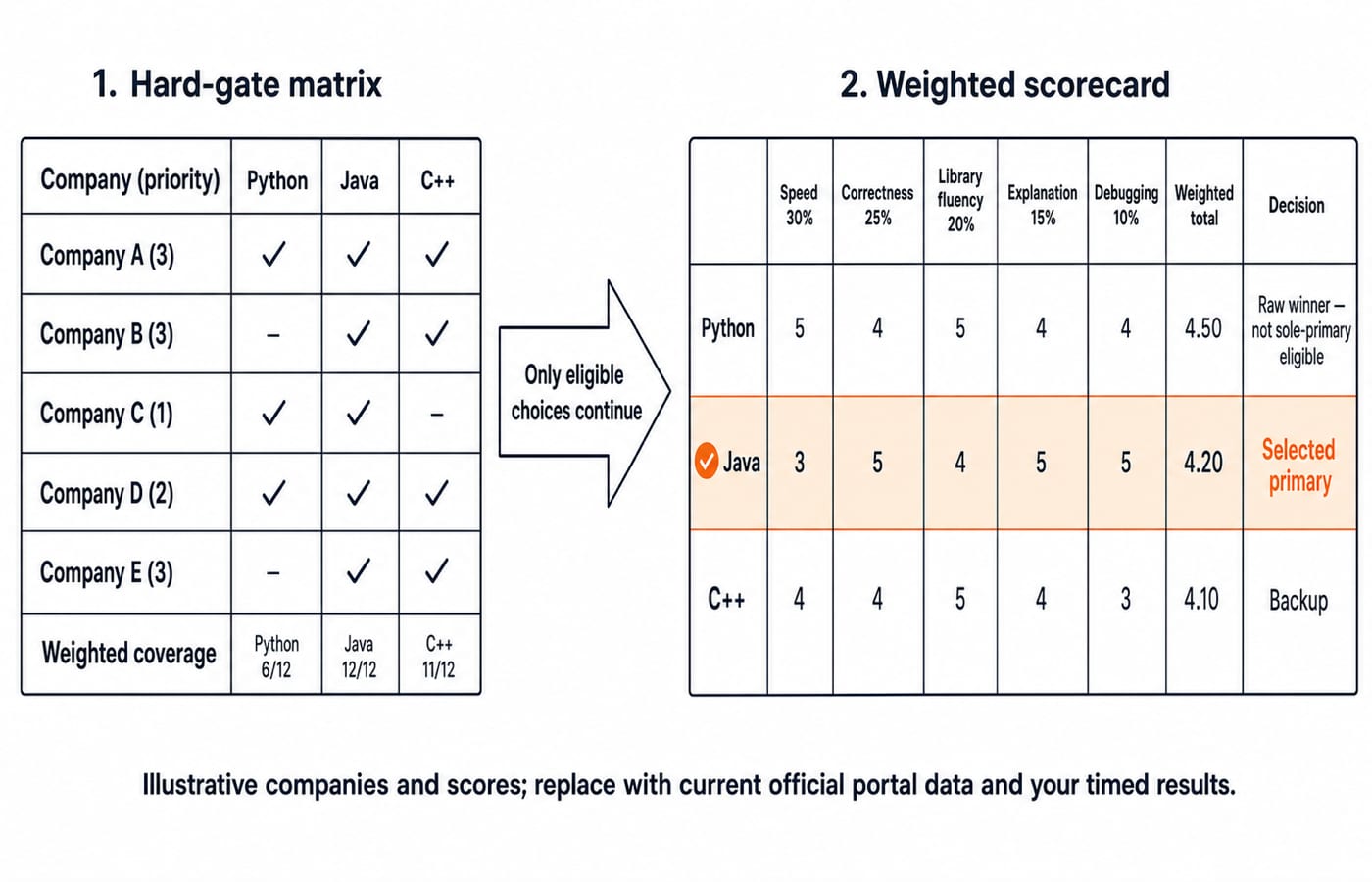
Total priority is 3 + 3 + 1 + 2 + 3 = 12. Python covers A, C and D: 3 + 1 + 2 = 6/12. Java covers all five: 12/12. C++ covers A, B, D and E: 3 + 3 + 2 + 3 = 11/12.
If a priority-3 target rejects a language, it cannot be your sole primary. Here, Python remains worth testing but fails as the only primary because placeholder Companies B and E exclude it. Java and C++ pass. Rebuild the sheet from the portals your own targets actually use, and recheck it before each application window, because supported-language lists change between hiring cycles.
2. Run the same three coding tests in every language
Within seven days, run separate 75-minute sessions for Python, Java and C++. Keep the editor, tests, internet or reference rule and breaks identical. Record time to first pass, failed runs, compile or runtime errors, documentation lookups, and whether you can explain the code without reading it.
Use these exact tasks:
Return zero-based indices
[0, 1]for[2, 7, 11, 15]with target9. Also test an empty array.Report
{[()()]}as balanced and{[(])}as not balanced. Also test an empty bracket string.For the undirected graph
A-B:4, A-C:1, C-B:2, B-D:1, C-D:5, returnA -> C -> B -> Dwith cost1 + 2 + 1 = 4. Also test unreachable vertexE.
If syntax is rusty, use Classic Programs in C, Java and Python as an optional warm-up before the clock starts. It cannot replace them.
3. Turn the observations into a weighted score
Give each language a 1-to-5 score for completion speed (30%), first-run correctness (25%), collections or library fluency (20%), explanation of choices and complexity (15%), and debugging comfort (10%). Then calculate:
Weighted score = sum of criterion score x criterion weight
Availability is a hard gate that sits outside the score. With placeholder scores:
Language | Speed | Correctness | Library fluency | Explanation | Debugging | Weighted score |
|---|---|---|---|---|---|---|
Python | 5 | 4 | 5 | 4 | 4 |
|
Java | 3 | 5 | 4 | 5 | 5 |
|
C++ | 4 | 4 | 5 | 4 | 3 |
|
Python wins the raw score at 4.50 and still loses. The gate in Section 1 had already removed it from sole-primary contention, so Java at 4.20 becomes the primary and C++ at 4.10 the backup. Had all three cleared the gate, Python would have taken it. Carry that inversion into your own sheet: the scorecard ranks the languages you are allowed to use, and it never overrules the gate.
4. Test trade-offs through operations, not slogans
Implement two operations in all three languages. Build a frequency map for [4, 1, 4, 2, 1, 4]; it must produce 4:3, 1:2, 2:1. Then sort [(-2, 5), (1, 3), (-2, 1), (0, 4)] by first value and then second; it must produce [(-2, 1), (-2, 5), (0, 4), (1, 3)].
Code length is only context. In Python, can you use built-ins without mutability or type mistakes? In Java, can you handle arrays, collections, comparators and generics without slow setup? In C++, can you use STL containers, iterators, comparators, and value or reference semantics without bugs? Concision, typing and control guarantee nothing.
After each implementation, give a 90-second explanation of the data structure, invariant, time complexity, space complexity and one edge case. If it breaks down, lower the explanation score even when the code passes.
5. Use a four-week trial at seven hours per week
Week 1: Five 60-minute sessions plus one 120-minute review equal
300 + 120 = 420 minutes, or seven hours. Refresh syntax, arrays, strings, maps and sets through 12 easy problems.Week 2: Repeat that seven-hour shape for stacks, queues, sorting, comparators and two pointers, with 12 easy-to-medium problems. Log
problem, language friction, algorithm gap, fixto separate language trouble from DSA gaps.Week 3: Three 90-minute timed sets plus 150 review minutes equal
270 + 150 = 420 minutes. Use array or string, stack or map, and graph or tree sets. Build a checklist from DSA Interview Questions for Placements, then write original solutions under fixed rules.Week 4: Two 120-minute mocks run under your target portal's own rules (its editor, whatever reference material it permits, no pausing), three 45-minute weak-area drills and one 45-minute decision audit equal
240 + 135 + 45 = 420 minutes. Recalculate the score, choose a primary for eight weeks, and keep a backup only if the target sheet requires it.
6. Keep the choice reversible without language hopping
After choosing, spend six hours weekly in the primary language and one hour maintaining the backup. Equal daily practice across three languages creates syntax switching and hides problem-solving progress.
Reconsider only if the primary fails a newly verified gate, or two consecutive 75-minute tests show language-caused failure. Retest the runner-up on Section 2. Switch only if it passes the gate and beats the primary by at least 0.50 on the five-point score in two consecutive tests.
After a missed day, do 30 minutes within 48 hours: revisit one failed case and update the log. Carry forward at most one problem, and never double tomorrow's hours. The 7 Placement Preparation Mistakes to Avoid guide covers resource hopping and unrealistic catch-up plans.
7. The short decision rule and next step
Eliminate unsupported options, run identical tasks, score performance, and choose the strongest eligible language. Use explanation and debugging as tie-breakers. Change it only when constraints or repeated measurements change.
If assembling the practice material is the bottleneck, Coding for Placements runs C, C++, Java and Python with competitive coding, concept videos and practice tests, so the same three tasks can be attempted in every language without hunting for problems first. To weigh it against the other placement-coding routes, open the Coding and DSA courses for placements hub.
Create your five-row target sheet today, then schedule the first 75-minute language test within the next 24 hours.
Keep learning
Classes and Objects MCQs: 12 Solved OOP Questions with Explanations
Solve 12 classes and objects MCQs, check each explanation, and use a worked Java trace to separate instance state, constructors, overloading and nested classes.
20 Oct 20267 min readProgramming Languages Survey
Programming Language Syntax MCQs: 12 Solved Questions on Grammar, Tokens and Semantics
Solve 12 MCQs on syntax, tokens, pseudocode, C grammar and runtime behaviour. Each explanation identifies the rule and applies it.
Updated 16 Oct 20268 min readProgramming Languages Survey
Imperative Programming Structure and Flow Control MCQs: 12 Solved Questions
Test whether you can trace changing state, choose the right loop, read a flowchart, and follow event-driven or exceptional control paths through 12 solved MCQs.
12 Oct 20267 min readProgramming Languages Survey
Static vs Dynamic Binding MCQs: 11 Solved Questions on Scope, Aliasing and Dispatch
Solve 11 binding questions from GATE and UGC NET papers by tracing lexical scope, runtime call chains, declared types and shared storage cells. Each answer shows why the tempting shortcuts fail.
Updated 8 Oct 20267 min readProgramming Languages Survey