JavaScript Tutorial: The Complete Learning Path from First Script to Real Projects
A beginner-friendly JavaScript roadmap that puts 30 topics in dependency order, then tests the sequence through one marks-report example and three checkpoints.
KnowledgeGate Team
Exam prep & CS education
Updated 24 Aug 20266 min read
You have decided to learn JavaScript, opened three tutorials, and quit all three because each started at a different place. The problem is usually not the language. It is the missing order: which concept must come before which. A dependency-first ladder gives each concept a clear prerequisite and a practical checkpoint.
1. Why JavaScript first, and what complete actually means
JavaScript runs in the browser, powers frontend frameworks such as React, works on backend runtimes such as Node.js, and appears regularly in Indian service-company and product-company placement interviews. One language can therefore open four doors: interactive web pages, frontend applications, backend APIs, and interview rounds.
Complete does not mean memorising every library method. It means building enough language and browser knowledge to create and debug useful programs independently. The foundation includes setup, language core, functions, data structures, browser work, asynchronous JavaScript, modern patterns, and projects. Frameworks belong after this foundation because React and Redux rely on functions, arrays, objects, modules, and asynchronous control flow.
For a college student studying for one focused hour a day, Stages 0 to 3 can form a four-week plan, followed by another four to five weeks for Stages 4 to 6. With two to three focused hours daily, you can plan for roughly five weeks. Treat these as planning estimates, not deadlines. A missed day does not reset your progress because every stage has a clear re-entry point.
2. The ladder at a glance: 7 stages, 30 concepts and 3 projects
Follow the 30 concepts in this order, then use the three projects as proof that the stages connect.
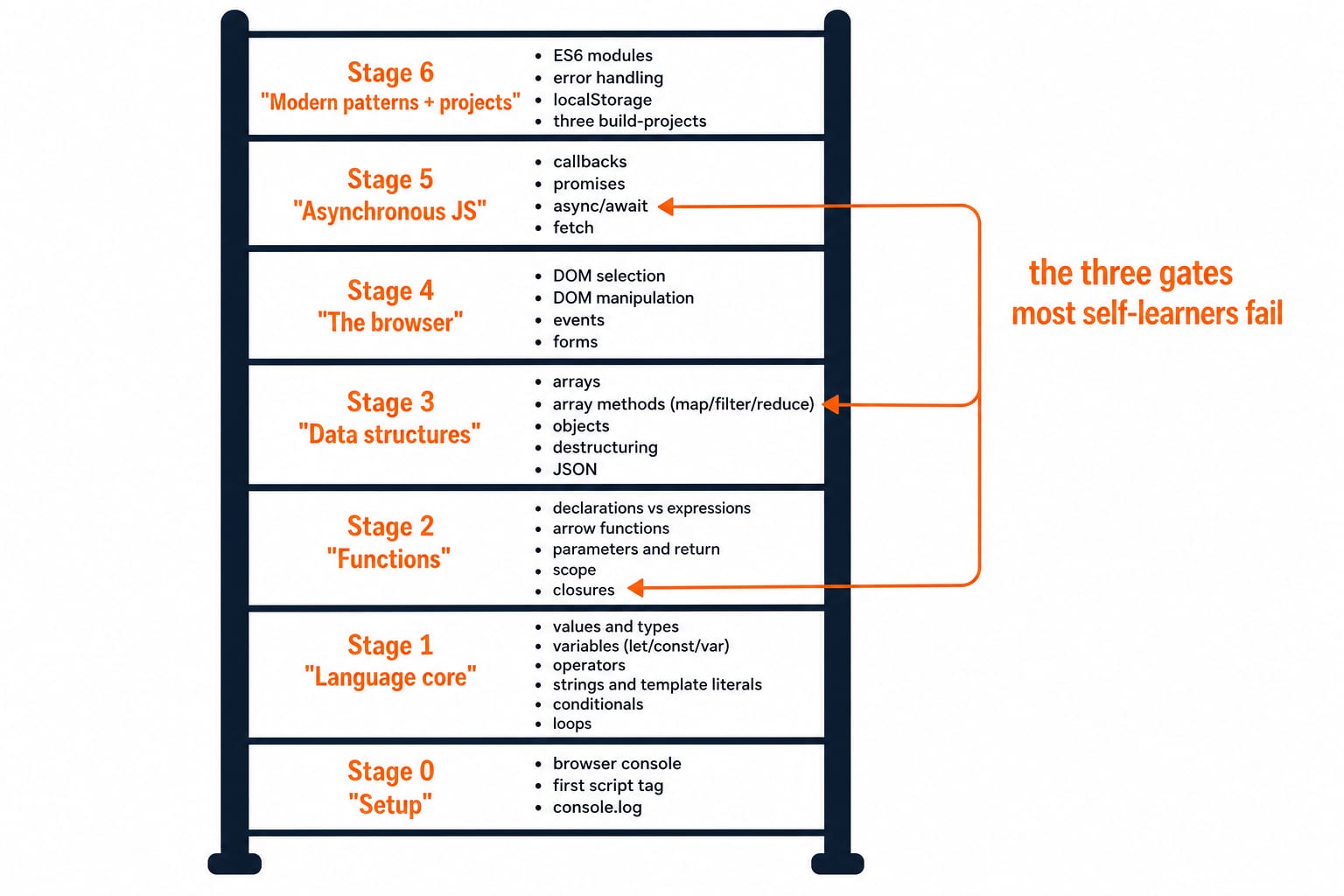
Stage 0, Setup: browser console, first script tag, console.log.
Stage 1, Language core: values and types, variables (let/const/var), operators, strings and template literals, conditionals, loops.
Stage 2, Functions: declarations vs expressions, arrow functions, parameters and return, scope, closures.
Stage 3, Data structures: arrays, array methods (map/filter/reduce), objects, destructuring, JSON.
Stage 4, The browser: DOM selection, DOM manipulation, events, forms.
Stage 5, Asynchronous JS: callbacks, promises, async/await, fetch.
Stage 6, Modern patterns and projects: ES6 modules, error handling, localStorage, then three projects with defined finish lines.
The ordering rule is simple: a topic appears only after every concept it silently uses. Closures come after scope because a closure is scope surviving a function call. Promises come after callbacks because promises solve problems that callbacks make visible. Skipping the dependency usually creates confusion later.
Stage 6: three projects with clear finish lines
Marks dashboard: render the five marks in the page, show 4 passes, 1 failure, and a passing average of 77.75, then validate a new mark entered through a form.
API catalogue: fetch a JSON list and render loading, success, empty, bad-data, and error states. Keep the fetch and rendering logic in separate functions.
Local task tracker: add, complete, filter, and delete tasks, persist them with localStorage, and restore the same state after a page reload.
A project is finished only when a user can complete the flow, invalid input produces a useful response, and a reload or failed request does not leave the interface in a misleading state.
3. One worked example carried up the ladder: the marks report
Use one dataset throughout the path: five marks, [72, 45, 88, 91, 60], with a pass mark of 60.
At Stage 1, a loop and an if statement are enough:
const marks = [72, 45, 88, 91, 60];
let passes = 0;

for (const mark of marks) {
  if (mark >= 60) passes++;
}

console.log(passes, marks.length - passes);
The passing marks are 72, 88, 91, and 60. Therefore 4 students pass, while 5 - 4 = 1 student fails.
At Stage 3, array methods express the same work more directly:
const passed = marks.filter(m => m >= 60);
const passingAverage = passed.reduce((sum, m) => sum + m, 0) / passed.length;
The filter returns [72, 88, 91, 60]. The sum is 72 + 88 + 91 + 60 = 311, and 311 / 4 = 77.75. The passing average is 77.75. This is where array methods stop being extra syntax and become thinking tools.
At Stage 5, feed the same JSON through fetch with a self-contained data URL. The response arrives asynchronously while the calculation stays the same:
const url = "data:application/json,%5B72%2C45%2C88%2C91%2C60%5D";
const res = await fetch(url);
const fetchedMarks = await res.json();
const fetchedPassed = fetchedMarks.filter(m => m >= 60);
const fetchedAverage = fetchedPassed.reduce((sum, m) => sum + m, 0) / fetchedPassed.length;

console.log(fetchedAverage);
The code prints 77.75 again. Asynchronous code changes how the data arrives, but functions and arrays still do the processing.
4. The three checkpoints where self-learners stall
Checkpoint 1: closures
Tutorials often show a counter without first showing the bug a closure helps explain. Test yourself by pushing three arrow functions into an array inside a loop. With var i, all three functions print 3 when called after the loop. With let i, they print 0, 1, and 2 because each iteration gets its own binding. If you cannot predict that result, revisit scope before Stage 3. The ECMAScript standard defines this language behaviour, while the MDN Web Docs JavaScript reference is the practical place to check it.
Checkpoint 2: reduce
Recreate the passing average without looking above. Then reduce ["pass", "fail", "pass", "pass", "pass"] into a frequency object. The result must be {pass: 4, fail: 1} because the input contains four "pass" values and one "fail" value.
Checkpoint 3: async/await
Explain why a console.log placed after a fetch call can run before the response data arrives: starting the request does not block the remaining synchronous code. Then fix the flow twice, once with a .then() chain and once inside an async function with await. Pass these three checkpoints before moving on.
5. Traps that waste weeks
The first trap is jumping to a framework because job posts mention React. React errors assume that you already understand functions, arrays, objects, closures, and asynchronous code. Finish Stage 6 first, then use the Complete React and Redux Course as the step after this ladder.
The second trap is the tutorial loop. Watching another explanation of the same topic feels productive, but your exit rule should be whether you can pass the checkpoints, not how many videos you completed.
The third trap is syntax hoarding. Learn a small working set of array methods: map, filter, reduce, find, includes, slice, and push. Look up the rest in the MDN Web Docs JavaScript reference when a real problem needs them.
6. How interviews and exams test this ladder
Placement interviews often press hardest on Stages 2 and 3. Expect output-prediction questions about closures, var, let, and this, followed by short transformations using map, filter, or reduce. The loop-with-var checkpoint above is a useful practice pattern.
Stage 5 appears in questions about the event loop, promises, and async/await. The stronger preparation is a fetch-based mini-project, where you handle loading, success, bad data, and errors, instead of memorising definitions.
Written exams usually compress the same skills into output-tracing or error-finding questions. Trace operator precedence, scope, coercion, array mutations, and promise ordering on paper, then state the final value or error. The marks loop and closure checkpoint provide two such traces; the fetch project tests the longer interview version.
Language fluency is only one part of the hiring bar. Placement-bound learners can continue into data-structures thinking with our sorting algorithms comparison and dynamic programming explainer. Add the SQL queries and joins guide when preparing for database rounds.
7. The short version, and where to start today
Set up the browser console today.
Complete one stage at a time, in dependency order.
Use the three checkpoints to decide when to move.
Carry one dataset through loops, arrays, and asynchronous code.
Finish the three Stage 6 projects before starting a framework.
Tonight, open the browser console and type the Stage 1 marks loop yourself. Do not move on until it prints 4 passes and 1 failure from your own code.
For a taught version of this ladder, with an instructor debugging alongside you, the Complete JavaScript Course covers Stages 0 to 6 end to end. After that, the Coding and Skill Development Courses catalogue gives you the follow-on paths.
Keep learning
Polymorphism in Java: Overloading, Overriding and Runnable Examples
Learn how Java chooses overloaded methods at compile time and overridden methods at runtime. Trace two complete programs, common traps and practice targets.
Updated 22 Oct 20266 min readJava

Packages and Access Modifiers in Java: Visibility Rules with Runnable Examples
Learn how Java package boundaries change member visibility. Compile a complete example covering public, protected, package-private and private access.
Updated 18 Oct 20265 min readJava
OOP Basics in Java: Classes, Objects and the Four Pillars with Runnable Examples
Connect Java's OOP syntax to design decisions with a complete Account example. Trace two objects through validation, overriding and runtime dispatch to exact output.
Updated 14 Oct 20265 min readJava
Classes and Objects in Java: Build and Trace Two Objects Step by Step
Build a Java Student class, create two independent objects, and trace fields, methods, aliases, null references, output, and common errors step by step.
Updated 10 Oct 20266 min readJava