LL(1) Parsing Table Construction for GATE
Build an LL(1) table cell by cell, test it for conflicts, and see how left recursion and common prefixes break predictive parsing.
KnowledgeGate Team
Exam prep & CS education
Updated 20 Jul 20266 min read266 views
An LL(1) table can look like a large grid of arbitrary choices. It is not. Once FIRST and FOLLOW are correct, filling the table is a mechanical exercise, and the final conflict check tells you whether the grammar is LL(1).
The safest exam method is to separate those jobs. Compute the sets, apply the two filling rules, and only then inspect the cells.
Why LL(1) questions can become free marks
LL(1) means that the parser scans the input from left to right, constructs a leftmost derivation, and uses one lookahead symbol. At every step, the non-terminal on top of the stack and the next input symbol select one production from the parsing table.
There is no guessing if each relevant cell contains at most one production. Most wrong answers come from an incorrect FOLLOW set, forgetting the epsilon rule, or deciding that a grammar is LL(1) before building the complete table.
FIRST and FOLLOW prerequisites in 90 seconds
FIRST(X) contains the terminals that can begin a string derived from X. If X can derive the empty string, epsilon also belongs to FIRST(X). FOLLOW(A) contains the terminals that can appear immediately after non-terminal A in some sentential form. The end marker $ belongs to FOLLOW of the start symbol.
Those two definitions are all the construction needs. If the set computation itself is the weak point, revise FIRST and FOLLOW in Compiler Design before attempting the table. The two details that matter most are:
FIRST of a sequence may need to move past nullable symbols.
FOLLOW is used for a production only when its right-hand side can derive epsilon.
The LL(1) table-filling rule
For every production A -> alpha, apply these rules:
For every terminal
ain FIRST(alpha), excluding epsilon, put A -> alpha in M[A, a].If epsilon is in FIRST(alpha), put A -> alpha in M[A, b] for every
bin FOLLOW(A). If$is in FOLLOW(A), this includes M[A,$].
All remaining cells are errors. Do not write epsilon into every empty cell. An epsilon production goes only under the FOLLOW symbols of its left-hand side.
This same rule sits inside the wider distinction between predictive and shift-reduce methods explained in top-down and bottom-up parsing.
Worked LL(1) table with an epsilon production
Use this grammar, with S as the start symbol:
S -> A B
A -> a A | epsilon
B -> b B | c
First compute FIRST:
FIRST(A) = {a, epsilon} because A can begin with
aor disappear.FIRST(B) = {b, c}.
FIRST(S) = FIRST(AB) = {a, b, c}. We include FIRST(B) because A is nullable.
Now compute FOLLOW:
FOLLOW(S) = {$} because S is the start symbol.
In S -> AB, B follows A, so FIRST(B) = {b, c} goes into FOLLOW(A). Thus FOLLOW(A) = {b, c}.
B is at the end of S -> AB, so FOLLOW(S) goes into FOLLOW(B). Thus FOLLOW(B) = {$}.
Fill the cells one production at a time.
S -> AB has FIRST(AB) = {a, b, c}, so place it in M[S, a], M[S, b], and M[S, c].
A -> aA has FIRST(aA) = {a}, so place it in M[A, a].
A -> epsilon is nullable. FOLLOW(A) = {b, c}, so place it in M[A, b] and M[A, c].
B -> bB goes in M[B, b].
B -> c goes in M[B, c].
The complete table is:
Non-terminal |
|
|
|
|
|---|---|---|---|---|
S | S -> AB | S -> AB | S -> AB | error |
A | A -> aA | A -> epsilon | A -> epsilon | error |
B | error | B -> bB | B -> c | error |
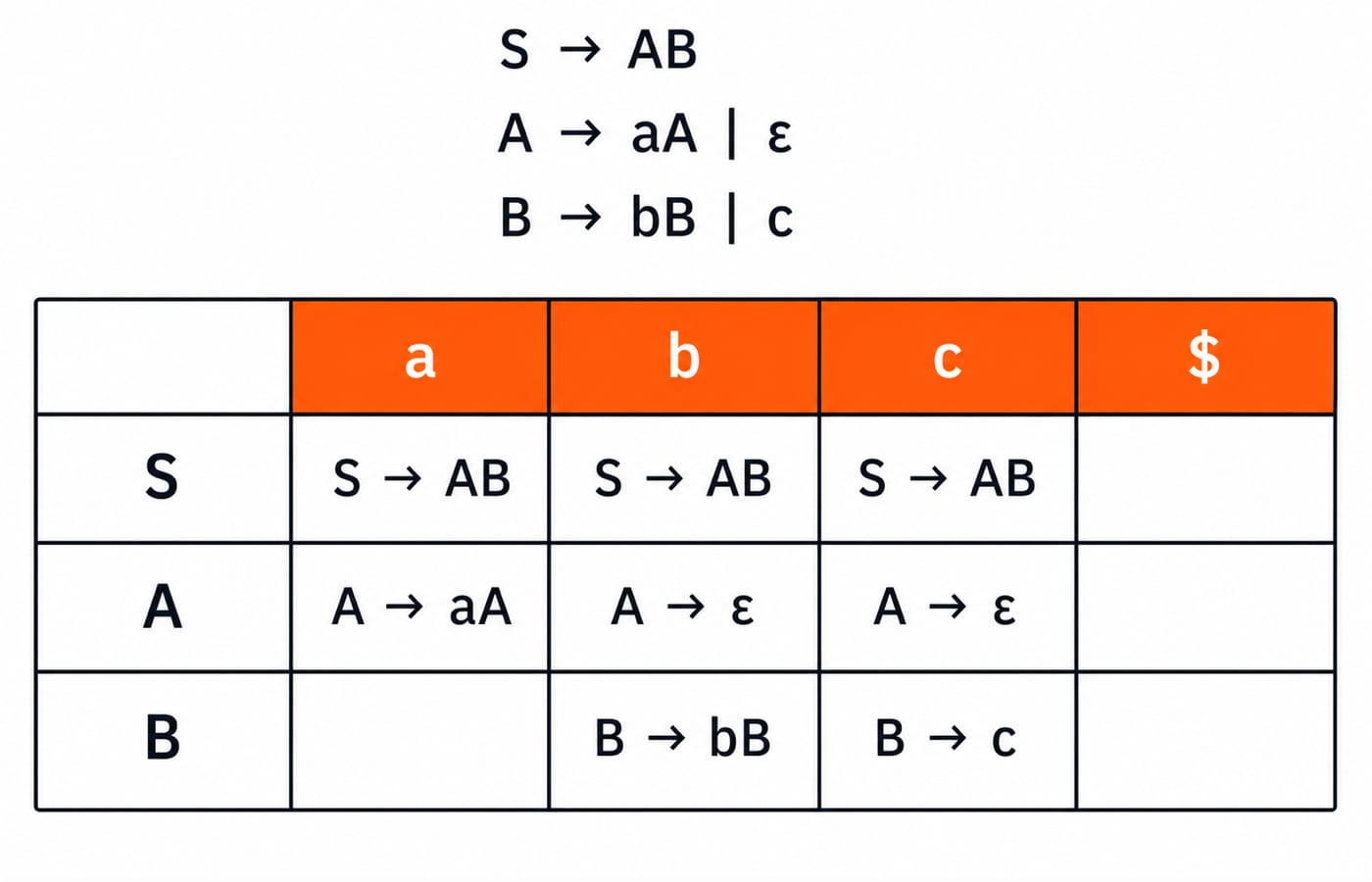
No cell contains two productions, so this grammar is LL(1). As a quick input check, for aac$, the parser repeatedly chooses A -> aA under lookahead a, then chooses A -> epsilon under c, followed by B -> c.
Is this grammar LL(1)? Use the collision test
Consider another grammar:
S -> a A | a B
A -> c
B -> d
FIRST(aA) = {a} and FIRST(aB) = {a}. Both S productions must therefore be placed in M[S, a]. That cell becomes multiply defined:
M[S, a] = {S -> aA, S -> aB}The parser cannot select a unique production from one lookahead symbol, so the grammar is not LL(1). The exact answer is not merely that the FIRST sets overlap. The decisive evidence is the collision in M[S, a].
An epsilon production can create the other common collision. If epsilon is in FIRST(alpha), FIRST of another alternative for A must not overlap FOLLOW(A), or both alternatives can land in the same table cell.
Two classic grammar fixes
Remove left recursion when a grammar contains a form such as E -> E + T | T. A predictive parser would keep expanding E without consuming input. The standard transformation introduces a helper non-terminal, for example E -> TE' and E' -> +TE' | epsilon.
Apply left factoring when alternatives share a prefix. The failed grammar above can be written as S -> aX, X -> A | B. Factoring postpones the decision until the parser has consumed the common a. It does not guarantee that every grammar becomes LL(1), so rebuild the sets and table after the transformation.
How GATE tests LL(1) construction
Typical questions ask for a particular cell, the number of filled entries, whether a grammar is LL(1), or which transformation makes predictive parsing possible. Three traps account for most of the marks lost on them.
The first trap is a collision that FIRST sets alone will never reveal. Take this grammar:
S -> A a
A -> a | epsilon
The two alternatives for A have disjoint FIRST sets, {a} and {epsilon}, so a quick FIRST against FIRST check passes. But A is nullable, and a follows A in S -> A a, so FOLLOW(A) = {a}. The filling rule then places A -> epsilon in M[A, a], where A -> a already sits. That one cell holds two productions and the grammar is not LL(1). This is why the epsilon rule is stated against FOLLOW of the left-hand side, not against the FIRST set of the sibling alternative.
The second trap is indirect left recursion. In S -> A a with A -> S b | c, no production begins with its own left-hand side, so the grammar looks safe. Yet S derives A a and then S b a, so the recursion is there and has to be removed before any predictive parser can run.
The third is a nullable chain. When two or more symbols at the front of a right-hand side can all derive epsilon, FIRST of that sequence keeps absorbing the next symbol's FIRST set, and one skipped symbol there quietly corrupts every cell built from it.
For topic placement and a route through the rest of Compiler Design, use the GATE CS preparation category.
The short version
Compute FIRST and FOLLOW, process every production with the two filling rules, and inspect every cell. One multiply defined cell is enough to reject the grammar. Empty cells are errors, not automatic epsilon entries.
After the method is stable, practise table construction and conflict questions in the GATE Test Series. Build the complete grid on paper each time until the epsilon and FOLLOW step becomes automatic.
Keep learning

Code Optimization Mistakes in Compiler Design: How to Avoid Losing GATE Marks
A rewrite that looks familiar is not necessarily safe. Trace six common optimization errors, learn why each one changes program meaning, and use a five-step check before accepting an answer.
Updated 22 Oct 20265 min readCompiler Design
Compiler Design Semester Guide: Trace One Program from Tokens to Target Code
Follow one assignment through lexical analysis, parsing, semantic checks, TAC, optimization and abstract target instructions, with every hand-off made visible.
Updated 18 Oct 20267 min readCompiler Design
Bottom-Up Parsing in Compiler Design: Shift-Reduce Trace, LR Items and Conflicts
Follow a nested-parentheses LR(0) parse from input to acceptance, derive every item set, and see why lookahead changes parser-family conflicts.
Updated 14 Oct 20265 min readCompiler Design
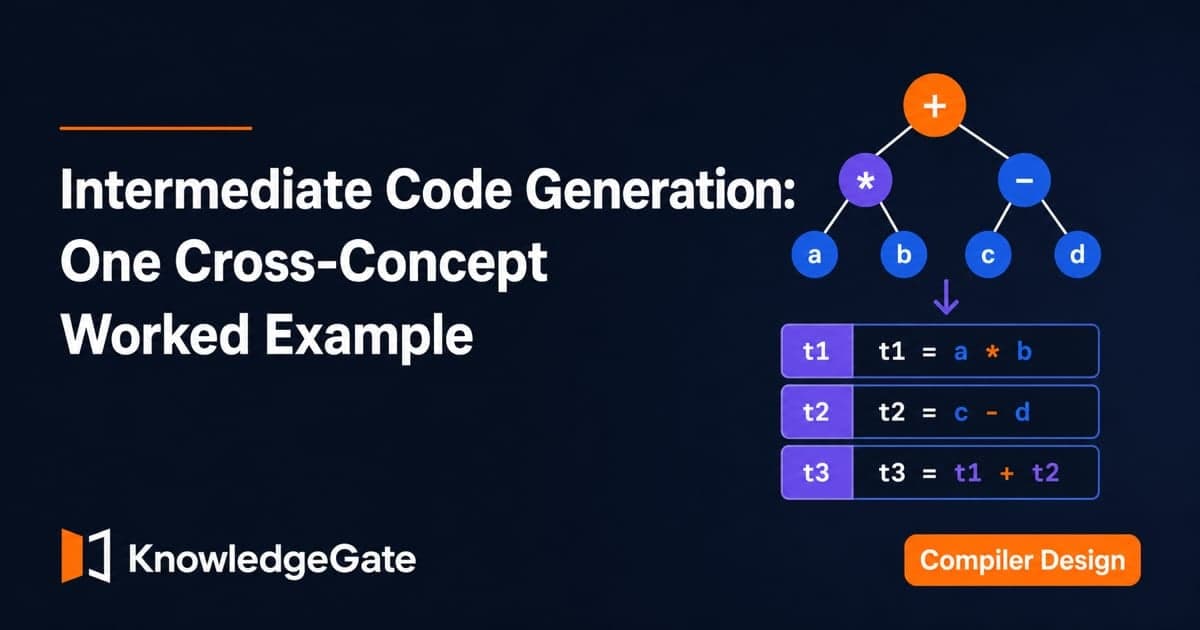
Intermediate Code Generation in Compiler Design: One Cross-Concept Worked Example
Carry one C-like fragment from its source facts to typed temporaries, three-address code, quadruples and a control-flow graph, with every value traced.
Updated 10 Oct 20266 min readCompiler Design