Phases of a Compiler for GATE: One Statement Traced Through Every Phase
Follow position = initial + rate * 60 through all six compiler phases. Each step shows the exact artifact, error class and hand-off that GATE can test.
KnowledgeGate Team
Exam prep & CS education
Updated 29 Jul 20266 min read
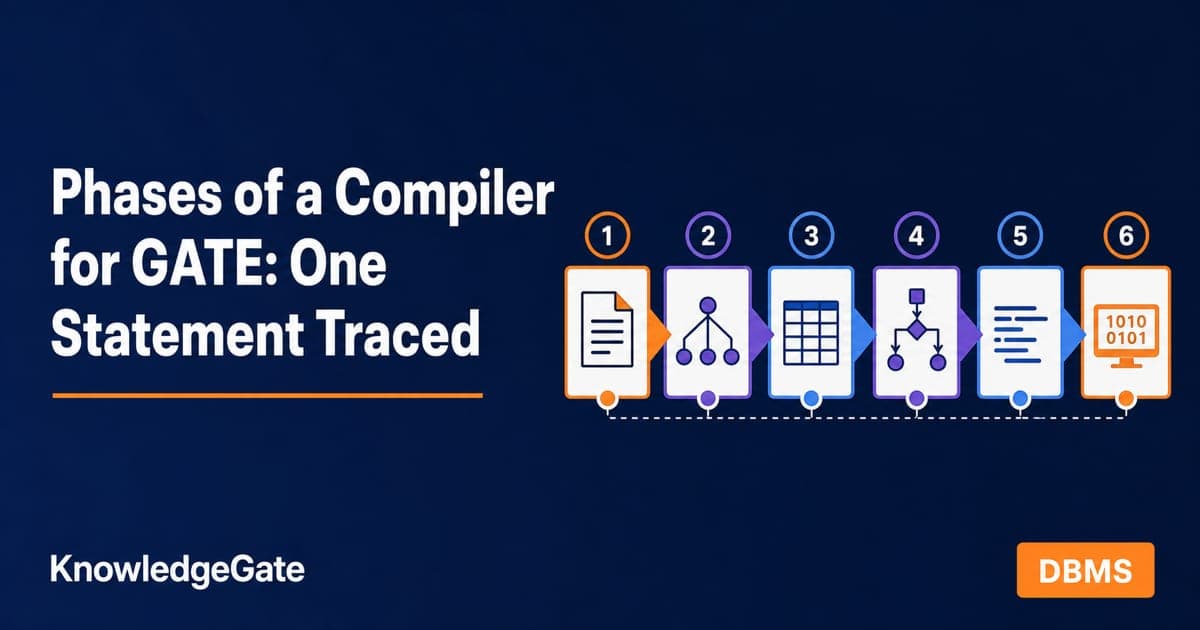
GATE often asks which compiler phase performs a task or which artifact a phase produces. Reciting six names in order will not settle those questions. The reliable method is to watch one statement change form from source text to target instructions and notice exactly what each phase hands over.
The two halves of a compiler
A compiler is usually explained as an analysis half and a synthesis half.
The analysis phase, or front end, breaks the source program into meaningful parts and checks them. Its three main stages are lexical analysis, syntax analysis and semantic analysis. By the end of analysis, the compiler has an annotated internal representation that says both what the program means and whether its use of names and types is valid.
The synthesis phase, or back end, turns that checked representation into a target program. Its stages are intermediate code generation, code optimization and target code generation. The target may be assembly or machine code for a particular architecture.
Two services run across this pipeline:
The symbol table stores information about identifiers, such as their names, types and storage details. Lexical analysis starts entries, and later phases add or use information.
The error handler receives different error classes from different phases. There is not one final error check after all compilation work is complete.
This front-end and back-end split is useful, but GATE usually tests the finer phase-to-artifact mapping.
The running assignment statement
One assignment statement is enough to exercise all six phases:
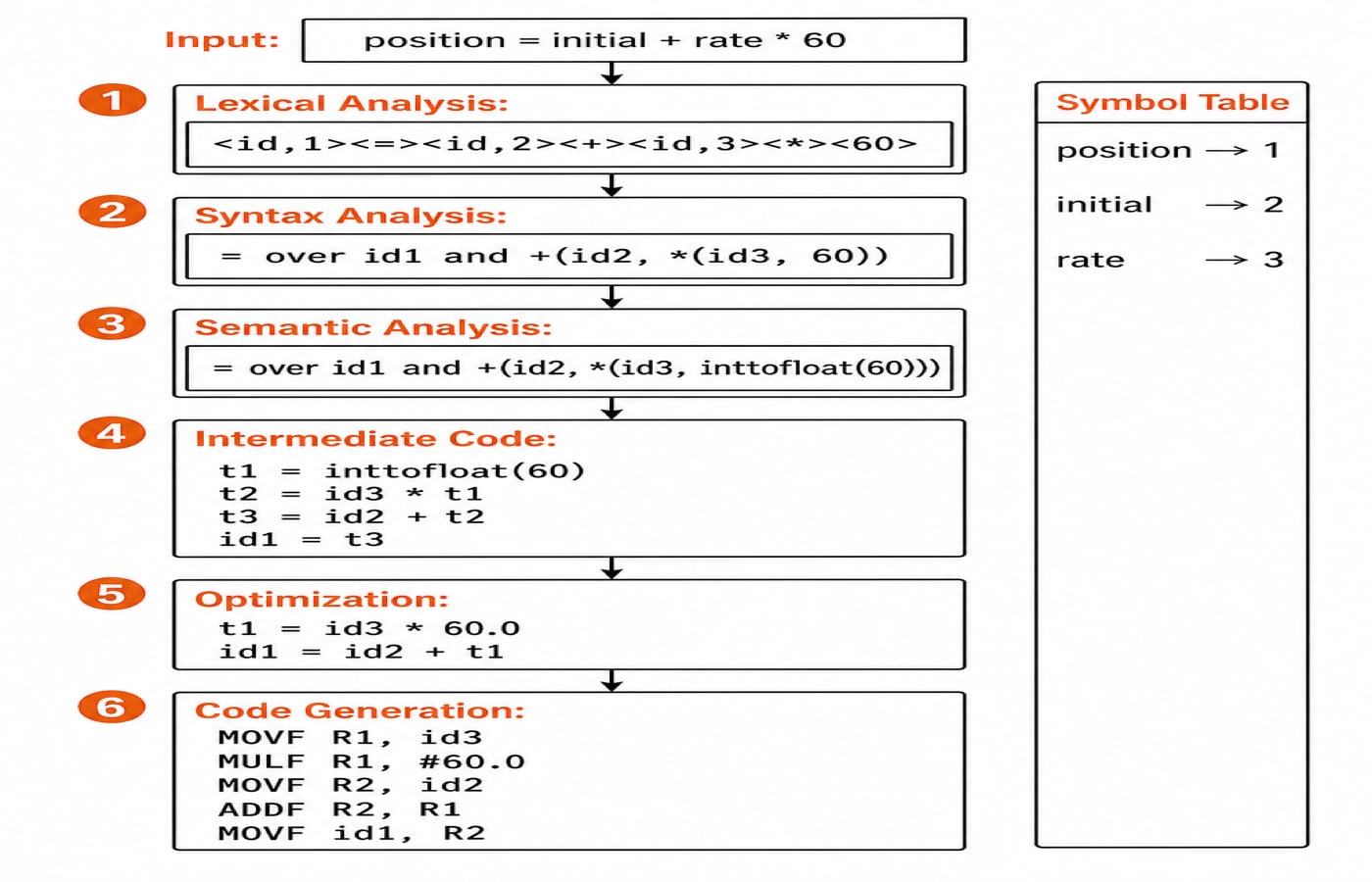
position = initial + rate * 60Assume position, initial and rate are floating-point variables. The literal 60 is an integer. That difference matters because the semantic phase must reconcile the types before floating-point multiplication can be generated.
For compact internal names, let the symbol table assign position -> 1, initial -> 2 and rate -> 3. Every later form preserves the multiplication before addition that operator precedence requires.
Analysis phases traced step by step
Lexical analysis reads characters and groups them into tokens. It also removes layout details such as spaces when they carry no meaning. For this statement, the token stream is:
<id,1> <=> <id,2> <+> <id,3> <*> <60>The three identifier tokens point to symbol-table entries rather than repeating full names. An illegal character or an invalid token pattern is a lexical error. The deeper token and lexeme distinction is covered in Lexical Analysis in Compiler Design: Tokens, Patterns and Lexemes Explained.
Syntax analysis takes the tokens and checks whether their order follows the grammar. Its tree has assignment = at the root. The left child is id1. The right child is +, with id2 on the left and a multiplication node on the right. That multiplication has children id3 and 60.
In compact form, the tree is =(id1, +(id2, *(id3, 60))). A misplaced operator, an unbalanced parenthesis or another grammar violation belongs here. If you need to connect this tree to parser mechanics, read Parsing in Compiler Design: Top-Down and Bottom-Up Explained.
Semantic analysis checks meaning that grammar alone cannot establish. The compiler confirms that the identifiers are declared and that the operand types are compatible. Here rate is a float but 60 is an integer, so the phase inserts a coercion:
=(id1, +(id2, *(id3, inttofloat(60))))The result is an annotated syntax tree. An undeclared identifier or an invalid type combination is a semantic error, not a syntax error.
Synthesis phases traced step by step
Intermediate code generation converts the annotated tree into a machine-neutral form. One possible three-address sequence has exactly four instructions:
t1 = inttofloat(60)
t2 = id3 * t1
t3 = id2 + t2
id1 = t3
There is one operation on the right of each instruction. The order also makes the data dependency visible: t2 needs t1, and t3 needs t2.
Code optimization improves the intermediate code without changing its result. A machine-independent optimizer can write the known converted constant as 60.0, eliminate the conversion instruction and store the addition directly into id1:
t1 = id3 * 60.0
id1 = id2 + t1
The count has fallen from four instructions to two. This is still intermediate code, not target assembly.
Code generation selects machine instructions and registers. For an illustrative floating-point target, the two optimized operations could become five instructions:
MOVF  R1, id3
MULF  R1, #60.0
MOVF  R2, id2
ADDF  R2, R1
MOVF  id1, R2
Read the two-operand form as destination first. MOVF R1, id3 loads rate into R1, MULF R1, #60.0 multiplies R1 in place, and the final MOVF id1, R2 stores the sum into position. This is one illustrative target sequence, not a universal instruction set: register choices and instruction names are what make this phase machine-dependent.
Artifact-per-phase table for match-the-phase questions
Input | Phase | Output |
|---|---|---|
Source character stream | Lexical analysis | Tokens and initial symbol-table entries |
Token stream | Syntax analysis | Parse tree or abstract syntax tree |
Syntax tree | Semantic analysis | Annotated tree with types and coercions |
Annotated tree | Intermediate code generation | Three-address code |
Intermediate code | Code optimization | Improved intermediate code |
Improved intermediate code | Code generation | Target assembly or machine code |
Read the table in both directions. The examiner may name an output and ask for its producer, or name a phase and ask what it emits.
Traps GATE plants in compiler-phase questions
The most common error is assigning a fault to the wrong phase. An illegal character is lexical. A missing operand or unbalanced parenthesis is syntactic. An undeclared variable or incompatible type is semantic. An array index going out of bounds while the program runs is a runtime error, unless a specific compile-time check can prove it.
Do not treat the symbol table as the private output of one phase. It is created and maintained across phases. Also keep machine-independent optimization separate from machine-dependent target generation. Optimization may transform three-address code without knowing the final register set.
Finally, do not confuse a parse tree with a token stream. Tokens have already discarded irrelevant character-level detail; a tree adds grammatical structure and precedence.
How GATE tests the six phases
Typical stems ask where inttofloat is inserted, which phase catches an undeclared identifier, what syntax analysis produces or how many stages belong to analysis.
Take a stem in the common form. Given the declarations int a; float b; and the assignment b = a * 2.5;, which phase inserts the type conversion? Lexical analysis returns <id,1> <=> <id,2> <*> <2.5> and never looks at a declaration. Syntax analysis builds =(id1, *(id2, 2.5)) and accepts it, because no grammar rule for an assignment mentions int against float. Semantic analysis is the first phase that reads the declared types out of the symbol table, finds an integer operand inside a floating-point multiplication, and rewrites it as inttofloat(a). The answer is semantic analysis, reached by the same route the running example took.
For wording tied to a particular year or paper pattern, verify the paper and answer key on the official GATE portal of the organising IIT. The compiler concepts themselves remain stable.
Short version and next step
Lexical analysis produces tokens, syntax analysis produces a tree, and semantic analysis annotates that tree. Intermediate code generation then produces TAC, optimization improves it, and code generation emits target instructions. The symbol table and error handling support the complete route.
Trace one arithmetic statement and one conditional statement on paper. Then use GATE Guidance by Sanchit Sir for the full Compiler Design sequence, or move through the wider GATE preparation category when you are building a subject plan.
Keep learning
Code Optimization Mistakes in Compiler Design: How to Avoid Losing GATE Marks
A rewrite that looks familiar is not necessarily safe. Trace six common optimization errors, learn why each one changes program meaning, and use a five-step check before accepting an answer.
Updated 22 Oct 20265 min readCompiler Design
Compiler Design Semester Guide: Trace One Program from Tokens to Target Code
Follow one assignment through lexical analysis, parsing, semantic checks, TAC, optimization and abstract target instructions, with every hand-off made visible.
Updated 18 Oct 20267 min readCompiler Design
Bottom-Up Parsing in Compiler Design: Shift-Reduce Trace, LR Items and Conflicts
Follow a nested-parentheses LR(0) parse from input to acceptance, derive every item set, and see why lookahead changes parser-family conflicts.
Updated 14 Oct 20265 min readCompiler Design
Intermediate Code Generation in Compiler Design: One Cross-Concept Worked Example
Carry one C-like fragment from its source facts to typed temporaries, three-address code, quadruples and a control-flow graph, with every value traced.
Updated 10 Oct 20266 min readCompiler Design