Normal Forms & BNF MCQs: 10 Solved Grammar Questions with Explanations
Solve ten exam-standard grammar questions on CNF, GNF, BNF notation, derivation counts, parse trees and conversion bounds, with every answer worked step by step.
KnowledgeGate Team
Exam prep & CS education
Updated 1 Sep 20268 min read
CNF, GNF, BNF, parse-tree height, and derivation length can look like a list of definitions until one option changes a symbol and invalidates an entire production. Each question tests a definition against an actual production or a numeric tree count.
Attempt each question before reading its explanation, and write one reason beside your choice. Questions 1 to 6, 9 and 10 open on their own solved-question pages, and Questions 7 and 8 are practised on the Normal Forms & BNF practice page. For the wider syllabus around this topic, start from UGC NET CS Exam Preparation.
CNF, GNF, and BNF Rules to Check Before the Questions
Term | Permitted or typical form | Quick check |
|---|---|---|
CNF |
| Two variables or one terminal, with the usual start-symbol epsilon exception. |
GNF |
| The first symbol is a terminal, and every remaining symbol is a variable. |
BNF |
| A notation, not a normal form. |
For S -> aAB | b, A -> a, B -> b, every alternative starts with a terminal and any remainder contains only variables. It is already in GNF.
For CNF, introduce X_a -> a and C -> AB: S -> X_a C | b, X_a -> a, C -> AB, A -> a, B -> b. The first and third right-hand sides contain two variables; all others contain one terminal. If CFG and normal-form restrictions still blur together, revise Context-Free Grammar MCQs: 11 Solved CFG, CFL, PDA Questions.
BNF sits at a different level from CNF and GNF. It is a way of writing a grammar down, not a restriction on its productions: <expr> ::= <expr> + <term> | <term> and E -> E + T | T are the same two rules in two notations. A grammar written in BNF can therefore be left-recursive, ambiguous, or already in CNF, and converting it still means rewriting the productions rather than changing the brackets. Options that offer BNF as a third normal form beside CNF and GNF are testing exactly this distinction.
Normal-Form MCQs 1-2: CNF Yield and GNF Recognition
Question 1
The maximum yield length of the following CNF CFG is
S → AB
A → CD
B → e
C → a
D → b
A. 8
B. 7
C. 4
D. 3
Correct answer: D. 3.
Here e is a terminal, not epsilon. S => AB => CDB => aDB => abB => abe, so the yield length is 3. No nonterminal branches. Open the solved question.
Question 2
Which one of the following is not a Greibach Normal form grammar?
(i)                     (ii)                 (iii)
S → a / bA / aA / bB     S → a / aA / AB      S → a / A / aA
A → a                   A → a                A → a
B → b                   B → b
A. (i) and (ii)
B. (i) and (iii)
C. (ii) and (iii)
D. (i), (ii) and (iii)
Correct answer: C. (ii) and (iii).
Grammar (i) starts with a terminal throughout. Grammar (ii) has S -> AB, and (iii) has S -> A; both variable-leading rules fail GNF. Open the solved question.
Greibach and Chomsky Normal Form MCQs 3-4: Language Shape and Parse-Tree Path Length
Question 3
The Greibach normal form grammar for the language L = {aⁿ bⁿ⁺¹ | n ≥ 0} is
A.
S → aSBB → bB / λB.
S → aSBB → bB / bC.
S → aSB / bB → bD.
S → aSb / b
Correct answer: C. S -> aSB / b, B -> b.
Option C is GNF. Test it: n=0 gives S => b; n=1 gives S => aSB => abB => abb; n=2 gives S => aSB => aaSBB => aabBB => aabbB => aabbb. Each is a^n b^(n+1). Open the solved question.
Question 4
If the parse tree of a word w generated by a Chomsky normal form grammar has no path of length greater than i, then the word w is of length
A. no greater than 2^(i+1)
B. no greater than 2^i
C. no greater than 2^(i−1)
D. no greater than i
Correct answer: C. no greater than 2^(i-1).
A CNF tree branches two ways at every variable, so if no path exceeds i edges the variables occupy at most i-1 levels of branching before the final terminal step, leaving at most 2^(i-1) leaves. Take i=3: S -> AB, A -> CD, B -> EF with C, D, E and F each rewriting to one terminal gives a longest path of 3 edges and exactly 2^2 = 4 terminals, which is the tight case. Open the solved question.
Chomsky Normal Form MCQs 5-6: Production Counts and Height Bounds
Question 5
To obtain a string of n terminals from a given Chomsky normal form grammar, the number of productions to be used is
A. 2n-1
B. 2n
C. n + 1
D. n²
Correct answer: A. 2n-1.
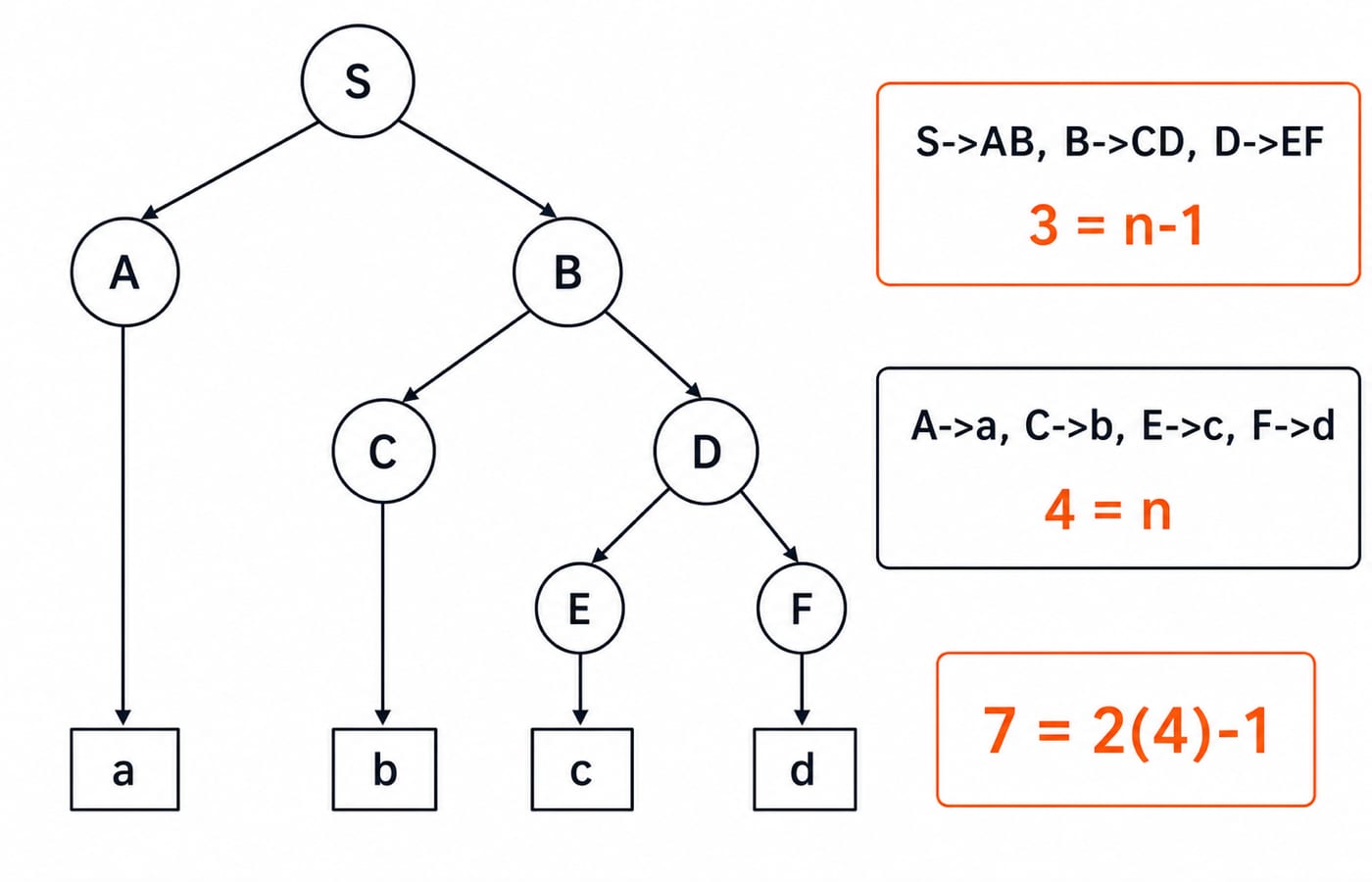
A binary CNF tree has n-1 binary expansions plus n terminal productions, totalling 2n-1.
For n=4, use S -> AB, A -> a, B -> CD, C -> b, D -> EF, E -> c, F -> d. Then S => AB => aB => aCD => abD => abEF => abcF => abcd: three binary plus four terminal steps, so 7=2(4)-1. Open the solved question.
Question 6
Let be a context-free grammer such that every one of its productions is of the form with . The derivation tree for any has a height such that
A.
B.
C.
D.
Correct answer: D. .
At most K^h leaves gives h >= log_K |W|. Skewed growth adds K-1 leaves per expansion, giving h <= (|W|-1)/(K-1).
For K=3, |W|=13, the bounds are log_3 13 ≈ 2.335 and (13-1)/(3-1)=6. Integer heights are 3 through 6, matching D. Open the solved question.
Grammar-Transformation MCQs 7-8: GNF Derivations, Epsilon Rules, and Left Recursion
Question 7
Consider the grammar G
S → xSy | xAy | ϵ
A → zA | ϵ
We convert the above Grammar to GNF. The number of steps required in GNF to derive the string “xxzzzyy”.
A. 5
B. 6
C. 7
D. 8
Correct answer: C. 7.
xxzzzyy has 2+3+2=7 terminals. One GNF step contributes one terminal, so the converted grammar needs seven steps, not the displayed grammar's rewrite count.
Question 8
Choose the Correct statement(s) from the following.
A. ϵ-production removal from grammar is always possible
B. We can't convert every CFG into CNF if it has ϵ-production
C. Number of LMDs and RMDs are always equal for a particular string from a given grammar.
D. There is no CFGs from which we can't remove left recursion
Correct answer: A, C, and D.
This is the one MSQ. A uses epsilon elimination while retaining an allowed start-symbol epsilon rule when needed. That exception still permits CNF conversion, so B is false.
Each parse tree yields one LMD and one RMD, so C is true. D's double negative selects universal left-recursion removal under the item's convention.
Mixed Normal-Form MCQs 9-10: Match the Grammar and Bound the Conversion
Question 9
Match List I with List II Choose the correct answer from the options given below :
List I: Production Rules                         List II: Grammar

A. S → XY                                           I. Greibach Normal Form
   X → 0
   Y → 1

B. S → aS | bSS | c                              II. Context Sensitive Grammar

C. S → AB                                         III. Chomsky Normal Form
   A → 0A | 1A | 0
   B → 0A

D. S → aAbc                                      IV. S-Grammar
   Ab → bA
   Ac → Bbcc
   bB → Bb
   aB → aa | aaA
A. A ‐ III, B ‐I , C ‐ IV, D ‐ II
B. A ‐ III, B ‐II , C ‐ I, D ‐ IV
C. A ‐ III, B ‐IV, C ‐ I, D ‐ II
D. A ‐ IV, B ‐III , C ‐ I, D ‐ II
Correct answer: C. A-III, B-IV, C-I, D-II.
A is CNF, B fits the S-grammar pattern, and D is context-sensitive because its rules preserve context and do not shorten strings.
Pair C is listed as Greibach Normal Form even though S -> AB is not terminal-leading on its own. Substituting A's alternatives gives S -> 0AB | 1AB | 0B, and with A -> 0A | 1A | 0 and B -> 0A every rule then begins with a terminal. Open the solved question.
Question 10
Let be any context-free grammar without any productions or unit productions. Let be the maximum number of symbols on the right of any production in . The maximum number of production rules for any equivalent grammar in Chomsky normal form is given by:
A.
B.
C.
D.
Correct answer: B. .
A length-K right-hand side needs at most K-1 binary rules. Across |P| productions and terminal helpers, the bound is (K-1)|P|+|T|.
For K=4, |P|=6, |T|=3, the bound is (4-1) x 6 + 3 = 21, option B. Open the solved question.
How Normal Forms and BNF Questions Are Tested: Short Version and Next Step
Use five checks: first right-hand-side symbol for GNF, right-hand-side shape for CNF, leaves plus binary nodes for the 2n-1 count, target terminals for GNF derivation steps, and ::= for BNF, which marks a notation rather than a normal form.
The answers are 1-D, 2-C, 3-C, 4-C, 5-A, 6-D, 7-C, 8-A/C/D, 9-C, 10-B.
Try a two-minute drill. For n=6, CNF uses 2(6)-1=11 productions. A nine-terminal GNF word takes 9 steps. For K=3, |P|=5, |T|=4, the conversion bound is (3-1) x 5 + 4 = 14. Recompute each first.
Next, try Parsing MCQs: 12 Solved Top-Down and Bottom-Up Questions, or take NTA-UGC-NET Paper - 2 for the wider syllabus. Redo all ten without explanations, naming the violated rule beside each error.
Keep learning

Phases of Compiler MCQs: 12 Solved Questions with Explanations
Solve 12 compiler-phase MCQs and learn why each answer is correct through a source-to-target trace, phase handoffs and a quick trap checklist.
3 Sep 20268 min read86 viewsCompiler Design MCQs
LALR(1) Parser and State Merging MCQs: 12 Solved Questions
Solve 12 published LALR(1) MCQs with fresh explanations, from parser hierarchy and state counts to LR(1) core merging, conflicts and grammar classification.
Updated 30 Aug 20267 min readCompiler Design MCQs
Operator Precedence MCQs: 10 Solved Grammar and Parse-Tree Questions
Solve 10 published Operator Precedence questions on grammar rules, precedence, associativity, parser facts, and expression trees, with fresh explanations.
Updated 29 Aug 20267 min readCompiler Design MCQs

Simplification of CFG MCQs: 12 Solved Questions with Explanations
Solve 12 published-bank CFG simplification MCQs with fresh explanations, elimination checklists, derivation checks, ambiguity reasoning, and a full mixed simplification.
Updated 27 Aug 20268 min readCompiler Design MCQs