Operator Precedence MCQs: 10 Solved Grammar and Parse-Tree Questions
Solve 10 published Operator Precedence questions on grammar rules, precedence, associativity, parser facts, and expression trees, with fresh explanations.
KnowledgeGate Team
Exam prep & CS education
Updated 29 Aug 20267 min read
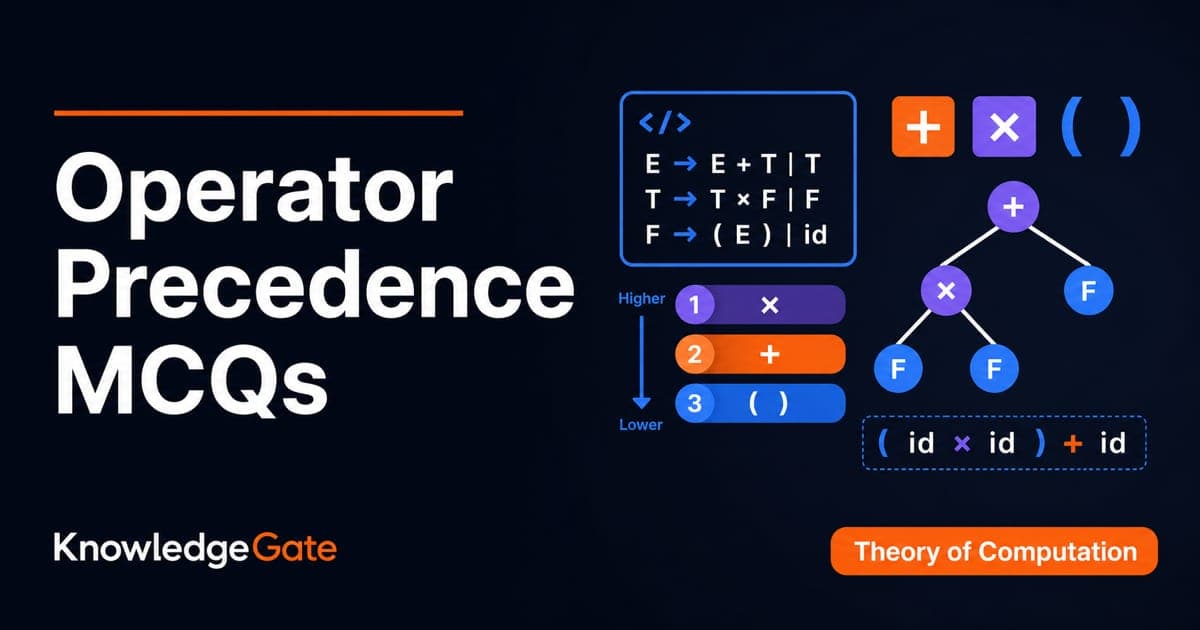
Operator Precedence questions switch without warning among grammar restrictions, precedence hierarchy, recursion direction, associativity, and expression-tree shape. Remembering only that higher precedence binds first still leaves you guessing when the grammar itself encodes the answer.
Start with the rule table, then attempt the 10 exam questions from GATE, ISRO, UPPSC Polytechnic Lecturer, Coal India and DSSSB. Choose an option first, and write the grouping or violated rule before reading each explanation. Continue with GATE CS Exam Preparation after the set if you want the wider syllabus route.
Operator precedence rules to apply before the MCQs
Idea | Rule |
|---|---|
Operator grammar | No epsilon production and no adjacent non-terminals on a right-hand side |
Precedence | An operator defined at a lower non-terminal level binds more tightly |
Associativity | Left recursion gives left grouping, while right recursion gives right grouping |
Expression tree | The lower-precedence operator sits nearer the root |
Use E -> E + T | T, T -> T * F | F, and F -> id to calibrate them. For id + id * id, * appears at the lower T level, so it binds first:
Find the tighter operation:
id * id.Substitute that unit into the expression:
id + (id * id).Both productions are left-recursive, so repetitions at either level group left.
Recursion direction is separate from precedence. P -> Q + P is right-recursive, so + becomes right-associative. If this parser's place inside bottom-up parsing is unclear, review Parsing in Compiler Design: Top-Down and Bottom-Up Explained.
Operator Precedence MCQs 1-2: associativity and expression trees
Question 1: infer associativity from recursive productions
GATE 2014, Computer Science, Set 2
Consider the grammar defined by the following production rules, with two operators * and +:
S -> T * P
T -> U | T * U
P -> Q + P | Q
Q -> Id
U -> Id

Which one of the following is TRUE?

A. + is left associative, while * is right associative
B. + is right associative, while * is left associative
C. Both + and * are right associative
D. Both + and * are left associative
Answer: B. Right-recursive P -> Q + P gives Id + (Id + Id). Left-recursive T -> T * U gives (Id * Id) * Id; S -> T * P changes neither rule.
Question 2: combine higher precedence with opposite associativity
GATE 2011, Computer Science
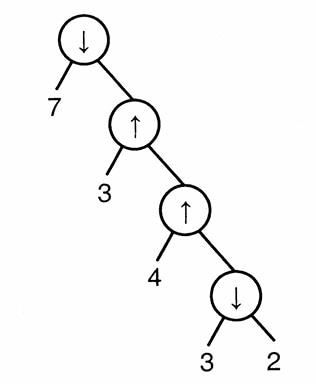
Consider two binary operators, ↑ and ↓. Operator ↓ has lower precedence than ↑. Operator ↑ is right-associative, while ↓ is left-associative. Which option represents the parse tree for this expression?

7 ↓ 3 ↑ 4 ↑ 3 ↓ 2
Option A
Option B
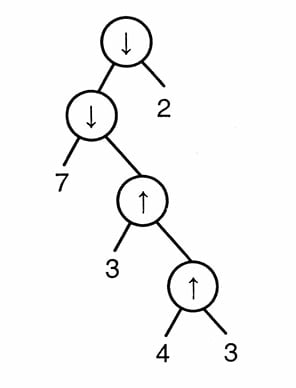
Option C
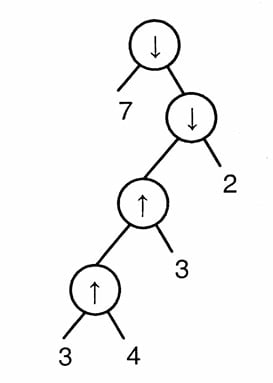
Option D
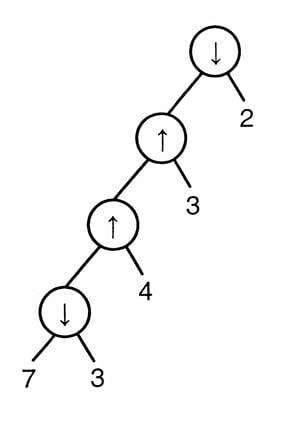
Answer: B. Higher precedence and right associativity give 3 ↑ (4 ↑ 3). Left-associative ↓ then gives ((7 ↓ (3 ↑ (4 ↑ 3))) ↓ 2), matching B: root ↓, right child 2, and the nested ↑ chain in its left subtree.
Operator Precedence MCQs 3-5: operator-grammar restrictions
Question 3: identify adjacent non-terminals and epsilon
GATE 2004, Computer Science
Which of the following grammar rules violate the requirements of an operator grammar ? P, Q, R are nonterminals, and r, s, t are terminals.
1.    P → Q R
2.    P → Q s R
3.    P → ε
4.    P → Q t R r

A. 1 only
B. 1 and 3 only
C. 2 and 3 only
D. 3 and 4 only
Answer: B. Production 1 has adjacent non-terminals Q R, and 3 derives epsilon. Terminals separate the non-terminals in 2 and 4; trailing r is valid.
Question 4: read precedence from grammar levels
GATE 2000, Computer Science
Given the following expression grammar:
E -> E * F | F + E | F
F -> F - F | id  which of the following is true?
A. * has higher precedence than +
B. - has higher precedence than *
C. + and - have the same precedence
D. + has higher precedence than *
Answer: B. - appears inside F, below the E level. Thus id * id - id groups as id * (id - id), proving that - has higher precedence than *; no full ranking is needed.
Question 5: apply both operator-grammar bans together
Indian Space Research Organization 2015, Computer Science
Which grammar rules violate the requirement of the operator grammar? A, B, C are variables and a, b, c are terminals
1) A → BC
2) A → CcBb
3) A → BaC
4) A → ε

A. 1 only
B. 1 and 2 only
C. 1 and 3 only
D. 1 and 4 only
Answer: D. Rule 1 has adjacent variables B C, and rule 4 derives epsilon. Terminals c and a separate the variables in 2 and 3, so only 1 and 4 fail.
Operator Precedence MCQs 6-7: hierarchy and grammar classification
Question 6: combine precedence, associativity, and ambiguity
Indian Space Research Organization 2020, Computer Science
Given the grammar:
S → T * S | T
T → U + T | U
U → a | b

Which of the following statements is wrong?

A. The grammar is not ambiguous
B. Priority of + over * is ensured
C. Right-to-left evaluation of * and + happens
D. None of these
Answer: D. Lower-level + makes a * b + a group uniquely as a * (b + a). Both productions are right-recursive, so repetitions group right; A, B, and C are true, leaving D.
Question 7: test four grammars against the definition
UPPSC Polytechnic Lecturer 2022, Computer Science
Which of the following grammars are operator grammar?
 Where E, F, T are non-terminals and +, -, i, d, ε are terminal symbols.
 G₁: E → E+T | T
   T → T*F | F
   F → i | d
 G₂: E → E+T | T
   T → T*F | F
   F → i | d | ε
 G₃: E → E+T | T
   T → T*F | F | ε
   F → i | d
 G₄: E → E+T | T
   T → F
   F → i | d | F * i | ε

A. G₁, G₂
B. G₁, G₃, G₅
C. G₁, G₃, G₄
D. None of these
Answer: D. Only G₁ has neither epsilon nor adjacent non-terminals. G₂, G₃ and G₄ each contain epsilon, so none qualifies. Option B mentions G₅ even though the question defines only four grammars, but that printing defect does not alter the result: no option lists only G₁.
Operator Precedence MCQs 8-10: repeated rules, parser claims, and a final tree
Question 8: recognise the same restriction pattern in a second exam
Coal India 2020, Computer Science
Which grammar rules violate the requirement of the operator grammar? A, B and C are variables; a, b and c are terminals.
i. A → BC
ii. A → CcBb
iii. A → BaC
iv. A → ε

A. i only
B. i and ii
C. i and iii
D. i and iv
Answer: D. This Coal India item repeats the production pattern in Question 5 with Roman labels. Rule i contains adjacent variables B C, while iv derives epsilon; terminals separate the variables in ii and iii. The labels change, but the two disqualifying structures do not.
Question 9: separate parser facts from an invalid top-down claim
Coal India 2017, Computer Science
Which of the following is/are FALSE?
I) An operator-precedence parser works on ambiguous grammar
II) A top-down parser works on left-recursive, unambiguous and deterministic grammar
III) LL(1) is a non-recursive descent parser
IV) CLR(1) is the most powerful parser

A. Only II
B. I, II, III and IV
C. II and IV
D. I, III and IV
Answer: A. Statement II is false because direct left recursion makes a top-down parser recurse without consuming input. Statement I refers to expression grammars whose ambiguity is resolved by precedence relations; a table-driven LL(1) parser is non-recursive, and CLR(1) is the most powerful of the standard LR variants. Therefore only II is false.
Question 10: build the expression tree after precedence grouping
DSSSB 2021, Computer Science, TGT Shift 3
Assume two binary operators ‘^’ and ‘v’. ‘^’ has higher precedence than ‘v’. Operator ‘^’ is right associative while operator ‘v’ is left associative. Which of the following represents the expression tree for the given expression? (9 v 3 ^ 4 v 2)Option A
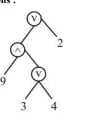
Option B
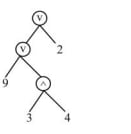
Option C
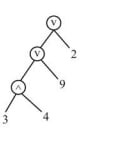
Option D
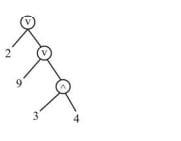
Answer: B. Higher precedence gives 9 v (3 ^ 4) v 2, then left associativity gives (9 v (3 ^ 4)) v 2. Option B has the matching root v, right child 2, and left subtree containing 9 and 3 ^ 4.
How exams test Operator Precedence and where errors happen
Demand | Questions | One-line method |
|---|---|---|
Grammar admissibility | 3, 5, 7, 8 | Reject epsilon and adjacent non-terminals |
Precedence or associativity from productions | 1, 4, 6 | Read level, then recursion direction |
Expression-tree construction | 2, 10 | Apply precedence, then associativity |
Parser-family statements | 9 | Check parser restrictions |
Check four common traps:
Distinguish terminals from non-terminals.
Read precedence from grammar levels, not production order.
Resolve higher precedence before associativity.
Put lower precedence at the tree root.
Next, connect this method to SLR vs CLR vs LALR Parsers for GATE: States and Conflicts.
Operator Precedence MCQs: the short version and next step
Recall five rules: reject epsilon and adjacent non-terminals; lower level means higher precedence; recursion sets associativity; lower precedence stays nearer the root.
Retry Questions 1, 2, 4, 6, 7, and 10 blind. Redraw both trees, then check B, B, B, D, D, B.
For structured learning, use GATE Guidance by Sanchit Sir. For timed practice, use the GATE Test Series. Solve blind, write the grouping or violated rule, then compare.
Keep learning
Phases of Compiler MCQs: 12 Solved Questions with Explanations
Solve 12 compiler-phase MCQs and learn why each answer is correct through a source-to-target trace, phase handoffs and a quick trap checklist.
3 Sep 20268 min read86 viewsCompiler Design MCQs
Normal Forms & BNF MCQs: 10 Solved Grammar Questions with Explanations
Solve ten exam-standard grammar questions on CNF, GNF, BNF notation, derivation counts, parse trees and conversion bounds, with every answer worked step by step.
Updated 1 Sep 20268 min readCompiler Design MCQs
LALR(1) Parser and State Merging MCQs: 12 Solved Questions
Solve 12 published LALR(1) MCQs with fresh explanations, from parser hierarchy and state counts to LR(1) core merging, conflicts and grammar classification.
Updated 30 Aug 20267 min readCompiler Design MCQs
Simplification of CFG MCQs: 12 Solved Questions with Explanations
Solve 12 published-bank CFG simplification MCQs with fresh explanations, elimination checklists, derivation checks, ambiguity reasoning, and a full mixed simplification.
Updated 27 Aug 20268 min readCompiler Design MCQs