OSI Model & Layers MCQs: 12 Solved Questions on PDUs and Encapsulation
Test OSI layers, PDUs, encapsulation and router traversal through solved MCQs, with explanations, a byte-by-byte frame trace and a layer-visit method.
KnowledgeGate Team
Exam prep & CS education
12 Oct 20267 min read
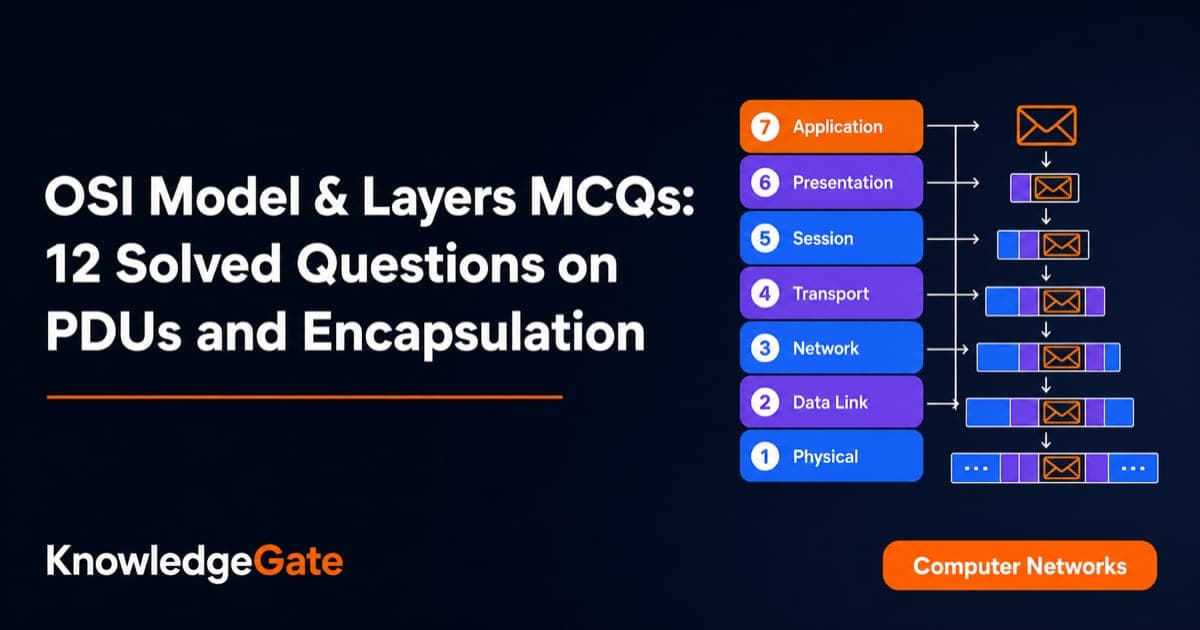
OSI questions look like memory tests, but close options usually swap one layer, one PDU name or one encapsulation direction. A mnemonic alone does not protect you against those swaps. Map the model's purpose, layer functions and PDU names first; then test the direction of encapsulation and count layer visits across routers. Select an option before reading its explanation.
Place OSI Model & Layers within the full syllabus through GATE CS Exam Preparation. After checking an explanation, reattempt that item from its linked question page.
OSI model layers, PDUs and one encapsulation trace
Layer | Core job | PDU |
|---|---|---|
7. Application | User-facing network services | Message or data |
6. Presentation | Translation, encryption and compression | Data |
5. Session | Dialogue, checkpoints and token management | Data |
4. Transport | Process-to-process delivery | TCP segment or UDP datagram |
3. Network | Logical addressing and routing | Packet or datagram |
2. Data Link | Framing, MAC access and link error detection | Frame |
1. Physical | Signals and bit timing | Bits |
Some PDU names vary by protocol, so the stated stack and wording control the answer.
Trace 1,000 bytes of application data. A 20-byte TCP header gives 1,000 + 20 = 1,020 bytes, the segment. A 20-byte IPv4 header gives 1,020 + 20 = 1,040 bytes, the packet. A 14-byte Ethernet II header and 4-byte FCS give 1,040 + 14 + 4 = 1,058 bytes, the frame.
Assume no TCP/IP options; exclude preamble and inter-frame gap. The 1,040-byte packet is below Ethernet's 1,500-byte payload limit, so IP fragmentation is unnecessary. The sender encapsulates by adding control information while data moves down. The receiver decapsulates by removing and interpreting it while data moves up. Use Computer Networks MCQs for practice.
OSI model MCQs 1-3: purpose, protocol stacks and TCP/IP comparison
Question 1: why the OSI model was created
Accenture 2023
What is the main reason the OSI model was created?
A. To create a layered model larger than the DoD model.
B. So application developers can change only one layer's protocols at a time.
C. So different networks could communicate.
D. So Cisco could use the model.
Correct answer: C. So different networks could communicate. Interoperability is decisive: the model gives unlike systems a common layered framework. Independent layer changes are a benefit, not the primary reason; size and vendor use are distractors.
Question 2: protocol stack
Accenture 2025
A list of protocols used by a system, one protocol per layer, is called ________
A. protocol architecture
B. protocol stack
C. protocol suite
D. protocol system
Correct answer: B. protocol stack. A stack is the vertical set of protocols operating at successive layers in one system. A suite is the broader family, while "one protocol per layer" identifies a stack.
Question 3: layers explicit in OSI
Accenture 2025
Which of the following layers is an addition to OSI model when compared with TCP IP model?
A. Application layer
B. Presentation layer
C. Session layer
D. Session and Presentation layer
Correct answer: D. Session and Presentation layer. OSI gives Session and Presentation separate layers. TCP/IP normally places those responsibilities in Application, so option D names both explicit additions.
OSI model MCQs 4-6: layer functions and the upper-layer boundary
Question 4: an incorrect layer-function pair
GATE 2014
In the following pairs of OSI protocol layer/sub-layer and its functionality, the INCORRECT pair is
A. Network layer and Routing
B. Data Link Layer and Bit synchronization
C. Transport layer and End-to-end process communication
D. Medium Access Control sub-layer and Channel sharing
Correct answer: B. Data Link Layer and Bit synchronization. Bit synchronization concerns bit-stream timing, so it belongs to Physical. Data Link handles frames; the other functions correctly map to Network, Transport and MAC.
Question 5: matching four layer functions
UGC NET 2021
Match List I with List II
List I List II
A. Data Link Layer I. True end‐to‐end layer
B. Network Layer II. Token Management
C. Transport Layer III. Produce billing information
D. Session Layer IV. Piggybacking
Choose the correct answer from the options given below:
A. A ‐ IV, B ‐ III, C ‐ I, D ‐ II
B. A ‐ IV, B ‐ II, C ‐ I, D ‐ III
C. A ‐ II, B ‐ III, C ‐ I, D ‐ IV
D. A ‐ IV, B ‐ I, C ‐ III, D ‐ II
Correct answer: A. A ‐ IV, B ‐ III, C ‐ I, D ‐ II. Start with the distinctive pairs: Transport is true end-to-end, Session manages tokens, and Data Link uses piggybacking. Network then maps to billing information, giving option A.
For focused upper-layer practice, continue with Application Layer MCQs: 12 Solved DNS, HTTP, Email.
Question 6: the conceptual SSL layer
ISRO 2011
In which layer of network architecture, the secured socket layer (SSL) is used?
A. physical layer
B. session layer
C. application layer
D. presentation layer
Correct answer: D. presentation layer. In this exam's conceptual mapping, encryption, decryption and representation belong to Presentation. Session manages dialogue; Application provides services to user processes.
OSI model MCQs 7-9: PDU names and encapsulation direction
Question 7: application-layer PDU
GATE 2012 and 2025
The protocol data unit (PDU) for the application layer in the Internet stack is
A. Segment
B. Datagram
C. Message
D. Frame
Correct answer: C. Message. Application programs exchange messages. Segment is Transport, datagram appears in UDP or IP contexts, and frame is Link.
Question 8: frame versus segment
UGC NET 2019
Which of the following statements is/are true with regard to various layers in the Internet stack?
P: At the link layer, a packet of transmitted information is called a frame.
Q: At the network layer, a packet of transmitted information is called a segment.
A. P only
B. Q only
C. P and Q
D. Neither P nor Q
Correct answer: A. P only. P is true because Link uses frames. Q is false because segment is a Transport term; Network normally uses packet or IP datagram.
Question 9: moving down the stack
Accenture 2023
In the layer hierarchy as the data packet moves from the upper to the lower layers, headers are ___________
A. Added
B. Removed
C. Rearranged
D. Modified
Correct answer: A. Added. Moving down the sender's stack is encapsulation, so layers add headers. At the receiver, decapsulation removes them, reversing the 1,000 -> 1,020 -> 1,040 -> 1,058-byte trace.
OSI model MCQs 10-12: host-to-host layers and router traversal
Question 10: host-to-host layers
ISRO 2015
In the OSI reference model, which layers are considered host-to-host / end-to-end layers?
A. Transport, session, presentation, application
B. Session, presentation, application
C. Datalink, transport, presentation, application
D. Physical, datalink, network, transport
Correct answer: A. Transport, session, presentation, application. Under this question's classification, Layers 4 through 7 provide host/application end-to-end services. The lower three move bits, frames and packets across links and networks.
Question 11: layer visits across one router
ISRO 2017
Assume that Source S and Destination D are connected through an intermediate router R. How many times a packet has to visit the network layer and data link layer during a transmission from S to D?
A. Network layer – 4 times, Data link layer – 4 times
B. Network layer – 4 times, Data link layer – 6 times
C. Network layer – 2 times, Data link layer – 4 times
D. Network layer – 3 times, Data link layer – 4 times
Correct answer: D. Network layer – 3 times, Data link layer – 4 times. Network is visited at S, R and D: 1 + 1 + 1 = 3. Two links each have a Data Link sender and receiver: 2 x 2 = 4.
Question 12: what Transport must add
GATE 2003
Which of the following functionalities must be implemented by a transport protocol over and above the network protocol ?
A. Recovery from packet losses
B. Detection of duplicate packets
C. Packet delivery in the correct order
D. End to end connectivity
Correct answer: D. End to end connectivity. The word "must" removes A, B and C because UDP need not recover loss, suppress duplicates or restore order. Transport must still provide logical end-to-end, process-level delivery above Network routing.
Next, use TCP and UDP MCQs: 12 Solved Transport Layer Questions to test the reliability distinction.
OSI model traps these questions are testing
Trap | Correction |
|---|---|
Bit synchronization -> Data Link | Bit synchronization belongs to Physical. |
Segment -> Network | A segment belongs to Transport; Network uses a packet or datagram. |
Token management -> Transport | Token management belongs to Session. |
Headers added while moving down -> decapsulation | Adding headers while moving down is encapsulation. |
For h links and ordinary routers between two hosts, Data Link is visited 2h times because every link has a sender and receiver. Network is visited at every endpoint and router. In the S-R-D path, h = 2, so Data Link has 2 x 2 = 4 visits, while Network has 3.
Direct layer-function recall requires one action-to-layer map. For terminology swaps, correct the swapped term before choosing an option. For multi-device reasoning, count endpoints, routers and links instead of relying on a mnemonic.
OSI model MCQs: the short version and next step
Learn each layer as a three-part unit: its scope, core job and PDU. Then practise the direction of encapsulation and count the devices or links in the path. If you miss 3 or more of these 12 questions, rebuild the seven-row table and reattempt the set without notes. If you score 10 or more, move straight to the linked Application and Transport collections instead of repeating definitions.
For readers who want Computer Networks sequenced inside a complete GATE CS plan, GATE Guidance by Sanchit Sir is the structured next step.
Keep learning
Repeater, Hub, Bridge & Switch MCQs: 12 Solved Questions with Explanations
Solve 12 exam questions on device layers, MAC forwarding, VLANs, collision and broadcast domains, port mirroring, bridges and crosspoint counting.
Updated 20 Oct 20267 min readComputer Networks MCQs
Ethernet IEEE 802.3 MCQs: 12 Solved Questions with Explanations
Solve 12 Ethernet questions on IEEE 802.3, speed generations, hubs, MAC addresses, multicast, CSMA/CD and the first binary backoff race.
Updated 16 Oct 20267 min readComputer Networks MCQs
Mobile Computing MCQs: Solved Questions on Concepts, Features and Applications
Work through 10 solved questions covering portability, cellular standards, Bluetooth, CDMA, Android, mobile cloud, and device constraints. Each answer has a concise explanation.
7 Oct 20267 min readComputer Networks MCQs
Computer Networks Basics & Criteria MCQs: 12 Solved Questions with Explanations
Solve 12 Computer Networks questions, then use clear explanations and worked criteria checks to separate similar terms confidently.
3 Oct 20268 min readComputer Networks MCQs