Repeater, Hub, Bridge & Switch MCQs: 12 Solved Questions with Explanations
Solve 12 exam questions on device layers, MAC forwarding, VLANs, collision and broadcast domains, port mirroring, bridges and crosspoint counting.
KnowledgeGate Team
Exam prep & CS education
Updated 20 Oct 20267 min read
Repeaters, hubs, bridges and Layer 2 switches are easy to memorise as a device-to-layer list, but that shortcut breaks when an MCQ combines it with MAC forwarding, collision domains, broadcast domains, VLANs or switch-count calculations. For connectors, routers, gateways, modems and servers, use Miscellaneous Topics MCQs for Computer Networks. Repeaters, hubs, bridges and Layer 2 switches instead demand device-layer, MAC-forwarding, VLAN, domain-count and crosspoint distinctions. Use the Computer Networks MCQs collection for the wider topic, and try each question here before opening its solution link. These device questions require direct recall, elimination and numerical reasoning.
Repeater and LAN-device MCQs: endpoints, Layer 1 and signal reach
A repeater works at OSI Layer 1. It regenerates a weakened signal but does not inspect addresses, filter frames, or reduce propagation time.
Question 1: Accenture 2024
Which of this is not a network edge device?
(a) PC
(b) Smartphones
(c) Servers
(d) Switch
Answer: (d) Switch. PCs, smartphones and servers are edge end systems. A switch is an intermediary LAN device that connects them and forwards traffic.
Question 2: IBPS 2023
A repeater works at which of the following layers in the OSI model?
(a) Physical Layer
(b) Data Link Layer
(c) Network Layer
(d) Transport Layer
(e) Application Layer
Answer: (a) Physical Layer. A repeater handles the signal representation of bits, not frames or packets. Bridges and Layer 2 switches instead use data-link information such as MAC addresses.
Question 3: RSSB 2023
In a Data Entry Office, the computer centers are on 1st and 4th floor. Both the centres are connected through LAN. However the signals take long time to travel. Which amongst the following hardware can improve the data transmission?
(a) Modem
(b) Repeater
(c) Router
(d) Computer
Answer: (b) Repeater. Within these options, it regenerates a signal weakened or distorted by distance. It does not increase propagation speed; a modem changes link signalling, while a router forwards packets between networks.
Solution.
Hub and switch MCQs: flooding versus selective forwarding
In a four-host LAN, a hub repeats an incoming signal through the other ports without a MAC table. A Layer 2 switch learns source MAC addresses and sends a known unicast through the selected destination port.
Question 4: TPSC Assistant Programmer 2025
Which of the following is the function of a switch in a network?
(a) It amplifies signals to prevent attenuation
(b) It connects different types of networks
(c) It forwards data packets based on MAC addresses
(d) It translates IP addresses to MAC addresses
Answer: (c) It forwards data packets based on MAC addresses. A Layer 2 switch reads an Ethernet frame's destination MAC address and uses its learned table to choose a port. A repeater handles attenuation, a router connects networks, and ARP resolves IP addresses to MAC addresses.
Question 5: TPSC 2026
What is the primary difference between a Hub and a Switch in a local area network?
(a) Hubs operate at Network layer, while Switches operate at Physical layer
(b) Hubs broadcast data to all ports while Switches send only to the destination port
(c) Hubs provide built-in firewall security, while Switches do not
(d) A Switch is used for wireless networks, whereas a Hub is only for wired
Answer: (b). A hub copies traffic across its shared segment, while a switch selects a port for a known unicast using its MAC table. It still floods broadcasts and unknown unicasts within the VLAN, so the option does not describe every frame.
Question 6: RSSB 2023
________ is a networking device that extracts the destination address from the data packet and searches for the destination to send the packet. It sends the signals to only selected device.
(a) Wires
(b) Server
(c) Switch
(d) Hub
Answer: (c) Switch. A LAN switch examines the frame's destination MAC address and consults its forwarding table. A hub has no destination lookup or selective forwarding logic.
Solution.
Layer 2 switch MCQs: VLANs and port mirroring
A VLAN creates a separate Layer 2 broadcast domain. Port mirroring instead copies selected traffic to a monitoring port.
Question 7: IBPS 2023
Which feature of an L2 switch allows network administrators to segment a network into multiple broadcast domains, each behaving like a separate network?
(a) Spanning Tree Protocol (STP)
(b) Port Mirroring
(c) VLAN (Virtual Local Area Network)
(d) Link Aggregation
(e) QoS (Quality of Service)
Answer: (c) VLAN (Virtual Local Area Network). Each VLAN is a distinct Layer 2 broadcast domain, even on one physical switch. STP prevents loops, link aggregation combines links, QoS prioritises traffic, and port mirroring supports observation.
Question 8: IBPS 2024
Which networking device commonly supports traffic monitoring features such as port mirroring, enabling packet analyzers operating in promiscuous mode to inspect network traffic?
(a) Repeater
(b) Hub
(c) Switch
(d) Bridge
(e) Router
Answer: (c) Switch. A managed switch can copy ingress, egress, or both directions of selected port or VLAN traffic to a monitor port. This exposes traffic ordinary switching would withhold; promiscuous mode alone does not expose all switched traffic.
Switch counting MCQs: 12-port domains and 10-line crosspoints
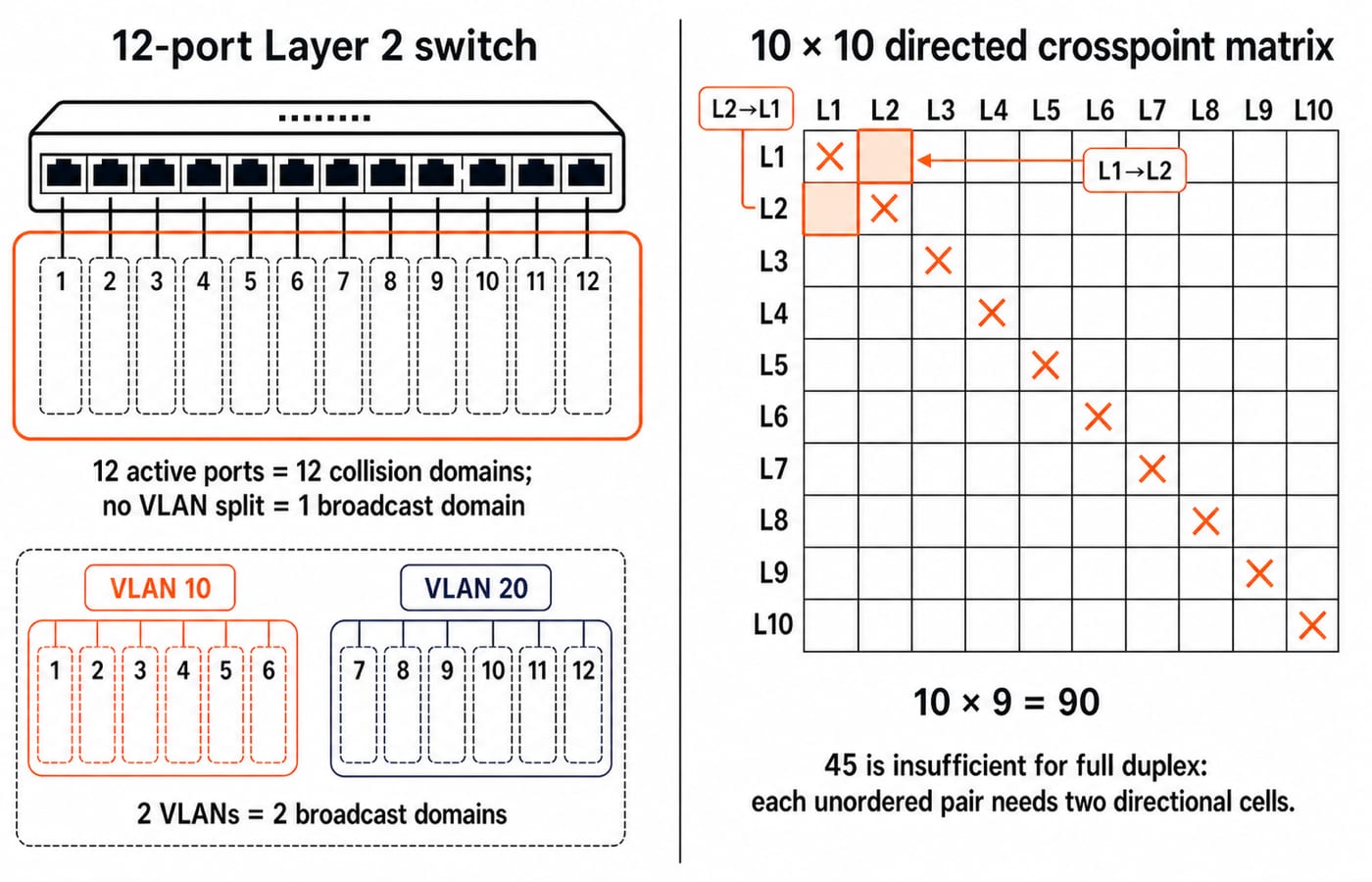
A Layer 2 switch creates one collision domain per active port but stays in one broadcast domain unless VLANs or a Layer 3 boundary split it. A full-duplex crosspoint fabric needs one directed crosspoint per ordered source-destination pair, excluding self-connections. Ethernet media, spanning tree, access control and frame calculations sit in Ethernet Cross-Concept MCQs. Device-port, collision-domain, broadcast-domain and directed-crosspoint calculations use the rules above.
Question 9: Accenture 2025
How many broadcast domains are created when you segment a network with a 12-port switch?
(a) 1
(b) 2
(c) 5
(d) 12
Answer: (a) 1. Twelve ports do not create 12 broadcast domains: in the default VLAN without a router, the count is 1. With all 12 ports active on point-to-point links, the collision-domain count is 12.
Question 10: UPPSC Polytechnic Lecturer 2018
The number of crosspoints needed for 10 lines in a crosspoint switch, which is full duplex in nature and there is no self-connection, is ____
(a) 100
(b) 45
(c) 50
(d) 90
Answer: (d) 90. Each line reaches 9 others, so the directed count is 10 x (10 - 1) = 10 x 9 = 90. The value 10 x 9 / 2 = 45 counts unordered pairs, not both directions.
Topic question hub. Use the hub for related crosspoint-switch practice; this question's direct page is unavailable.
Bridge MCQs: MAC addresses, LAN segments and domain traps
A bridge is a small Layer 2 forwarding device and the switch's conceptual ancestor. It learns source MAC addresses, forwards or filters by destination MAC, separates collision domains, and preserves the broadcast domain.
Question 11: GATE 2005
Which of the following statements is FALSE regarding a bridge?
(a) Bridge is a layer 2 device
(b) Bridge reduces collision domain
(c) Bridge is used to connect two or more LAN segments
(d) Bridge reduces broadcast domain
Answer: (d) Bridge reduces broadcast domain. A bridge is Layer 2, connects LAN segments, and separates their collision domains. It forwards broadcasts, so a router or VLAN boundary is needed for separate broadcast domains.
Question 12: UGC NET 2014
A bridge has access to _______ address in the same network.
(a) Physical
(b) Network
(c) Datalink
(d) Application
Answer: (a) Physical. Here, physical address means the frame's MAC address, which a bridge learns for forwarding. A network address is Layer 3; Datalink and Application name layers, not address types.
Repeater, hub, bridge and switch comparison for MCQ elimination
Check the forwarding input first, then the domain effect. This separates Layer 1 signal questions from Layer 2 forwarding questions.
Device | Usual OSI layer | Forwarding input | Treatment of traffic | Collision-domain effect | Broadcast-domain effect |
|---|---|---|---|---|---|
Repeater | Layer 1 | No address lookup | Regenerates every bit | Preserves the collision domain | Preserves the broadcast domain |
Hub | Layer 1 | No address lookup | Repeats to the other ports | One shared collision domain | One broadcast domain |
Bridge | Layer 2 | Learned MAC table | Filters or forwards between segments | One collision domain per segment | One broadcast domain |
Layer 2 switch | Layer 2 | Learned MAC or CAM table | Sends a known unicast to one selected port | One collision domain per active port | One broadcast domain per VLAN |
The relevant distinction is between ordinary Layer 2 switching and Layer 3 routing. Use the GATE CS Exam Preparation category for the wider Computer Networks syllabus.
Repeater, hub, bridge and switch MCQs: the short version and next step
Answers in order: 1 Switch is not an edge device; 2 Physical Layer; 3 Repeater; 4 MAC-based forwarding; 5 a hub floods while a switch selects known unicast; 6 Switch; 7 VLAN; 8 Switch; 9 one broadcast domain; 10 90 directed crosspoints; 11 "Bridge reduces broadcast domain" is false; 12 Physical address.
Device layers, address-based forwarding, monitoring, domain counts and crosspoint counting all matter when distinguishing these devices. Redraw the diagram, then retry Questions 5, 9, 10 and 11.
For a structured route through Computer Networks, use GATE Guidance by Sanchit Sir. Otherwise, revise the comparison table and repeat the four trap questions.
Keep learning
Ethernet IEEE 802.3 MCQs: 12 Solved Questions with Explanations
Solve 12 Ethernet questions on IEEE 802.3, speed generations, hubs, MAC addresses, multicast, CSMA/CD and the first binary backoff race.
Updated 16 Oct 20267 min readComputer Networks MCQs
OSI Model & Layers MCQs: 12 Solved Questions on PDUs and Encapsulation
Test OSI layers, PDUs, encapsulation and router traversal through solved MCQs, with explanations, a byte-by-byte frame trace and a layer-visit method.
12 Oct 20267 min readComputer Networks MCQs

Mobile Computing MCQs: Solved Questions on Concepts, Features and Applications
Work through 10 solved questions covering portability, cellular standards, Bluetooth, CDMA, Android, mobile cloud, and device constraints. Each answer has a concise explanation.
7 Oct 20267 min readComputer Networks MCQs
Computer Networks Basics & Criteria MCQs: 12 Solved Questions with Explanations
Solve 12 Computer Networks questions, then use clear explanations and worked criteria checks to separate similar terms confidently.
3 Oct 20268 min readComputer Networks MCQs