Routing Basics and Flooding MCQs: 12 Solved Questions with Explanations
Solve 12 routing and flooding questions with clear explanations, a shortest-path warm-up, protocol classification and a quick checking routine.
KnowledgeGate Team
Exam prep & CS education
Updated 26 Oct 20267 min read
Routing MCQs mix device and forwarding vocabulary with routing-table logic, static versus dynamic decisions, flooding, protocol families and hop-by-hop layer counts. A memorised one-line definition is not enough when two options differ by one layer, one hop or one protocol class.
For the two MSQs, test every choice independently. Seven questions link directly to their bank page; the remaining five use the Routing Basics and Flooding question hub because no reliable per-question route is available. Start with the shortest-path and flooding trace, then solve the set without looking at the answers.
1. Routing and flooding: the five rules to keep beside you
A router uses the destination IP address to find a route.
The entry gives a next hop or interface, not every host's physical location.
A metric compares routes. Lower wins when it represents cost.
With no route, including a default, the router drops the packet and may report it unreachable.
Flooding sends a new packet on every line except the arrival line. Hop limits and duplicate caches control copies.
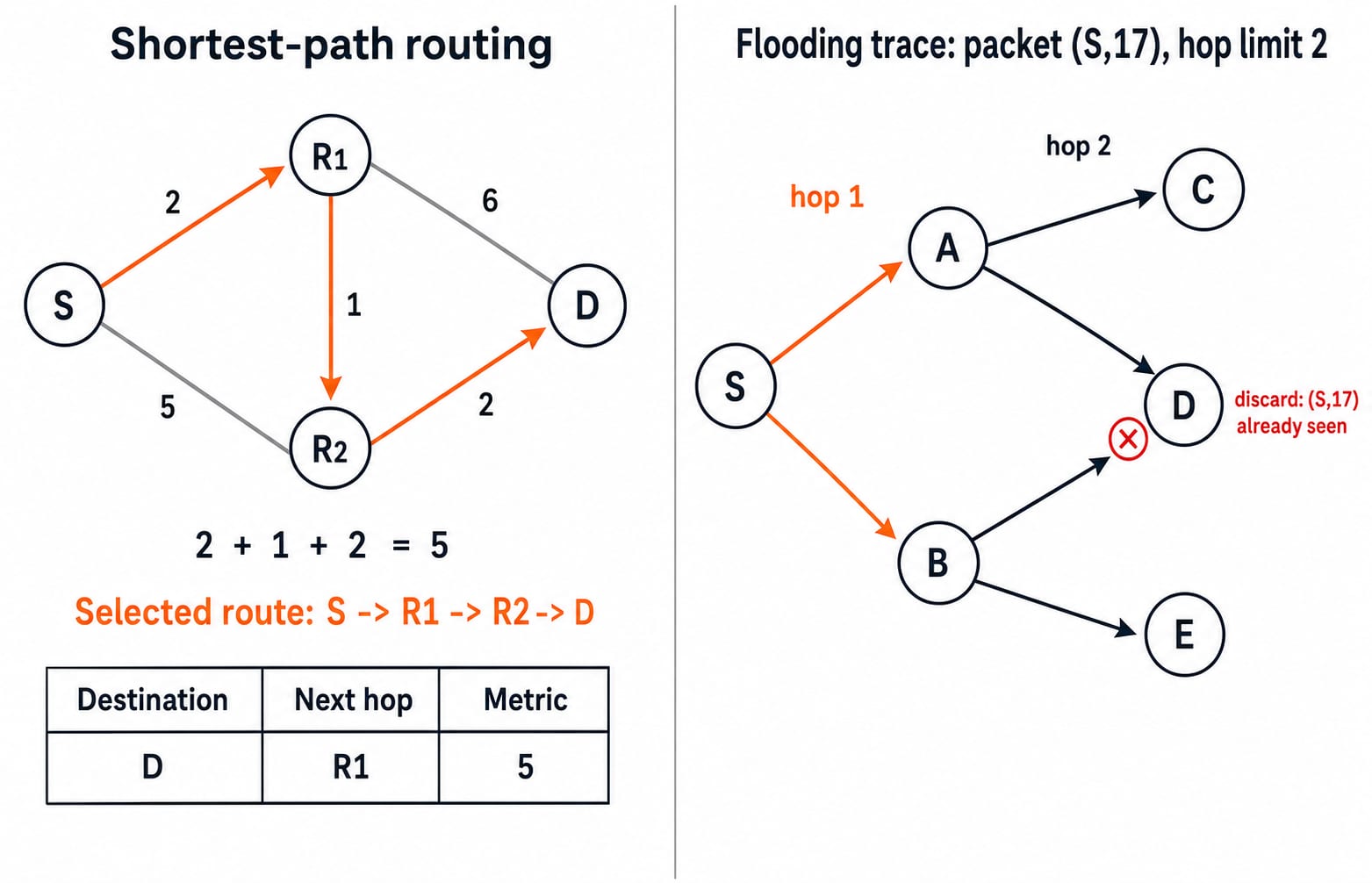
Consider undirected links S-R1 = 2, S-R2 = 5, R1-R2 = 1, R1-D = 6 and R2-D = 2.
S-R2-D = 5 + 2 = 7S-R1-D = 2 + 6 = 8S-R1-R2-D = 2 + 1 + 2 = 5S-R2-R1-D = 5 + 1 + 6 = 12
The least-cost route is S-R1-R2-D. At S, destination D has next hop R1 and metric 5.
For packet (S,17) with hop limit 2, S sends to A and B. Then A forwards to C,D, while B forwards to D,E. D caches (S,17) and discards the second copy.
2. Router, destination address and routing-table purpose
These questions test a router's forwarding role, destination IP and routing-table purpose. Router and Gateway MCQs owns device boundaries, OSI-layer distinctions and IOS commands; this set stays with route selection and mixed routing concepts.
Question 1
Bihar STET 2019, Computer Science
______ is a device that forwards packets between networks by processing the routing information included in the packet.
A. Bridge
B. Firewall
C. Router
D. All of these
E. None of these
Correct answer: C. Router.
A router reads routing information and selects a next hop. A bridge connects layer-2 segments, while a firewall applies policy. “All of these” is wrong.
Question 2
ISRO 2007 and BEL 2007, Computer Science
When a host on network A sends a message to a host on network B, which address does the router look at?
A. Port
B. IP
C. Physical
D. Subnet mask
Correct answer: B. IP.
The router uses the destination IP. A port identifies an application endpoint, while a physical address serves the local link. A subnet mask interprets a prefix, but is not the destination. See the solved question.
Question 3
UP Police 2013, Computer Science, Paper 2 - Subject Oriented (Shift I)
What is the purpose of a routing table?
A. To store every address of every node
B. To know the exact location of destination address
C. To flood network
D. To find most efficient route to the destination
Correct answer: D. To find most efficient route to the destination.
A routing table stores prefixes, next hops, interfaces and metrics. In the warm-up, 5 beats 7 and 8. It neither stores every node's address nor floods.
3. Edge networks, missing routes and hop-by-hop layer counts
Question 4
Accenture 2024
What is a stub network?
A. A network with more than one exit point.
B. A network with more than one exit and entry point.
C. A network with only one entry and no exit point.
D. A network that has only one entry and exit point.
Correct answer: D. A network that has only one entry and exit point.
A stub network has one boundary path. Traffic enters and leaves there. Multiple exits imply a transit-capable or multihomed case. See the stub-network solution.
Question 5
MPPSC 2025, Computer Science
What happens if a router can’t find a route for a packet?
A. Router sends it to a default gateway
B. Router drops it and sends unreachable message
C. Router broadcasts it to all networks
D. Router saves it for later
Correct answer: B. Router drops it and sends unreachable message.
“Can’t find a route” means neither a specific nor default route matches. The router drops the packet and may report it unreachable. A default would itself be a match. Broadcasting or indefinite storage is not the fallback.
Question 6
Coal India 2017, Computer Science
Assume that source S and destination D are connected through five intermediate routers R1, R2, R3, R4 and R5. Determine how many times each packet has to visit the Network layer and the Data Link layer during transmission from S to D?
A. Network Layer: 7 times, Data Link Layer: 12 times
B. Network Layer: 5 times, Data Link Layer: 12 times
C. Network Layer: 12 times, Data Link Layer: 12 times
D. Network Layer: 7 times, Data Link Layer: 7 times
Correct answer: A. Network Layer: 7 times, Data Link Layer: 12 times.
Write S-R1-R2-R3-R4-R5-D. Its 2 endpoints + 5 routers = 7 network-layer visits. Seven nodes create 7 - 1 = 6 links. Data-link handling occurs at both ends of each link, so 2 x 6 = 12 visits. Check the layer-count solution.
4. Static, non-adaptive and dynamic routing decisions
Static routing is a common non-adaptive case: an administrator configures the route, and it stays until changed. These questions stop at static-versus-dynamic classification. DVR, RIP and Split Horizon MCQs owns neighbour-vector updates, hop-count metrics, count-to-infinity and split horizon.
Question 7
DSSSB 2021, Computer Science
Routing algorithms which do not base their routing decisions on measurements or estimates of the current traffic and topology belong to which category?
A. Adaptive algorithm
B. Greedy algorithm
C. Back propagation algorithm
D. Non-adaptive algorithm
Correct answer: D. Non-adaptive algorithm.
Non-adaptive routing uses predetermined decisions, not current measurements. Adaptive routing reacts to change. Greedy and back propagation are unrelated. See the classification solution.
Question 8
ISRO 2016, Computer Science
Dynamic routing protocol enable routers to
A. Dynamically discover and maintain routes
B. Distribute routing updates to other routers
C. Reach agreement with other routers about the network topology
D. All of the above
Correct answer: D. All of the above.
Dynamic protocols discover routes, exchange updates and converge after changes. A, B and C describe that process broadly, so D is correct. Open the dynamic-routing solution. In a distance-vector protocol, convergence means agreement on usable routes, not that every router stores a full topology map.
5. Flooding: recognise the forwarding rule and control duplicate copies
Question 9
DSSSB 2021, Computer Science
Sending incoming packet to every outgoing line except the one it arrived is known as _____.
A. Congestion
B. Scratching
C. Flooding
D. Message calling
Correct answer: C. Flooding.
Flooding copies a packet onto every line except its arrival line. S makes two copies; A and B make four transmissions. D rejects repeated (S,17). Hop limits and caches bound duplication. Try the flooding solution.
6. RIP, OSPF, BGP, IGMP and IP classification
Question 9 tests generic flooding as a forwarding rule; the following items classify routing protocols. LSR and OSPF Comparison MCQs owns link-state advertisements, Dijkstra, the link-state database and the full RIP-versus-OSPF comparison.
Question 10
Which of the following are true about routing protocol?
A. RIP is an intra domain protocol
B. BGP is an inter domain protocol
C. OSPF based on distance vector routing protocol
D. RIP based on distance vector routing protocol
Correct answers: A, B and D.
Test each MSQ line. RIP is intra-domain and distance-vector, so A and D are true. BGP is inter-domain, so B is true. OSPF is link-state, making C false.
Question 11
Which of the following are protocols of Network Layer?
A. RIP
B. BGP
C. OSPF
D. IP
Correct answers: A, B, C and D.
In the syllabus's functional classification, all four support Layer 3 routing or reachability. On the wire, RIP uses UDP and BGP uses TCP, while OSPF is carried directly in IP; the question asks about network-layer function, not transport encapsulation.
Question 12
ISRO 2017, Computer Science, May
Match with the suitable one:
List-I                                      List-II
(A) Multicast group membership              1. Distance vector routing
(B) Interior gateway protocol               2. IGMP
(C) Exterior gateway protocol               3. OSPF
(D) RIP                                     4. BGP
A. A-2, B-3, C-4, D-1
B. A-2, B-4, C-3, D-1
C. A-3, B-4, C-1, D-2
D. A-3, B-1, C-4, D-2
Correct answer: A. A-2, B-3, C-4, D-1.
Match before choosing: multicast membership uses IGMP (A-2); OSPF is an interior gateway protocol (B-3); BGP is an exterior gateway protocol (C-4); RIP uses distance-vector routing (D-1). This selects A. Review the matching solution.
7. A 90-second checking routine and the next practice step
Use five passes:
Spend
15 secondsidentifying MCQ versus MSQ.Spend
15 secondsunderlining the decision object: address, route, layer or protocol.Spend
20 secondsdrawing the path or table.Spend
20 secondseliminating options from the wrong layer or algorithm family.Spend
20 secondsrecomputing counts and confirming every MSQ choice.
For Question 6, write seven nodes and six links first. That gives 7 network-layer visits and 2 x 6 = 12 data-link visits.
The short version: routers forward by destination IP and a table choice. Non-adaptive routes ignore live measurements, dynamic protocols exchange reachability, and flooding needs controls. Classify every acronym independently.
Retry the mixed set from the start. For a structured next step, use GATE Guidance by Sanchit Sir to place routing beside the rest of your GATE CS preparation.
Keep learning
Authentication and Digital Signature MCQs: 12 Solved Hash and Signing Questions
Work through 12 solved exam questions that connect challenge-response, integrity, hash lengths, X.509 certificates and the exact key order for signing and confidentiality.
Updated 25 Oct 20267 min readComputer Networks MCQs
UDP Protocol and Header MCQs: 12 Solved Questions with Explanations
Solve 12 UDP questions, then check the reasoning behind connectionless service, application choices, the 8-byte header, and packet-length calculations.
24 Oct 20267 min readComputer Networks MCQs
Repeater, Hub, Bridge & Switch MCQs: 12 Solved Questions with Explanations
Solve 12 exam questions on device layers, MAC forwarding, VLANs, collision and broadcast domains, port mirroring, bridges and crosspoint counting.
Updated 20 Oct 20267 min readComputer Networks MCQs
Ethernet IEEE 802.3 MCQs: 12 Solved Questions with Explanations
Solve 12 Ethernet questions on IEEE 802.3, speed generations, hubs, MAC addresses, multicast, CSMA/CD and the first binary backoff race.
Updated 16 Oct 20267 min readComputer Networks MCQs