SBI PO Interview Biodata Form: Build Defensible Answers From Every Entry
Learn how to unpack education, gaps, hometown, projects, achievements, and hobbies into concise answers that remain truthful under follow-up questions.
KnowledgeGate Team
Exam prep & CS education
Updated 30 Aug 20265 min read
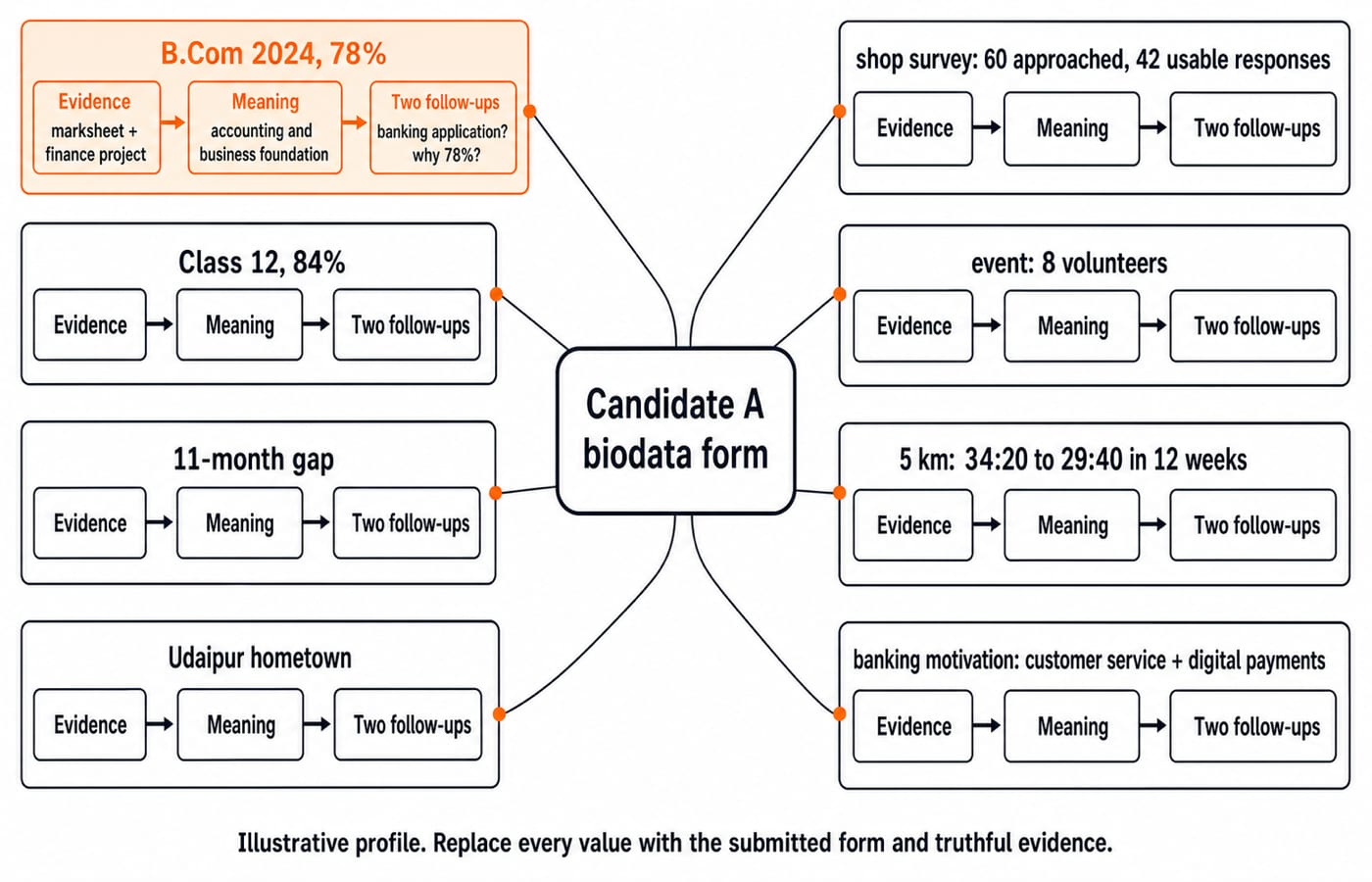
A degree, gap, hometown, project, achievement, or hobby may look like one short biodata entry. To a panel, it can open several follow-up questions. A polished first answer is not enough if its evidence fails at the second question. Turn your submitted form into truthful, concise, defensible answers. Candidate A models the rehearsal method; replace every sample value with evidence from your submitted form.
Start with the submitted SBI PO biodata, not a generic question list
Use the current SBI advertisement, call letter, and candidate instructions on the SBI careers current-openings page for exact form, documents, stages, marks, timings, and rules. Panels vary.
Ask: Can I explain each entry in 30 to 60 seconds, give a truthful example, handle two follow-ups, and supply relevant documents? Weak means unpacked. The SBI PO syllabus and exam-pattern guide gives stage context; SBI PO Exam Preparation lists KnowledgeGate courses. Cycle details come from SBI.
Turn each biodata entry into an Evidence, Meaning, Follow-up card
Build this six-column sheet:
form entry | exact fact | evidence | what it shows | likely follow-up 1 | likely follow-up 2 |
|---|---|---|---|---|---|
Education | B.Com 2024, 78% | Marksheet, finance project | Accounting, business base | Which B.Com subject can you apply to a bank branch decision? | Why did you score 78% rather than a higher figure? |
Class 12 | 84% | Marksheet | Record | Strongest subject? | College change? |
Gap | 11 months | Reviews, mock log | Structure | Why disrupted? | What changed? |
Hometown | Udaipur | Experience | Awareness | Observed issue? | Its limit? |
Project | 60 shops, 42 usable | Questionnaire, sheet | Research | Your part? | Sample limit? |
Achievement | 8 volunteers | Event records | Coordination | Your decision? | Trade-off? |
Hobby | 12-week 5 km routine | Running log | Consistency | Week 7? | Progress measure? |
Motivation | Service, digital payments | Shop log | Interest | Why officer? | Why banking? |
Candidate A could say: "My 78% shows a foundation, not mastery. My finance project shows applied learning. Timed application was weaker, so I changed my practice."
Defend education choices, marks, and an 11-month gap
Use 60 seconds: 10 for fact, 20 for honest context, 20 for action, and 10 for relevance. Never invent or contradict the form.
Candidate A planned 4 focused hours daily, 5 days weekly, for 40 weeks: 4 x 5 x 40 = 800 planned hours, not perfect attendance. Thirty-two weekly review sheets show 8 disrupted weeks. Across 12 full mocks, scores moved from 61 in Mock 1 to 74 in Mock 12, without predicting SBI performance. Candidate A cut repeated theory from 12 to 6 weekly hours, shifting 6 to timed sets and review.
Candidate A can defend the education choice directly: "I chose B.Com for structured training in accounting and business. My finance project then made me apply that base to real records. Banking combines that financial foundation with customer service and responsible execution." For the gap, name its real cause, show what changed between 61 and 74, and state what you would do differently. Records must support every detail.
Make hometown and banking motivation evidence-led
A hometown answer needs one observation, its limit, and one banking implication. Never invent local population, literacy, branch-density, inclusion, agriculture, or payment statistics.
In 30 days at one family shop, Candidate A logged 480 payments: 312 / 480 = 65% digital and 168 / 480 = 35% cash. Of 27 help requests, 18 involved failed or pending transactions and 9 involved initiating payment. Only that shop and month support the insight that adoption and support needs can coexist, not all Udaipur.
In 50 seconds, spend 15 on the problem, 20 on service, judgement, and responsible execution, and 15 on preparation. Avoid prestige, security, or copied slogans. SBI PO vs IBPS PO can clarify role differences. SBI's current notice remains the authority for recruitment rules.
Convert projects, work, and achievements into result plus limitation
Use situation, objective, personal action, measured result, and limitation. Separate your work from the team's.
Of 60 shops approached, 47 responded; removing 5 incomplete forms left 42. The usable rate was 42 / 60 = 70%, not 47/60. Candidate A designed 12 questions, conducted 16 interviews, cleaned the 42-row sheet, and found 25 / 42 x 100 = 59.5% tracked daily cash flow. This convenience sample describes only its respondents.
Eight volunteers faced 240 registrations in 120 minutes: 240 / 8 = 30 each, or 120 / 30 = 4 minutes each. Two began at one per 7 minutes. Candidate A paired each with an experienced volunteer and separated document checks. The extra queue and hand-off were trade-offs. Compare throughput, waits, and errors. Never invent a result.
For work experience, state the task, result, and authority boundary: "I checked 180 invoice records, flagged 12 mismatches, and sent them to my supervisor; I did not approve payments." The measurable result is 12 flagged records, while supervisor review is the limitation. Replace the figures and duties with your own evidence.
Make hobbies and strengths survive specific follow-ups
A hobby needs a recent routine, specific knowledge, a setback, and a lesson. Keep dormant interests out of the spoken introduction unless required, but never contradict the form.
Across three weekly 5 km sessions for 12 weeks (easy, interval, steady), time fell from 34:20 (2,060 seconds) to 29:40 (1,780 seconds). Improvement was 280 seconds, or 4:40, and 280 / 2,060 x 100 = 13.6%. After missing Week 7, Candidate A resumed the Week 6 load rather than doubling sessions.
Practise: "Why running, not a team sport?", "How did you measure progress?", "What caused Week 7's break?", and "What did consistency teach you?" Link logged behaviour to a modest strength.
Use a seven-day, ten-hour biodata rehearsal plan
Day | Work | Minutes |
|---|---|---|
1 | Audit form, create eight cards | 75 |
2 | Education and gap | 75 |
3 | Hometown and motivation | 75 |
4 | Projects, work, achievements | 75 |
5 | Hobbies, strengths, weakness | 60 |
6 | 35-minute mock, 25-minute evidence check, 60-minute rewrite and recording | 120 |
7 | 35-minute mock, 25-minute follow-up drill, 60-minute final correction | 120 |
75 + 75 + 75 + 75 + 60 + 120 + 120 = 600 minutes = 10 hours.
A missed Day 3 moves its 35-minute hometown block to Day 4 and 40-minute motivation block to Day 5; they become 110 and 100 minutes. Preserve both mocks, never double the next day, and drop optional browsing.
Score each answer 0 to 2 on form consistency, specific evidence, direct relevance, and follow-up resilience. Maximum 8; rewrite below 6. A contradiction gets 0 for consistency; fix it before the next mock. The SBI PO Mains Preparation Course supports the written stage. Keep that study separate from interview rehearsal.
SBI PO interview biodata: the short version and next step
Copy exact entries. Make eight Evidence, Meaning, Follow-up cards with a truthful example each, run two follow-up-heavy mocks, correct scores below 6/8, and recheck current SBI material.
Spend 20 minutes on your "B.Com, 78%" equivalent. Write two follow-ups, record 60 seconds, and test every sentence against form, document, or truthful example. Then tackle your least comfortable entry. For a wider speaking, resume, and mock-interview framework, use the Interview & Resume Preparation Course.
Keep learning
SBI SO Cutoffs: Check Corrections and Build a Practice Target
A cutoff becomes useful only when its post, category and score basis match your comparison. Work through a real SBI correction and a hypothetical target-setting exercise to plan your next mocks.
5 Oct 20264 min readSBI Exams
SBI SO Syllabus: Section-by-Section Study Map for IT Aspirants
Build an IT/System study map around your exact SBI post. Use a historical exam table, original worked exercises and an eight-hour sample week to turn topic lists into practice.
1 Oct 20265 min readSBI Exams
SBI SO Preparation Strategy: A 12-Week Role-Specific Plan
Build an SBI SO plan around the exact Specialist Cadre Officer post you are targeting. This guide gives an 11-hour weekly calendar, diagnostics, repair loops and separate written-test and interview branches.
Updated 24 Sep 20266 min readSBI Exams
SBI SO Exam Pattern and Marking Scheme: Post-Wise Routes Explained
There is no single SBI SO paper pattern. Use this guide to identify your post's route, understand qualifying and merit components, and build a timetable from the official notice.
Updated 22 Sep 20264 min readSBI Exams