UGC NET CS and GATE CS Study Plan: A 16-Week Integrated Schedule
Prepare the shared CS core once, then protect separate lanes for Paper 1, NET-only topics and GATE problem solving. This plan shows exactly how to allocate, review and recover 18 study hours each week.
KnowledgeGate Team
Exam prep & CS education
Updated 1 Sep 20265 min read

Preparing separately for UGC NET CS and GATE CS duplicates lectures and notes. Treating them as identical is just as risky because Paper 1, NET-only coverage and GATE-style problem solving need protected practice. This 16-week calendar reuses the shared CS core while keeping those lanes separate. Its hours, practice-set sizes and thresholds are a workable planning model, not an official timetable or pattern, so resize them to your sustainable capacity.
1. Audit the UGC NET CS and GATE CS overlap
With the current syllabi open, sort every topic into three columns:
Shared CS core | NET track | GATE track |
|---|---|---|
Confirmed areas such as programming and algorithms, discrete mathematics, theory of computation, compilers, operating systems, DBMS, networks, software engineering, digital logic and computer organisation | Paper 1 plus Paper 2 gaps outside the overlap | GATE-only gaps plus multi-step numerical work |
Use UGC NET CS vs GATE CS syllabus overlap and extra topics to build the columns. Then check the preparation and format distinctions in UGC NET vs GATE CS differences and how to prepare both.
For a 30-question shared-core diagnostic with 18 correct, 8 wrong and 4 unattempted, attempted accuracy is 18 / 26 = 69.2% and completion is 26 / 30 = 86.7%. Put the 12 wrong or unattempted items on the first repair list. Never average this with an exam-specific lane.
2. Follow one 16-week, 18-hour phase map
Phase | Shared core | Paper 1 | NET-only CS | GATE problems | Weekly total |
|---|---|---|---|---|---|
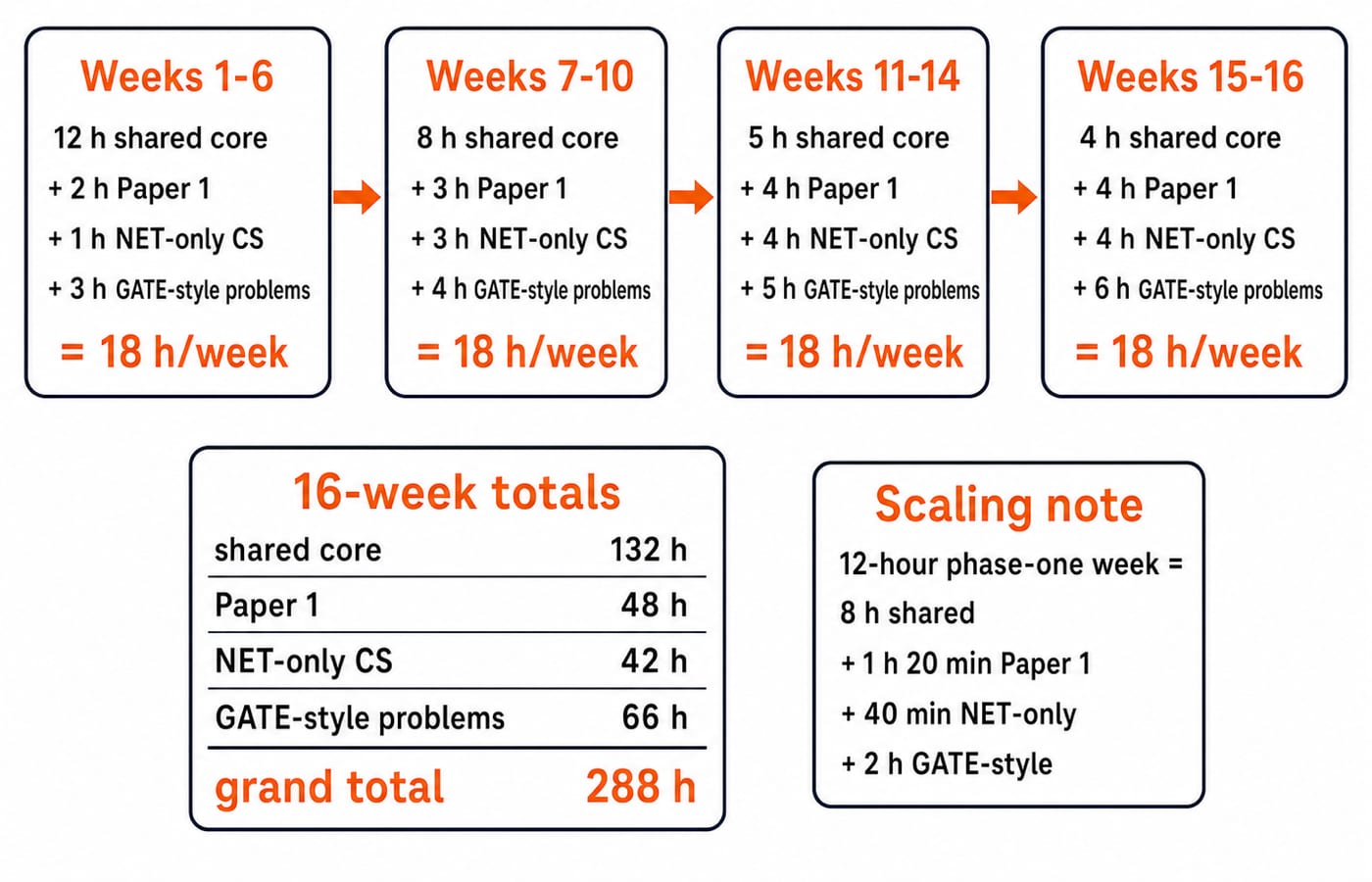
Weeks 1-6 | 12 h | 2 h | 1 h | 3 h | 18 h |
Weeks 7-10 | 8 h | 3 h | 3 h | 4 h | 18 h |
Weeks 11-14 | 5 h | 4 h | 4 h | 5 h | 18 h |
Weeks 15-16 | 4 h | 4 h | 4 h | 6 h | 18 h |
16-week total | 132 h | 48 h | 42 h | 66 h | 288 h |
The total is 132 + 48 + 42 + 66 = 288 hours. At 12 sustainable hours, multiply every bucket by 12 / 18 = 2/3 and extend the calendar. Phase one becomes 8 hours shared core, 1 hour 20 minutes Paper 1, 40 minutes NET-only CS and 2 hours GATE work, exactly 12 hours.
3. Make one shared lesson produce two outputs
Use a 120-minute cycle: 30 minutes concept study, 15 minutes closed-book recall, 25 minutes conceptual questions, 35 minutes multi-step work and 15 minutes error logging. Check: 30 + 15 + 25 + 35 + 15 = 120 minutes. Produce both a recall sheet and solved work.
For FCFS, use P1(arrival 0, burst 5), P2(arrival 1, burst 3) and P3(arrival 2, burst 1). P1 runs 0-5, P2 5-8 and P3 8-9. Waiting times are 0 - 0 = 0, 5 - 1 = 4 and 8 - 2 = 6; the average is (0 + 4 + 6) / 3 = 10 / 3 = 3.33 time units. Recall FCFS and the order without notes, then rebuild the timeline with changed values. The NTA-UGC-NET Paper - 2 course is an optional structured source for shared and NET Paper 2 concepts.
4. Ring-fence Paper 1 and NET-only CS
From phase two, reserve three Paper 1 hours: 60 minutes concept study, 45 practice, 45 review and 30 spaced recall. Check: 60 + 45 + 45 + 30 = 180 minutes. Do not lend this block to a comfortable CS topic.
For a custom 25-question diagnostic with 14 correct, 7 wrong and 4 unattempted, attempted accuracy is 14 / 21 = 66.7% and completion is 21 / 25 = 84%. Split the 11 non-correct items into 5 concept gaps, 4 recall gaps and 2 reading errors. Next block: 90 minutes concept repair, 60 retrieval and 30 re-test.
Keep a NET-only CS backlog. Six gaps minus two closed in week 7 leaves four in week 8. Remove each only after retrieval.
5. Give GATE-style problems a second pass
Use 20 minutes for two untimed setup problems, 25 for five timed problems, 30 for error classification and 15 to redo one failure from blank. Check: 20 + 25 + 30 + 15 = 90 minutes.
On a custom 20-problem set, 11 correct, 6 wrong and 3 unattempted gives attempted accuracy 11 / 17 = 64.7% and completion 17 / 20 = 85%. Split 9 misses into 4 concept gaps, 3 method-selection gaps and 2 careless or time-pressure errors. Next three hours: 90 minutes concept repair, 60 method drills and 30 checked re-solves, totalling 180 minutes. GATE Guidance by Sanchit Sir offers an optional structured route for problem solving and feedback.
6. Review four lanes without blending scores
Give each dashboard row hours completed, attempted accuracy, completion and open error topics. A week-10 snapshot might show:
Lane | Hours completed | Attempted accuracy | Completion | Open error topics |
|---|---|---|---|---|
Shared core | Log actual |
| Log separately | List |
Paper 1 | Log actual |
| Log separately | List |
NET-only CS | Log actual |
| Log separately | List |
GATE-style problems | Log actual |
| Log separately | List |
The combined 64 / 90 = 71.1% hides the weakest lane, so it is not a readiness score. Next week, assign 5 hours shared maintenance, 4 Paper 1, 3 NET-only CS and 6 GATE work. Check: 5 + 4 + 3 + 6 = 18. Rebalance after the next dashboard.
7. Carry missed study debt visibly
One phase-one week is: Monday 2 shared hours; Tuesday 2 shared; Wednesday 2 shared + 1 Paper 1; Thursday 2 shared + 1 GATE; Friday 2 shared + 1 Paper 1; Saturday 2 shared + 2 GATE + 1 NET-only; Sunday unscheduled. This gives 12 + 2 + 1 + 3 = 18 hours.
Missing Friday leaves 15 completed hours. Use Sunday for 1 shared repair hour and 30 Paper 1 minutes, reaching 16.5. Carry the remaining 1 shared hour and 30 Paper 1 minutes into equal new-content time next week. Never delete review or double tomorrow's load.
8. The short version for the final two weeks
In weeks 15-16, keep separate practice and analysis blocks for each examination. The weekly 4 Paper 1 + 4 NET-only CS + 6 GATE-style + 4 shared-revision hours preserve each lane. Do not create a hybrid mock.
Audit adherence honestly: 16 x 18 = 288 planned hours. After 17 missed hours, logged time is 288 - 17 = 271 and adherence is 271 / 288 = 94.1%. Use the error dashboard, not the missing 5.9%, to choose final revision.
Share concept learning, separate exam-specific practice, review four lanes weekly and carry missed work visibly. Inspect the current UGC NET preparation courses and test series, then create the three-column audit and schedule your first 18-hour week.
Keep learning

Scope and Importance of International Business: UGC NET Commerce Examples
Exports, licensing and foreign investment cross borders in different ways. Separate their roles, compare entry modes and work through the opportunity-cost arithmetic behind comparative advantage.
Updated 13 Oct 20266 min readNET Strategy & Updates

FEMA Explained: Objectives, Key Provisions and UGC NET Commerce Examples
Two equal overseas payments can fall into different FEMA categories. Learn to classify transactions, apply an exporter checklist and calculate a penalty ceiling without counting the first day twice.
Updated 9 Oct 20265 min readNET Strategy & Updates

CSIR NET Normalization: Percentile and Normalised Marks Worked Out
Can 120 and 130 raw marks mean the same percentile? Follow a two-shift example from raw marks to percentile and normalised marks, then check which number belongs beside a cutoff.
Updated 5 Oct 20265 min readNET Strategy & Updates

UGC NET Eligibility for CA Holders: Equivalence, Marks and Subject Choice
Completed CA but have no MCom certificate? Understand the equivalence route, check the percentage requirement and resolve marks or subject-entry doubts before applying for NET.
30 Sep 20264 min readNET Strategy & Updates