UGC NET Paper 1 Higher Education Timeline: Institutions, Commissions, Policies and Digital Initiatives
Turn disconnected Higher Education dates into a classified timeline. Learn the ancient centres, modern bodies, policies and digital initiatives through worked ordering drills.
KnowledgeGate Team
Exam prep & CS education
Updated 3 Sep 20266 min read

Dates such as 1956, 1968, 1986 and 2017 may look familiar, yet become difficult to order when centres, commissions, laws, policies, accreditors and platforms share one question. This lesson builds one timeline that attaches each date to an event type and memory cue for quick, reliable recall, clarifying what happened and when. The UGC NET Paper 1 vs Paper 2: what each tests comparison locates Higher Education within Paper 1.
Build the Higher Education timeline with five event types
Classify the noun before recalling its year. Use five labels: centre of learning, commission, Act or statutory body, policy, and framework or platform.
In a five-card warm-up, Nalanda, 5th century CE is a centre, Kothari Commission, 1964-66 is a commission, UGC Act, 1956 is an Act, National Policy on Education, 1968 is a policy, and SWAYAM, 2017 is a platform. These values are not interchangeable. A commission recommends, an Act creates legal authority, a policy states direction, and a platform delivers a service.
Keep one memory sentence for every later section: place -> review -> law or body -> policy -> delivery.
This decision narrows year options before recall begins.
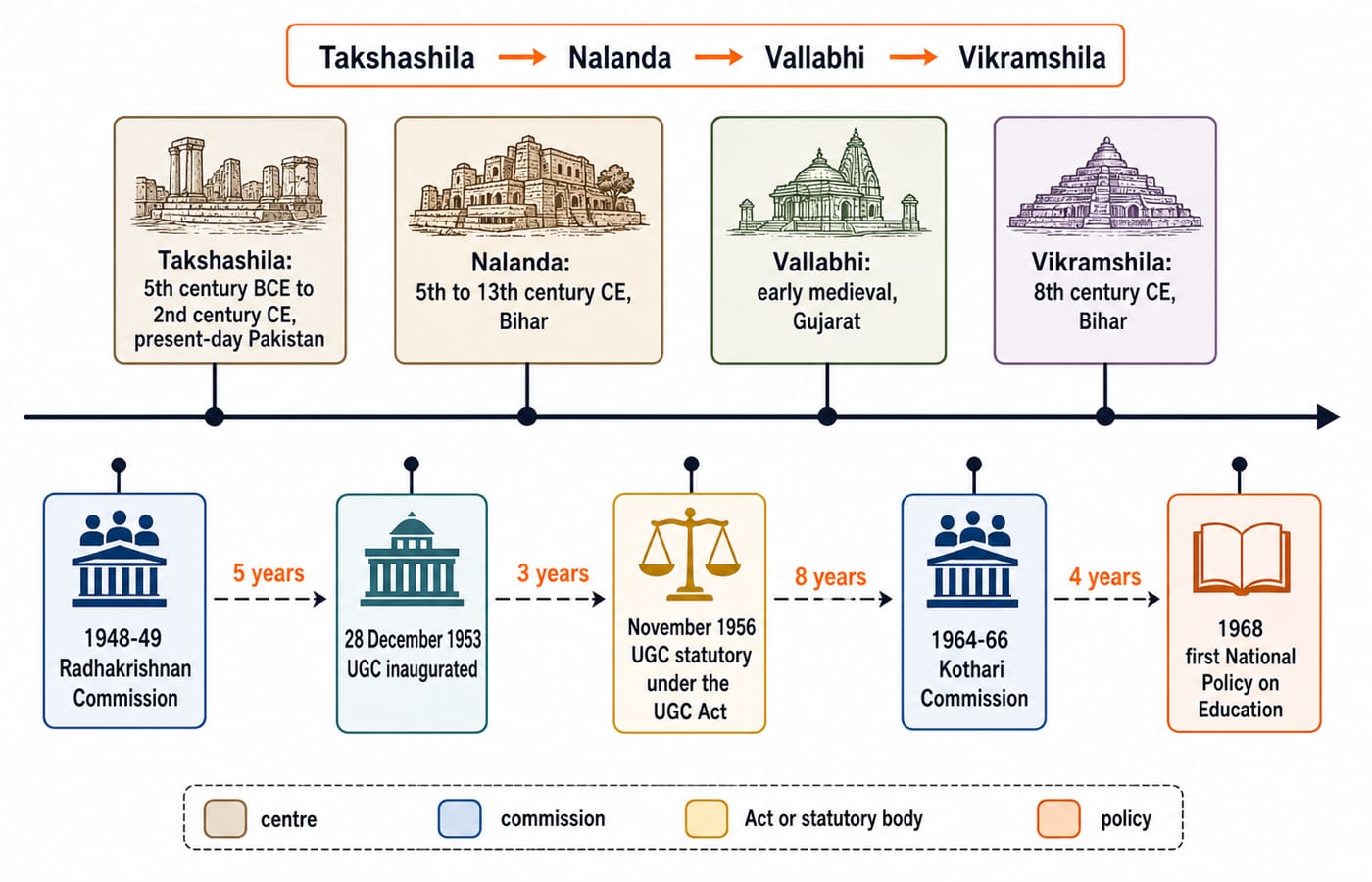
Ancient centres: connect each name to a region and era
Centre | Present-day region | Secure era cue | Memory hook |
|---|---|---|---|
Takshashila or Taxila | Pakistan | 5th century BCE to 2nd century CE | The BCE anchor |
Nalanda | Bihar | 5th to 13th century CE | The long eastern centre |
Vallabhi | Gujarat | Early-medieval western centre | West before Vikramshila |
Vikramshila | Bihar | 8th century CE, Pala-era cue | The later Bihar centre |
UNESCO supplies the dated ranges for Taxila and Nalanda. Bihar Tourism supports the century cues for Nalanda and Vikramshila, while NEP 2020 groups Takshashila, Nalanda, Vallabhi and Vikramshila as ancient multidisciplinary models.
Now order four cards. Separate BCE from CE first, which makes Takshashila the earliest. Among secure CE anchors, Nalanda begins in the 5th century, before Vikramshila in the 8th. Use the western early-medieval cue to place Vallabhi between them for revision in exams. The final recall order is Takshashila -> Nalanda -> Vallabhi -> Vikramshila.
Higher Education chronology from Radhakrishnan to NPE 1968
UGC records the University Education Commission under S. Radhakrishnan in 1948-49, its formal inauguration on 28 December 1953, and statutory status under the UGC Act in November 1956. Next come the Education Commission, commonly called the Kothari Commission, in 1964-66, and the first National Policy on Education in 1968, as labelled in the Ministry policy archive.
Sort on the displayed start or milestone years:
1948 -> 1953 -> 1956 -> 1964 -> 1968
The adjacent gaps are 1953 - 1948 = 5 years, 1956 - 1953 = 3 years, 1964 - 1956 = 8 years, and 1968 - 1964 = 4 years. This arithmetic is a memory drill, not a claim that each event was caused only by the one immediately before it.
This moves from review to institution, law and policy.
Recall the meanings too: Radhakrishnan = university review, 1953 = UGC inauguration, 1956 = UGC statutory, Kothari = broad education review, and 1968 = policy. The often-confused UGC milestones are three anchor years apart. If you want this chronology inside a structured Paper 1 route, use the NTA UGC NET Paper 1 Course.
The 1976 to 1994 bridge: Constitution, policy and quality bodies
The Ministry of Education records education moving to the Concurrent List through the 1976 constitutional amendment. The chain then continues through the National Policy on Education 1986, statutory status for AICTE under its 1987 Act, NPE 1986 as modified in 1992 with the Programme of Action 1992, and NAAC's establishment in 1994.
The anchor sequence is 1976 -> 1986 -> 1987 -> 1992 -> 1994. Its gaps are 1986 - 1976 = 10, 1987 - 1986 = 1, 1992 - 1987 = 5, and 1994 - 1992 = 2. Therefore, the widest adjacent gap is 10 years, from the Concurrent List change to NPE 1986.
Avoid two traps. The years 1986 and 1992 do not name unrelated national policies. The Ministry's wording is NPE 1986 as modified in 1992, accompanied by POA 1992. Also, 1976 is a constitutional allocation milestone, not a founding year for UGC, AICTE or NAAC.
Sorting by type keeps constitutional authority separate from later institutional creation.
Regulator, accreditor and ranker are different categories
Entity | Recognition role | Date cue |
|---|---|---|
UGC | Statutory university-education standards body | 1956 |
AICTE | Statutory technical-education planning and standards body | 1987 Act |
NAAC | Institutional assessment and accreditation | 1994 |
NBA | Programme accreditation in technical and professional fields | Established 1994, independent autonomous body from 7 January 2010 |
NIRF | Ranking framework | Launched 29 September 2015 |
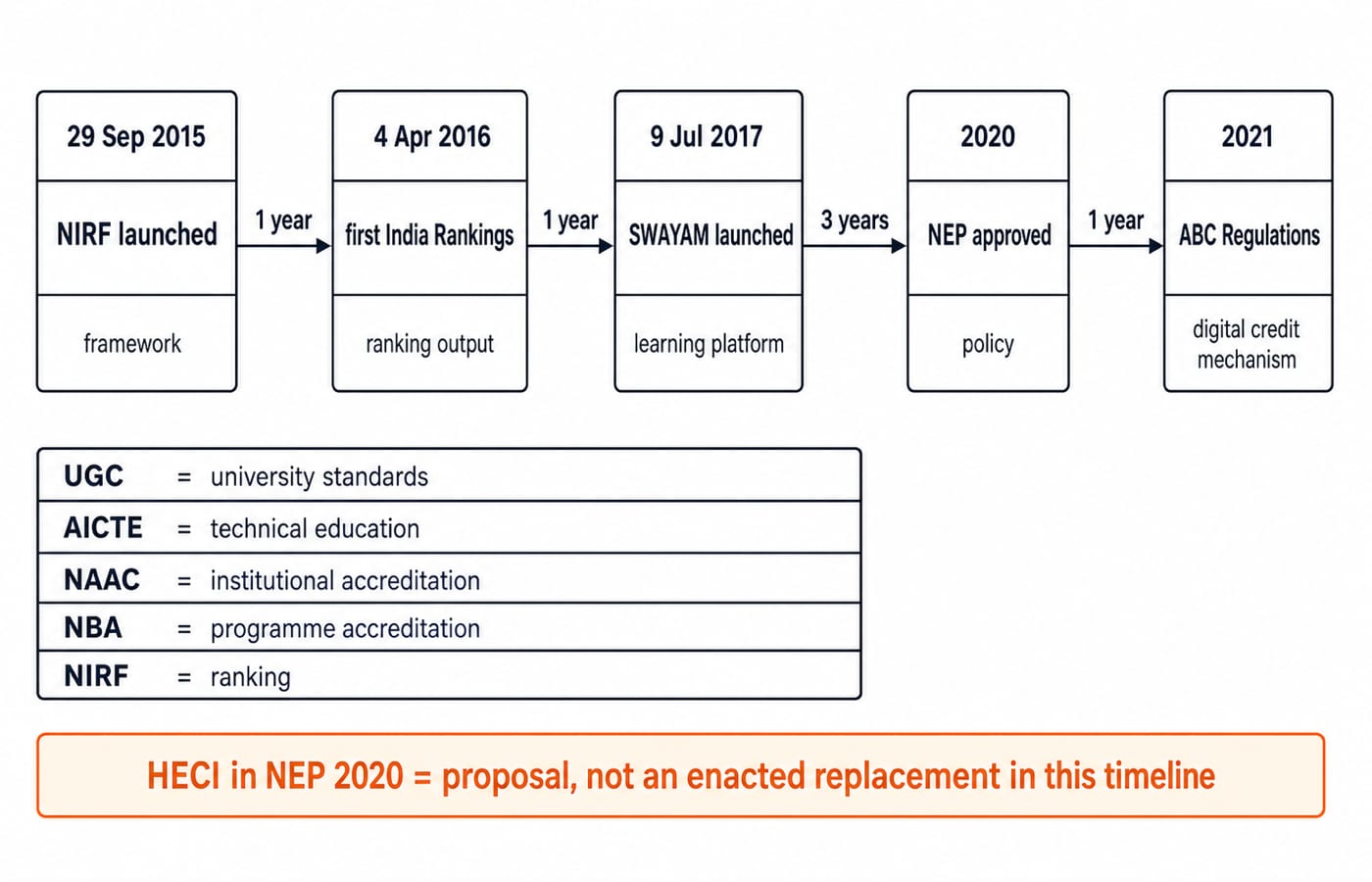
Match five clues carefully: university-education standards -> UGC; technical-education statutory body -> AICTE; institutional accreditation -> NAAC; programme accreditation -> NBA; institutional ranking framework -> NIRF. The score is 5/5 only when every arrow matches. In particular, NIRF -> regulator and NBA -> whole-institution ranker are wrong.
The clue's noun usually identifies the answer category first. Read Higher Education Structure: UGC, NAAC, NBA & NIRF for the fuller body-by-body explanation.
NIRF to ABC, 2015 to 2021: know each status
NIRF records its framework launch on 29 September 2015, and a Ministry review records the first India Rankings on 4 April 2016. The same review records SWAYAM's official launch on 9 July 2017. The National Education Policy was approved in 2020, and the UGC Academic Bank of Credits Regulations followed in 2021.
The anchor-year drill is 2015 -> 2016 -> 2017 -> 2020 -> 2021, producing gaps of 1, 1, 3, 1 years. The first two cards belong to one ranking system: NIRF's 2015 launch and its first rankings in 2016. SWAYAM 2017 is the learning platform, NEP 2020 is the policy, and ABC 2021 is the credit regulation and digital mechanism.
Keep the status verbs exact. NIRF ranks, SWAYAM delivers online courses, NEP 2020 states policy direction, and the UGC's 2021 ABC Regulations support digital credit storage and transfer. NEP 2020 proposes the Higher Education Commission of India, so do not treat HECI as an enacted replacement for UGC in this timeline.
This is why memorising one continuous date list is weaker than learning each card's status and function.
Solve chronology questions with a two-pass check
Pass 1 labels each card as centre, commission, law or body, policy, framework, platform or regulation. Pass 2 carefully orders only the year anchors, then checks the relationship between entity and event. This stops a familiar acronym from overriding its date.
Take this scrambled set: SWAYAM 2017, UGC statutory 1956, NPE modified 1992, Radhakrishnan Commission 1948-49, ABC Regulations 2021, NPE 1968, NIRF 2015, Concurrent List 1976. The correct order is 1948 -> 1956 -> 1968 -> 1976 -> 1992 -> 2015 -> 2017 -> 2021.
Exactly 3 cards fall before 1970: 1948, 1956 and 1968. UGC statutory status to NIRF launch spans 2015 - 1956 = 59 years. These subtractions are revision devices, not official exam statistics. KnowledgeGate has about 460 published Higher Education questions, but this does not predict topic frequency. The UGC NET Preparation Courses & Test Series is the wider revision route.
The short version: revise one chain, then test recall
Takshashila -> Nalanda -> Vallabhi -> Vikramshila
1948 Radhakrishnan -> 1953 UGC inauguration -> 1956 UGC statutory -> 1964 Kothari -> 1968 NPE
1976 Concurrent List -> 1986 NPE -> 1992 modification and POA -> 1994 NAAC
2015 NIRF -> 2017 SWAYAM -> 2020 NEP -> 2021 ABC
Cover the years, recall each exact entity and role, then uncover them and correct the first broken link. For an optional next practice step, use the UGC NET Paper 1 Test Series.
Keep learning

Scope and Importance of International Business: UGC NET Commerce Examples
Exports, licensing and foreign investment cross borders in different ways. Separate their roles, compare entry modes and work through the opportunity-cost arithmetic behind comparative advantage.
Updated 13 Oct 20266 min readNET Strategy & Updates
FEMA Explained: Objectives, Key Provisions and UGC NET Commerce Examples
Two equal overseas payments can fall into different FEMA categories. Learn to classify transactions, apply an exporter checklist and calculate a penalty ceiling without counting the first day twice.
Updated 9 Oct 20265 min readNET Strategy & Updates
CSIR NET Normalization: Percentile and Normalised Marks Worked Out
Can 120 and 130 raw marks mean the same percentile? Follow a two-shift example from raw marks to percentile and normalised marks, then check which number belongs beside a cutoff.
Updated 5 Oct 20265 min readNET Strategy & Updates

UGC NET Eligibility for CA Holders: Equivalence, Marks and Subject Choice
Completed CA but have no MCom certificate? Understand the equivalence route, check the percentage requirement and resolve marks or subject-entry doubts before applying for NET.
30 Sep 20264 min readNET Strategy & Updates