UGC NET CS Attempt Strategy Without Negative Marking: A Three-Pass Plan
Use a rehearsed 180-minute clock to answer quick recalls first, protect time for technical work, and leave disciplined elimination and guesses until the final pass.
KnowledgeGate Team
Exam prep & CS education
Updated 4 Sep 20265 min read
With no negative marking, answering every question appears obvious. The real conflict is timing: an early blind guess can consume minutes that belonged to a solvable technical question. This three-pass plan first banks quick recall, then protects computation time, and finally converts remaining uncertainty into elimination and recorded guesses. The aim is not to guess better. It is to keep every solvable mark ahead of uncertainty. Use the NET CS Exam preparation resources, then calibrate the gates with your own mocks.
UGC NET marking rule: what it changes
For its June 2026 cycle, NTA's Information Bulletin specifies Paper I as 50 questions for 100 marks and Paper II as 100 questions for 200 marks, completed together in 180 minutes without a break. Each correct answer earns 2 marks. Incorrect or unanswered items earn 0; an answered item marked for review is evaluated, while an unanswered item marked for review earns 0. NTA describes every question as compulsory. Check the newest bulletin for your cycle on the official UGC-NET website, because the scheme can change.
When time is expiring, a recorded answer is preferable to a blank under this rule. A blind item is still not worth unlimited time. Your scarce resource is 180 minutes, not attempts. Solve in descending order of confidence per minute, postponing low-information guesses until they cannot displace a solvable question.
Put four timer gates around the three passes
Use this 180-minute clock as a starting template:
Clock | Purpose | Stop rule |
|---|---|---|
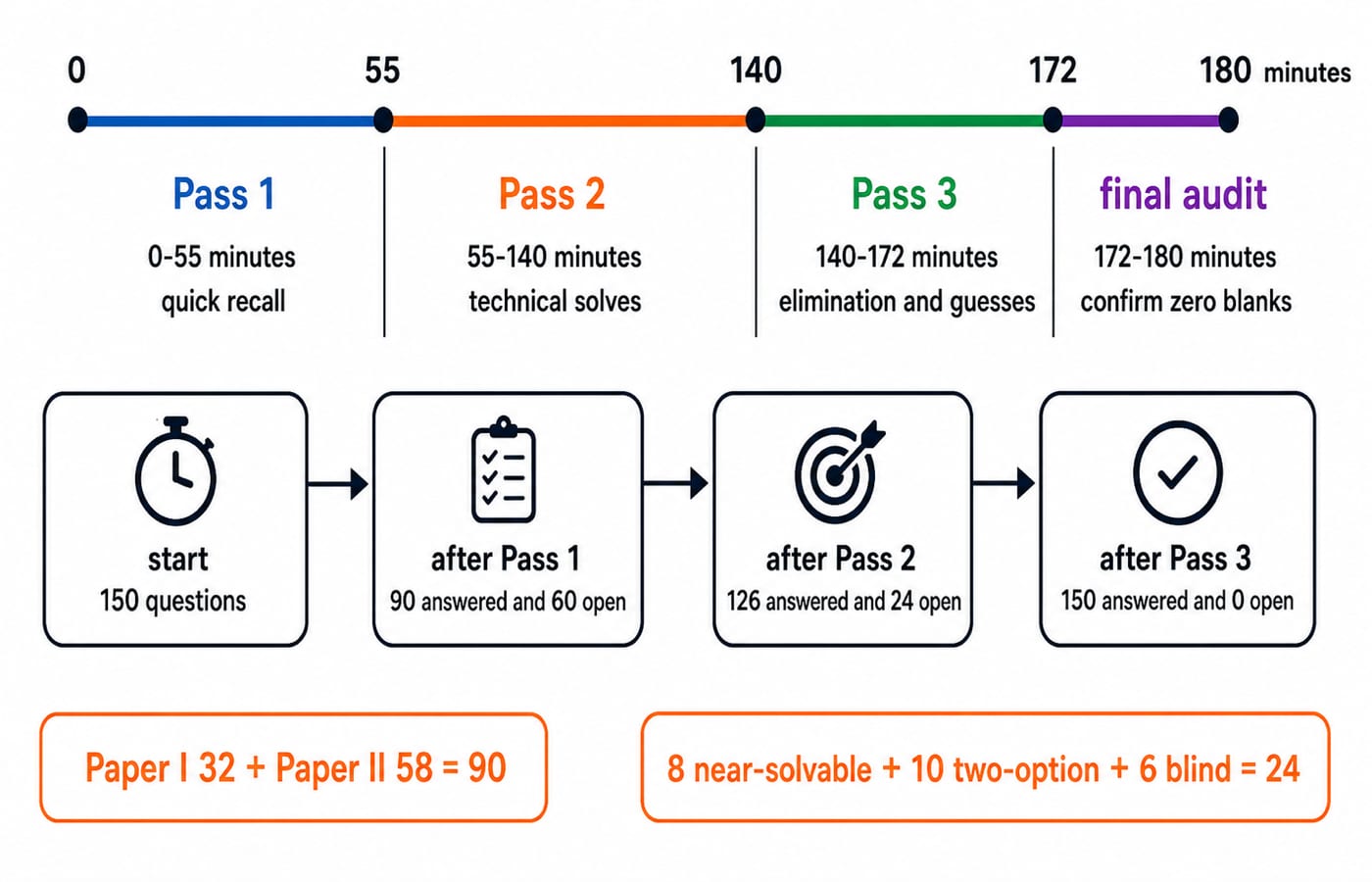
0 to 55 minutes | Pass 1: recognition and one-step recall | Leave if no route appears in about 30 seconds |
55 to 140 minutes | Pass 2: selected technical and numerical work | Stop at 2.5 minutes unless one short step remains |
140 to 172 minutes | Pass 3: marked items, elimination and remaining guesses | Protect the audit boundary |
172 to 180 minutes | Final audit within Pass 3 discipline | Check blanks, answer states and accidental non-submissions |
The blocks total 55 + 85 + 32 + 8 = 180 minutes. The audit is not a fourth solving round, and you never borrow from its final 8 minutes. The 30-second and 2.5-minute stops are rehearsal values, not NTA rules. Adjust them only from mock evidence.
Work one mock through all three passes
A candidate scans 150 questions. Pass 1 answers 32 Paper I recall items and 58 Paper II recall or one-step items. That gives 32 + 58 = 90 answered and 150 - 90 = 60 open at minute 55. On permitted rough work, the candidate indexes them N, E, or B. These are learner-owned, not exam-interface labels.
Pass 2 gives 85 minutes to the best open candidates. Completing 36 gives 90 + 36 = 126 answered at minute 140. Then 60 - 36 = 24 remain open, and 150 - 126 = 24. They comprise 8 near-solvable items, 10 narrowed to two options, and 6 with no useful elimination.
Pass 3 spends 18 minutes on the 8 near-solvable items, 10 minutes on the 10 two-option items, and 4 minutes on the 6 blind answers. Thus 18 + 10 + 4 = 32 minutes, reaching 140 + 32 = 172. The count becomes 126 + 8 + 10 + 6 = 150. The final 8 minutes confirm zero blanks. This is a rehearsal template, not a score guarantee.
Expected value puts guessing last, not first
Under the cited 2-mark rule, a blind guess among four options has expected marks of (1/4 × 2) + (3/4 × 0) = 0.5. A blank gives 0. If you genuinely eliminate two options, the expectation becomes (1/2 × 2) + (1/2 × 0) = 1.0. This timing argument is not a promise that one guess will be correct.
Opportunity cost decides the order. Three minutes on a blind item worth 0.5 expected marks can crowd out a numerical with a 75% success chance, worth 0.75 × 2 = 1.5. Solve the numerical first, then guess in the reserved final pass.
Do not manufacture a 50-50 choice. An option that merely “looks wrong” is not eliminated. You should be able to name the rule, contradiction, or computed value that removes it.
Build a triage code that survives pressure
On permitted rough work, write only the question number and one code, such as 37-N, 84-E, 119-B. N means a known numerical route, E means evidence removes an option, and B means no current route. The index should take seconds, not become a second answer sheet.
Revisit N first, E second, and B last. Within N, take one-step finishes before multi-stage derivations. Within E, take true two-option questions before those with only one option removed. No negative marking removes the score penalty from B, but not its time cost. The UGC NET mock test strategy shows how to analyse these timed runs. When revisiting, avoid changing a correct answer without fresh evidence, one of the common UGC NET mistakes to avoid.
Rehearse the UGC NET clock before exam day
Start with an 8-hour week: one 180-minute full mock, one 120-minute analysis, and three 60-minute mixed drills, one per pass. The total is 180 + 120 + (3 × 60) = 480 minutes, or 8 hours. Record each pass's end time and answered count, avoidable time sinks, and blanks found in the audit.
For the final two weeks, use 10 hours per week: two 180-minute mocks and two 120-minute analyses. That is (2 × 180) + (2 × 120) = 600 minutes, or 10 hours. Change a gate only after two mocks show the same failure, such as crossing minute 55 in Pass 1 or leaving more than 24 open at minute 140. Fit this into the UGC NET Computer Science last 45 days plan.
If you miss a day, do not stack drills onto a tired evening. Drop one 60-minute drill, preserve the full mock, and keep at least 90 minutes of analysis. Use the NTA UGC NET Paper 2 complete course for concept gaps, and combined-paper practice for pacing gaps.
Carry a one-card plan into the next mock
The short version is 0 to 55 for recall, 55 to 140 for the best technical questions, 140 to 172 for elimination and every remainder, then 172 to 180 for a zero-blank audit. Adjust those gates from mock evidence, and use the latest official bulletin for the live exam scheme.
Copy 90 answered at 55, 126 at 140, and 150 at 172 onto your analysis sheet. Run one full mock, then move only one gate by at most 5 minutes. The UGC NET Computer Science and Applications Test Series is the natural next step if you need timed Paper I plus Paper II practice in one place.
Keep learning

Scope and Importance of International Business: UGC NET Commerce Examples
Exports, licensing and foreign investment cross borders in different ways. Separate their roles, compare entry modes and work through the opportunity-cost arithmetic behind comparative advantage.
Updated 13 Oct 20266 min readNET Strategy & Updates

FEMA Explained: Objectives, Key Provisions and UGC NET Commerce Examples
Two equal overseas payments can fall into different FEMA categories. Learn to classify transactions, apply an exporter checklist and calculate a penalty ceiling without counting the first day twice.
Updated 9 Oct 20265 min readNET Strategy & Updates

CSIR NET Normalization: Percentile and Normalised Marks Worked Out
Can 120 and 130 raw marks mean the same percentile? Follow a two-shift example from raw marks to percentile and normalised marks, then check which number belongs beside a cutoff.
Updated 5 Oct 20265 min readNET Strategy & Updates

UGC NET Eligibility for CA Holders: Equivalence, Marks and Subject Choice
Completed CA but have no MCom certificate? Understand the equivalence route, check the percentage requirement and resolve marks or subject-entry doubts before applying for NET.
30 Sep 20264 min readNET Strategy & Updates