UGC NET CS Mock Review: Turn Errors into a Paper 1 and 2 Study Plan
A mock score is only a result. Use this worked review system to diagnose every weak item, divide 12 repair hours between both papers, and retest the learning.
KnowledgeGate Team
Exam prep & CS education
Updated 25 Aug 20265 min read
A mock score tells you what happened, but it does not tell you what to study next. A missing concept needs a different repair from failed recall, a missed qualifier, slow execution or a blind guess. This review turns every item worth revisiting into a tagged Paper 1 and Paper 2 workload, then into a testable 12-hour study cycle.
Scope note: The 24-hour start, error weights, time allocations, schedule, retest intervals and closure threshold below form one illustrative study model. They are not NTA rules, official UGC NET specifications or exam marks, and the worked counts are not a real candidate result.
Start the review before the score becomes the whole story
Queue every wrong response, unattempted item and correct response marked low-confidence. Before opening an explanation, record five fields: paper, topic, chosen response or blank, time or stall note, and confidence: high/low. A lucky correct answer stays because its method is not yet repeatable.
Begin the first pass within 24 hours, while the decision path remains memorable. Use the UGC NET Mock Test Strategy for the wider mock-taking and analysis process. This review starts after the mock ends.
Give every review item one primary error tag
Give each item one primary tag. Keep topic separate to prevent double-counting.
Concept: Without a clock, can I explain the rule and solve a near variant? If not, choose concept.
Recall: Did I understand the method but fail to retrieve a fact, formula or definition?
Interpretation: Did I miss a qualifier, condition, diagram label or what the stem actually asked?
Speed: Can I solve it now with the known method, but not within my self-set time budget?
Blind guessing: Did I choose without a rule, calculation or elimination reason?
Ban silly, bad luck and careless because they prescribe no action. This log needs a repairable cause.
Worked mock review: turn 53 flagged items into a two-paper load
In the worked example, the flagged-item count is:
Paper 1:
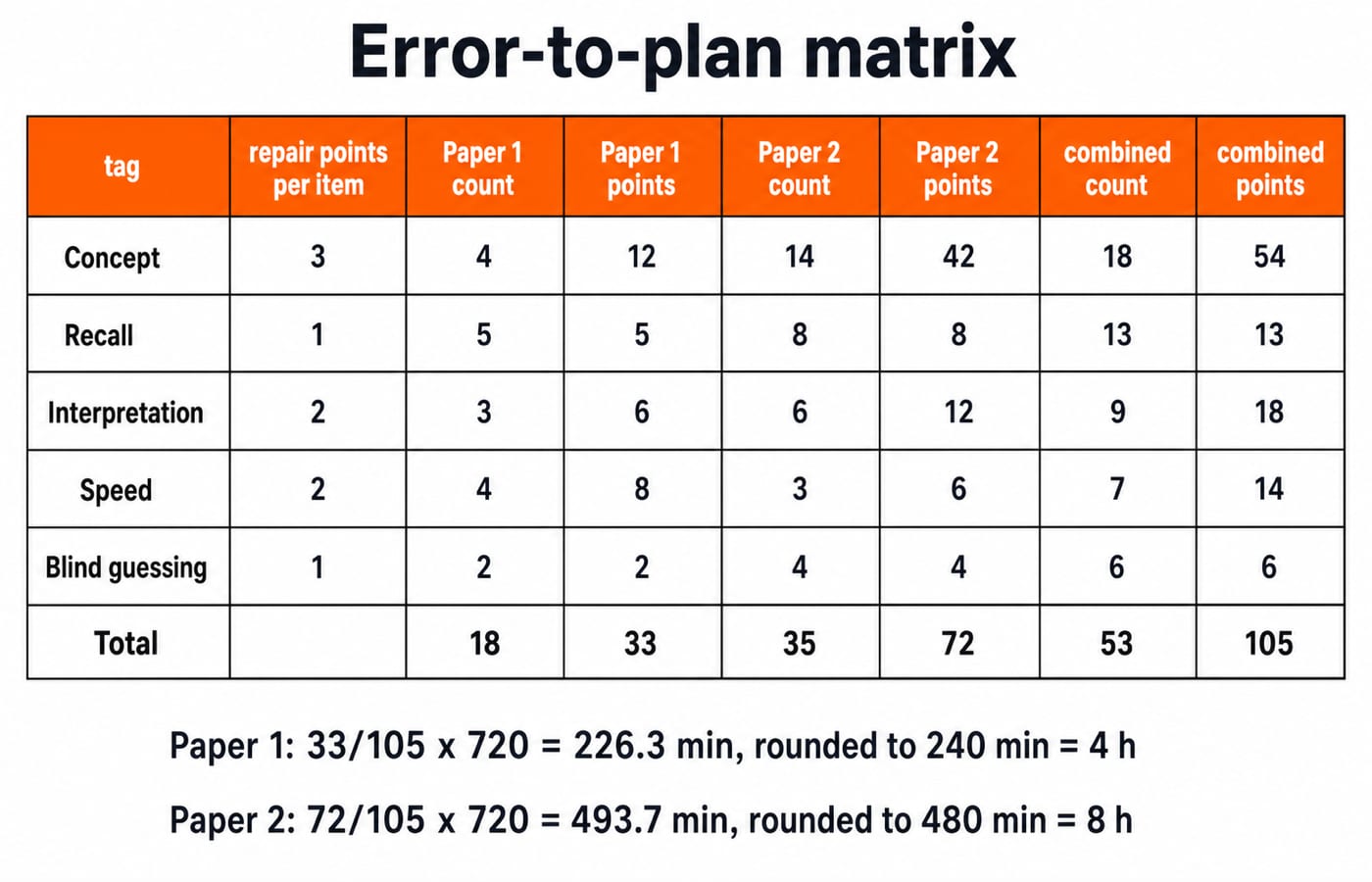
4 concept + 5 recall + 3 interpretation + 4 speed + 2 blind guessing = 18items.Paper 2:
14 concept + 8 recall + 6 interpretation + 3 speed + 4 blind guessing = 35items.Both:
18 concept + 13 recall + 9 interpretation + 7 speed + 6 blind guessing = 53items.
Weight concept 3, recall 1, interpretation 2, speed 2 and blind guessing 1.
Paper 1:
(4 x 3) + (5 x 1) + (3 x 2) + (4 x 2) + (2 x 1) = 33points.Paper 2:
(14 x 3) + (8 x 1) + (6 x 2) + (3 x 2) + (4 x 1) = 72points.Check:
33 + 72 = 105.
Across 720 minutes, Paper 1 gets 33/105 x 720 = 226.3 minutes, about 3 hours 46 minutes. Paper 2 gets 72/105 x 720 = 493.7 minutes, about 8 hours 14 minutes. Round to four-hour and eight-hour blocks, preserving 12 hours.
Build the next 12 hours around the repair load
The rounded repair blocks are:
Repair type | Paper 1 min | Paper 2 min | Combined min |
|---|---|---|---|
Concept | 90 | 270 | 360 |
Recall | 45 | 45 | 90 |
Interpretation | 45 | 75 | 120 |
Speed | 45 | 45 | 90 |
Blind-guess calibration | 15 | 45 | 60 |
Total | 240 | 480 | 720 |
Run six self-set two-hour sessions: Monday, 120 P2 concept; Tuesday, 90 P1 concept + 30 P1 recall; Wednesday, 90 P2 concept + 30 P2 interpretation; Thursday, 60 P2 concept + 45 P2 recall + 15 P2 guess; Friday, 15 P1 recall + 45 P1 interpretation + 45 P1 speed + 15 P1 guess; Saturday, 45 P2 interpretation + 45 P2 speed + 30 P2 guess.
The UGC NET CS last 45 days plan places cycles in a longer calendar.
Replace every tag with a task that produces evidence
A 45-minute concept packet is 10 minutes reconstructing the rule, 15 checking it, 15 solving five fresh items and five logging misses. Produce a one-page explanation and fresh-set result.
A 15-minute recall cycle is eight minutes closed-book retrieval, four correcting and three immediately retrieving again. Produce a small deck.
A 45-minute interpretation block uses five stems, with nine total minutes per stem to mark qualifiers, restate the demand and solve. Produce five rewritten demands.
A 45-minute speed block is three self-timed 10-minute mini-sets plus 15 minutes comparing methods. Produce a time-and-method log.
A 15-minute guess block uses 10 decisions, each with a written rule or elimination reason. Produce 10 reason lines.
“Revise DBMS” leaves no evidence. When Paper 2 concept repairs dominate, the NTA-UGC-NET Paper 2 Complete Course is one structured route. Fresh work can also use KnowledgeGate's over 59,000 published questions platform-wide, not all of which are UGC NET CS questions.
Close an error only after a fresh-item retest
From the 14 Paper 2 concept items, choose a DBMS cluster and take a 10-item diagnostic: 4/10. Complete two 45-minute concept packets. Re-solve the old set after 48 hours and score 9/10, then take a matched fresh set after 72 hours and score 7/10.
The old-set gain may be memory. The fresh 7/10 fails this practical closure gate: at least 8/10 on two fresh 10-item sets. Add another 45-minute packet. If the next fresh sets are 8/10 and 9/10, close the cluster and keep a delayed check. Keep it open if you cannot explain the method.
A missed day changes the calendar, not the evidence
If Tuesday's 120-minute session is missed, do not double Wednesday. Move the higher-priority 90-minute Paper 1 concept repair to Sunday and carry 30 recall minutes into the next available block. The week records 690 minutes = 11 hours 30 minutes; the cycle stays incomplete until the carried 30 minutes is done.
If two sessions are missed, complete 4 x 120 = 480 minutes = 8 hours, carry all 240 missed minutes forward, and postpone the next full mock until repairs and fresh-item checks are complete. Never erase time, halve tasks or test merely to stay on a date.
Short version: tag, weight, repair, retest
Queue wrong, blank and low-confidence items. Tag, weight each paper's repairs, complete outputs, then retest fresh items. Create: paper | topic | item | confidence | primary tag | repair task | minutes | fresh-set score | status.
Use the UGC NET CS Test Series, Paper 1 + Paper 2 for a structured next mock, or explore the UGC NET CS Exam Preparation category. The next mock should test completed repairs, not just produce another score.
Keep learning

Scope and Importance of International Business: UGC NET Commerce Examples
Exports, licensing and foreign investment cross borders in different ways. Separate their roles, compare entry modes and work through the opportunity-cost arithmetic behind comparative advantage.
Updated 13 Oct 20266 min readNET Strategy & Updates
FEMA Explained: Objectives, Key Provisions and UGC NET Commerce Examples
Two equal overseas payments can fall into different FEMA categories. Learn to classify transactions, apply an exporter checklist and calculate a penalty ceiling without counting the first day twice.
Updated 9 Oct 20265 min readNET Strategy & Updates

CSIR NET Normalization: Percentile and Normalised Marks Worked Out
Can 120 and 130 raw marks mean the same percentile? Follow a two-shift example from raw marks to percentile and normalised marks, then check which number belongs beside a cutoff.
Updated 5 Oct 20265 min readNET Strategy & Updates

UGC NET Eligibility for CA Holders: Equivalence, Marks and Subject Choice
Completed CA but have no MCom certificate? Understand the equivalence route, check the percentage requirement and resolve marks or subject-entry doubts before applying for NET.
30 Sep 20264 min readNET Strategy & Updates