UGC NET Paper 1 Mathematical Aptitude: 6-Topic Formula Roadmap
Build Mathematical Aptitude in dependency order, then use worked checks and a 30-minute loop to turn six formula groups into reliable solving habits.
KnowledgeGate Team
Exam prep & CS education
Updated 24 Aug 20266 min read128 views

Candidates often collect formulas chapter by chapter, yet hesitate when a mixed question hides whether it needs a remainder cycle, ratio base, successive multiplier, series rule, interest base or work rate. This roadmap places six topics in dependency order and gives one calculation habit for each. Use it within the wider UGC NET CS Exam Preparation path and follow the sequence below.
Build the Mathematical Aptitude formula roadmap in dependency order
Start with 12 diagnostic questions, two per topic.
Topic | Minimum formula | Calculation habit | Ready-to-move-on check |
|---|---|---|---|
Number System |
| Reduce before raising powers | Solve one remainder and one last-digit item |
Ratio and Proportion |
| Keep the comparison base visible | Split a total and rebuild the ratio |
Percentage |
| Write the base first | Reverse a change without blindly subtracting the percentage |
Sequence and Series | Check first differences, second differences, ratios, then alternating positions | Use one rule for every term | Justify the next term |
Interest |
| Label principal, rate and time units | Compare both amounts |
Time and Work |
| Choose common work units | Rebuild the full job from contributions |
Scores of 2, 1, 0, 2, 1, 0 total 6/12. Study Percentage and Time and Work first, then Ratio and Interest. UGC NET Paper 1 vs Paper 2 separates general Paper I practice from subject-specific Paper II work.
NTA's UGC NET Information Bulletin page lists the June 2026 bulletin issued on 30 April 2026 and defines broad Paper I scope. The topic order, question counts and 30-minute loop in this roadmap are study choices, not NTA-set timing, a fixed Mathematical Aptitude marks share or weightage, or claims about topic frequency. KnowledgeGate's broader Mathematics and Aptitude practice inventory likewise does not indicate UGC NET topic frequency.
If most rows show gaps, use the NTA UGC NET Paper 1 Course as a structured route.
Number System: reduce powers before calculating
Find the last digit of 7^83 without expanding the power. The units-digit cycle is:
7^1 -> 7, 7^2 -> 9, 7^3 -> 3, 7^4 -> 1.
It then repeats every four powers. Since 83 = 4 x 20 + 3, exponent 83 occupies position 3 in the cycle. The last digit is therefore 3. Notice that 83 mod 4 = 3 identifies the position, not the final digit by itself. A zero remainder would point to the final position in the cycle.
Use the same habit for 2^20 mod 7. Powers of 2 modulo 7 cycle through 2, 4, 1. Since 20 = 3 x 6 + 2, the remainder is the second cycle value, 4. As an independent check, 2^18 = (2^3)^6, and each 2^3 leaves remainder 1 modulo 7. Multiplying by the remaining 2^2 again gives remainder 4.
Ratios and percentages: preserve the base through every change
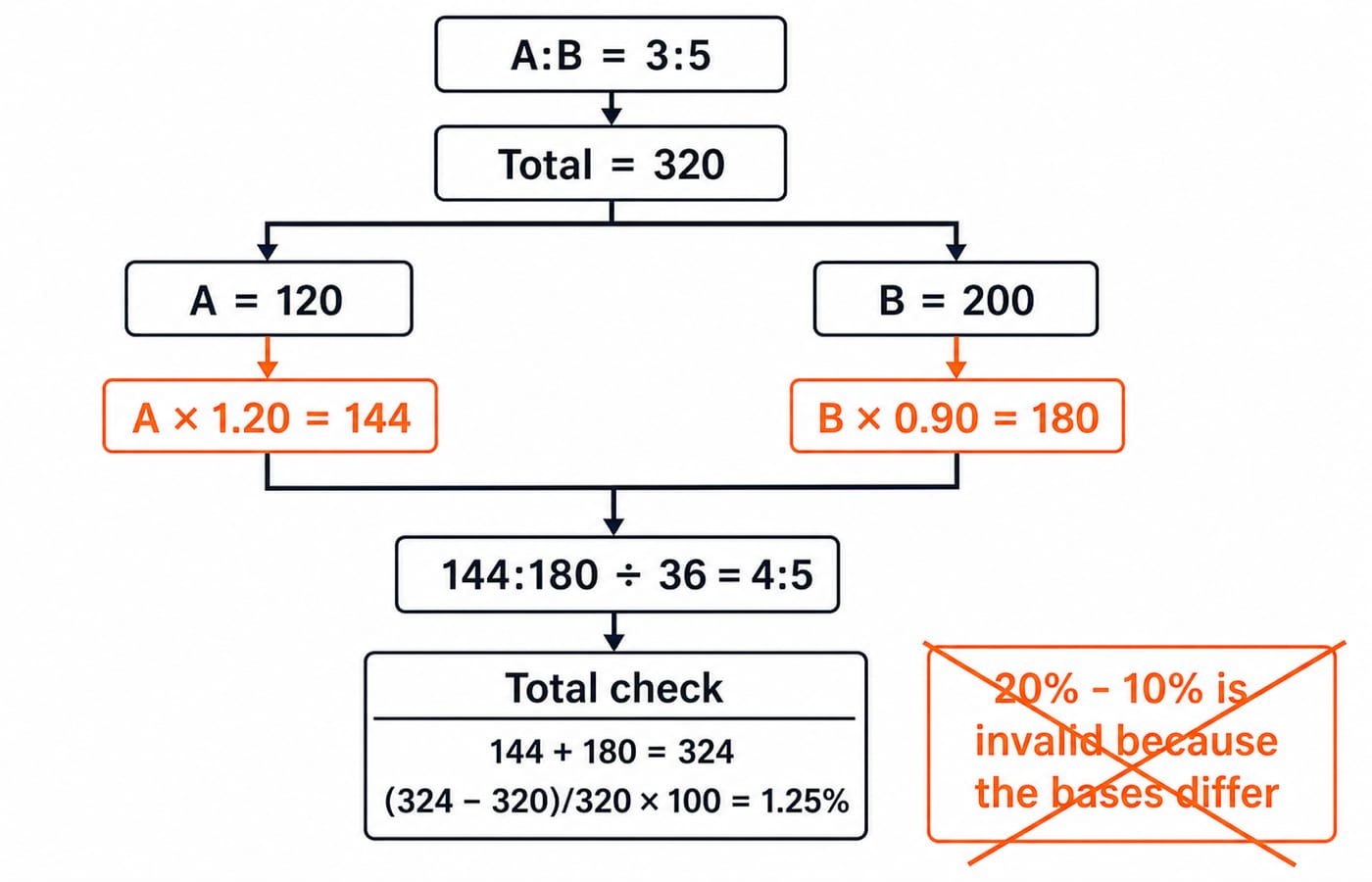
Let A:B = 3:5 and A+B = 320. There are eight equal parts, so one part is 320/8 = 40. Therefore, A = 3 x 40 = 120 and B = 5 x 40 = 200.
Increase A by 20 percent: 120 x 1.20 = 144. Decrease B by 10 percent: 200 x 0.90 = 180. The new ratio is 144:180 = 4:5, after dividing both terms by 36. As a separate check, the total changes from 320 to 144 + 180 = 324. Its increase is (324 - 320)/320 x 100 = 1.25 percent.
The shortcut 20 percent - 10 percent = 10 percent fails because the bases differ. Even on the same base, use multipliers: 800 x 1.25 = 1000, then 1000 x 0.80 = 800. The net change is zero, not a 5 percent increase. Write old value -> multiplier -> new value before forming the ratio.
Sequence and Series: test differences before guessing
Consider 3, 8, 15, 24, 35, ?. Its first differences are 5, 7, 9, 11, increasing by 2 each time. The next difference is 13, so the missing term is 35 + 13 = 48.
Now verify independently. The position rule is a_n = n^2 + 2n. For n = 1, 2, 3, 4, 5, it produces 3, 8, 15, 24, 35; for n = 6, a_6 = 6^2 + 2 x 6 = 36 + 12 = 48.
Use a fixed inspection order: constant first difference, constant second difference, constant ratio, alternating odd and even positions, then mixed operations. Reject a rule that fits only the first three terms but fails a later term. Here, the growing differences reveal the quadratic pattern, so the raw terms are not an arithmetic progression.
Simple and compound interest: separate the bases
Take P = 8000, annual rate r = 10 percent, and t = 2 years. Simple interest is SI = 8000 x 10 x 2 / 100 = 1600, so the amount is 8000 + 1600 = 9600.
For annual compounding, the amount is 8000 x (1.10)^2 = 8000 x 1.21 = 9680. Compound interest is 9680 - 8000 = 1680, and the difference from simple interest is 1680 - 1600 = 80. The two-year shortcut confirms it: P(r/100)^2 = 8000 x (0.10)^2 = 80.
The underlying habit matters more than the shortcut. SI uses the original principal in both years. CI adds 800 in the first year, making the updated base 8800, then adds 880 in the second year. Thus, 800 + 880 = 1680. The shortcut above belongs only to this two-year, annually compounded setup; change the time or compounding convention and you must rebuild the calculation.
Time and Work: convert days into rates
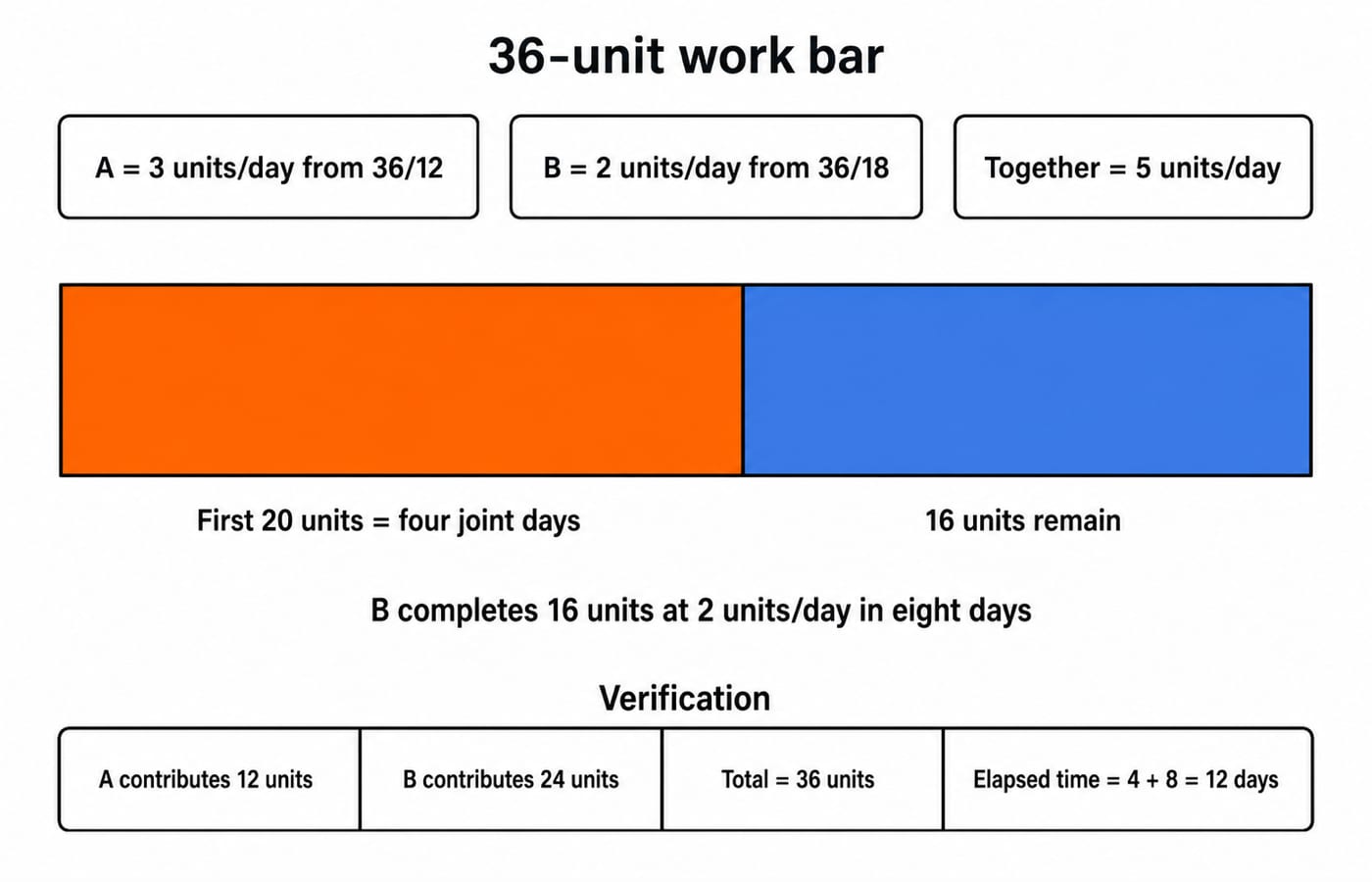
A completes a job in 12 days and B in 18 days. Choose LCM(12,18) = 36 work units. A's rate is 36/12 = 3 units/day; B's rate is 36/18 = 2 units/day. Together they complete 5 units/day, so uninterrupted joint work takes 36/5 = 7.2 days.
Now let both work for four days before A leaves. They first complete 4 x 5 = 20 units, leaving 36 - 20 = 16 units. B completes the remainder in 16/2 = 8 days. Total elapsed time is 4 + 8 = 12 days.
Verify by contribution: A completes 4 x 3 = 12 units. B completes 4 x 2 + 8 x 2 = 24 units. Their total is 12 + 24 = 36, exactly one job. Add rates, not completion times, and keep the time unit consistent. The expression 12 + 18 has no useful meaning for their combined completion time.
Turn formulas into a 30-minute mixed practice loop
Set a 30-minute practice budget and attempt 18 questions, three per topic. Use 18 minutes for a first pass, 8 to re-solve marked items without solutions, and 4 to update the error log. Check: 18 + 8 + 4 = 30 minutes.
For a 13/18 score, classify the five misses: two setup errors, one formula-recall error and two arithmetic errors. Redraw the base or work unit for setup, retrieve the formula from memory for recall, and recompute the final two lines for arithmetic.
Retest with six fresh questions, one per topic. A 5/6 with Time and Work still wrong means only that topic carries forward. Continue practising with KnowledgeGate's over 2,100 published questions across these broader Mathematics and Aptitude topics and several exams. The Aptitude for Placements: A 30-Day Practice Routine offers an adjacent daily-practice model.
The short version and next step
Reduce Number System patterns, preserve Ratio bases, use Percentage multipliers, test Series through differences, separate SI from the updated CI base, then convert work into rates. Start with the 12-question diagnostic and carry only failed topics into the 30-minute loop. That requires no purchase. Once concepts are covered, the UGC NET Paper 1 Test Series offers a structured way to test Paper I readiness.
Keep learning

Scope and Importance of International Business: UGC NET Commerce Examples
Exports, licensing and foreign investment cross borders in different ways. Separate their roles, compare entry modes and work through the opportunity-cost arithmetic behind comparative advantage.
Updated 13 Oct 20266 min readNET Strategy & Updates

FEMA Explained: Objectives, Key Provisions and UGC NET Commerce Examples
Two equal overseas payments can fall into different FEMA categories. Learn to classify transactions, apply an exporter checklist and calculate a penalty ceiling without counting the first day twice.
Updated 9 Oct 20265 min readNET Strategy & Updates

CSIR NET Normalization: Percentile and Normalised Marks Worked Out
Can 120 and 130 raw marks mean the same percentile? Follow a two-shift example from raw marks to percentile and normalised marks, then check which number belongs beside a cutoff.
Updated 5 Oct 20265 min readNET Strategy & Updates

UGC NET Eligibility for CA Holders: Equivalence, Marks and Subject Choice
Completed CA but have no MCom certificate? Understand the equivalence route, check the percentage requirement and resolve marks or subject-entry doubts before applying for NET.
30 Sep 20264 min readNET Strategy & Updates