Which Skill Sets Are in Demand for Tech Jobs?
Explore the technical and human skill combinations showing up across software, AI, data, cloud, and security roles—and how students can prove them with focused projects.
KnowledgeGate Team
Exam prep & CS education
21 Oct 20265 min read
When you look at technology job descriptions, it can feel as if every company wants a different programming language, framework, cloud platform, and AI tool.
The useful question is not “Which tool is trending?” but “Which combination of skills helps me do the work of the role I want?”
Demand varies by role, employer, location, and experience level. Still, recent employer and hiring-platform research points to a few broad themes: AI and data fluency, secure and reliable systems, strong technical foundations, and the ability to explain and apply your work. Use these as signals, then check them against current job descriptions.
What current skills reports suggest
LinkedIn’s Skills on the Rise 2026 identifies fast-growing skills across 12 markets using changes in skills members add to their profiles and the skills associated with hiring success. Its global overview describes AI skills moving beyond experimentation toward building, improving, and deploying AI and machine-learning systems. It also highlights collaboration, communication, and risk management. These are broad signals, not a promise that every tech vacancy requires the same toolkit.
The World Economic Forum’s Future of Jobs Report 2025 draws on employer expectations for 2025–2030. It identifies AI and big data, networks and cybersecurity, and technological literacy among the fastest-growing skills, while analytical thinking, creative thinking, resilience, and curiosity also remain relevant. Together, these reports suggest that employers value combinations: technical depth plus judgment, communication, and the ability to keep learning.
Skill sets that show up across technology roles
1. Programming and software engineering fundamentals
Being able to write code is a starting point. Employers also need people who can understand an existing codebase, break a problem into manageable parts, use version control, debug errors, test changes, and explain trade-offs. Data structures and algorithms remain useful for problem solving and technical interviews, but your preparation should also include practical engineering habits: readable code, meaningful tests, and clear documentation.
Choose one language that fits your target role and build confidence with it before collecting several languages on your résumé. For many student projects, Python or Java can be a practical starting point; the right choice depends on the jobs you are targeting.
2. Practical AI fluency
AI literacy is broader than writing prompts. For a software role, it can mean using AI tools carefully while checking generated code, understanding model limitations, and protecting private data. For an AI or machine-learning role, the work goes further: prepare data, select and evaluate a model, compare it with a baseline, and explain where it fails.
A useful portfolio project shows your reasoning, not just an API call. Document the problem, the data you used, how you checked the output, and what a human should verify. Avoid presenting an AI-generated result as reliable without testing it.
3. Data skills: SQL, analysis, and data quality
Many technology teams make decisions using application, product, or operational data. SQL helps you retrieve and combine data; Python or another analysis tool can help clean and explore it. Statistics and visualization matter because a chart is only useful when the question, assumptions, and limits are clear.
For data engineering or machine-learning work, add pipeline concepts: how data is collected, transformed, validated, and made available to other systems. Data quality, access control, and privacy are part of the work—not afterthoughts.
4. Cloud, networking, and security basics
Modern applications depend on infrastructure. Even if you are not applying for a cloud or security role, familiarity with Linux, HTTP, networks, databases, deployment, logs, and access permissions helps you work effectively with the systems around your code. For a specialist role, go deeper into one cloud platform or security area and practise it in a controlled project environment.
Security is also a habit: validate inputs, avoid exposing secrets, apply least privilege, and consider what could go wrong when a feature is used in an unexpected way. These basics make a project more credible than a long list of tools.
5. Problem solving and communication
Technical work rarely happens in isolation. You may need to clarify an unclear requirement, ask for a code review, write a useful bug report, or explain why a solution is slower but safer. Analytical thinking, teamwork, adaptability, and clear communication help turn technical knowledge into work others can use. They strengthen a technical skill set; they do not replace it.
Build a skill stack for the role you want
Start with one role family rather than trying to prepare for every technology job at once. The diagram below shows a shared foundation branching into role-specific skills and a concrete way to demonstrate them.
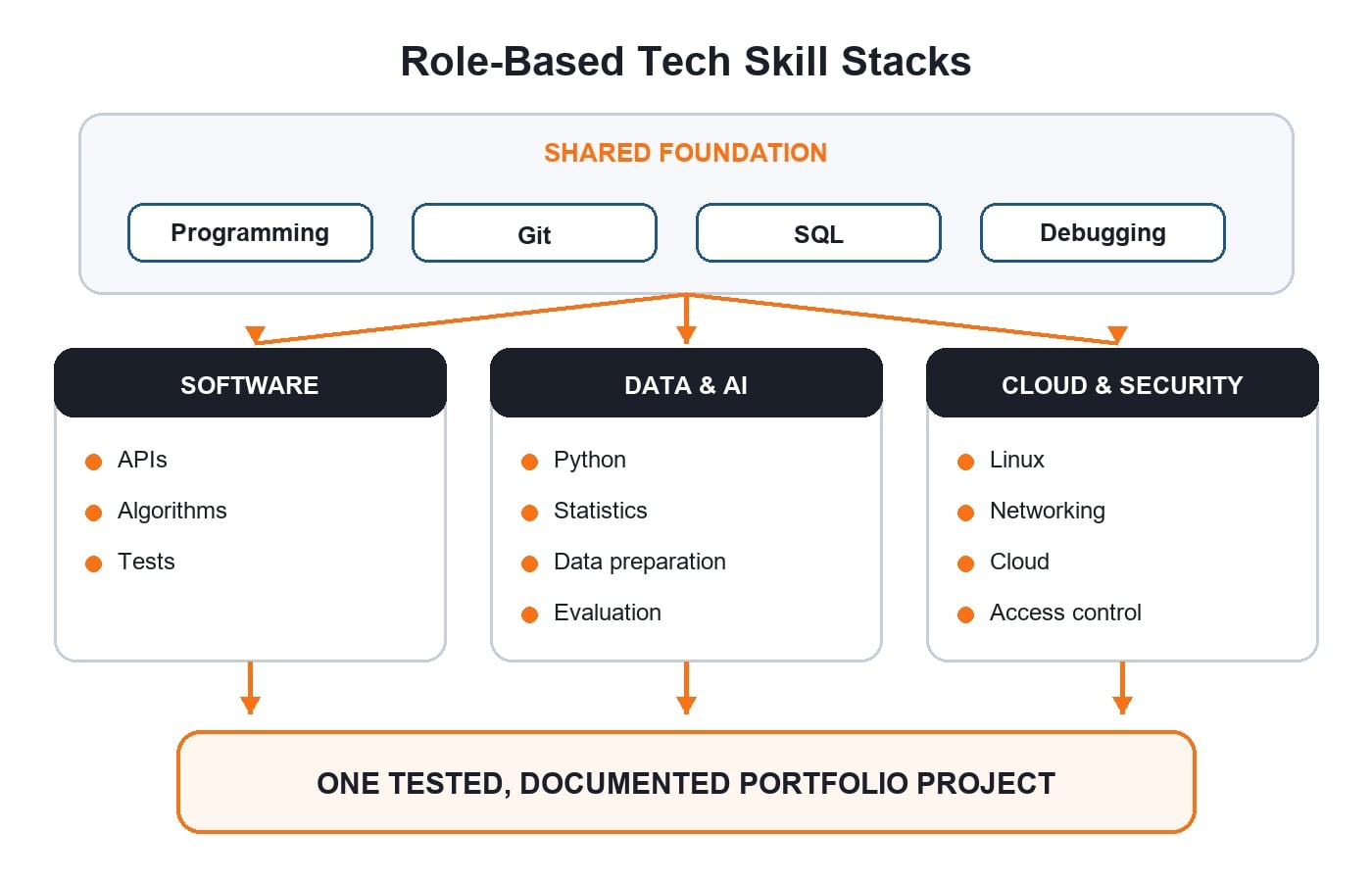
For example, a software-development portfolio might include a small API-backed application with tests and a clear README. A data project could show a cleaned dataset, SQL queries, a short analysis, and the limits of its conclusions. A cloud or security project might document a deployment, the permissions it needs, and how logs help diagnose a failure.
A project does not need to be large. It should be complete enough that another person can understand what problem it solves, run it, inspect the code, and see how you tested it. If you claim a performance improvement, measure it and explain the comparison. Never invent results to make a résumé bullet sound stronger.
A practical way to choose what to learn next
Collect real job descriptions. Find several entry-level postings for one role and location. Note the skills that appear repeatedly, separating required foundations from tools that appear in only one listing.
Check your current evidence. For each repeated skill, ask whether you can explain it, use it in a small task, and show an example. A keyword on a résumé is not proof by itself.
Choose one gap. Pick the missing skill that blocks your target role most. Learn the concept, practise it, and use it in a project rather than starting multiple courses at once.
Make the evidence easy to review. Keep the repository organized, add setup instructions and tests, and prepare a short explanation of your decisions and limitations. Ask a peer or mentor to review it, then improve it.
For structured practice, explore KnowledgeGate courses in Python, AI for Placement, and Coding for Placements. You can also read AI Is Changing Campus Hiring: How Students Can Show Their Skills for advice on presenting your abilities, and the TCS NQT coding-question guide for a concrete example of building programming evidence.
The takeaway
There is no universal checklist that guarantees a tech job. A stronger approach is to combine reliable fundamentals with one role-specific area, then demonstrate the combination through a tested project and a clear explanation. Let current job descriptions guide your next learning choice, and revisit that choice as your goals and the market change.
Keep learning
AI Is Changing Campus Hiring: How Students Can Show Their Skills
Make your technical skills visible in AI-assisted campus hiring with clear resume evidence, one explainable project, and a practical interview routine.
15 Oct 20265 min readPlacement Preparation
Resume Checklist: What Must Be Included and What Must Be Left Out
3 Oct 20264 min readPlacement Preparation
LDAP Explained: DNs, Bind, Search Filters, and a Developer Login Flow
Build one LDAP mental model from directory tree to login. Trace a service bind, escaped user search, password-verifying user bind, and group-based role check.
Updated 13 Aug 20265 min readPlacement Preparation

Group Discussion Rounds for Placements: How GD Is Scored and How to Prepare Topics
Speaking more is not the same as scoring more in a GD. Learn what panels observe, how to prepare topic notes, and how to practise useful contributions.
11 Aug 20266 min readPlacement Preparation