Commutative Property and Abelian Groups: Tests, Worked Examples and Exam Traps
Learn how to separate commutativity from the other group axioms, test custom operations step by step, and avoid the usual classification traps.
KnowledgeGate Team
Exam prep & CS education
Updated 13 Oct 20266 min read
Commutativity looks like a simple swap rule, but that simplicity causes a common mistake: a commutative operation need not form a group, and a group need not be Abelian. Swapping operands, changing brackets, finding an identity and finding inverses are separate checks. A custom operation needs five property checks; a finite Cayley table can reveal commutativity, and one counterexample is enough to disprove it in S_3.
Commutative property versus Abelian group: the extra condition
A binary operation * on a set G is commutative when a*b = b*a for every a,b in G. A group already has closure, associativity, a two-sided identity and an inverse for every element. It is Abelian only when commutativity also holds. Every Abelian group is a group, but not every group is Abelian.
Swapping is different from regrouping. On the integers, define x ⊕ y = x^2 + y^2. The operation is commutative because x^2 + y^2 = y^2 + x^2. It is not associative. With x=1, y=2 and z=3:
(1 ⊕ 2) ⊕ 3 = 5 ⊕ 3 = 25 + 9 = 341 ⊕ (2 ⊕ 3) = 1 ⊕ 13 = 1 + 169 = 170
One unequal triple disproves associativity. Several successful trials would not prove it. The GATE CS Exam Preparation page gives the broader catalog route.
Fully worked example: prove that shifted addition is an Abelian group
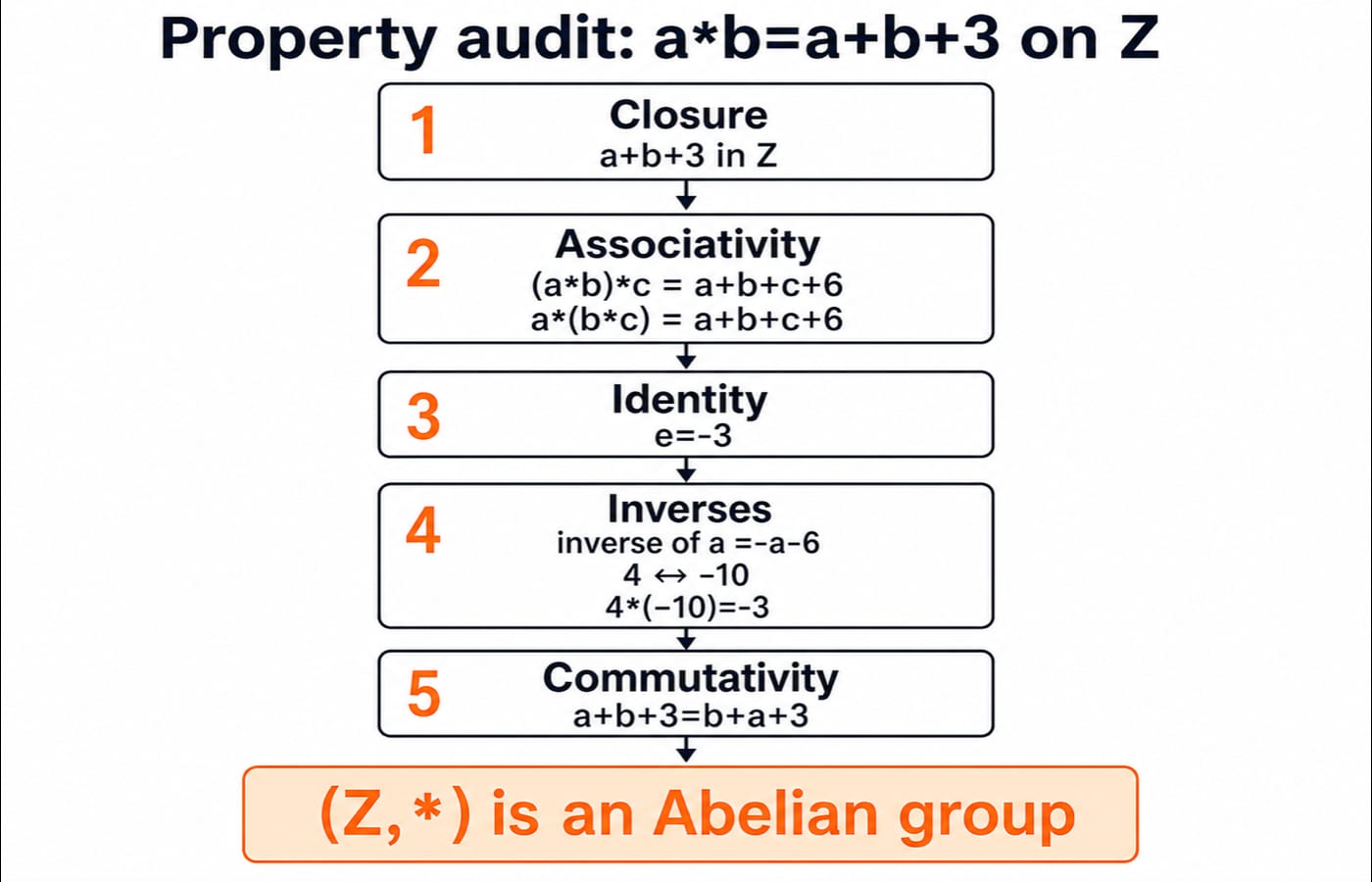
Let G=Z and define a*b = a+b+3. Symmetry is not enough, so check every property in order.
For inverse uniqueness, left- and right-sided group equations, and reversed product laws, use Inverse Property in Group Theory: Concepts and a Complete Worked Example. The calculation below treats inverses as one of five properties required for an Abelian-group classification.
Closure: If
a,bare integers, thena+b+3is also an integer.Associativity:
(a*b)*c = (a+b+3)+c+3 = a+b+c+6a*(b*c) = a+(b+c+3)+3 = a+b+c+6
Both parenthesisations give the same result.
Identity: Solve instead of guessing. From
a*e=a, we geta+e+3=a, soe=-3. The other side also works:e*a = -3+a+3 = a.Inverse: The inverse of
amust combine with it to givee=-3. Solvinga*b=-3givesa+b+3=-3, henceb=-a-6, an integer for every integera. It also works on the left. Fora=4, its inverse is-10, and4*(-10)=4-10+3=-3=(-10)*4.Commutativity: For arbitrary integers,
a*b = a+b+3 = b+a+3 = b*a.
All five checks pass, so (Z,*) is an Abelian group. Commutativity did not supply associativity, an identity or inverses. Every line of the audit was needed.
Finite Abelian example: read symmetry in the Cayley table of Z_4
Take Z_4={0,1,2,3} with addition modulo 4, written +_4. Its Cayley table is:
| 0 | 1 | 2 | 3 |
|---|---|---|---|---|
0 | 0 | 1 | 2 | 3 |
1 | 1 | 2 | 3 | 0 |
2 | 2 | 3 | 0 | 1 |
3 | 3 | 0 | 1 | 2 |
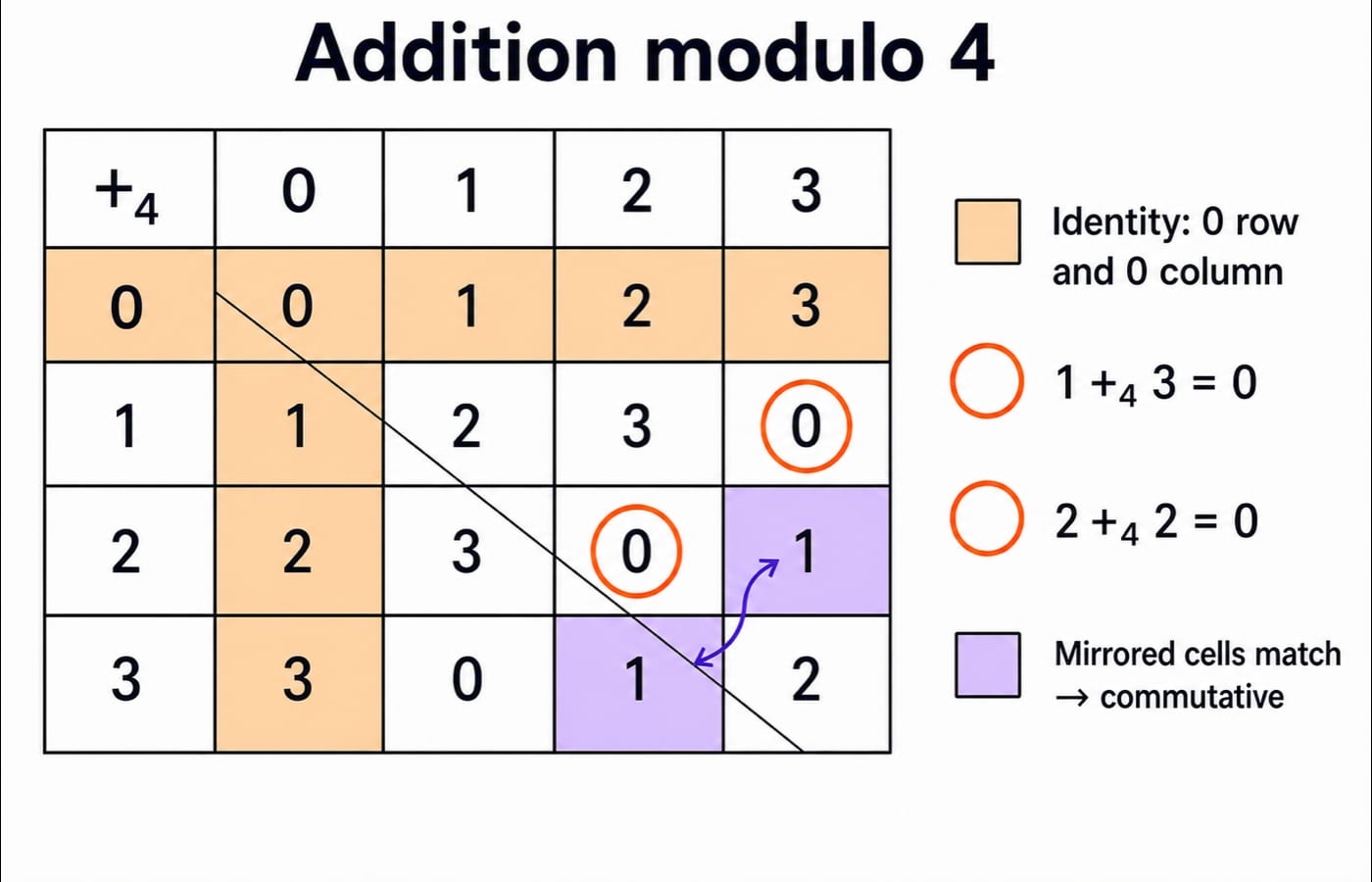
All entries lie in Z_4, so closure holds. Row 0 and column 0 reproduce the headers, making 0 the two-sided identity. The zero cells give the inverse pairs 0 <-> 0, 1 <-> 3 and 2 <-> 2.
Reflection across the main diagonal leaves the table unchanged. For example, row 1, column 3 and row 3, column 1 both contain 0. Row 2, column 3 and row 3, column 2 both contain 1. This symmetry shows a+_4 b = b+_4 a. A symmetric table proves commutativity for the displayed operation, but not associativity by itself. Here associativity follows from integer addition modulo 4. Thus Z_4 under addition modulo 4 is a finite Abelian group.
A valid group need not be Abelian: the S_3 counterexample
For finite-versus-infinite groups, cyclicity, and element-order classification, use Classification of Finite and Infinite Groups: Orders, Cyclicity and Worked Examples. The S_3 calculation here answers a narrower question: reversing two products changes the result, so commutativity fails.
S_3 is the group of six permutations of {1,2,3} under composition:
e, (12), (13), (23), (123), (132).
Use the convention that the right-hand permutation acts first. Let a=(12) and b=(23). For a o b=(12)o(23), track each input through (23) and then (12):
1 -> 22 -> 33 -> 1
Therefore a o b=(123). Reverse the order. The composition b o a=(23)o(12) maps:
1 -> 33 -> 22 -> 1
Therefore b o a=(132). Since (123) != (132), composition is not commutative in S_3. One pair disproves the universal law. S_3 is a non-Abelian group, showing that associativity, identity and inverses do not force commutativity. This does not make every permutation group non-Abelian; small or special ones can commute.
Classify familiar sets and operations without pattern matching
Structure | Identity | Inverse check | Commutative? | Classification |
|---|---|---|---|---|
|
| inverse of | Yes | Abelian group |
|
| inverse of | Yes | Abelian group |
|
|
| Yes | Not a group |
|
|
| Yes | Not a group |
For binary strings over Sigma={0,1}, concatenation has the empty string epsilon as a two-sided identity. However, the string 0 has no inverse that can concatenate with it to produce epsilon. Concatenation is also noncommutative because 0 followed by 1 gives 01, while the reverse gives 10. Thus (Sigma*, concatenation) is a noncommutative monoid, not a group.
How exam-style questions test commutativity and Abelian groups
Most questions use one of four tasks: identify the extra Abelian condition, classify a familiar set-operation pair, expand a custom operation through every property, or read a Cayley or truth table for symmetry. Mirrored table entries test commutativity. Identity, inverses and associativity remain separate checks.
A useful proof starts with a group satisfying (ab)^2=a^2b^2 for every a,b. Expand it:
abab = aabb.
Left-multiply by a^-1 to obtain bab=abb. Then right-multiply by b^-1 to obtain ba=ab. Hence the group is Abelian. These cancellations are valid because inverses and associativity are already available in a group.
Practise all four task types, not only the one you find easiest. For timed mixed practice, use the GATE Test Series: Mocks and Topic-wise Tests.
Common traps and reliable proof moves
Treating examples as proof: To prove commutativity, work with arbitrary
a,b. To disprove it, one counterexample such as(12)o(23) != (23)o(12)is enough.Swapping instead of regrouping: Associativity compares
(a*b)*cwitha*(b*c). Write both before calculating.Forgetting the set: Multiplication is commutative on
Q, but(Q, multiplication)is not a group because0has no inverse. Removing0changes the answer.Checking only one side: A convenient right identity or one inverse is insufficient. Verify both sides and cover every element.
Trusting table symmetry too soon: A symmetric Cayley table establishes commutativity, not all group axioms.
Use one fixed audit: set and operation, closure, associativity, two-sided identity, inverse for every element, then commutativity.
Short version and the next step
Commutativity means a*b=b*a. An Abelian group is a group that also satisfies this law. Shifted addition a*b=a+b+3 passed all five checks with identity -3, while S_3 failed commutativity for the two chosen transpositions.
Now rebuild the Z_4 table and redo the shifted-addition proof from a blank page. Then use GATE Guidance by Sanchit Sir as a sequenced route through Discrete Mathematics. Repeat the audit in order until no property is skipped.
Keep learning
Graphical Method in Linear Programming: Feasible Region, Corner Points and Optimality with a Worked Example
Learn the two-variable graphical method in the right order, then solve and audit a complete maximisation model without trusting the sketch alone.
Updated 21 Oct 20265 min readEngineering Mathematics
Duality in LP: Construct the Dual, Solve a Worked Example, and Apply Key Properties
Learn a reliable matrix-first method to form an LP dual, solve both programs to value 21, and use duality properties to check optimality and avoid sign errors.
Updated 17 Oct 20266 min readEngineering Mathematics
Closure, Semigroup and Monoid: Worked Algebraic Structure Examples
Learn a reliable order for testing closure, associativity and identity. Worked tables and counterexamples show exactly when a structure becomes a semigroup or monoid.
Updated 9 Oct 20266 min readEngineering Mathematics
Classification of Finite and Infinite Groups: Orders, Cyclicity and Worked Examples
Learn how group axioms, group order, element order and generators classify finite and infinite groups through complete, checkable examples.
Updated 4 Oct 20266 min readEngineering Mathematics