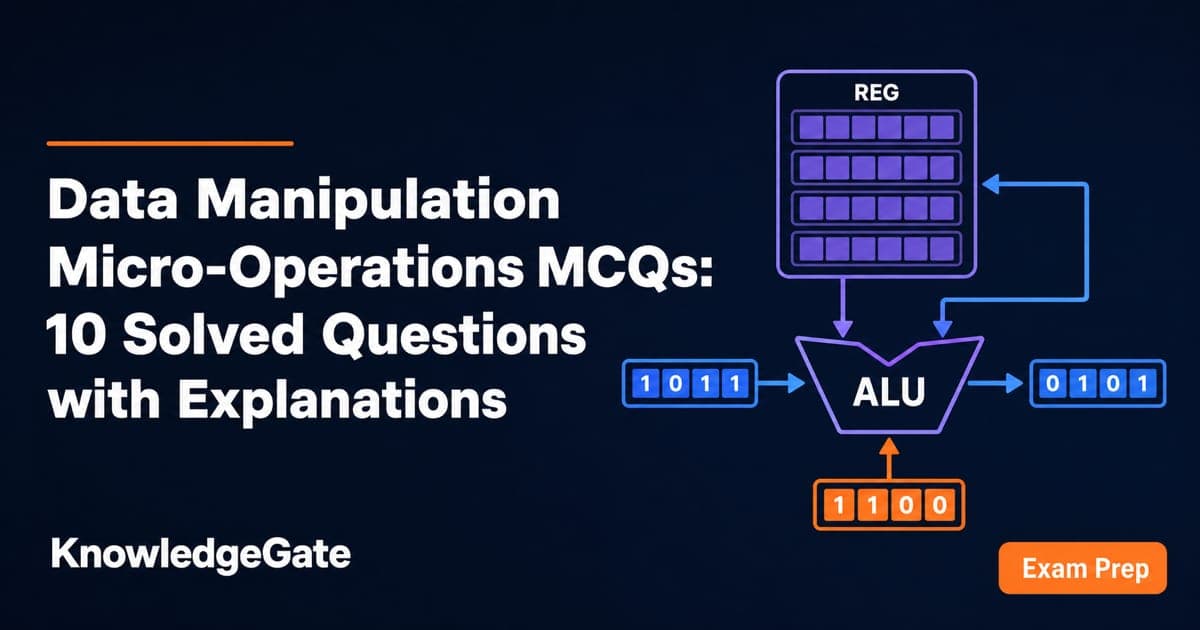
Data Manipulation Micro-Operations MCQs: 10 Solved Questions with Explanations
Solve 10 micro-operations MCQs with step-by-step explanations of shifts, ALU behaviour, register logic, Booth recoding and control width.
K
KnowledgeGate Team
Exam prep & CS education
Updated 20 Oct 2026·7 min read
Micro-operation options often turn on one distinction: sign-preserving versus logical shift, destination versus source, or encoded versus simultaneous operations. Mark the representation, destination and control interpretation before choosing an answer.
Data manipulation micro-operations: the four checks to make first
Class or notation
What to check
Arithmetic micro-operation
It changes a numeric value, such as addition or increment.
Logic micro-operation
It acts independently on corresponding bits.
Shift micro-operation
It moves bits to new positions.
R1 ← expression
The register on the left is the destination.
Let R1 = 1010 and R2 = 1100. XOR gives R1 ← R1 ⊕ R2 = 0110; R2 stays 1100. For signed 8-bit -6 = 11111010, arithmetic right shift copies the sign bit and gives 11111101 = -3. A 4-bit left shift takes +3 = 0011 to 0110 = +6, but takes +5 = 0101 to 1010. Since 1010 represents -6, not +10, the second shift overflows.
Always identify the representation, mark the destination, operate at the original width, then interpret the result in its original signed or unsigned context.
Micro-operations MCQs 1-3: signed shifts, accumulator state and cycle minimisation
Question 1
UGC NET 2023, Computer Science, Paper 2 (December)
The microoperation which divides a signed binary number by 2 is:
A. Circular shift
B. Logical shift
C. Arithmetic shift right
D. Arithmetic shift left
Correct answer: C. Arithmetic shift right.
Signed two's-complement division by two must copy the old sign bit. Thus 11111010 (-6) becomes 11111101 (-3). Logical right shift injects 0, circular shift rotates a bit, and arithmetic left shift moves towards multiplication. Open the solved question.
Question 2
ISRO 2008, Computer Science
Consider the following Assembly language program
Code
MVIA   30 H
ACI    30 H
XRA    A
POP    H
After the execution of the above program, the contents of the accumulator will be
A. 30 H
B. 60 H
C. 00 H
D. contents of stack
Correct answer: C. 00 H.
Trace through the final accumulator write. MVI A, 30H loads 30H, and ACI 30H updates it. Then XRA A applies b ⊕ b = 0 to every bit, producing 00H. POP H changes H-L, not the accumulator. Open the solved question.
Question 3
ISRO 2020, Computer Science
A non-pipelined CPU has 12 general purpose registers (R0, R1, R2, ..... R12). Following operation are supported:
Code
ADD Ra, Rb, Rr Add Ra to Rb and store the result in Rr
MUL Ra, Rb, Rr Multiply Ra to Rb and store the result in Rr
MUL operations takes two clock cycles, ADD takes one clock cycle. Calculate minimum number of clock cycles required to compute the value of the expression XY + XYZ + YZ. The variables X, Y, Z are initially available in registers R0, R1 and R2 and contents of these registers must not be modified.
A. 5
B. 6
C. 7
D. 8
Correct answer: B. 6.
Factor XY + XYZ + YZ = Y(X + XZ + Z), then preserve R0 to R2:
MUL R0, R2, R3 computes XZ in 2 cycles.
ADD R0, R3, R4 computes X + XZ in 1 cycle.
ADD R4, R2, R5 computes X + XZ + Z in 1 cycle.
MUL R1, R5, R6 multiplies by Y in 2 cycles.
The total is 2 + 1 + 1 + 2 = 6 cycles. Two multiplications and two additions are necessary, so 6 is minimal. Open the solved question.
Micro-operations MCQs 4-6: ALU components, shift overflow and doubling
Question 4
UGC NET 2024, Computer Science, Paper 2 (August)
Match List I with List II
List - I (computing systems)
List - II (working/output)
Choose the correct answer from the options given below :
A. (A)-(II), (B)-(III), (C)-(IV), (D)-(I)
B. (A)-(IV), (B)-(II), (C)-(III), (D)-(I)
C. (A)-(IV), (B)-(I), (C)-(II), (D)-(III)
D. (A)-(II), (B)-(IV), (C)-(III), (D)-(I)
Correct answer: C. (A)-(IV), (B)-(I), (C)-(II), (D)-(III).
A half adder produces sum and carry, so A matches IV. A decoder maps n inputs to 2^n outputs, so B matches I. A register is CPU storage, matching II; main memory holds the running program and data, matching III. Therefore A-IV, B-I, C-II, D-III. Open the solved question.
Question 5
UPPSC Polytechnic Lecturer 2022, Computer Science
Which one of the following micro-operations in ALU causes overflow sometimes?
A. Logical shift left
B. Arithmetic shift left
C. Circular shift right
D. None of the above
Correct answer: B. Arithmetic shift left.
Arithmetic left shift means signed multiplication by two only within range. In four bits, 0101 (+5) << 1 = 1010, which means -6 instead of the required +10. That mismatch is overflow. Circular shift is rotation; logical shift has no signed-arithmetic interpretation. Open the solved question.
Question 6
KVS 2018, Computer Science
Shifting a register content to left by one bit is equivalent to _____.
A. Division by 2
B. Addition by 2
C. Multiplication by 2
D. Subtraction by 2
Correct answer: C. Multiplication by 2.
Each retained bit moves to the next higher place value. Thus 0011 (base 2) = 3 becomes 0110 (base 2) = 6, and 3 x 2 = 6. This requires that no significant bit be lost, as Question 5 showed. Open the solved question.
Micro-operations MCQs 7-8: destination registers and operation classes
Question 7
DSSSB 2021, Computer Science, TGT Shift 5
The 4-bit registers R1 and R2 initially have the following values.
R1 : 1010
R2 : 1100
What is the content of R1 and R2 after execution of this micro-operation?
R1 ← R1 ⊕ R2
⊕ is a symbol of Ex-OR.
A. R1 : 0110, R2 : 1100
B. R1 : 1010, R2 : 0110
C. R1 : 0110, R2 : 0110
D. R1 : 1010, R2 : 1100
Correct answer: A. R1 : 0110, R2 : 1100.
Column by column, 1⊕1=0, 0⊕1=1, 1⊕0=1, and 0⊕0=0, so 1010 ⊕ 1100 = 0110. The arrow writes only to R1. R2 stays 1100, making A the only correct pair. Open the solved question.
Question 8
DSSSB 2021, Computer Science
By how many different ways micro-operations encountered in digital computers are classified?
A. One
B. Two
C. Three
D. Four
Correct answer: D. Four.
The four classes are register-transfer, arithmetic, logic and shift. Their examples are R2 ← R1, R3 ← R1 + R2, R1 ← R1 ⊕ R2, and R1 ← shl R1. Therefore D is correct.
Micro-operations MCQs 9-10: Booth recoding and micro-instruction width
Question 9
GATE 1996
Booth's algorithm for integer multiplication gives worst performance when the multiplier pattern is
A. 101010...1010
B. 100000...0001
C. 111111...1111
D. 011111...1110
Correct answer: A. 101010...1010.
Booth recoding saves work on long runs of 1s because only their boundaries trigger actions. For 10101010, with q[-1] = 0, adjacent pairs alternate between 10 and 01 at almost every step, causing repeated subtract and add actions. 01111110 has only two run boundaries, so A is worst.
Question 10
GATE 1997
A micro-instruction is to be designed to specify:
1. none or one of three micro-operations of one kind; and
2. any subset of up to six micro-operations of another kind.
What is the minimum number of bits in the micro-instruction?
A. 9
B. 5
C. 8
D. None of the above
Correct answer: C. 8.
The first kind has four exclusive choices: none or one of three operations. Thus log2(4) = 2 bits suffice. Any subset of the six independent operations in the second kind may coexist, requiring a six-bit mask. The minimum is 2 + 6 = 8 bits. A one-of-six code would wrongly prevent simultaneous operations.
For full control-unit field sizing across horizontal and vertical formats, use Hardwired and Microprogrammed Control Unit MCQs. Question 10 here isolates the difference between an exclusive code and a simultaneous enable mask.
The traps these data manipulation micro-operations MCQs expose
Trap
Question
One-line check
Sign-preserving versus zero-fill shift
Q1
A signed right shift must copy the sign bit.
Final write versus intermediate accumulator value
Q2
Trace every instruction through the last accumulator write.
Algebraic factorisation versus literal execution
Q3
Factor first, then count the required operations.
Signed overflow versus raw bit movement
Q5-Q6
Preserve the width and reinterpret the shifted result.
Source versus destination register
Q7
The left side of ← is the only destination.
Exclusive code versus simultaneous enable mask
Q10
Ask whether choices exclude one another or coexist.
For a 60-second check, circle the representation, mark the left side of ←, write every logic-operation bit, preserve the width, and decide whether control choices exclude or coexist.
Data manipulation micro-operations: the next practice step
Retest Questions 1, 3, 5, 7, 9 and 10 without looking. Practise signed shifts, algebraic scheduling, overflow, destination semantics, Booth transitions and control encoding. Require one intermediate line per answer. If you cannot produce it, review the rule rather than memorising the option.
For sequenced Computer Organization study alongside the rest of COA, continue with GATE Guidance by Sanchit Sir.
The short version: preserve the representation, trace the destination, and count control choices according to whether they exclude or coexist. Skip any one of those checks and a familiar-looking option can still be wrong.