Digital India and e-Governance: Models, Service Architecture and Worked ICT Examples
See how an e-governance service works from request to decision. Follow a fictional application, calculate workload and uptime, and test its controls.
KnowledgeGate Team
Exam prep & CS education
Updated 23 Aug 20265 min read
Digital India questions can look like portals and abbreviations to memorise. A strong answer connects the service request to the responsible government unit, follows data through the service architecture, and checks trust and inclusion. The fictional RES-CERT trace below also makes capacity and availability calculations concrete.
Related reading: UPI system design and cyber and information security.
Digital India, digitisation, digitalisation and e-governance are not synonyms
Suppose a district office handles residence certificates. Digitisation turns a paper certificate into a searchable PDF. Digitalisation replaces its paper hand-off with online submission, validation and routing. E-government is institutional use of ICT for administration and service delivery. E-governance adds rules, accountability, participation, transparency and service outcomes. Digital India connects digitised records, digital workflows, electronic service delivery and governance outcomes.
The portal, mobile page and assisted counter are front-office channels. Identity checks, routing, departmental records, approval, audit and notifications form the back office. A polished portal with a broken back office is not end-to-end e-governance. Use the GATE CS Exam Preparation route to connect this ICT reasoning with broader computing concepts.
The four interaction models: G2C, G2B, G2G and G2E
Model | Parties | Fictional transaction | Direction |
|---|---|---|---|
G2C, Government to Citizen | District office and citizen C-031 | Residence-certificate status | District office to C-031 |
G2B, Government to Business | Licensing office and firm B-204 | Application renewal | Licensing office to B-204 |
G2G, Government to Government | District-07 and State Registry-02 | Request for a verified field | District-07 to State Registry-02 |
G2E, Government to Employee | Department HR and employee E-118 | Leave decision | Department HR to E-118 |
One service can mix models. C-031 makes a G2C request, while District-07 makes a G2G check with State Registry-02. Each leg, not the portal, sets the label.
Viewing eligibility is information access. Submitting APP-1042, receiving its decision and recording audit events is a transaction. The IBPS SO IT Professional Knowledge: Subject Topic Map organises adjacent computing concepts for broader IT revision.
What happens inside an end-to-end digital public service
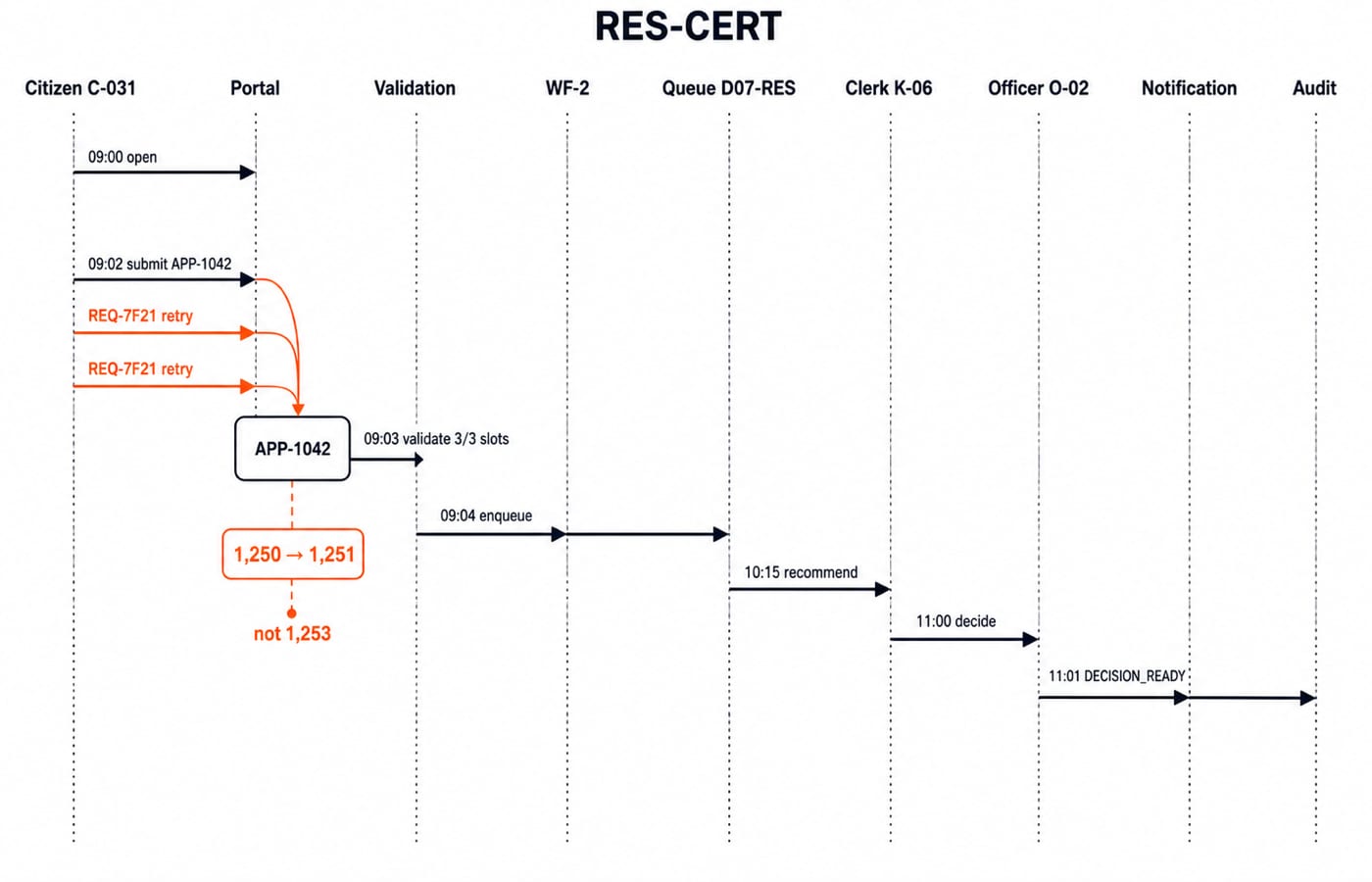
Consider a fictional residence-certificate service. At 09:00, citizen C-031 opens service code RES-CERT. At 09:02, the portal receives APP-1042 for district 07 with three documents. At 09:03, validation confirms all three document slots. At 09:04, workflow WF-2 enqueues it in D07-RES. Clerk K-06 recommends a decision at 10:15; officer O-02 decides at 11:00; at 11:01, the service sends DECISION_READY and records the audit event.
Now add a network timeout. The 09:02 submission is repeated twice with idempotency key REQ-7F21. Both retries must return the existing APP-1042, not create extra rows. The application counter therefore moves from 1,250 to 1,251, not 1,253.
The channel accepts the request, authentication establishes the user, and form validation checks inputs. A service registry identifies the process. Workflow routes it, the departmental system supports review, and the decision store preserves the result. Notification reports status, while audit records who did what and when. Together, these layers turn a portal submission into a traceable government decision.
Worked example: queue capacity, backlog and service availability
Assume 240 requests per working day, 6 clerks, 5 complete reviews per clerk-hour and 6 productive review hours per clerk-day.
Daily capacity is:
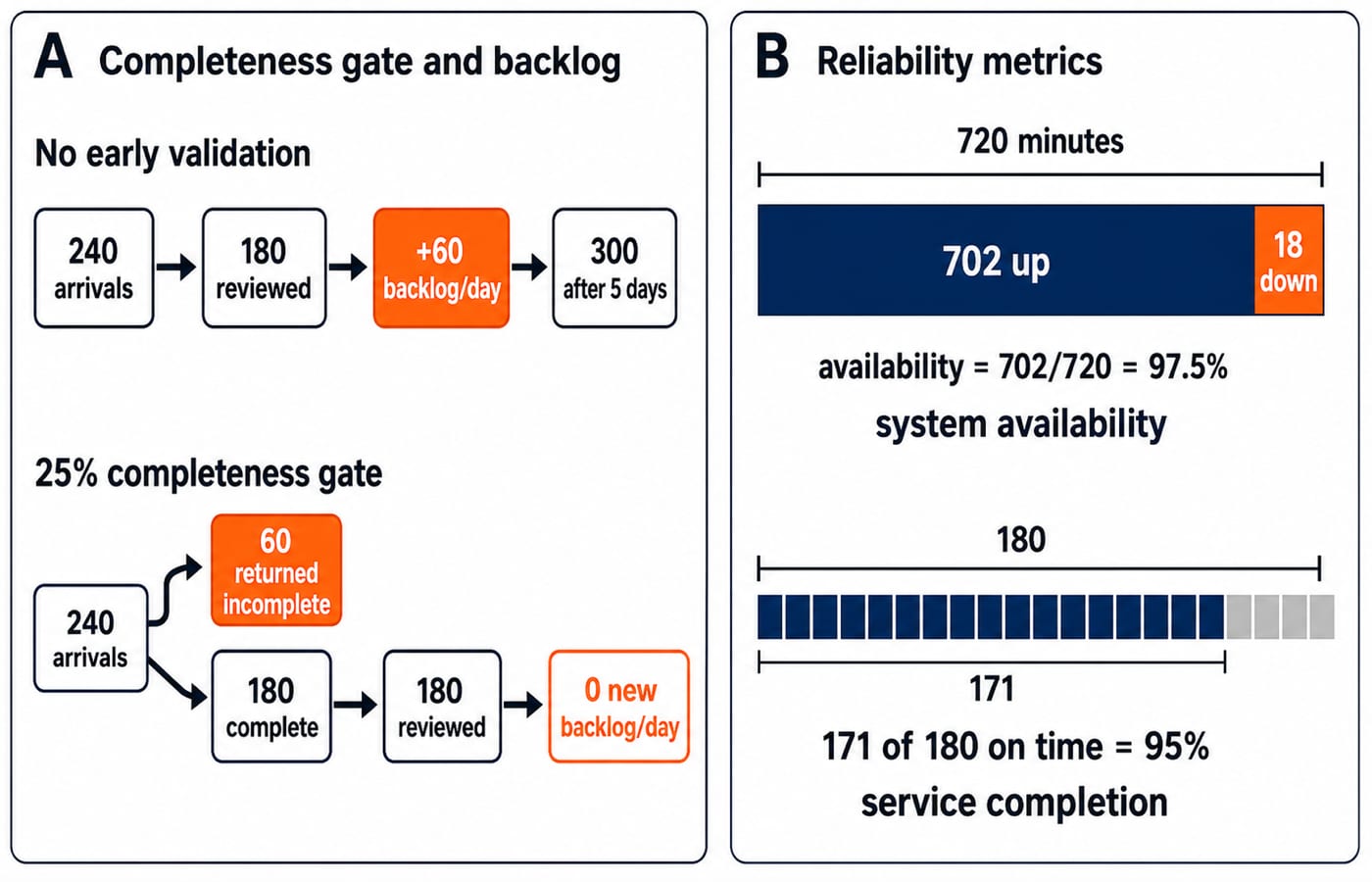
6 clerks x 5 requests per hour x 6 hours = 180 requests per day
Without early validation, daily backlog growth is:
240 arrivals - 180 reviews = 60 requests per day
After five working days: 60 x 5 = 300 requests.
A completeness gate identifies 25% as incomplete, so 240 x 0.25 = 60 applications return before clerk review. The complete queue gets 240 - 60 = 180, matching capacity. New backlog growth is 180 - 180 = 0. Incomplete cases have not vanished. Measure their resubmissions, and do not mistake workload routing for citizen satisfaction.
Availability is separate. In a 720-minute window, 18 unavailable minutes leave 720 - 18 = 702 uptime minutes:
Availability = (702 / 720) x 100 = 97.5%
If 171 of 180 complete cases finish on time, timely completion is (171 / 180) x 100 = 95%. Availability measures portal usability; timely completion measures the service promise.
Trust, security, privacy and inclusion are design requirements
Authentication establishes identity. Authorization decides permissions. Auditability preserves evidence of actions.
Role | Allowed on APP-1042 | Not allowed |
|---|---|---|
Citizen C-031 | Read own form, documents and status | Set a decision |
Clerk K-06 | Read three document slots and write a recommendation | Alter citizen identity data |
Officer O-02 | Approve or reject | Erase earlier audit events |
Auditor A-09 | Read the event history | Alter the application |
Match controls to threats. REQ-7F21 stops retries creating duplicates. Object-level authorization blocks access through a guessed application number. Encrypted transport and integrity checks address alteration in transit. Purpose limitation and data minimisation reduce excessive collection. Timestamped actor and event records support disputed-action review. No single control secures the whole service.
Inclusion requires assisted counters, save-and-resume on weak connections, keyboard-operable forms, clear errors, multilingual instructions and a non-digital escalation path. High availability proves neither accessibility, privacy, fairness nor successful delivery.
Common Digital India and e-governance traps
Calling every scan e-governance. A scan is digitisation. Governance needs a process, decision responsibility and measurable outcomes.
Classifying the entire portal as G2C. Classify each leg by its parties:
C-031 -> District-07is G2C, whileDistrict-07 -> State Registry-02is G2G.Treating retries as new transactions. The same idempotency key must return
APP-1042, so the counter rises by one.Equating 97.5% availability with successful governance. Inspect completion time, resubmission, access, grievance handling and audit outcomes separately.
Memorising current names, pillars, portal counts or dates from an undated note. Verify each current initiative on the responsible official website before relying on its name, scope or date.
Confusing transparency with exposure of all data. Make process status and responsibility visible while protecting personal data through role-based access.
How objective exams and interviews test the topic
Common questions ask you to distinguish digitisation from digitalisation, classify interaction legs, order architecture steps, calculate capacity or uptime, spot an authorization failure, choose an inclusion or audit control, or explain why a portal is only the front office. This combines classification, sequence tracing, small calculations and control selection, so practise switching between concept and scenario questions.
Use this 60-second routine:
Underline the two parties and label the interaction.
Identify the input and output.
Separate the channel from the workflow.
Write the metric formula with units.
Test security, privacy, audit and inclusion.
For the queue, 240 arrivals - 180 capacity = 60 requests per day before validation. Across MCQ, MSQ and NAT question formats, the underlying reasoning stays the same; only the way you record the answer changes.
Digital India and e-governance: the short version and next step
Digitisation changes format. Digitalisation changes workflow. E-governance joins ICT with institutions and accountability. Service quality needs separate measures for access, process, security and outcomes. Remember the checks: 1,250 -> 1,251, 60 requests/day backlog, 97.5% availability and 95% timely completion.
For a wider organised concept path, use GATE Guidance by Sanchit Sir, then move to timed practice with the GATE Test Series. Redraw the APP-1042 sequence, then explain every arrow's parties, permission and audit record.
Keep learning
NOT, OR and AND Gates: Evolution, Truth Tables and a Worked Circuit
Learn how NOT, OR and AND gates developed from switching ideas, then trace F=(A+B')C node by node and confirm it with a complete truth table.
Updated 23 Oct 20265 min readDigital Logic
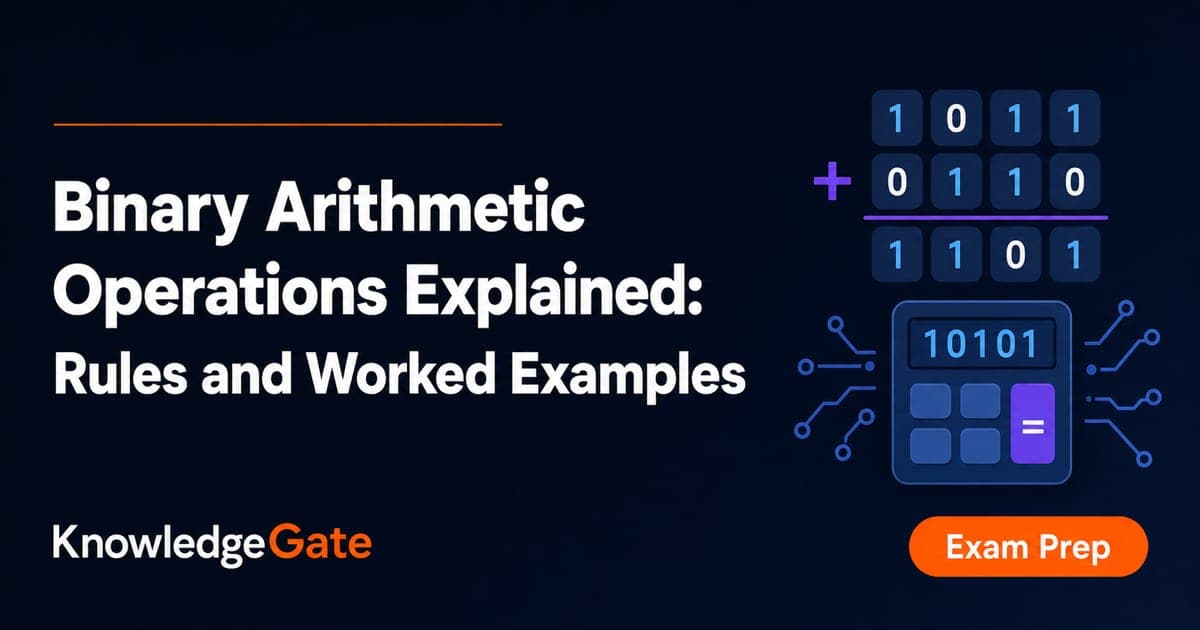
Binary Arithmetic Operations Explained: Rules and Worked Examples
Learn binary addition, subtraction, multiplication and division with aligned worked examples, then separate carry, borrow and two's-complement overflow.
Updated 19 Oct 20266 min readDigital Logic
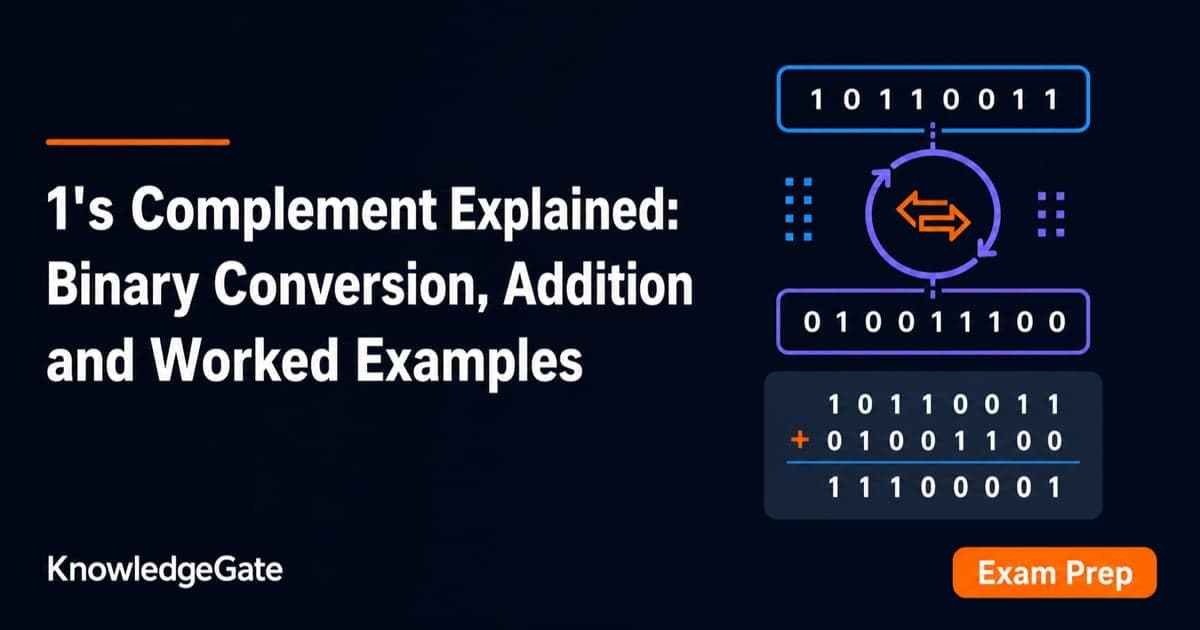
1's Complement Explained: Binary Conversion, Addition and Worked Examples
Learn how fixed-width 1's complement numbers represent negatives, why zero has two encodings, and how end-around carry works through exact examples.
Updated 15 Oct 20266 min readDigital Logic
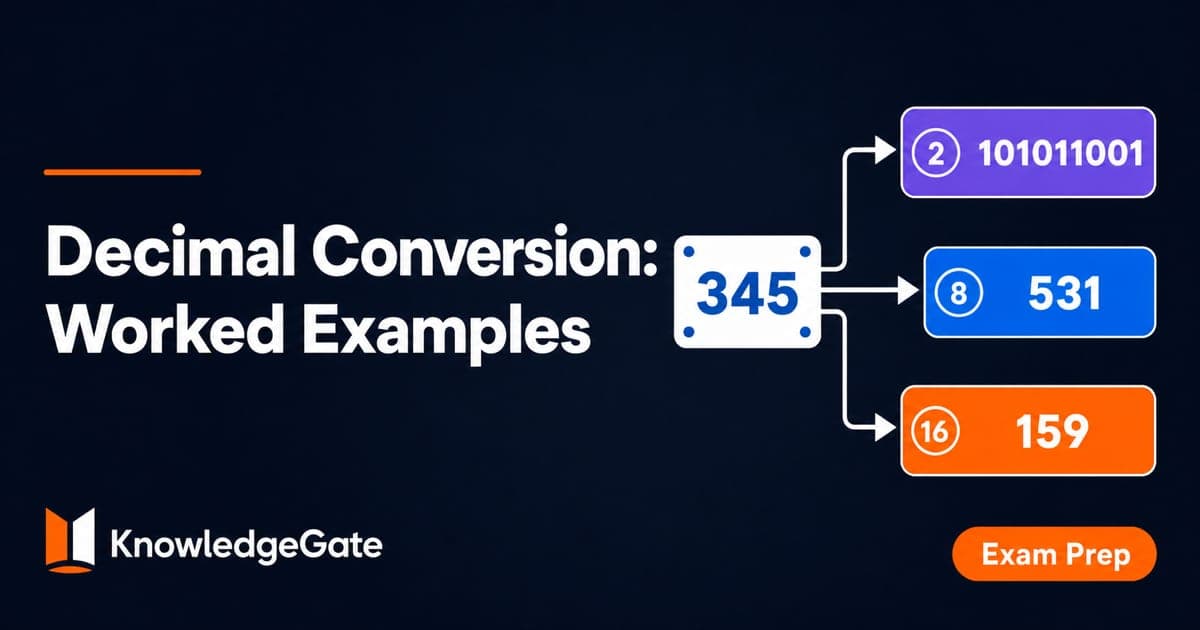
Decimal Conversion Explained: Binary, Octal and Hexadecimal Worked Examples
Learn one dependable method for converting values between decimal, binary, octal and hexadecimal, including fractions, shortcuts and checks.
Updated 11 Oct 20265 min readDigital Logic