

Evaluation, Assessment and Measurement for Teaching Exams: Concepts, Types and Worked Examples
Learn how a score becomes evidence and then a teaching decision through clear distinctions, classroom cycles, an eight-learner quiz, and exam-style traps.
KnowledgeGate Team
Exam prep & CS education
Updated 27 Oct 20265 min read

Aspirants often memorise measurement, assessment and evaluation as interchangeable words, then lose scenario-based questions. Assessment and Evaluation for Teaching Exams: Complete Notes with Worked Examples owns outcome-to-tool alignment, fairness and discrimination, and carries Riya's fraction trail from diagnostic error to outcome judgment. A multi-domain score sheet and class response grid serve a different job: calculate class mean, item facility and criterion mastery before choosing the next teaching move.
From score to decision: measurement, assessment and evaluation
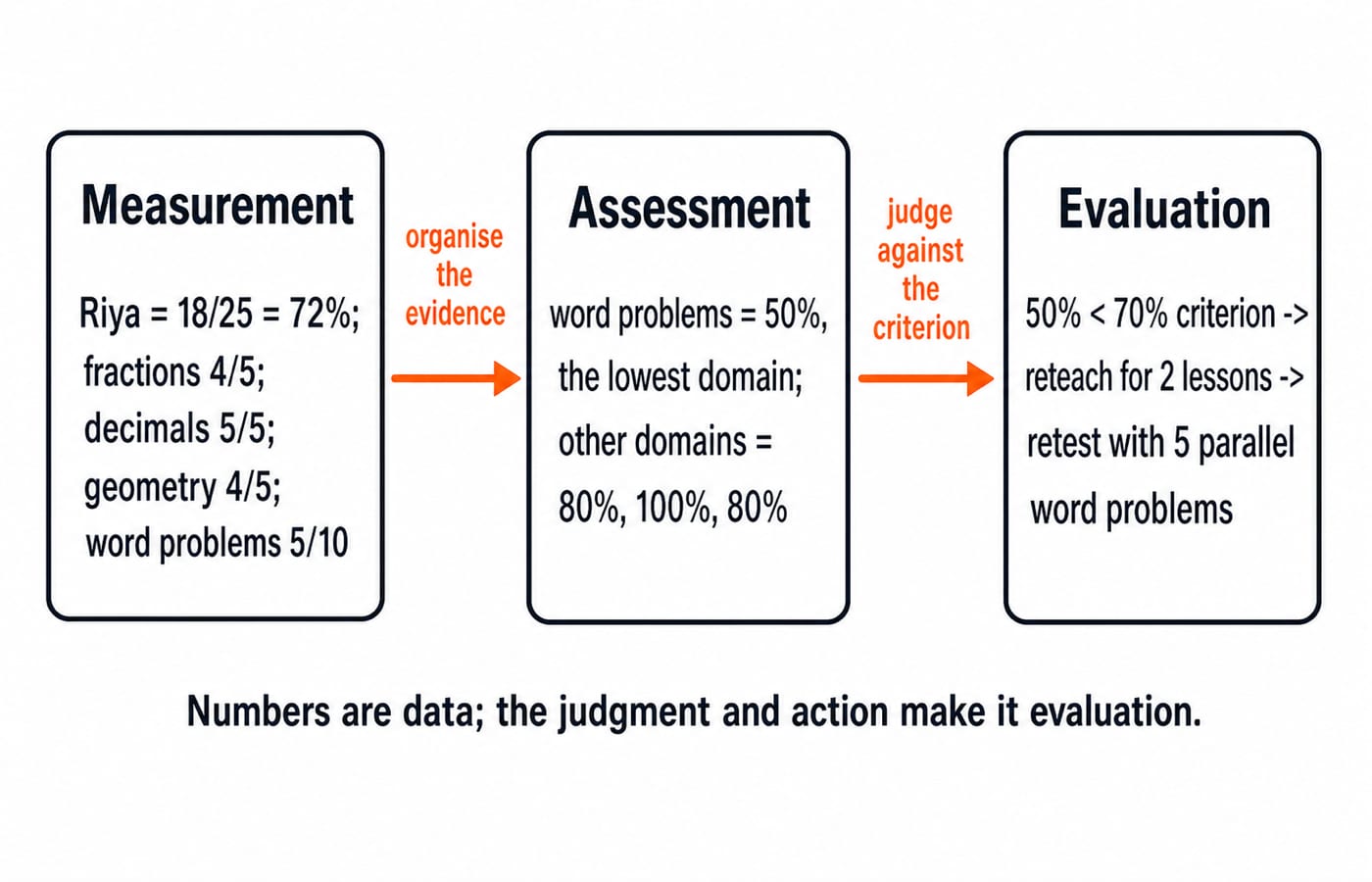
Measurement assigns a number or category to performance. Assessment collects and interprets evidence. Evaluation judges it against a purpose or criterion and leads to a decision. A test is an instrument, not a synonym for all three processes.
In a Grade 6 maths test, Riya scores 18/25 = 72%: fractions 4/5 = 80%, decimals 5/5 = 100%, geometry 4/5 = 80%, and word problems 5/10 = 50%. Recording these values is measurement.
Assessment identifies word problems as Riya's weakest domain at 50%, compared with 80%, 100%, and 80% elsewhere. Evaluation judges 50% against a teacher-set 70% criterion and schedules two reteaching lessons plus a five-question parallel retest. Evidence matters only when it changes teaching.
Classify evidence by purpose, user and decision timing
The difference is purpose, who uses the evidence, and what happens next. Timing alone is not enough.
Type | Purpose | Main user of evidence | Action |
|---|---|---|---|
Assessment for learning | Guide the next teaching move | Teacher | Adapt instruction and support |
Assessment as learning | Build self-monitoring and regulation | Learner | Diagnose and improve one's own process |
Assessment of learning | Record attainment after a period | Teacher, learner, or institution | Report the outcome |
On Monday, Riya gets 6/10 on an exit ticket. For learning, the teacher groups the four errors by misconception before Tuesday's lesson. As learning, Riya logs them as 2 operation-choice, 1 unit-reading, and 1 calculation error, then uses a checklist. Of learning, her end-unit score is 42/50 = 84% and becomes the final record. Evidence use determines the role.
Before instruction, a four-item diagnostic prerequisite check produces 1/4 and exposes a fraction gap. During instruction, a Lesson 2 exit ticket produces 3/5, so the teacher corrects the worked example and rechecks the next day. After the unit, a 20-mark summative task produces 16/20 and records attainment.
Formative does not mean informal, frequent, or ungraded by definition. Summative does not simply mean written. A five-item chapter-end quiz is formative if its evidence is used immediately for reteaching. The same quiz is summative if it is used only as the terminal record.
Riya's 18/25 = 72% meets a fixed 70% criterion. Rank 12 among 30 learners is norm-referenced because it compares her with the group. Do not infer mastery from rank or rank from percentage.
Response-grid worked example: mean, facility and mastery
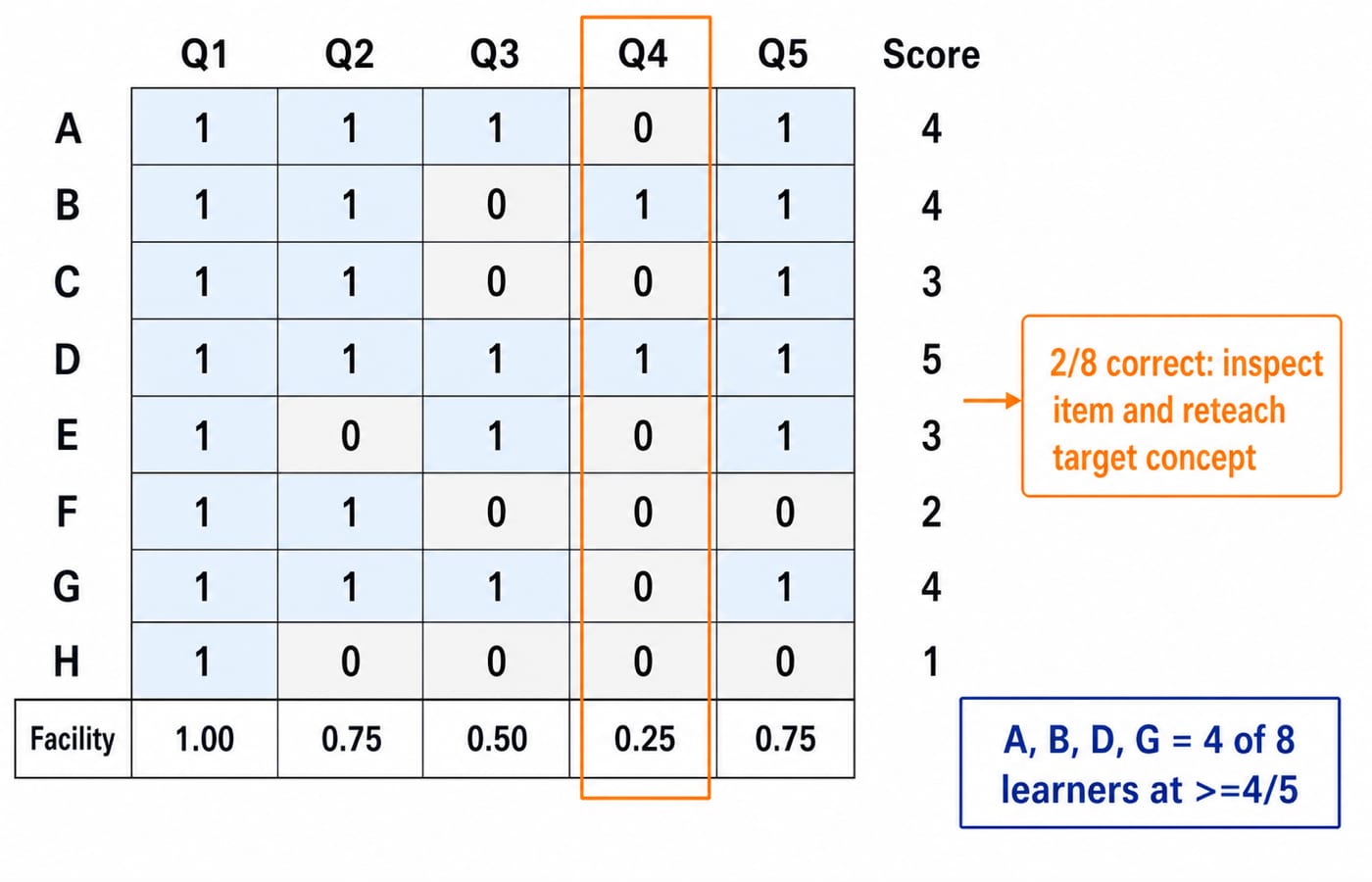
In the eight-learner, five-item response grid, 1 means correct and 0 means incorrect.
Learner | Q1 | Q2 | Q3 | Q4 | Q5 | Score |
|---|---|---|---|---|---|---|
A | 1 | 1 | 1 | 0 | 1 | 4/5 |
B | 1 | 1 | 0 | 1 | 1 | 4/5 |
C | 1 | 1 | 0 | 0 | 1 | 3/5 |
D | 1 | 1 | 1 | 1 | 1 | 5/5 |
E | 1 | 0 | 1 | 0 | 1 | 3/5 |
F | 1 | 1 | 0 | 0 | 0 | 2/5 |
G | 1 | 1 | 1 | 0 | 1 | 4/5 |
H | 1 | 0 | 0 | 0 | 0 | 1/5 |
The score total is 4 + 4 + 3 + 5 + 3 + 2 + 4 + 1 = 26. Therefore, the class mean is 26/8 = 3.25 out of 5, and 3.25/5 x 100 = 65%.
Item facility is the number correct divided by 8. Q1 is 8/8 = 1.00, Q2 is 6/8 = 0.75, Q3 is 4/8 = 0.50, Q4 is 2/8 = 0.25, and Q5 is 6/8 = 0.75. With mastery fixed in advance at 4/5, A, B, D, and G meet it. That is 4/8 = 50% of the class.
Q4 is the weakest observed item, but that does not prove learners lack the concept. Inspect the taught concept, wording, and key. Then review Q4, reteach its target concept, support C, E, F, and H, and use a parallel five-item check. Deleting Q4 does not improve learning.
Quality checks before a number drives action
Validity asks whether the tool measures the intended outcome. Reliability concerns consistency across occasions, forms, or raters. Objectivity limits scorer dependence. Usability asks whether administration, scoring, time, and resources are workable.
A 20-mark application blueprint assigns 8 marks to concept identification, 6 to classroom application, 4 to evidence interpretation, and 2 to feedback choice. The total is 8 + 6 + 4 + 2 = 20. A replacement paper with 16/20 marks for definition recall is poorly aligned, even if scored consistently.
If equivalent forms give one learner 16/20 and 9/20, the seven-mark swing flags a reliability check but does not prove unreliability. Scores of 4/5 and 2/5 from two raters flag objectivity. A five-point analytic rubric can award one mark each for definition, distinction, evidence, judgment, and decision. For usability, 40 minutes per script across 60 learners is 2,400 minutes, or 40 hours.
Teaching-exam elimination rules: follow purpose before labels
Test equals process: A test is a tool used within a larger process.
Measurement equals judgment: Measurement describes with a number or category; judgment belongs to evaluation.
Assessment always means marks: Evidence may include observations, portfolios, responses, or feedback.
Evaluation means only the final exam: Evaluation can occur whenever evidence is judged for a decision.
Assessment for learning guides teaching, assessment as learning supports self-monitoring, and assessment of learning records attainment. Continuous assessment gathers evidence across learning, not through a test every day. A higher raw score does not automatically mean greater validity.
Three question shapes recur: classify a prerequisite check before instruction as diagnostic; order value, interpreted evidence, judgment and action as measurement, assessment and evaluation; and match a purpose with assessment for, as, or of learning.
A calculation stem may give 18/25 = 72% against a 70% criterion. The value is measurement, interpreting the response pattern is assessment, and judging that it meets the criterion before choosing a step is evaluation.
Confirm domain labels and paper details on the exam authority's official site. When reviewing practice, use the evidence instead of counting attempts. Teaching Exam Mock Test Strategy applies that review loop under exam conditions.
Revision sequence: recompute, classify and act
Measurement gives the value.
Assessment builds and interprets the evidence.
Evaluation makes a judgment and decision.
Purpose separates diagnostic, formative, and summative evaluation, as well as assessment for, as, and of learning.
Redraw the three-stage flow from memory, solve three classification stems, and recompute the eight-learner quiz without looking at the answer. Then name the one additional data point that could reverse the teaching decision.
For structured Paper 1 study, continue with the NTA UGC NET Paper 1 Course. The NET preparation hub brings together related study options. Keep the sequence clear: record the value, interpret the evidence, then judge and act.
Keep learning

Curriculum and School Environment for Teaching Exams: Concepts, Caselets and Worked Examples
Learn to separate curriculum from syllabus, diagnose school conditions, audit alignment with numbers, and solve teaching-exam caselets logically.
Updated 26 Oct 20266 min readCTET & UPTET

Inclusive Education and Special Needs for Teaching Exams: Concepts, Cases, and Common Traps
Learn to separate inclusion from integration, match barriers to supports, and solve teaching-exam caselets through one fully worked classroom redesign.
Updated 25 Oct 20266 min readCTET & UPTET

Guidance, Counselling and Mental Health for Teaching Exams: Concepts, Cases and Exam Traps
Learn to separate guidance, counselling and mental-health support, then apply the distinctions to learner cases without crossing a teacher's professional boundaries.
Updated 23 Oct 20266 min readCTET & UPTET

Classroom Management and Communication for Teaching Exams: Complete Notes and Worked Scenarios
Connect classroom management, communication, feedback, discipline, and teacher immediacy, then practise an exam-style vignette with a step-by-step solution.
Updated 19 Oct 20266 min readCTET & UPTET