IBPS SO IT Officer Preparation Strategy: A 16-Week Phase-by-Phase Plan
Turn 18 weekly hours into a realistic IBPS SO IT Officer plan, from the first diagnostic to mock repair, tapering and a conditional next-stage bridge.
KnowledgeGate Team
Exam prep & CS education
Updated 17 Oct 20266 min read
Collecting notes and mocks is easy. Deciding what to study this week after a missed day is harder. This 16-week plan turns weekly capacity into foundations, practice, mocks, repair and tapering. Use the IBPS PO & SO IT Exam Preparation hub for relevant resources.
Before planning, confirm requirements on the official IBPS website. Its current notice governs the stages, scope, dates, timings, marks and rules. Numbers below are illustrative planning values, not an official paper pattern.
1. Fix the baseline and weekly capacity before Week 1
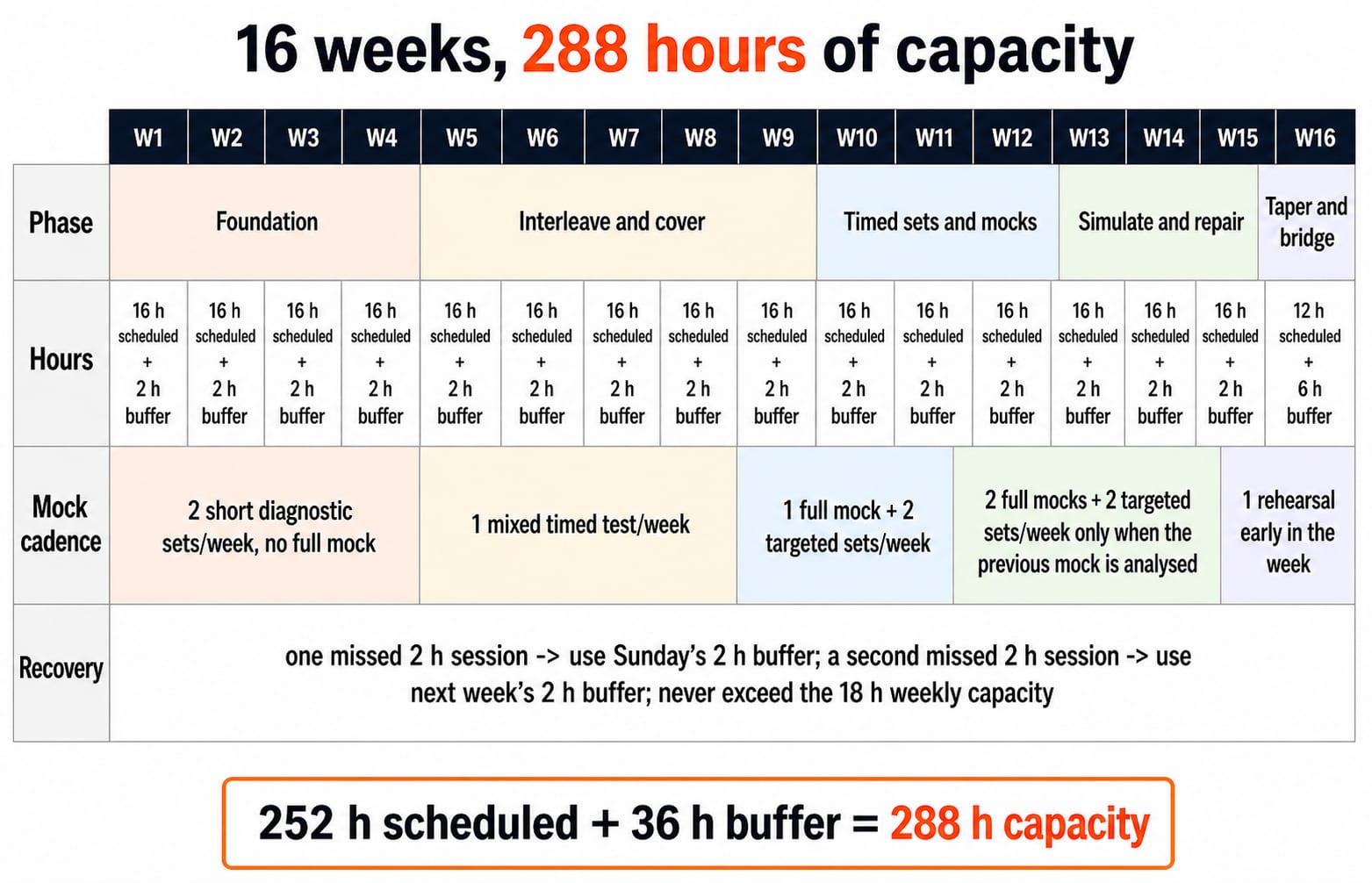
Treat this as capacity arithmetic: 16 weeks x 18 hours = 288 hours. Schedule 16 hours and protect 2 for recovery in Weeks 1 to 15. In Week 16, schedule 12 light hours and leave 6 unfilled. The result is 252 scheduled hours + 36 buffer hours = 288 hours, not 288 fresh-study hours.
On Sunday before Week 1, take a private 60-question planning set:
Area | Correct | Wrong | Skipped | Gap units |
|---|---|---|---|---|
Technical | 18 | 7 | 5 | 7 + 0.5(5) = 9.5 |
Reasoning and quantitative aptitude | 11 | 5 | 4 | 5 + 0.5(4) = 7 |
English | 8 | 1 | 1 | 1 + 0.5(1) = 1.5 |
There are 37 correct in 50 attempts, so attempted accuracy is 37/50 = 74%. Gap units total 18. Allocate 14 learning hours: technical gets 14 x 9.5/18 = 7.39 hours, reasoning and quantitative aptitude get 14 x 7/18 = 5.44 hours, and English gets 14 x 1.5/18 = 1.17 hours. Round to 7.5, 5.5 and 1 hour. Add 2 hours for a timed set and analysis, preserving the buffer.
2. Phase 1, Weeks 1 to 4: build usable foundations
Use five 90-minute technical blocks each week, giving 7.5 hours. Use DBMS for 4 hours and Operating Systems for 3.5 in Week 1, Computer Networks for 4 and Data Structures for 3.5 in Week 2, then Programming for 3, Software Engineering for 2 and Cyber Security for 2.5 in Week 3. Use Week 4 for 7.5 hours of mixed retrieval across all seven. This sequence is not an official syllabus. Use the IBPS SO IT Professional Knowledge subject topic map to plan coverage.
Inside one 90-minute block, spend 20 minutes on closed-book recall, 50 on guided questions and 20 on correction. If 20 DBMS questions produce 14 correct, 4 wrong and 2 skipped, begin the next block by re-solving those 6. Keep preparation parallel: 5.5 hours for reasoning and quantitative aptitude, 1 for English, 2 for the timed set and analysis, and 2 as buffer.
3. Phase 2, Weeks 5 to 9: interleave and add timed work
Change the five technical blocks to 2 new-topic blocks + 2 mixed-retrieval blocks + 1 weakest-topic repair block. In Week 7, for example, use Networking and Security as the new topics, DBMS plus OS and Data Structures plus Programming as the mixed blocks, and give the repair block to the area with the most Week 6 gap units.
Track personal speed with a 30-question training set. Completing it in 36 minutes in Week 5 means 36 x 60/30 = 72 seconds per question. The same calculation gives 66 seconds at 33 minutes in Week 7 and 60 seconds at 30 minutes in Week 9. These are personal targets. Keep one mixed timed test per week and finish its error log before taking the next. The IBPS SO IT Prelims Preparation Course supplies structured lessons, practice and mocks; this plan supplies workload and recovery.
4. Phase 3, Weeks 10 to 13: increase mocks without collecting scores
In Weeks 10 and 11, take 1 full mock and 2 targeted sets per week. In Weeks 12 and 13, take 2 full mocks and 2 targeted sets per week. Across the phase, that is 6 full mocks and 8 targeted sets. Configure each full mock around the pattern in your current official notice. The IBPS SO IT Officer Prelims 4-week 60/40 strategy covers the stage-specific split; here, stay focused on the full 16-week arc.
A 100-question mock has 82 attempts, with 61 correct, 21 wrong and 18 skipped. The attempt rate is 82/100 = 82%, attempted accuracy is 61/82 = 74.4%, and raw correct rate is 61/100 = 61%. Classify the 21 wrong answers as 8 concept gaps, 6 misreads, 4 time-pressure errors and 3 guesses.
Turn that diagnosis into 6 repair hours: 2 hours reteaching the 8 concept gaps, 1.5 slowly re-solving the 6 misreads, 1 on a pacing set for the 4 time errors, 0.5 writing a no-blind-guess rule for the 3 guesses, and 1 revisiting the 6 highest-priority skipped questions. Log the repair before another mock.
5. Phase 4, Weeks 14 to 15: simulate, analyse and freeze sources
Plan 2 full mocks per week only when the previous mock has been analysed. Review each mock twice. In Pass 1, classify every wrong or skipped item as a concept, reading, pacing or guessing error. In Pass 2, re-solve it without seeing the answer. If a mock remains unanalysed on Sunday, cancel the second mock next week and use that slot for repair.
Freeze new sources at the start of Week 14. Build a one-page repair sheet with at most 20 entries: 8 technical concepts, 5 reasoning or quantitative triggers, 3 English errors, and 4 pacing or guessing rules. Each entry needs the error, the correct rule and one fresh check question. More scores without diagnosis are not progress.
6. Phase 5, Week 16: taper and bridge conditionally
Schedule only 12 hours: 4 on the error sheet, 2 on formula and definition recall, 2 on one early-week rehearsal, 2 reviewing it, and 2 checking official instructions and practical logistics. Leave 6 hours unfilled for sleep, delay or a genuine emergency. Add no new topic and attempt no late mock marathon.
Only if the live notice and your result confirm a next stage, use a 72-hour restart: a 2-hour written-stage audit on Day 1, 3 hours of professional-knowledge repair on Day 2, and 3 hours of spoken explanation practice on Day 3. That is 2 + 3 + 3 = 8 bridge hours. The IBPS SO IT Mains Preparation Course can structure next-stage study. Keep technical and HR question practice in a separate interview plan. This bridge decides when to restart and how to use the first 8 hours, without assuming who qualifies or when results arrive.
7. Use the buffer honestly and close with a weekly scorecard
Recover one missed 2-hour session from Sunday's buffer. For two, recover one on Sunday and one from next week's buffer, staying within 18 hours. After two weeks at 12 completed hours or less, reset to 12 scheduled hours plus a 2-hour buffer. Do not carry an expanding backlog.
An 8-week alternative has 8 x 20 = 160 hours, split into 144 scheduled + 16 buffer hours: 2 foundation weeks, 2 interleaving, 2 mock-building, 1 simulation and 1 taper. It cannot offer equal depth with 252 - 144 = 108 fewer scheduled hours, so reduce strong diagnostic areas without omitting required scope.
Finish Sunday with a scorecard: 16 hours scheduled, 15 completed, 1-hour backlog, 1 of 1 mocks analysed, and 4 high-priority errors unresolved. Now run the diagnostic, open the IBPS hub, choose a course and write Week 1 in hours.
Keep learning
IBPS SO IT Officer Syllabus: What to Study for Each Section
Separate the official IBPS exam structure from the detailed study map. See what to cover for English, Reasoning, Quantitative Aptitude, Professional Knowledge and Descriptive English.
Updated 21 Oct 20264 min readIBPS Exams
IBPS SO IT Officer Exam Pattern and Marking Scheme: Prelims, Mains and Interview
Understand the CRP SPL-XVI stage sequence, section timings and marks, then use worked score calculations and a 12-hour study plan to prepare for each stage.
Updated 13 Oct 20264 min read110 viewsIBPS Exams
IBPS Clerk Eligibility and Selection Process: From Application to Allotment
Separate the eligibility gate from the selection gate using a dated checklist, three candidate profiles and a 124-to-62 Main-score example.
Updated 8 Oct 20264 min readIBPS Exams
IBPS PO Preparation Mistakes: 7 Errors That Cost Final Selection
Hard work is not enough when attempt counts, new resources and rigid timetables hide weak accuracy. Replace seven common errors with measurable habits.
Updated 4 Oct 20265 min readIBPS Exams