IBPS SO IT Officer Syllabus: What to Study for Each Section
Separate the official IBPS exam structure from the detailed study map. See what to cover for English, Reasoning, Quantitative Aptitude, Professional Knowledge and Descriptive English.
KnowledgeGate Team
Exam prep & CS education
Updated 21 Oct 20264 min read
The phrase "IBPS SO IT Officer syllabus" often mixes two things: the official exam-section structure and a coaching topic checklist. This guide separates them. It shows what the current IBPS notification specifies, then maps each section to topics in KnowledgeGate's curricula. Recheck the latest notification and information handout on the official IBPS website for your cycle because the pattern can change.
Read the syllabus in two layers
The CRP SPL-XVI detailed notification defines the tests, marks, timings, penalty and progression rules. The preparation map comes from live course curricula, not an official topic-by-topic appendix.
Use the notice for "what is tested under which rules?" Use the IBPS PO and SO IT Exam Preparation category for "what should I study?" Dates, vacancies, fees, eligibility, cutoffs and salary are outside this map and controlled by the latest notice.
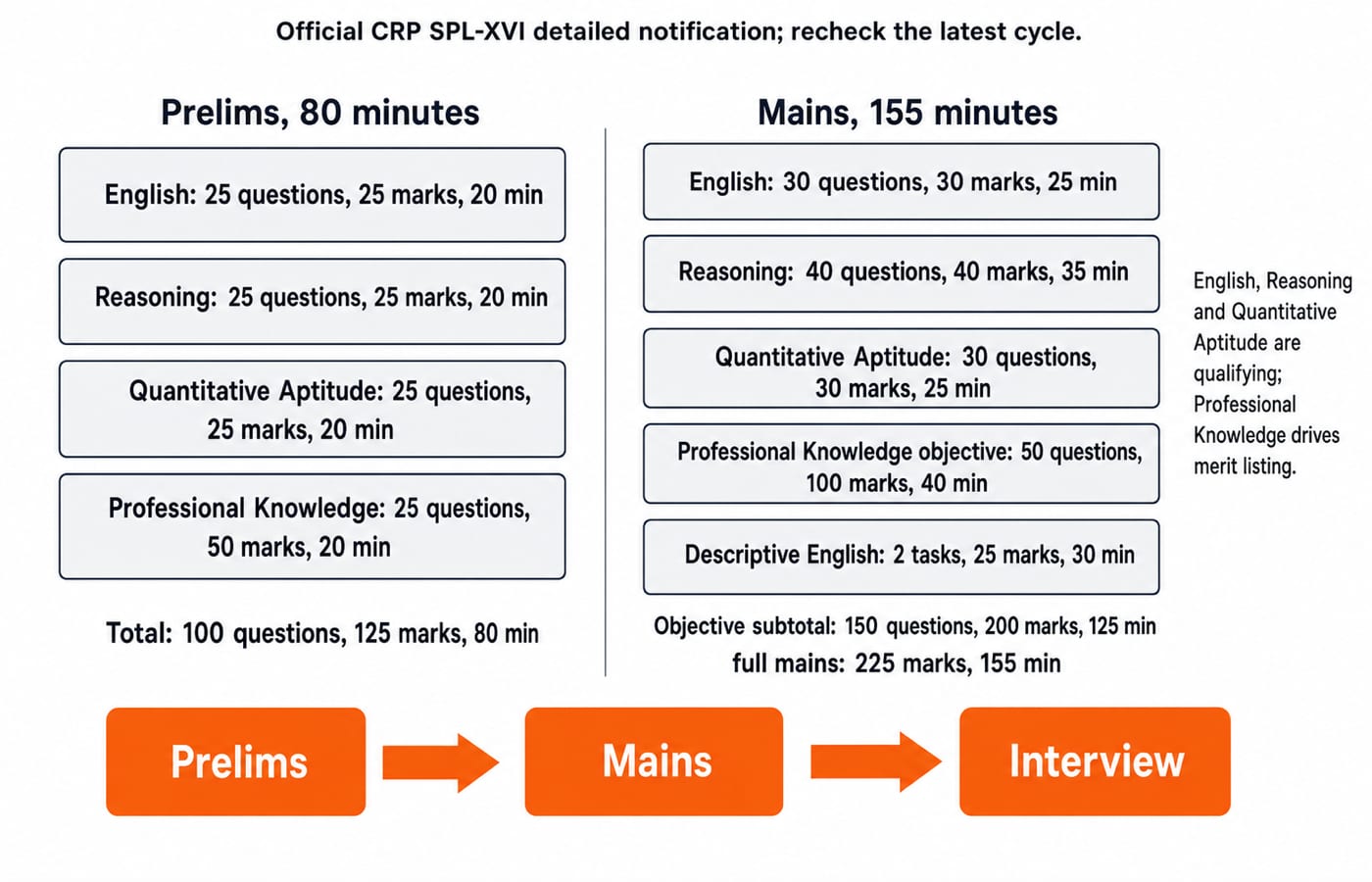
Current prelims-to-mains structure
Source: CRP SPL-XVI detailed notification.
Prelims test | Questions | Marks | Time |
|---|---|---|---|
English Language | 25 | 25 | 20 minutes |
Reasoning | 25 | 25 | 20 minutes |
Quantitative Aptitude | 25 | 25 | 20 minutes |
Professional Knowledge | 25 | 50 | 20 minutes |
Total | 100 | 125 | 80 minutes |
Mains test | Questions or tasks | Marks | Time |
|---|---|---|---|
English Language | 30 questions | 30 | 25 minutes |
Reasoning | 40 questions | 40 | 35 minutes |
Quantitative Aptitude | 30 questions | 30 | 25 minutes |
Professional Knowledge (Objective) | 50 questions | 100 | 40 minutes |
Objective subtotal | 150 questions | 200 | 125 minutes |
Descriptive Paper (English) | 2 tasks | 25 | 30 minutes |
Full mains | 150 objective questions plus 2 descriptive tasks | 225 | 155 minutes |
Each prelims test has an IBPS-decided qualifying cutoff. In mains, other tests are qualifying; Professional Knowledge drives merit listing. Shortlisted candidates proceed to interview.
English Language: build control before speed
Study three blocks. Language base: vocabulary, nouns, adjectives, tenses, pronouns, adverbs, prepositions, conjunctions and articles. Sentence control: voice, direct and indirect speech, correction, completion and para jumbles. Passage work: reading comprehension and cloze tests.
Change Each of the servers have a unique IP address. to Each of the servers has a unique IP address. Singular each controls the verb.
Reasoning: relations before multi-condition sets
Cover short-form logic: series, coding-decoding, syllogisms, inequalities, blood relations and directions; evidence and decision: data sufficiency, deductive and inductive reasoning, counting figures and decision tables; and arrangement and spatial work: puzzles, seating, clocks, calendars, cubes and dice.
A to E face north in seats 1 to 5. A is two places left of C; B is immediately right of A; D is at an end; C is not; E is not adjacent to C.
Possible (A,C) pairs are (1,3), (2,4) and (3,5). The last puts C at an end. With (1,3), B is 2, D is 5 and E is 4, adjacent to C. Therefore A=2, B=3, C=4, E=1, D=5: E-A-B-C-D.
After learning the blocks, use the 4-week prelims strategy for timed practice.
Quantitative Aptitude: arithmetic, interpretation and counting
Cover arithmetic: ratio, mixtures, speed-time-distance, percentage, average, time and work, interest, profit and loss, ages and partnership; number and algebra: number systems, sequences, algebra and speed mathematics; and data and counting: data interpretation, permutations and combinations, probability, mensuration and geometry.
A system processes 240 applications on Monday, 300 on Tuesday and 360 on Wednesday:
Tuesday increase:
(300 - 240) / 240 x 100 = 25%.Wednesday increase:
(360 - 300) / 300 x 100 = 20%.Three-day average:
(240 + 300 + 360) / 3 = 300applications.
The IBPS SO IT Prelims course structures their coverage.
Professional Knowledge: cover the technical core systematically
Use four course-backed blocks:
Programming and problem solving: C, C++, Java, Python, OOP, data structures and algorithms.
Data and systems: DBMS, SQL, operating systems, computer organisation, microprocessors and digital logic.
Networks and software: data communication, networks, protocols, cloud, IoT, security, web technology, software engineering, SDLC and testing.
Theory and emerging areas: theory of computation, compiler design, AI, image processing, emerging technologies and MS Office applications.
Use the prerequisite-first CS study order to sequence them.
For ENROLMENT(student_id, course_id, student_name, course_name, grade), take student_id -> student_name, course_id -> course_name and (student_id, course_id) -> grade. Each name depends on part of the composite key. Decompose to STUDENT(student_id, student_name), COURSE(course_id, course_name) and ENROLMENT(student_id, course_id, grade), removing those partial dependencies.
In prelims Professional Knowledge, 25 questions = 50 marks, or 2 marks each. The official wrong-answer penalty is one fourth of a question's marks, here 0.5. For 18 correct, 4 wrong, 3 blank: 18 x 2 - 4 x 0.5 = 36 - 2 = 34/50. In a 1-mark section: 18 x 1 - 4 x 0.25 = 17/25.
The IBPS SO IT Mains course structures Professional Knowledge and descriptive coverage. KnowledgeGate also has more than 1,800 published IBPS-tagged questions.
Descriptive English: practise output separately
The notification gives the English Descriptive Paper 2 tasks, 25 marks and 30 minutes. The curriculum calls it English Writing Ability. Await the latest handout before assuming task types or word limits.
Practice: "Should public-sector banks require two-factor authentication for every high-risk digital transaction?" Spend 5 minutes outlining, 20 writing and 5 checking, totalling 30 minutes. Cover fraud reduction, customer friction and accessibility, and risk-based thresholds, then conclude fairly. Replace this with your cycle's official format.
Turn the map into a checked syllabus tracker
Topic | Learned? | Practice result | Next action |
|---|---|---|---|
SQL joins | Yes | 24/30 correct = 80% | Revise outer joins |
Syllogisms | Yes | 15/20 = 75% | Do 10 timed questions |
Reading comprehension | No | 6/10 = 60% | Study passage mapping, then retry 10 |
Confirm the official structure, study four objective sections separately, and add Descriptive English for the mains pattern.
Take the first-stage section map through the IBPS SO IT Prelims course, the deeper Professional Knowledge and descriptive work through the IBPS SO IT Mains course, or compare the wider preparation set in the IBPS PO and SO IT Exam Preparation category. Reopen the latest official notification and handout before finalising your checklist.
Keep learning
IBPS SO IT Officer Preparation Strategy: A 16-Week Phase-by-Phase Plan
Turn 18 weekly hours into a realistic IBPS SO IT Officer plan, from the first diagnostic to mock repair, tapering and a conditional next-stage bridge.
Updated 17 Oct 20266 min readIBPS Exams
IBPS SO IT Officer Exam Pattern and Marking Scheme: Prelims, Mains and Interview
Understand the CRP SPL-XVI stage sequence, section timings and marks, then use worked score calculations and a 12-hour study plan to prepare for each stage.
Updated 13 Oct 20264 min read113 viewsIBPS Exams
IBPS Clerk Eligibility and Selection Process: From Application to Allotment
Separate the eligibility gate from the selection gate using a dated checklist, three candidate profiles and a 124-to-62 Main-score example.
Updated 8 Oct 20264 min readIBPS Exams
IBPS PO Preparation Mistakes: 7 Errors That Cost Final Selection
Hard work is not enough when attempt counts, new resources and rigid timetables hide weak accuracy. Replace seven common errors with measurable habits.
Updated 4 Oct 20265 min readIBPS Exams