Infosys Aptitude Questions: High-Yield Quant, Reasoning and Verbal Problems Solved
Build dependable placement aptitude skills through fully worked quant, data interpretation, reasoning and verbal problems. Then use a timed drill and error log to target weak steps.
KnowledgeGate Team
Exam prep & CS education
Updated 30 Aug 20267 min read279 views
An "Infosys aptitude" search often produces changing section lists and tempting shortcuts. Yet speed is useless if you apply a percentage to the wrong base, combine work rates incorrectly or reverse a seating clue. Work through quant, data interpretation, reasoning and verbal problems step by step, then use each missed result to choose the next drill. The Infosys Placement Preparation Guide connects these aptitude skills to the wider hiring journey; your assessment invitation remains the source of truth for the current pattern.
Infosys aptitude topic map: four skill blocks and where to begin
Organise your study map into four reusable skill blocks: arithmetic (percentages, ratios, profit and loss), rate problems (time and work, time-speed-distance), data interpretation, and logical plus verbal reasoning. They diagnose skills, while an employer may change labels, order or delivery by role or hiring cycle.
The KnowledgeGate Infosys course groups quant, logical reasoning, verbal English, puzzles, grammar and writing. Each block earns its place here because it trains a reusable decision: choose the correct base, combine rates consistently, translate clues into fixed relations, or prove verbal choices from grammar and sequence.
Triage by error. If calculation accuracy is weak, begin with the next three sections. If you reread clues, begin with logical reasoning. If options differ by grammar or sequence, begin with verbal ability. The Placement Preparation category supports structured preparation beyond one company.
Percentages and ratios: keep the base visible before using a shortcut
A commodity has a unit price of 100 and a family buys 50 units. Initial expenditure is 100 x 50 = 5,000. The price rises by 20%, so the new unit price is 120. The family allows spending to rise by only 8%, making the new budget 5,000 x 1.08 = 5,400.
New consumption is 5,400 / 120 = 45 units. The fall is 50 - 45 = 5 units, so the reduction is (5 / 50) x 100 = 10%. The shortcut 20% - 8% = 12% is wrong because the changes use different bases.
Take teams A and B in the ratio 3:5, with 64 people. One part is 64 / 8 = 8, so A has 24 and B has 40. If 8 move from B to A, the counts become 32 and 32, giving 1:1. The unchanged total of 64 is the quickest check.
Use this order: choose the original base, convert percentages into actual values, perform the change, then use the requested denominator for the final percentage.
Time, work and distance: add rates, not days or speeds blindly
A completes a job in 12 days, so A's rate is 1/12 per day. B completes it in 18 days, so B's rate is 1/18. Together, they work at 1/12 + 1/18 = 3/36 + 2/36 = 5/36 per day. In 4 days, they complete 4 x 5/36 = 20/36 = 5/9, leaving 4/9.
If A leaves, B needs (4/9) / (1/18) = (4/9) x 18 = 8 days. Check it directly: B's final contribution is 8/18 = 4/9, exactly the remainder.
For distance, a 180 m train crosses a pole in 12 s. Its speed is 180/12 = 15 m/s, or 15 x 18/5 = 54 km/h. To cross a 270 m platform, the train's front travels the train length plus platform length: 180 + 270 = 450 m. Time is 450/15 = 30 s.
The traps differ. Work questions combine fractions of one complete job, so never add completion days. Crossing questions use total relative distance, so never ignore the train's own length when it passes a platform.
Data interpretation: use the combined denominator, then compare percentages
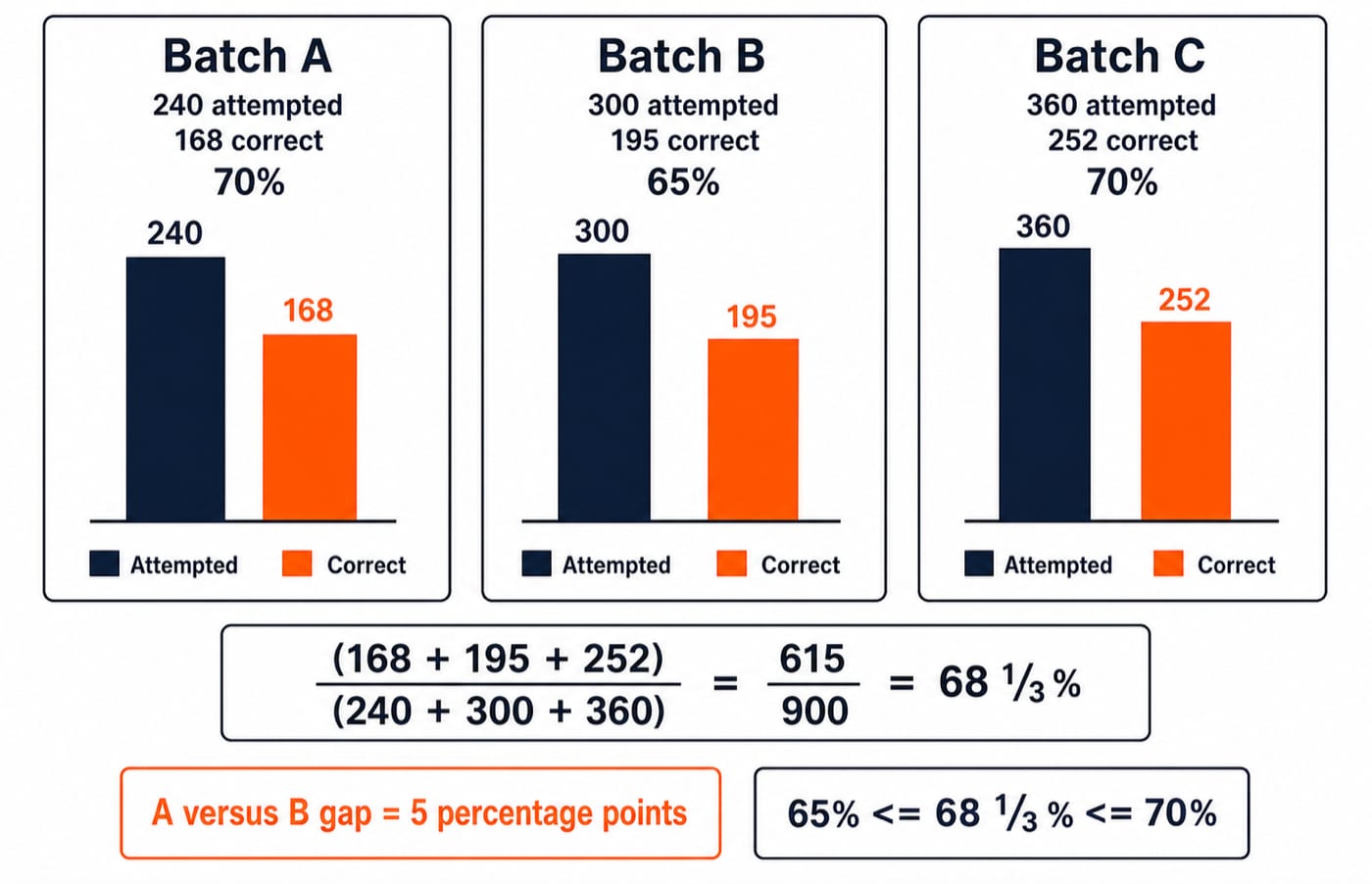
Consider this mock-practice table:
Batch | Questions attempted | Correct answers |
|---|---|---|
A |
|
|
B |
|
|
C |
|
|
Accuracy for A is 168/240 x 100 = 70%. For B, it is 195/300 x 100 = 65%. For C, it is 252/360 x 100 = 70%. The gap between A and B is 5 percentage points, not 5%.
For combined accuracy, add counts first. Total correct is 168 + 195 + 252 = 615, while total attempted is 240 + 300 + 360 = 900. Combined accuracy is 615/900 x 100 = 68 1/3%.
The simple average also gives (70 + 65 + 70)/3 = 68 1/3% here, but that match is accidental because the batch sizes differ. Always use total favourable / total relevant x 100. Check that the result lies between the lowest and highest batch accuracies, and 65% <= 68 1/3% <= 70%.
Logical reasoning: translate every clue into a fixed relation
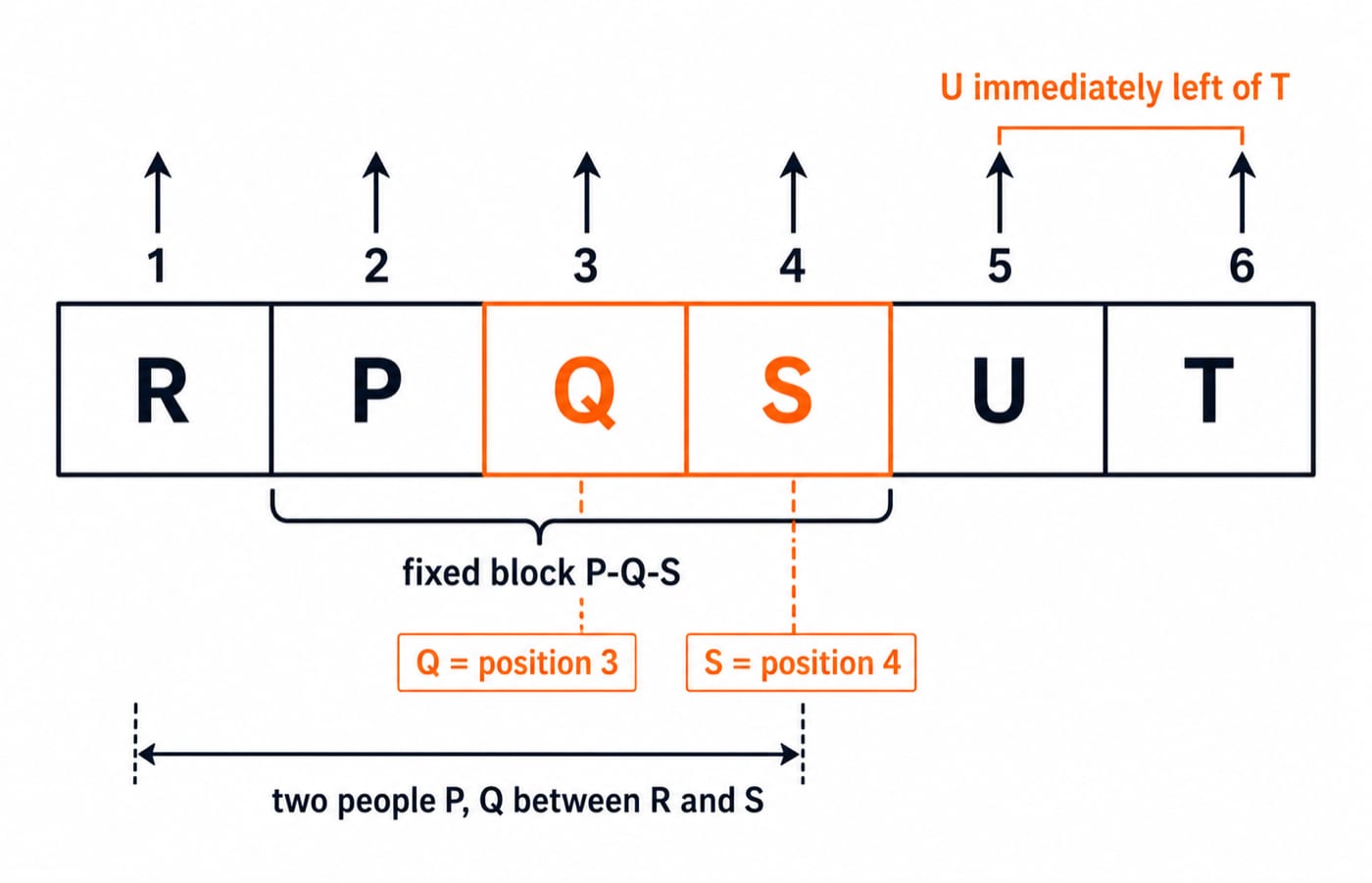
Six people, P, Q, R, S, T, U, occupy seats 1 to 6 from left to right and face north. R is at the far left, T at the far right, and U immediately left of T. This gives R _ _ _ U T.
P sits immediately left of Q, while S sits immediately right of Q. The block P Q S must fill seats 2, 3, 4, producing R P Q S U T. Thus, Q is third, S fourth, and exactly two people, P and Q, sit between R and S.
Because everyone faces north, each person's left and right match the reader's left and right. If the facing direction changes, redraw the row before placing anyone.
A syllogism needs the same discipline. From All testers are analysts and Some analysts are coders, it does not follow that Some testers are coders. Tester Mira could be an analyst, while another analyst, Kabir, is the coder. Shared membership in analysts does not force the smaller groups to overlap.
Verbal ability: use grammar structure and transition words, not what merely sounds familiar
In Each of the applicants have submitted their form, the subject is the singular Each, so have changes to has: Each of the applicants has submitted their form.
In Neither the supervisor nor the trainees was ready, the nearer subject trainees is plural. The correction is Neither the supervisor nor the trainees were ready. Identify the governing subject instead of treating either answer as an idiom.
Now order these statements: A. Therefore, the application asked the user to sign in again. B. The access token had expired during a long idle period. C. The next API request returned an authentication error. D. Refreshing the session generated a new token. The correct order is B-C-A-D. Expiry is the cause, the next request exposes the problem, Therefore introduces the response, and refreshing resolves it.
Use a repeatable check: identify the grammatical subject, find reference and transition words, place cause before consequence, then reread for logical continuity.
Infosys aptitude practice: a 25-minute mixed drill and error log
A mixed drill should rotate changed-consumption calculations, partial-job remainders, combined DI rates, seating slots, grammar subjects and cause-effect ordering. This forces each method to compete for attention, which is closer to real decision-making than completing one topic in a long block.
Try 20 mixed questions in 25 minutes. Spend the first 12 minutes on direct items, with a 60-second cap before marking and moving. Use the next 10 minutes for calculations or arrangements needing two or more steps. Reserve 3 minutes to check denominators, units, seat direction and grammar subjects. Follow the actual assessment's navigation and marking instructions.
Keep a five-item error log: 5,000 is the expenditure base; joint work uses 5/36 per day; combined DI uses 615/900; the row is R P Q S U T; and Each takes has. The Infosys Superset Preparation Course offers company-specific preparation. Keep Infosys Pseudocode Questions separate from aptitude practice. Check the official Infosys Careers portal for current openings. Use the exact instructions in your assessment invitation to set the time limits, navigation rules and marking choices for the real attempt.
Infosys aptitude short version and the next practice step
Remember the retrieval chain. Percentages need the correct base, ratios need actual parts, work needs rates, crossings need full distance, DI needs the combined denominator, puzzles need a slot diagram, grammar needs the governing subject, and para-jumbles need cause, consequence and reference words.
Without notes, recover the 10% consumption reduction, 8 days remaining for B, 30 s platform crossing, 68 1/3% combined accuracy, row R P Q S U T, and order B-C-A-D. Any missed result identifies the next topic to revise. Use the Aptitude for Placement course when you want broader structured practice.
Keep learning

HCLTech Recruitment Process and Test Pattern: Build Your Drive Map
Build a source-controlled HCLTech drive map from the current role page and invitation, then use worked diagnostics to prepare for each assigned stage.
Updated 23 Oct 20265 min readCompany-Specific Prep
Capgemini Coding Questions: 4 Patterns with Step-by-Step Solutions
Learn four transferable coding patterns through constructed Capgemini preparation examples. Each solution includes an invariant, complete trace, complexity and edge-case checks.
Updated 19 Oct 20266 min readCompany-Specific Prep
Capgemini Placement Preparation: An 8-Week Test-Matched Study Plan
Build an eight-week Capgemini preparation timetable from the route you are actually invited to take. Use two baselines and an error log to decide where every study hour goes.
Updated 15 Oct 20265 min readCompany-Specific Prep
Cognizant Recruitment Process and Test Pattern: What Each Stage Screens
Learn how to read a Cognizant drive invitation, map each possible stage to the skill it screens, and turn the stated test blocks into a focused study plan.
Updated 11 Oct 20265 min readCompany-Specific Prep