Wipro Hiring Routes: WILP, Elite NTH and Turbo Decision Map
Compare a current Wipro drive notice against seven evidence fields, then use a five-area diagnostic to decide what to practise and how deeply.
KnowledgeGate Team
Exam prep & CS education
Updated 29 Aug 20265 min read
WILP, Elite and Turbo serve different starting points. WILP combines work and study for BCA and B.Sc. graduates, Elite recruits new engineering graduates, and Turbo targets engineering talent from selected premier institutes. A current drive notice still controls batch, academic, backlog, stage, location and offer terms.
Wipro hiring routes: separate the route label from the preparation base
Wipro's current Early Careers page describes WILP as work-and-study for BCA and B.Sc. graduates, Elite as technical hiring for new engineering graduates, and Turbo as technical hiring from selected premier institutes. A drive notice may instead say Elite NTH; copy its exact label into your evidence card.
Use two layers:
Route layer: copy qualification, batch, role, stages, location and offer conditions from the current notice.
Preparation layer: practise areas named in that notice, with depth set by diagnostic gaps.
Company-Specific Placement Courses gives category context. Wipro Interview Experience Patterns: Fresher Routes Compared explains recurring interview evidence across routes. Choose with the decision fields below, then prepare that evidence after the notice confirms your route.
WILP vs Elite NTH vs Turbo: build an evidence-first comparison table
The route descriptions establish three starting points. The drive notice supplies the yes-or-no fields that decide whether you can apply.
Route label | Current Wipro description | First decision | Confirm in the current notice |
|---|---|---|---|
WILP | A work-and-study route for BCA and B.Sc. graduates, combining full-time work with a sponsored M.Tech. | Choose this route only when your degree and the work-plus-study model fit. | Eligible degree and batch, academic and backlog clauses, programme terms, stages, location and deadline. |
Elite NTH or Elite | The current Early Careers page calls Elite a technical graduate hiring programme for new engineering graduates. | Treat the exact label in your notice as authoritative and check that its engineering-graduate route fits you. | Eligible branches and batch, academic and backlog clauses, role, stages, location and deadline. |
Turbo | Technical hiring for engineering talent from 46 premier institutes, including IIITs, NITs and selected private colleges, with niche-technology learning and certification. | Confirm that your institute and batch are included before comparing preparation depth. | Included institutes and batch, academic and backlog clauses, role, stages, location and deadline. |
Wipro Careers supplied these route distinctions on 9 August 2026. The matching notice alone confirms its degree list, batch, academic conditions, stages, location, role and offer terms.
Wipro eligibility check: a fully worked seven-field example
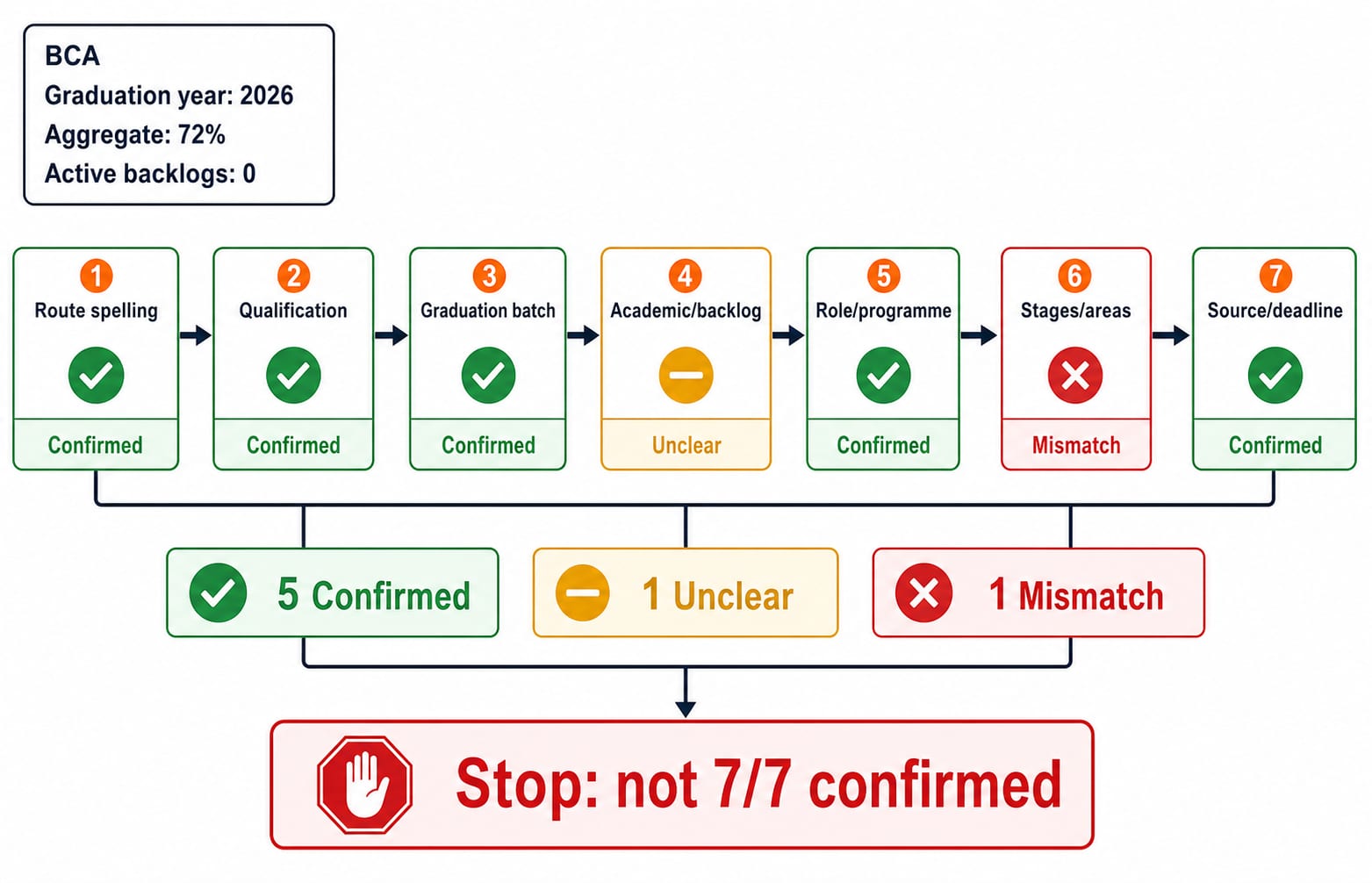
Consider a fictional BCA candidate graduating in 2026 with 72%, no active backlogs and flexible location. The notice confirms route spelling, qualification, role, assessed areas and application source; conflicts with the graduation batch; and leaves the backlog clause unclear.
Evidence field | Result |
|---|---|
Route spelling | Confirmed |
Qualification | Confirmed |
Graduation batch | Mismatch |
Academic or backlog clause | Unclear |
Role or programme | Confirmed |
Stages or assessed areas | Confirmed |
Application source or deadline | Confirmed |
The count is 5 confirmed + 1 unclear + 1 mismatch = 7 fields. Therefore, 5/7 confirmed is not enough. The mismatch means do not apply under that notice, and the unclear backlog wording must be resolved with the issuing source. The fraction is an evidence count, not a probability of selection.
Wipro preparation coverage: map each assessed area to a practice artefact
The Wipro Preparation: Elite NTH, Turbo & WILP course covers the five-area base. Use the last column as a gate.
Covered area | Diagnostic artefact | Evidence to save | Current notice names it? |
|---|---|---|---|
Aptitude | 20-question timed set | Score and error types, with Aptitude for Placements: Quant, Reasoning, Verbal as extra practice context | Tick after reading |
Logical reasoning | 20-question timed set | Score and error types | Tick after reading |
English | 20-question timed set | Score and error types | Tick after reading |
Written communication | One 250-word response | Five-point rubric sheet | Tick after reading |
Coding | Two tasks using all supplied cases | Code, outputs and failed cases | Tick after reading |
These artefacts are planning tools, not an official Wipro pattern.
Wipro readiness diagnostic: calculate gaps before choosing depth
Set personal practice thresholds of 16/20 for each objective area, 2/2 fully passing coding tasks and 4/5 writing points. These are self-set targets, not Wipro cutoffs.
Area | Result | Threshold | Gap | Percentage-point shortfall |
|---|---|---|---|---|
Aptitude | 13/20 = 65% | 16/20 = 80% | 3 answers | 15 |
Logical reasoning | 16/20 = 80% | 16/20 = 80% | 0 | 0 |
English | 11/20 = 55% | 16/20 = 80% | 5 answers | 25 |
Coding | 1/2 = 50% | 2/2 = 100% | 1 task | 50 |
Written communication | 3/5 = 60% | 4/5 = 80% | 1 point | 20 |
Priority is coding, English, writing, aptitude, then reasoning. Use percentage-point shortfall only to rank practice. Do not add unlike units into a fake overall Wipro score.
Wipro preparation depth: make a 14-day, 28-hour plan
Allocate the measured gaps as coding 8 hours, English 7, aptitude 5, writing 4, mixed mock plus error review 3, and reasoning 1. The check is 8 + 7 + 5 + 4 + 3 + 1 = 28 hours.
Phase | Allocation |
|---|---|
Days 1 to 4, 8 hours | English 3, coding 3, aptitude 2 |
Days 5 to 8, 8 hours | Coding 3, English 2, writing 2, aptitude 1 |
Days 9 to 12, 8 hours | Coding 2, aptitude 2, English 2, writing 1, reasoning 1 |
Days 13 to 14, 4 hours | Mixed mock and review 3, writing 1 |
The phase check is 8 + 8 + 8 + 4 = 28. If four hours disappear, cut aptitude from 5 to 3, writing from 4 to 3, and reasoning from 1 to 0. The revised check is 8 + 7 + 3 + 3 + 3 + 0 = 24 hours. This protects the largest gaps and final feedback loop.
Wipro route comparison traps: keep every claim attributed
Course coverage becomes an assumed official pattern. One course covers three labels, but every drive may assess differently. Tick the notice column before allocating time.
A route name becomes permanent shorthand. Old summaries can carry the wrong qualification, batch, role, location or agreement term. Save the matching source and retrieval date in every row.
Preparation stops after the first assessment. If the notice names later stages, continue with Wipro Interview Process: 3 Stages and a 14-Hour Plan. That earlier guide owns stage-by-stage interview preparation; the current notice remains authoritative when its sequence differs.
Wipro hiring routes: the short decision sequence
Choose WILP when the notice confirms BCA or B.Sc. work-and-study eligibility. Choose Elite NTH or Elite when its engineering-graduate route includes your degree and batch. Choose Turbo only when the drive includes your institute and batch. Require 7/7 evidence fields before committing preparation time.
Diagnose only areas named in the notice, then allocate the 28 hours by measured gaps. Use the verified Wipro preparation course above when those areas match. A defensible decision combines the official route family, notice-level eligibility and a preparation allocation you can recompute.
Keep learning
HCLTech Recruitment Process and Test Pattern: Build Your Drive Map
Build a source-controlled HCLTech drive map from the current role page and invitation, then use worked diagnostics to prepare for each assigned stage.
Updated 23 Oct 20265 min readCompany-Specific Prep
Capgemini Coding Questions: 4 Patterns with Step-by-Step Solutions
Learn four transferable coding patterns through constructed Capgemini preparation examples. Each solution includes an invariant, complete trace, complexity and edge-case checks.
Updated 19 Oct 20266 min readCompany-Specific Prep
Capgemini Placement Preparation: An 8-Week Test-Matched Study Plan
Build an eight-week Capgemini preparation timetable from the route you are actually invited to take. Use two baselines and an error log to decide where every study hour goes.
Updated 15 Oct 20265 min readCompany-Specific Prep
Cognizant Recruitment Process and Test Pattern: What Each Stage Screens
Learn how to read a Cognizant drive invitation, map each possible stage to the skill it screens, and turn the stated test blocks into a focused study plan.
Updated 11 Oct 20265 min readCompany-Specific Prep