InfyTQ Certification: Exam Rounds, Syllabus, and the Path to an Infosys Offer
Understand the InfyTQ learning and certification path, what the technical and coding rounds demand, and why certification opens an interview rather than guaranteeing an offer.
KnowledgeGate Team
Exam prep & CS education
Updated 27 Jul 20265 min read56 views
You have heard that InfyTQ can open a fast route into Infosys, but the process still sounds like one mysterious test. Is it a platform, a certification, or a series of hiring rounds? It is all three at once: a learning platform, a two-stage technical certification, and an entry point to an interview track that still has a gate of its own. Clearing the certification moves you into that track. It is not the same as receiving an offer.
What InfyTQ actually is
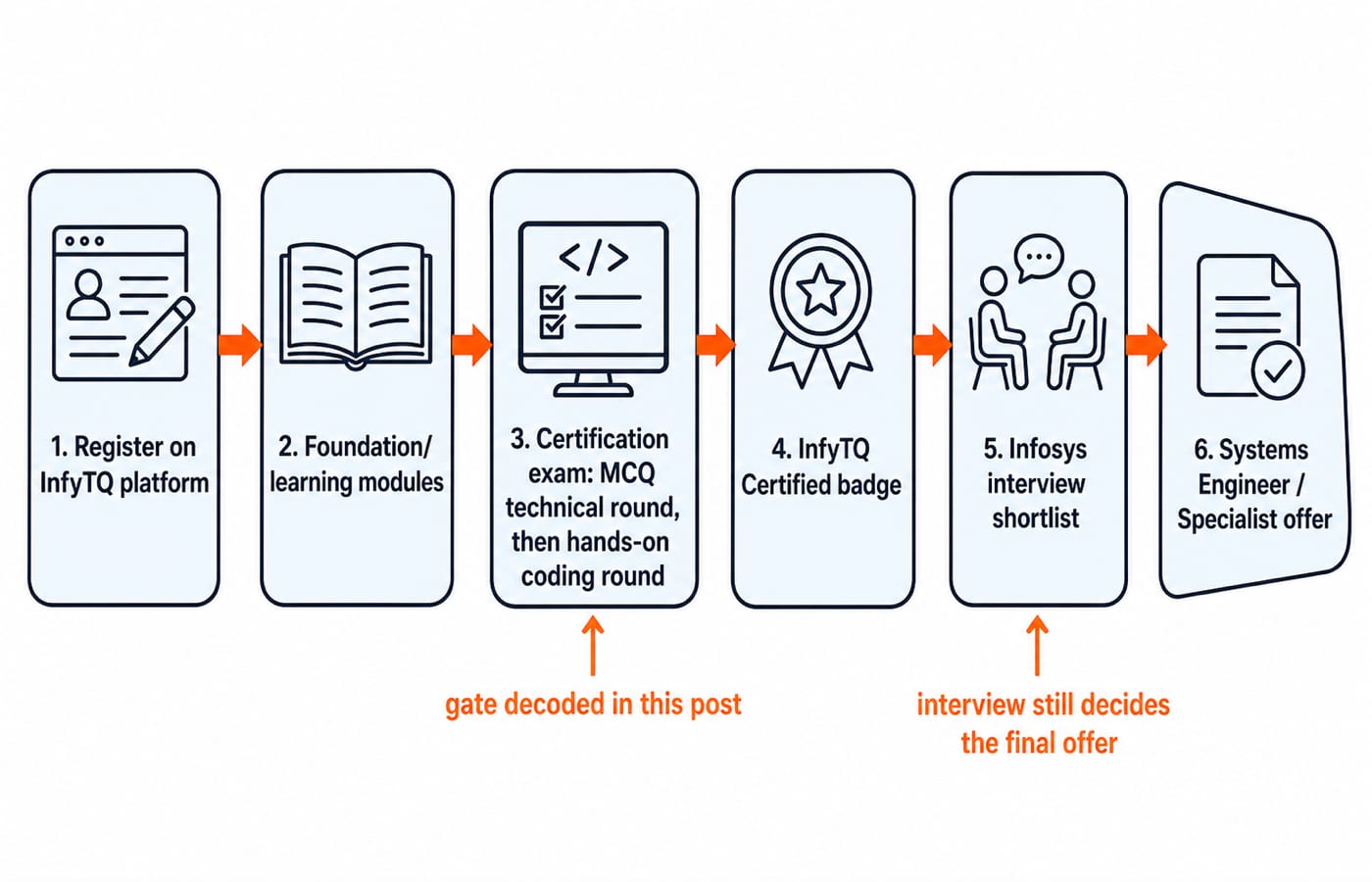
InfyTQ is Infosys's digital learning and certification platform, not simply a one-day recruitment paper. The learner journey begins with registration and foundation learning, moves through practice and the certification assessment, and can then feed into an Infosys interview track.
Think of the process as a funnel. Learning prepares you for the certification gate. Performance at that gate can make you eligible for interview consideration. The interview and the rest of the applicable hiring process still decide whether an offer follows.
This distinction protects you from two bad plans. The first is preparing only for a generic Infosys aptitude test and ignoring certification subjects. The second is treating the badge as an automatic job. The wider company process, from aptitude to the final conversation, is the subject of the Infosys placement preparation guide.
The exam rounds and structure
The certification assessment has a two-stage technical shape. The first stage checks objective understanding through technical multiple-choice questions. The next stage asks you to write and run code in an in-browser environment. It is a move from recognition to execution.
That difference changes preparation. In an MCQ, the correct output or query may appear among the options. In a hands-on round, you must read input, choose an approach, write syntactically valid code, run it, inspect errors, and handle edge cases. Knowing what a loop does is not the same as producing working code under a test condition.
The certified badge is the assessment outcome, and stronger certification performance can improve the hiring routes for which you are considered. However, exact question counts, duration, qualifying rules, attempt limits, and tier names can be revised. Confirm every such detail on your current InfyTQ dashboard before scheduling mocks. Do not copy a past candidate's screen and assume it is your rulebook.
The syllabus, decoded
The technical scope can be organised into four connected blocks.
Python programming fundamentals
Build control flow, functions, strings, lists, dictionaries, file handling, exceptions, and object-oriented basics. Learn to trace a program, but also type it. Small syntax errors and weak input handling become visible only when code runs.
Data structures and problem solving
Revise arrays or lists, stacks, queues, searching, sorting, and basic complexity. The goal is not to memorise an advanced algorithm catalogue. It is to recognise a pattern, choose a reasonable structure, and turn the idea into a working program.
DBMS and SQL
Prepare keys, normalisation, relational design, joins, grouping, subqueries, constraints, and transactions. DBMS is cleanly testable in both concept and query form. For SQL, write queries against small tables rather than merely reading solved answers.
KnowledgeGate's question bank carries about 2,000 DBMS and SQL questions you can drill against. Use them to find the weak concept, then write the related query yourself. An MCQ can reveal a gap, but a compiler or a database console proves whether you closed it.
Object orientation, pseudocode, and logic
Know classes, objects, inheritance, encapsulation, and simple method behaviour. Pseudocode and output tracing sit alongside programming because they test whether you can follow state changes without being distracted by full language syntax.
The Infosys pseudocode tracing guide gives this recurring trap a separate practice method. Trace variables line by line and write the value after every update. Mental shortcuts are where off-by-one errors survive.
How certification leads to an Infosys offer
Certification opens a door. Depending on the current programme and your performance, it can make you eligible for an interview track and for consideration for roles such as Systems Engineer or a specialist role. The sequence from module to offer is worth holding in your head.
Learning modules build the required base.
The certification assessment tests technical knowledge and coding execution.
The badge records that outcome and can carry you to interview consideration.
The interview evaluates technical explanation, projects, communication, and role fit.
An offer follows only after the applicable selection process is cleared.
Notice where the work changes shape. Steps one to three reward silent, solitary practice; step four rewards saying the same thing out loud to a stranger. That is why interview preparation should begin before the badge arrives. Keep a clear explanation of every project on your resume, revise the CS foundations behind the code you wrote, and practise describing one solution without reading it from the screen.
Where students lose it
Preparing only MCQs
Candidates who recognise correct code can still freeze at a blank editor. During practice, start from an empty file, type the solution, run sample cases, and create at least one edge case. Debugging is part of the skill being tested.
Rushing pseudocode tracing
Output questions punish skipped updates and assumed loop counts. Build a small trace table with the iteration, condition, and changed variables. It is slower at first and much faster than correcting an intuitive mistake later.
Treating DBMS as reading-only theory
Definitions matter, but SQL requires production. Create two or three small tables and practise joins, aggregates, grouping, and nested queries. If a query is wrong, explain whether the error came from syntax, grouping, or the relationship between tables.
Assuming the badge guarantees the job
This creates a preparation gap exactly where the process moves to interviews. Certification eligibility and final selection are different outcomes. Keep the next gate visible from the beginning.
How to prepare, in order
Start with Python fundamentals and short problem-solving exercises. Next, add data structures and timed coding problems. Build DBMS and SQL in parallel, using question practice for coverage and live query writing for execution.
Once the foundations hold, rehearse the two assessment modes separately. Run timed technical MCQs, then complete hands-on problems in a real compiler without copying starter code. Finish by mixing the modes in one session and reviewing every error.
The InfyTQ Preparation Course follows the certification track across programming, DBMS, data structures, and coding. The broader Placement Preparation category helps you add aptitude, resumes, and interviews around that specific exam.
The short version and next step
InfyTQ is a learning and certification platform with an objective technical stage and a hands-on coding stage. Python, problem solving, data structures, and DBMS or SQL form the core preparation blocks. The badge can earn interview eligibility or consideration, not an automatic offer, so coding and interview preparation must overlap.
Confirm the current rules on your own InfyTQ dashboard, then work the two assessment modes until neither one surprises you. The InfyTQ Preparation Course carries the certification gate itself. For the placement journey that continues after it, including aptitude and interview work, the Mera Placement Hoga complete placement bundle picks up where the badge stops.
Keep learning
Cyber Safety and Security: Information Security and Cyber Law with Worked Examples
Learn information security as an applied subject. Classify security failures, work Caesar and RSA examples, separate common attacks, and revise India's cyber-law framework.
Updated 22 Oct 20266 min readGATE Strategy & Roadmap
Internet & Web Technology for GATE: Syllabus Boundary, Weightage Method and Prep Order
Treat Internet and Web Technology as an overlap area, not a promised standalone subject. Build scope, paper-audit, URL-tracing and subnetting skills in a 12-session plan.
Updated 18 Oct 20265 min readGATE Strategy & Roadmap
How to Use Practice Exams and Past Papers with Spaced Repetition
Turn practice exams and past papers into a spaced revision system. Learn how to analyse mistakes, schedule reattempts, and fit mocks into a weekly study plan.
15 Oct 20266 min readGATE Strategy & Roadmap
Information Security & Cyber Laws for GATE: Syllabus Scope, Weightage Reality and Prep Order
Check where security concepts overlap with GATE CS, where Cyber Laws sits outside the cited syllabus, and how to protect core preparation while serving a second target.
Updated 14 Oct 20265 min readGATE Strategy & Roadmap