Modes and Connections MCQs: 12 Solved Questions with Explanations
Solve 12 published modes and connections questions using arrow tests, device counts and clean distinctions between direction, timing and link sharing.
KnowledgeGate Team
Exam prep & CS education
4 Sep 20268 min read
Modes and connections questions look easy when terms are studied separately, but one option may quietly switch from transmission direction to bit transfer or link sharing. Pause before reading the choices: separate direction, timing and device count, then judge each label without relying on a memorised device example. Use A -> B for simplex, A -> B followed by B -> A for half-duplex, and simultaneous A <-> B for full-duplex. A dedicated two-device link is point-to-point, while three or more devices sharing one link form a multipoint connection.
Related reading: transmission media MCQs and switching techniques.
Modes and connections MCQs: the decision rules to use first
Keep these definitions separate before you look at the options.
Concept | Exact decision rule | Arrow or link picture |
|---|---|---|
Simplex | One permitted direction |
|
Half-duplex | Two permitted directions, but only one is active at a time |
|
Full-duplex | Two directions active simultaneously |
|
Point-to-point | Exactly two devices use a dedicated link |
|
Multipoint | Three or more devices share one link | A, B and C share the medium |
Broadcast network | One shared channel is visible across the attached machines | One transmission reaches the shared network |
Simplex, half-duplex and full-duplex answer who may send and when. Serial and parallel answer how bits travel: serial sends one bit at a time over a channel, while parallel sends multiple bits at the same time over several channels. Narrow band, voice band and broad band are older channel classes based on transmission-speed capacity, so they answer a third kind of question.
Use a three-question check. Can both endpoints send? If yes, can they send simultaneously? Finally, is the link dedicated to two devices or shared by more devices? The GATE CS Exam Preparation category places these rules inside the wider Computer Networks study route.
Simplex and full-duplex MCQs on data-flow direction
Question 1, UP Police 2013
A remote batch-processing operation in which data is solely input to a central computer would require
(a) telegraph line
(b) simplex lines
(c) mixed band channel
(d) all of the above
Answer: (b) simplex lines. Draw the stated flow as remote input -> central computer. No return-data path is required, so one permitted direction is sufficient. The other named lines do not make every option correct, which also eliminates (d).
Question 2, Navodaya Vidyalaya Samiti 2017
Which data communication method is used to transmit the data over a serial communication link in both directions at the same time?
(a) Simplex
(b) Half-duplex
(c) Full-duplex
(d) Four fire circuit
Answer: (c) Full-duplex. The phrase “both directions at the same time” gives the complete test: A -> B and B -> A are active simultaneously. Serial tells us that bits are placed on the link one at a time; it does not change the duplex classification.
Question 3, DSSSB 2022
Communication of CPU with keyboard and monitor is an example of which of the following modes of communication?
(a) Simplex
(b) Half-duplex
(c) Full-duplex
(d) Both simplex and half-duplex
Answer: (a) Simplex. Treat the peripheral links separately. The keyboard uses keyboard -> CPU, while the monitor uses CPU -> monitor; each individual link carries data in only one direction. Combining two one-way links in one stem does not turn either link into half-duplex.
Half-duplex and full-duplex MCQs with device examples
Question 4, DSSSB TGT Shift 5 2021
_____ mode allows transmission in either direction but not simultaneously.
(a) Duplex
(b) Half Duplex
(c) Simplex
(d) Half-Simplex
Answer: (b) Half Duplex. The path may be A -> B or B -> A, but only one direction is active at a time. “Not simultaneously” rules out full-duplex, while the permitted reverse direction rules out simplex.
Question 5, UP Police 2016
Which of the following options is an example of a full-duplex transmission device?
(a) Radio
(b) Walkie-Talkie
(c) Telephone
(d) Television
Answer: (c) Telephone. In a telephone conversation, each person can speak and hear at the same time, so both directions may be active simultaneously. Radio and television are one-way examples. A walkie-talkie normally permits both directions, but only one speaker transmits at a time.
Question 6, UGC NET June 2025
Which of the following statements are true? A. Full duplex communication is bidirectional. B. FM radio is an example of simplex communication. C. A walkie-talkie is an example of full-duplex communication. D. In half-duplex communication, both devices can send and receive data at the same time. E. A landline telephone is an example of half-duplex communication.
(a) A, B, C, D, and E
(b) C, D, and E Only
(c) A and B Only
(d) A, B, and D Only
Answer: (c) A and B Only. A is true because full-duplex is bidirectional, and B is true because FM radio sends from station to receiver. C is false because a walkie-talkie is half-duplex, D is false because half-duplex is not simultaneous, and E is false because a normal landline telephone is full-duplex. Only A and B survive.
Transmission-mode MCQs that mix direction with serial and parallel transfer
Question 7, UGC NET January 2026
Match the LIST-I with LIST-II LIST-I LIST-II A. Simplex I. Multiple bits transmitted over several channels at the same time B. Serial II. Data transmission in one direction only C. Full-duplex III. Data is sent one bit at a time over a single channel D. Parallel IV. Data transmission in two directions at the same time Choose the correct answer from the options given below:
(a) A-II, B-I, C-IV, D-III
(b) A-II, B-III, C-IV, D-I
(c) A-III, B-II, C-I, D-IV
(d) A-III, B-II, C-IV, D-I
Answer: (b) A-II, B-III, C-IV, D-I. Match each pair independently: Simplex means one direction, Serial means one bit over one channel, Full-duplex means two directions at the same time, and Parallel means multiple bits over several channels. Therefore A maps to II, B to III, C to IV and D to I.
Question 8, BEL Probationary Engineer 2023
In the context of computer networks, which of the following is a data transmission mode? I. Simplex II. Half Simplex III. Full Duplex
(a) Only I and II
(b) I, II and III
(c) Only II and III
(d) Only I and III
Answer: (d) Only I and III. Simplex and Full Duplex are standard transmission modes. “Half Simplex” is not the middle category; the standard term is Half Duplex. Eliminating every option containing II leaves I and III only.
For wider Unit 9 study after these mixed classification questions, NTA-UGC-NET Paper - 2 provides the structured course route.
Point-to-point and multipoint connection MCQs
Question 9, Accenture 2023
Three or more devices share a link in ________ connection.
(a) Unipoint
(b) Multipoint
(c) Point to point
(d) Simplex
Answer: (b) Multipoint. Three or more devices sharing one link is exactly a multipoint configuration. Point-to-point has exactly two endpoints. Simplex describes permitted direction, not how many devices share the link.
Question 10, DSSSB TGT 2024
Which statement is correct regarding a point-to-point connection in data communication?
I. It provides a dedicated link between two devices.
II. It is a time-shared connection.
(a) Only II
(b) Both I and II
(c) Neither I nor II
(d) Only I
Answer: (d) Only I. A point-to-point configuration has exactly two devices and a link dedicated to those endpoints, so statement I is true. Time sharing is associated with a shared multipoint arrangement, so statement II is false. The result is true, false, which selects Only I.
Use Computer Networks MCQs when you want to move from this subtopic to the broader subject collection.
Broadcast links and communication-channel class MCQs
Question 11, Accenture 2024
Communication channel is shared by all the machines on the network in _______
(a) broadcast network
(b) unicast network
(c) multicast network
(d) anycast network
Answer: (a) broadcast network. A broadcast network uses a shared communication medium, so a transmitted frame can reach all machines attached to that network. Addressing determines which machine accepts it. Unicast, multicast and anycast describe delivery scopes, but the stem asks for the network form with one shared channel.
Question 12, BEL Probationary Engineer 2023
In computer networks, which of the following are the basic categories of communication channels (paths) when classified by data-transmission speed?
I. Narrow band
II. Voice band
III. Broad band
(a) Only I and II
(b) I, II and III
(c) Only II and III
(d) Only I and III
Answer: (b) I, II and III. Under the classification used in the question, communication paths are grouped as narrow band, voice band and broad band according to transmission-speed capacity. All three labels belong to that classification, so no item is eliminated. Retaining I, II and III selects (b).
Continue with more Modes and Connections PYQs in the topic practice hub.
Modes and connections MCQs: exam traps and the next step
Four corrections prevent most errors in this set. Bidirectional does not always mean simultaneous, because half-duplex alternates direction. Simplex and duplex are independent of serial and parallel transfer. Point-to-point and multipoint count the devices sharing a link, not the permitted directions. Broadcast describes a shared network channel, not two-way timing.
Redo all 12 questions by drawing the arrows first and writing the device count beside the link. Open each linked question page after the attempt to compare your choice, then return to the broader study pages when a definition needs revision.
For structured Computer Networks study, GATE Guidance by Sanchit Sir is the wider course route. If you only want another focused practice set, continue with TCP and UDP MCQs: 12 Solved Transport Layer Questions. Draw the direction, test simultaneity, count the devices, and only then choose the label.
Keep learning
Repeater, Hub, Bridge & Switch MCQs: 12 Solved Questions with Explanations
Solve 12 exam questions on device layers, MAC forwarding, VLANs, collision and broadcast domains, port mirroring, bridges and crosspoint counting.
Updated 20 Oct 20267 min readComputer Networks MCQs
Ethernet IEEE 802.3 MCQs: 12 Solved Questions with Explanations
Solve 12 Ethernet questions on IEEE 802.3, speed generations, hubs, MAC addresses, multicast, CSMA/CD and the first binary backoff race.
Updated 16 Oct 20267 min readComputer Networks MCQs
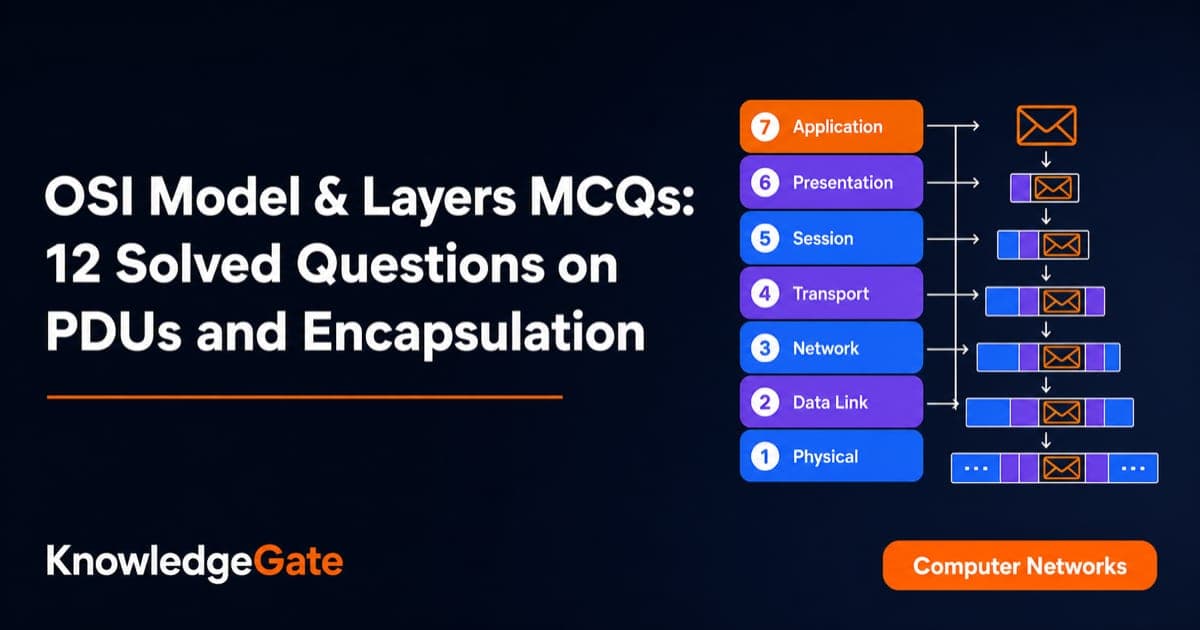
OSI Model & Layers MCQs: 12 Solved Questions on PDUs and Encapsulation
Test OSI layers, PDUs, encapsulation and router traversal through solved MCQs, with explanations, a byte-by-byte frame trace and a layer-visit method.
12 Oct 20267 min readComputer Networks MCQs

Mobile Computing MCQs: Solved Questions on Concepts, Features and Applications
Work through 10 solved questions covering portability, cellular standards, Bluetooth, CDMA, Android, mobile cloud, and device constraints. Each answer has a concise explanation.
7 Oct 20267 min readComputer Networks MCQs