Ethernet Cross-Concept MCQs: 12 Solved Data Link Layer Questions
Solve 12 Ethernet questions spanning devices, MAC structure, CSMA/CD, STP, VLANs, collision domains, switch port accounting and frame payload conversion.
KnowledgeGate Team
Exam prep & CS education
Updated 30 Aug 20267 min read
Ethernet questions rarely stay inside one definition. A single set can move from bridges and MAC addresses to CSMA/CD, spanning tree, VLANs, collision domains and frame limits, so recognising the concept is often harder than recalling the fact. Bridges forward by MAC address; classic shared Ethernet uses CSMA/CD; one spanning-tree instance elects one root; VLANs separate broadcast domains; and switch ports, inter-switch links and payload units determine the numerical answers. Attempt each item on paper before checking the answer. For question-specific practice, open the links attached to Q1, Q2, Q3, Q9 and Q10. For Q4, Q5, Q6, Q7, Q8, Q11 and Q12, use the Ethernet cross-concept PYQ question hub.
1. Ethernet devices, media and physical addressing
Q1. Bridge between homogeneous LANs
Identify the device from the following options that usually links two homogeneous packet broadcast local networks.
A. A Hub
B. A Router
C. A Bridge
D. A Gateway
Answer: C. A Bridge.
A bridge joins similar LAN segments at the data-link layer and forwards or filters frames by MAC address. A hub repeats signals, a router works at the network layer, and a gateway suits unlike systems or protocol conversion.
Q2. Wired LAN connectivity
RSSB 2023, Informatic Assistant
In LAN, connectivity can be created using Wi-Fi or ______ cables.
A. TV
B. Radio
C. Mobile
D. Ethernet
Answer: D. Ethernet.
Wi-Fi provides wireless LAN connectivity, while Ethernet cabling supplies the wired alternative requested. The stem asks only for the cable family.
Q3. Ethernet physical address length
Ethernet uses ………… physical address that is imprinted on the Network Interface Card (NIC).
A. 48-bits
B. 48-bytes
C. 4-bytes
D. 128-bits
Answer: A. 48-bits.
A conventional Ethernet MAC address contains 48 bits and is commonly written as six hexadecimal octets. Since 48 / 8 = 6 bytes, neither 48 bytes nor 4 bytes is the intended length.
2. Ethernet access method and MAC address structure
Q4. CSMA/CD usage
Which of the following uses CSMA/CD?
A. Ethernet 802.3
B. Wifi 802.11
C. Token Ring
D. None
Answer: A. Ethernet 802.3.
Classic shared, half-duplex IEEE 802.3 Ethernet listens before sending and detects a collision after transmission begins. Switched full-duplex Ethernet has no shared collision channel, so CSMA/CD is not active there. Wi-Fi uses collision avoidance instead.
Q5. First 24 bits of a MAC address
The first 24 bits of MAC address represents
A. Ip address
B. port address
C. Device Id
D. Organisation unique identifier
Answer: D. Organisation unique identifier.
In the textbook 48-bit split, the first 24 bits form the organisationally unique identifier, or OUI. The remaining 24 bits identify an interface value allocated by that organisation.
3. Spanning tree and switched Ethernet domains
Q6. Default STP BPDU interval
Accenture 2023
How often are BPDUs sent from a layer 2 device?
A. Never
B. Every 2 seconds
C. Every 10 minutes
D. Every 30 seconds
Answer: B. Every 2 seconds.
The classic STP default hello interval is 2 seconds. Configuration BPDUs originate from the root bridge and propagate at that interval under default settings. Custom timers and other spanning-tree modes can differ.
Q7. Collision domains on a switch
Accenture 2025
How many collision domains are created when you segment a network with a 12-port switch?
A. 1
B. 2
C. 5
D. 12
Answer: D. 12.
Each active switch port has its own collision domain, so a 12-port switch can create 12 collision domains when every port is in use. A hub behaves differently because all attached devices share one collision domain.
Q8. Root bridge count
Accenture 2023
In a network with dozens of switches, how many root bridges would you have?
A. 1
B. 2
C. 5
D. 12
Answer: A. 1.
One spanning-tree instance elects one root bridge, however many switches participate. Separate VLANs or spanning-tree instances can have different roots; within the single instance named here, the answer is one.
4. VLAN segmentation and VTP behaviour
Q9. Purpose of a VLAN
What does a VLAN do?
A. Acts as the fastest port to all servers.
B. Provides multiple collision domains on one switch port.
C. Breaks up broadcast domains in a layer 2 switch internetwork.
D. Provides multiple broadcast domains within a single collision domain.
Answer: C. Breaks up broadcast domains in a layer 2 switch internetwork.
VLAN membership creates logical layer-2 broadcast boundaries on shared switching hardware. A broadcast inside one VLAN does not enter another VLAN without layer-3 routing. Collision domains belong to switch ports, not to the purpose of VLANs.
Q10. VTP behaviour
Which one of the following is true regarding VLANs?
A. Two VLANs are configured by default on all Cisco switches.
B. VLANs only work if you have a complete Cisco switched internetwork. No off-brand switches are allowed.
C. You should not have more than 10 switches in the same VTP domain.
D. VTP is used to send VLAN information to switches in a configured VTP domain.
Answer: D. VTP is used to send VLAN information to switches in a configured VTP domain.
VTP distributes VLAN database information among participating switches in one configured domain. VLANs are not Cisco-only, there is no universal ten-switch ceiling, and the default-VLAN claim is incorrect as written.
5. Ethernet port-count and frame-payload NATs
Q11. Minimum number of six-port switches
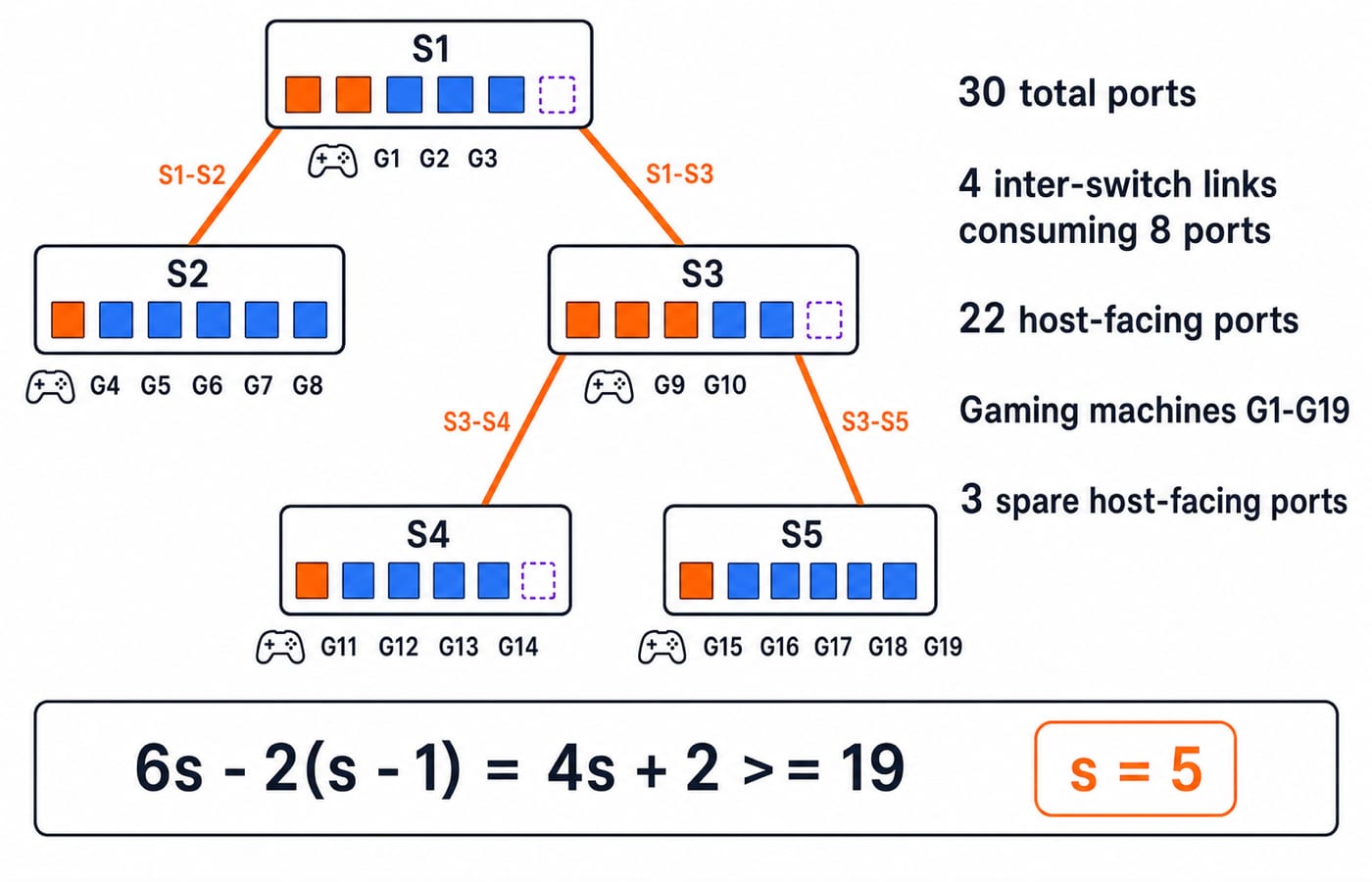
Consider we have a 6-port Ethernet switch and we have 19 gaming machines. These gamers need to be connected in a LAN using these switches. Assume these switches don’t have any separate uplink ports. The minimum number of switches needed is _______.
Options: None. This is a NAT item.
Answer: 5.
Let s be the number of switches. Connecting them as a tree needs s - 1 inter-switch links, and each link consumes two ports, so the host-facing count is 6s - 2(s - 1) = 4s + 2. We need 4s + 2 >= 19, hence s >= 17/4 = 4.25; the smallest integer is 5.
Cross-check the boundary: four switches leave 4(4) + 2 = 18 host ports and fail by one; five leave 4(5) + 2 = 22, enough for 19 machines with 3 ports spare.
Q12. Maximum Ethernet data in bits
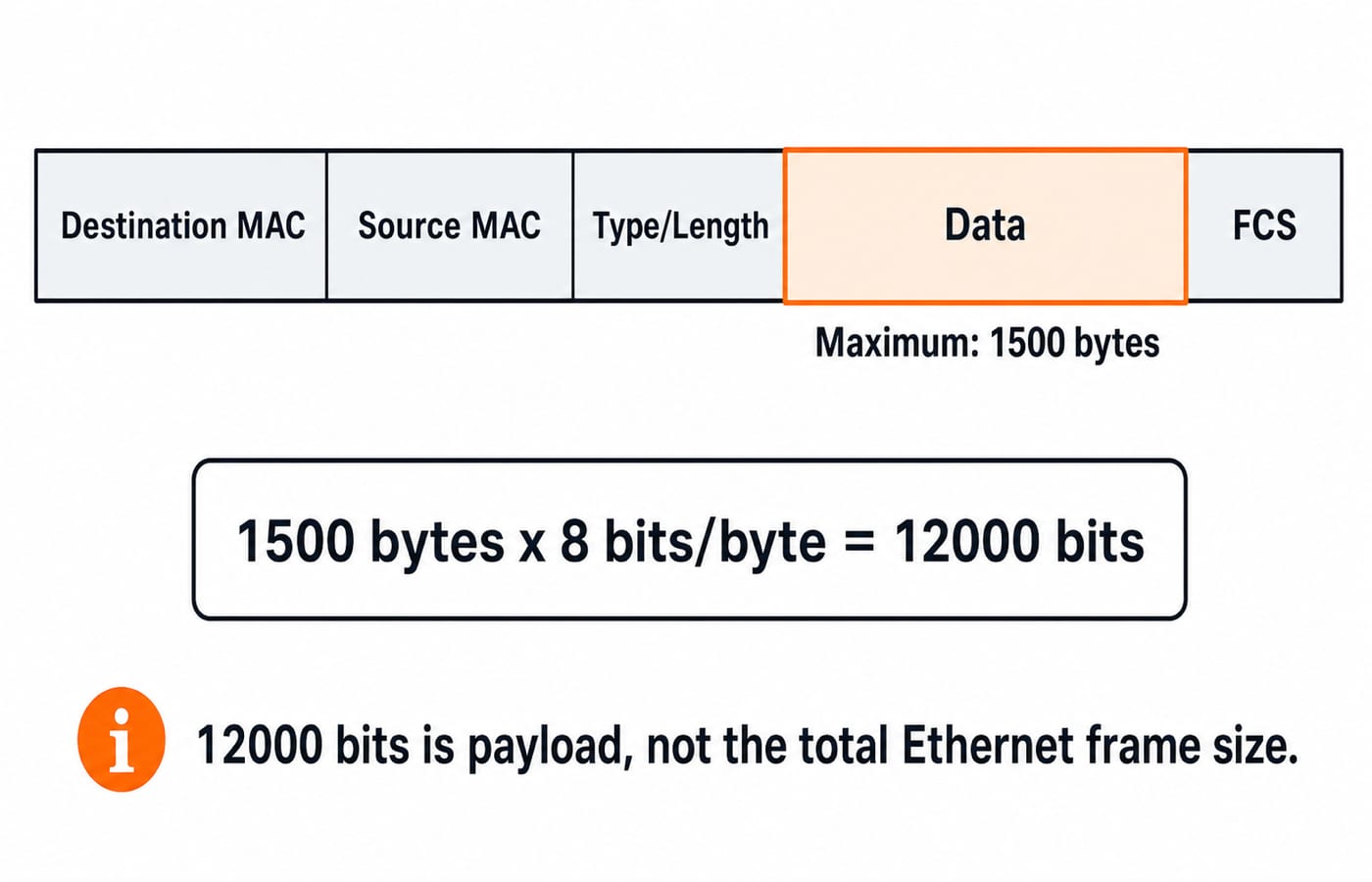
Maximum value of data that can sit inside an Ethernet is _______ bits.
Options: None. This is a NAT item.
Answer: 12000 bits.
Here, data means the standard maximum Ethernet payload of 1500 bytes. Since each byte contains 8 bits, 1500 bytes x 8 bits/byte = 12000 bits. This is the payload only, not the total frame size, so do not add the Ethernet header or frame check sequence.
6. Ethernet MCQ score diagnosis and next practice set
Use these revision buckets: devices, media and address size (Q1-Q3); access control and MAC structure (Q4-Q5); STP and switch domains (Q6-Q8); VLAN control (Q9-Q10); numerical port and payload accounting (Q11-Q12).
Mistake | Why it fails | Repair |
|---|---|---|
Treating a hub as a bridge | A hub repeats signals but does not filter frames by MAC address | Match a bridge with data-link forwarding between similar LAN segments |
Saying all Ethernet always uses CSMA/CD | Full-duplex switched links do not share a collision channel | Attach CSMA/CD to classic shared, half-duplex Ethernet |
Confusing bits with bytes | One byte contains 8 bits | Write the unit conversion before selecting an answer |
Giving each switch all six host ports | Every inter-switch link consumes one port at each end | Subtract |
Calling VLANs collision domains | VLANs divide broadcast domains | Associate collision domains with switch ports |
Assuming several roots in one STP instance | One instance elects one root bridge | State the instance scope before counting roots |
For the next network-layer numerical set, solve Subnetting MCQs: 12 Solved IP Addressing Questions. Then use TCP and UDP MCQs: 12 Solved Transport Layer Questions to practise protocol comparison.
7. Ethernet cross-concept MCQs: the short version
A bridge joins similar LAN segments.
An Ethernet MAC address is
48 bits = 6 bytes, and its OUI is the first24 bits.A 12-port switch creates 12 collision domains when all ports are active.
One spanning-tree instance has one root bridge.
Five 6-port switches joined as a tree provide 22 host-facing ports after four inter-switch links.
The maximum Ethernet payload is
1500 bytes = 12000 bits.
For a structured route through Computer Networks, continue with GATE Guidance by Sanchit Sir. To compare the wider learning and test routes first, use GATE CS Exam Preparation Courses & Test Series.
Transfer check: 7 eight-port switches joined as a tree leave 44 host-facing ports: 56 total ports minus 12 ports used by six inter-switch links.
Keep learning
UDP Protocol and Header MCQs: 12 Solved Questions with Explanations
Solve 12 UDP questions, then check the reasoning behind connectionless service, application choices, the 8-byte header, and packet-length calculations.
24 Oct 20267 min readComputer Networks MCQs
Repeater, Hub, Bridge & Switch MCQs: 12 Solved Questions with Explanations
Solve 12 exam questions on device layers, MAC forwarding, VLANs, collision and broadcast domains, port mirroring, bridges and crosspoint counting.
Updated 20 Oct 20267 min readComputer Networks MCQs
Ethernet IEEE 802.3 MCQs: 12 Solved Questions with Explanations
Solve 12 Ethernet questions on IEEE 802.3, speed generations, hubs, MAC addresses, multicast, CSMA/CD and the first binary backoff race.
Updated 16 Oct 20267 min readComputer Networks MCQs
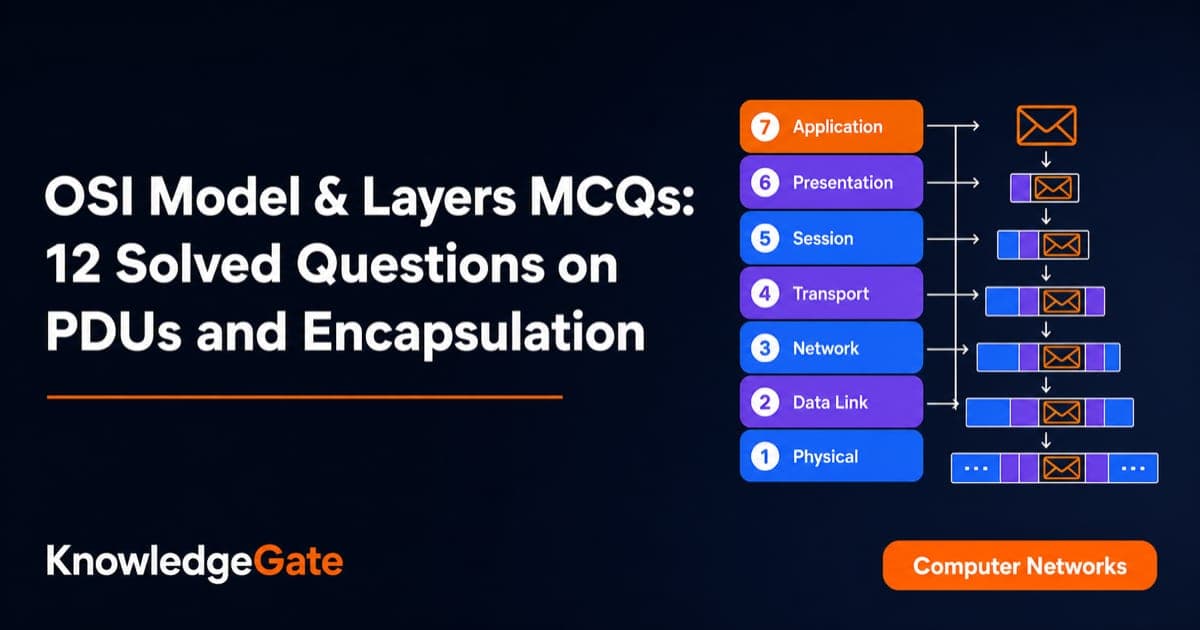
OSI Model & Layers MCQs: 12 Solved Questions on PDUs and Encapsulation
Test OSI layers, PDUs, encapsulation and router traversal through solved MCQs, with explanations, a byte-by-byte frame trace and a layer-visit method.
12 Oct 20267 min readComputer Networks MCQs