NFA Interview Questions and Answers: Basics, Design and Worked Traces
Build interview-ready NFA answers from first principles. Design a machine for strings ending in 01, trace active states, handle epsilon-closure, and derive its reachable DFA subsets.
KnowledgeGate Team
Exam prep & CS education
Updated 27 Oct 20265 min read
Saying that an NFA can have many next states is rarely enough in an interview. The next question may ask for its transition function, an active-state trace, or a small machine designed from a language. This guide builds a progressive answer ladder: define, compare, design, trace, convert, and explain how the same machine can be simulated in code. The examples are interview practice patterns, not claims about any named employer's current process.
1. What is an NFA? Give the 30-second model answer
A nondeterministic finite automaton is a 5-tuple M = (Q, Sigma, delta, q0, F), where Q is a finite set of states, Sigma is the input alphabet, delta is the transition function, q0 is the start state, and F is the set of accepting states. Without epsilon moves, delta: Q x Sigma -> 2^Q. Therefore, one state-symbol pair may lead to the empty set, one state, or several states.
After the complete input has been consumed, the NFA accepts if at least one possible path ends in a state belonging to F. Nondeterminism is a mathematical model. It does not mean that a program literally guesses the correct path.
An epsilon-NFA extends the function to delta: Q x (Sigma union {epsilon}) -> 2^Q. An epsilon transition changes state without consuming an input symbol.
2. How is an NFA different from a DFA, and is it more powerful?
Point | DFA | NFA |
|---|---|---|
Next state | Exactly one for every state-symbol pair | A set containing zero or more states |
Active state | One state | A set of states may be active |
Missing move | A complete DFA defines a move, often to a dead state | Represented by the empty set |
Epsilon move | Not allowed | Allowed only in the epsilon-NFA extension |
NFAs and DFAs recognise exactly the regular languages, so an NFA is not more expressive. Every n-state NFA has an equivalent DFA with at most 2^n subset states, although many subsets may be unreachable.
Why use an NFA, then? It can represent a useful choice compactly. For a suffix language, the machine can keep reading the prefix while also branching when the relevant suffix may have started. That often makes the design easier to explain before converting it to a DFA.
3. Design an NFA for binary strings ending in 01
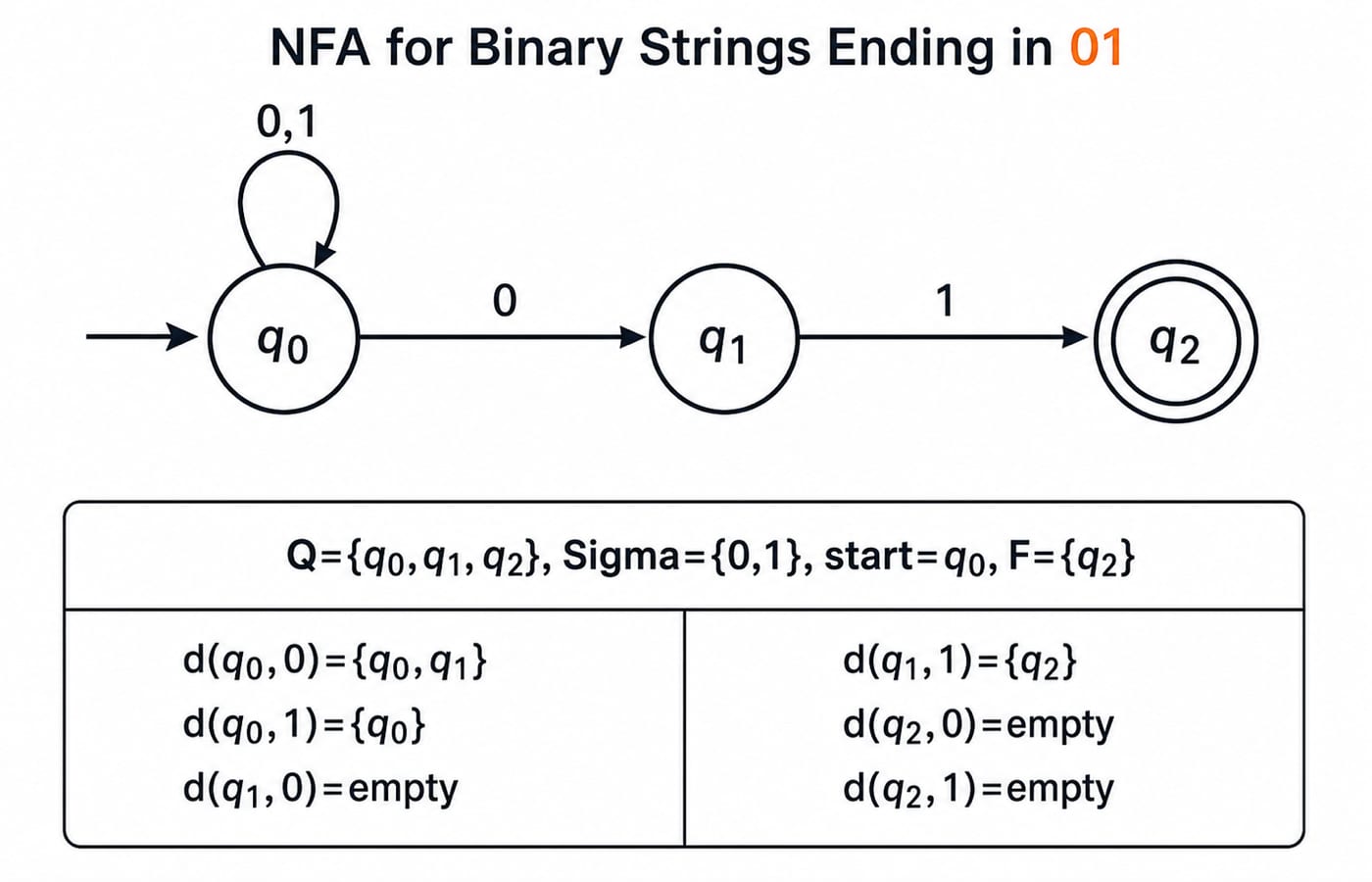
First say the language clearly: all strings in {0,1}* whose final two symbols are 01. Use Q = {q0, q1, q2}, Sigma = {0, 1}, start state q0, and F = {q2}. Define all six transitions:
delta(q0, 0) = {q0, q1}delta(q0, 1) = {q0}delta(q1, 0) = emptydelta(q1, 1) = {q2}delta(q2, 0) = emptydelta(q2, 1) = empty
State q0 consumes any prefix. On a 0, it keeps the prefix path in q0 and starts a candidate suffix in q1. State q1 requires a following 1. State q2 has no outgoing move, so that 1 must be the final symbol. The machine accepts 01, 101, and 1101. It rejects epsilon, 10, and 010.
4. Trace why 1101 passes while 1110 fails
For 1101, carry the complete active set after every symbol:
S0 = {q0}
1: {q0}
1: {q0}
0: {q0, q1}
1: delta(q0, 1) union delta(q1, 1) = {q0} union {q2} = {q0, q2}
The final set contains q2, so 1101 is accepted. For 1110, the trace is {q0} -> {q0} -> {q0} -> {q0} -> {q0, q1}. It rejects because the final set lacks q2.
Now test the trap 010. Its path reaches q2 after the prefix 01, but that path dies on the last 0. The final set is {q0, q1}, so reaching an accepting state early does not accept the string.
5. What changes when epsilon transitions are allowed?
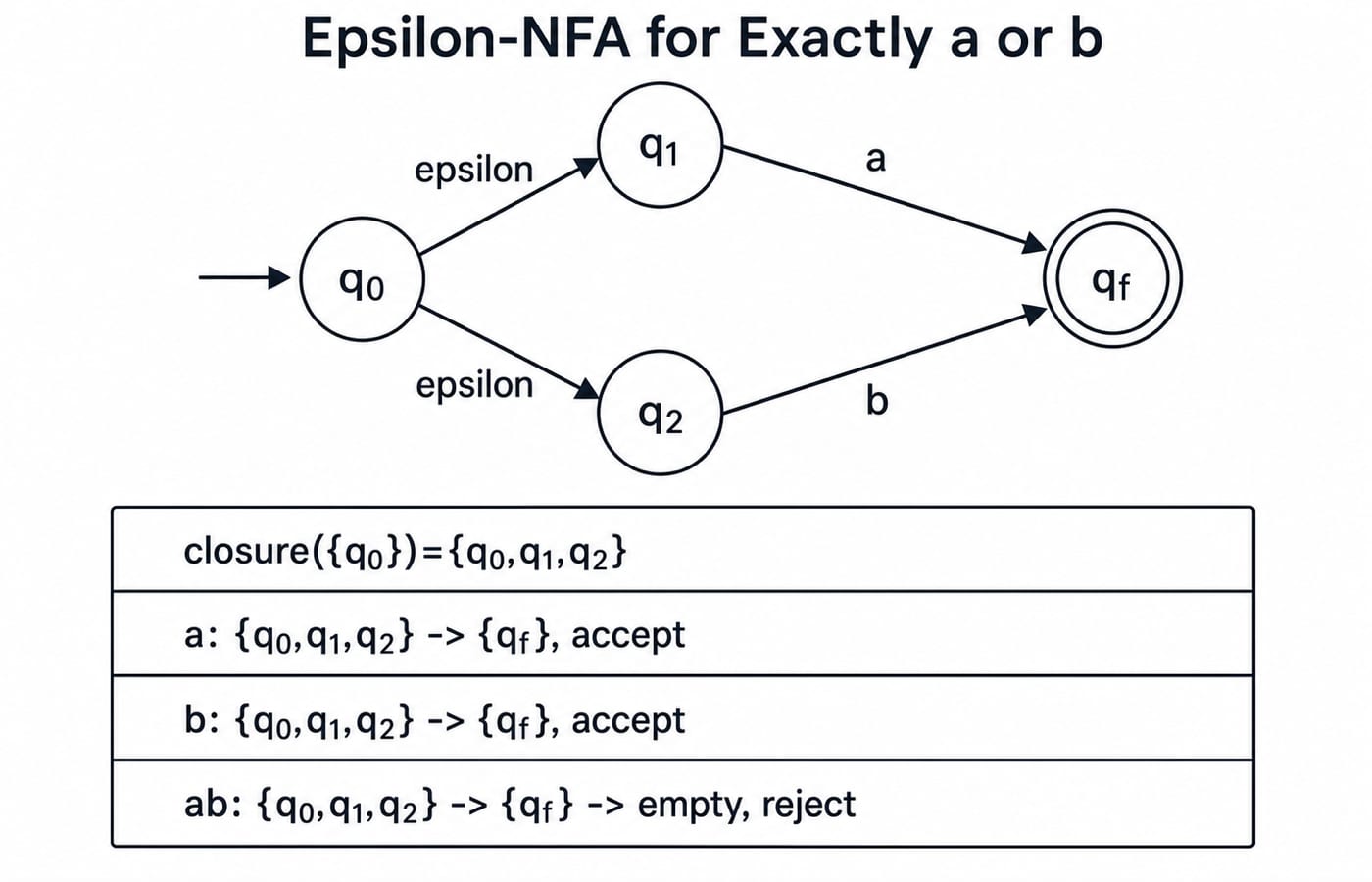
Consider an epsilon-NFA accepting exactly {a, b}. Let Q = {q0, q1, q2, qf}, Sigma = {a, b}, start state q0, and F = {qf}. Its only transitions are q0 --epsilon--> q1, q0 --epsilon--> q2, q1 --a--> qf, and q2 --b--> qf. Every other transition is empty.
The initial closure is epsilon-closure({q0}) = {q0, q1, q2}. On a, the move reaches {qf}, whose epsilon-closure remains {qf}, so the input is accepted. Input b reaches {qf} through q2. For epsilon, the initial closure lacks qf, so it rejects. For ab, the set after a is {qf}, then the b move is empty, so it rejects.
The reusable rule is simple: take epsilon-closure before reading the first symbol and again after every symbol move.
6. Convert the worked NFA to a DFA and simulate it in code
Subset construction needs only the reachable sets. Name A = {q0}, B = {q0, q1}, and accepting C = {q0, q2}.
DFA state | On | On |
|---|---|---|
|
|
|
|
|
|
|
|
|
The NFA has three states, so the theoretical upper bound is 2^3 = 8 subset states. Only three are reachable here. The full NFA to DFA conversion procedure follows this same idea.
For simulation, initialise active = {q0}. For each input symbol, replace active with the union of that symbol's transition sets from every active state. Accept if the final set intersects F. For an epsilon-NFA, take the initial closure and close the set after every move. With adjacency sets, runtime is proportional to the labelled transitions inspected across the input. A simple upper bound is O(|w| x |E|), with O(|Q|) active-set space.
7. How interviews and exams turn NFA basics into follow-ups
Treat this as a question ladder, not a claim about employer frequency. A baseline service-company or early technical-screen question may ask for the definition, the NFA-DFA difference, or one trace. A deeper product-company or systems follow-up may ask you to justify the design, find reachable DFA subsets, handle epsilon-closure, or sketch active-set simulation. Actual processes vary by employer and role.
Repair these common traps in your spoken answer:
"All paths must accept" becomes "at least one full-input path must accept."
"An NFA is more powerful" becomes "both models have the same expressive power."
"All
2^nstates appear" becomes "2^nis an upper bound.""Every member of a final subset must be final" becomes "one member in
Fis enough.""Reaching a final state early accepts" becomes "the complete input must be consumed."
KnowledgeGate currently has 20+ published questions for this subtopic. Use the NFA Basics & Design MCQs to practise these exact distinctions and traces.
8. The short answer and the next practice step
Recall six points: an NFA maps a state-symbol pair to a set of states; acceptance is existential after full input consumption; an NFA and a DFA have the same expressive power; suffix design becomes easier by branching at a possible start; tracing carries an active-state set; conversion treats each reachable set as one DFA state.
Use the Theory of Computation course for the full finite-automata sequence, the Interview & Resume Preparation course to practise concise spoken delivery, and the CS Fundamentals category as your broader study path.
Keep learning
Turing Machine Variations and UTM: Equivalence, Simulation and Worked Examples
Compare major Turing machine variants, trace a two-tape decider, and decode one transition of a universal Turing machine without confusing simulation with decidability.
Updated 25 Oct 20265 min readTheory of Computation
Regex Design and Algebra Explained: Identities, Arden's Theorem, and Worked Examples
Build regular expressions from language constraints, simplify them with safe identities, prove the result, and solve a recursive equation with Arden's theorem.
Updated 24 Oct 20265 min readTheory of Computation
Regex Basics and Definitions: Operators, Worked Examples and Exam Patterns
Learn how regular expressions denote languages, how their three core operators bind, and how to build and check expressions with exact binary examples.
Updated 21 Oct 20265 min readTheory of Computation
Regex and Finite Automata Equivalence: Conversions, Worked Examples and Exam Traps
Build and verify equivalent regex, NFA and DFA descriptions step by step. The worked conversions show what each state means and how to catch a false match.
Updated 17 Oct 20266 min readTheory of Computation