Probability for GATE CS
Translate the wording into events before calculating. Exact dice, Bayes and expectation examples show how to build the denominator and avoid the standard independence trap.
KnowledgeGate Team
Exam prep & CS education
Updated 21 Jul 20265 min read
Probability questions are usually lost during setup, not calculation. A solver uses the wrong sample space after seeing the word "given", reverses a conditional probability, or treats mutually exclusive events as independent. Name the events first and most of the arithmetic becomes short.
The Engineering Mathematics for GATE course carries the full learning sequence. Four patterns cover most of what GATE asks: restricting a sample space under a condition, inverting a conditional with Bayes, testing independence with the product rule, and splitting an expectation by linearity.
Conditional probability
For events A and B with P(B) > 0,
P(A|B) = P(A intersection B) / P(B)
The condition B changes the sample space. Once B is known to have happened, outcomes outside B are no longer possible.
Worked dice example
Two fair dice are rolled. Given that their sum is 8, what is the probability that the first die shows 3?
Let:
B = the sum is 8.
A = the first die shows 3.
The ordered outcomes satisfying B are:
(2,6), (3,5), (4,4), (5,3), (6,2)
There are five equally likely outcomes in the conditional sample space. Only (3,5) also satisfies A. Therefore:
P(A|B) = 1/5
The denominator is 5, not 36, because the condition has already restricted the sample space. Using 1/36 would calculate the unconditional probability of rolling (3,5), which is not what was asked.
The same method works for cards, components and selected students. List or count only the outcomes that satisfy the condition, then count how many of those also satisfy the requested event.
Total probability and Bayes' theorem
Bayes questions become reliable with a two-step recipe:
Use total probability to find the probability of the observed evidence.
Divide the required joint branch by that evidence probability.
If sources A and B are mutually exclusive and exhaustive, and D is the observed event, then:
P(D) = P(A)P(D|A) + P(B)P(D|B)
and:
P(B|D) = P(B)P(D|B) / P(D)
Worked defective-item problem
A factory receives 60% of its items from machine A and 40% from machine B. Machine A produces 2% defective items; machine B produces 5% defective items. An item selected at random is defective. Find the probability that it came from machine B.
Write every percentage as a fraction:
P(A) = 60/100 = 3/5
P(B) = 40/100 = 2/5
P(D|A) = 2/100 = 1/50
P(D|B) = 5/100 = 1/20
First calculate the total defective probability:
P(D) = (3/5)(1/50) + (2/5)(1/20)
= 3/250 + 2/100
= 3/250 + 1/50
= 3/250 + 5/250
= 8/250 = 4/125
Now select the branch "machine B and defective":
P(B intersection D) = P(B)P(D|B)
= (2/5)(1/20) = 2/100 = 1/50
Apply Bayes' theorem:
P(B|D) = (1/50) / (4/125)
= (1/50)(125/4) = 125/200 = 5/8
Therefore, the required probability is 5/8.
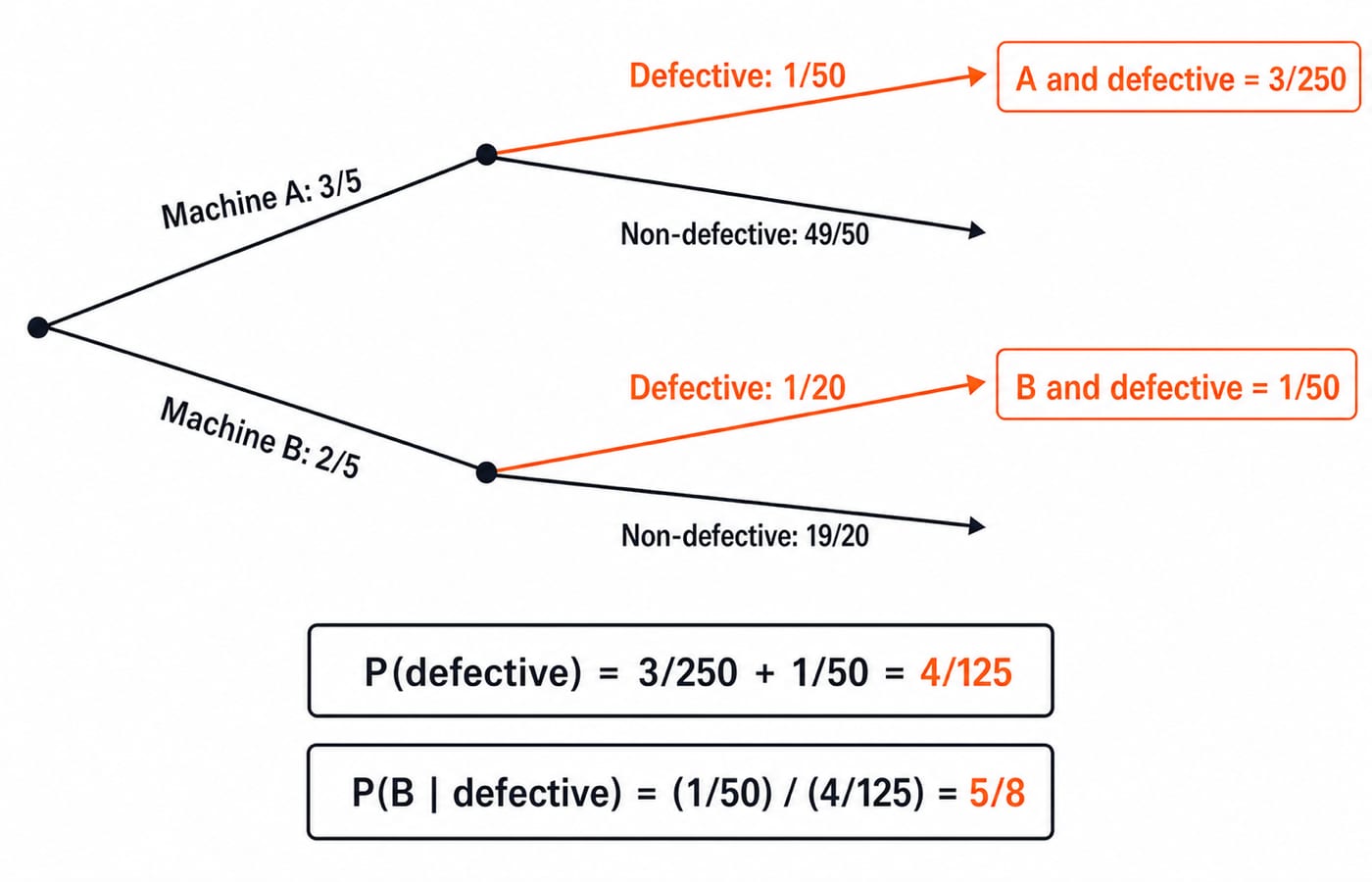
Check the result another way. Among defective items, machine A contributes 3/250 and machine B contributes 1/50 = 5/250. The defective total is 8/250, so B's share is (5/250)/(8/250) = 5/8. Both routes agree.
The most common reversal is to use P(D|B) = 1/20 as the answer to P(B|D). These conditionals are different. One asks for defect rate among B items; the other asks for B's share among all defective items.
Independence versus mutual exclusivity
Events A and B are independent when:
P(A intersection B) = P(A)P(B)
Knowing one occurred does not change the probability of the other.
Events are mutually exclusive when:
P(A intersection B) = 0
They cannot happen together. If two mutually exclusive events both have positive probability, they cannot be independent because P(A)P(B) is positive while their intersection probability is zero.
For a fair die, let A be "the result is odd" and B be "the result is even". Then P(A) = 1/2, P(B) = 1/2, and P(A intersection B) = 0. But P(A)P(B) = 1/4. The events are mutually exclusive and dependent, not independent.
Also remember the conditional form of independence: if P(B) > 0 and A is independent of B, then P(A|B) = P(A).
Expectation basics
For a discrete random variable X,
E[X] = sum of x P(X=x) over all values x
The most useful property is linearity:
E[X1 + X2 + ... + Xn] = E[X1] + E[X2] + ... + E[Xn]
This does not require the variables to be independent.
Suppose a fair coin is tossed five times. Let Xi be 1 if toss i is heads and 0 otherwise. Then the total number of heads is:
X = X1 + X2 + X3 + X4 + X5
For every toss, E[Xi] = 1(1/2) + 0(1/2) = 1/2. Therefore:
E[X] = 5(1/2) = 5/2 = 2.5
An expectation need not be a possible observed value. You cannot see 2.5 heads in one experiment, but 2.5 is the long-run average count across repeated five-toss experiments.
How GATE tests probability
Expect conditional sample spaces, Bayes inversion, independence tests, expectation, or a counting problem that feeds into probability. Write the event notation before choosing a formula. If the problem says "given", rebuild the denominator from the stated condition.
GATE stems are short, and the condition is usually buried in one clause. "A card drawn at random is an ace" and "given that the first card drawn is an ace" start different calculations from nearly the same words. Draw two cards without replacement from a standard deck: given the first is an ace, the second is an ace with probability 3/51, because the condition has already removed one ace and one card from what is left.
Bayes stems name two or three sources and one observation, exactly like the machine A and machine B items above. The observation supplies the denominator, never the answer. Expectation stems hide the distribution instead: when counting the cases is painful, define an indicator variable for each trial or each position, take its expectation on its own, and add. Linearity holds even when those indicators are dependent, which is what makes the trick work on problems that look intractable. Where the answer has to be typed in rather than chosen, keep the fractions exact and round only at the final step.
The KnowledgeGate question bank carries about 450 probability questions. Use GATE CS Subject Weightage to place this block in revision, then use the GATE CS 6-Month Plan to schedule repeated practice. For the current syllabus and official exam-specific instructions, check the official GATE portal of the organising IIT. GATE CS Exam Preparation Courses & Test Series holds the wider route.
The short version and next step
For conditional probability, restrict the sample space first. For Bayes, compute the total evidence probability, then divide the required joint branch by that total. Test independence with the product rule, and do not confuse it with mutual exclusivity. Use linearity to split expectations into easy pieces.
Rework the Bayes tree until every branch product is clear, then use the GATE Test Series for timed mixed problems. Correct event setup matters more than speed, and speed follows once the setup is consistent.
Keep learning
Graphical Method in Linear Programming: Feasible Region, Corner Points and Optimality with a Worked Example
Learn the two-variable graphical method in the right order, then solve and audit a complete maximisation model without trusting the sketch alone.
Updated 21 Oct 20265 min readEngineering Mathematics

Duality in LP: Construct the Dual, Solve a Worked Example, and Apply Key Properties
Learn a reliable matrix-first method to form an LP dual, solve both programs to value 21, and use duality properties to check optimality and avoid sign errors.
Updated 17 Oct 20266 min readEngineering Mathematics

Commutative Property and Abelian Groups: Tests, Worked Examples and Exam Traps
Learn how to separate commutativity from the other group axioms, test custom operations step by step, and avoid the usual classification traps.
Updated 13 Oct 20266 min readEngineering Mathematics

Closure, Semigroup and Monoid: Worked Algebraic Structure Examples
Learn a reliable order for testing closure, associativity and identity. Worked tables and counterexamples show exactly when a structure becomes a semigroup or monoid.
Updated 9 Oct 20266 min readEngineering Mathematics