CTET 2024 Previous Year Questions (PYQs) with Solutions
Real questions from the CTET 2024 paper, solved. Every question below shows its options, the correct answer, and a full text solution — free to read, no login needed. Open any question to practice it interactively inside its course.
- questions
- 200
- with a full solution
- 200
- tagged CTET 2024 in the bank
- 486
- Question 1.CTET 2024
If the median of the data 30, 8, 7, 3, 17, 15, 21, 24, 29, 23 is x and the median of the data is obtained by replacing 3 by 33 and 8 by 18 in the above data is y, then what is the difference between y and x?
- A.
2
- B.
3
- C.
4
- D.
1
Correct answer: B
Solution
For a data set with an EVEN number of values, once it is arranged in ascending order the median is not a single term but the average of the two middle terms — the (n/2)th and (n/2 + 1)th terms. Whenever any value in the set is replaced, the set must be re-sorted from scratch before this same rule is reapplied, since a replacement can shift which terms land in the middle.
Arrange the original 10 values — 30, 8, 7, 3, 17, 15, 21, 24, 29, 23 — in ascending order: 3, 7, 8, 15, 17, 21, 23, 24, 29, 30.
With n = 10 (even), the median x is the average of the 5th and 6th terms: (17 + 21) / 2 = 19.
Replace 3 with 33 and 8 with 18 in the original data, giving 30, 18, 7, 33, 17, 15, 21, 24, 29, 23.
Re-sort this updated data in ascending order: 7, 15, 17, 18, 21, 23, 24, 29, 30, 33.
The median y is again the average of the 5th and 6th terms of this newly sorted list: (21 + 23) / 2 = 22.
The required difference is y − x = 22 − 19 = 3.
Both replaced values (3 and 8) sat in the lower half of the original ordering, and both replacements (33 and 18) land in the upper half of the new ordering, so exactly two terms move from below the middle to above it — this consistently pulls the middle pair upward, confirming that y should exceed x rather than staying the same or falling below it.
- A.
- Question 2.CTET 2024
A class VI mathematics teacher posed the following problem to her students: “In a morning walk, three persons started together. Their steps measure 70 cm, 85 cm and 95 cm respectively. What is the minimum distance each should walk so that all can cover the same distance in complete steps?” Which of the following concepts would be required to solve the given problem?
- A.
Concept of LCM
- B.
Concept of division
- C.
Concept of proportion
- D.
Concept of HCF
Correct answer: A
Solution
To solve the problem, we need to find the minimum distance that is a multiple of all three step lengths: 70 cm, 85 cm, and 95 cm. This is because each person must cover the same distance in complete steps, meaning the total distance must be divisible by each person's step length.
The smallest such distance is the least common multiple (LCM) of the three numbers. LCM gives the smallest number that is a multiple of all given numbers.
Therefore, the concept of LCM is required to solve this problem.
- A.
- Question 3.CTET 2024
Cloud computing provides:
- A.
On-demand computing resources over the internet
- B.
Only local storage
- C.
Offline applications
ऑफलाइन एप्लिकेशन
- D.
Manual processing
मैनुअल प्रोसेसिंग
Correct answer: A
Solution
Correct Answer: A
Cloud computing provides on-demand computing resources over the internet. This includes servers, storage, databases, networking, software, and analytics that can be accessed remotely without direct management by the user.
हिन्दी उत्तर: A
क्लाउड कंप्यूटिंग इंटरनेट पर आवश्यकता अनुसार कंप्यूटिंग संसाधन प्रदान करती है। इसमें सर्वर, स्टोरेज, डेटाबेस, नेटवर्किंग, सॉफ्टवेयर और एनालिटिक्स शामिल हैं जिन्हें उपयोगकर्ता द्वारा सीधे प्रबंधित किए बिना रिमोटली एक्सेस किया जा सकता है।
- A.
- Question 4.CTET 2024
निम्नलिखित गद्यांश को पढ़कर पूछे गए प्रश्नों के सबसे उपयुक्त उत्तर वाले विकल्प को चुनिए :
एक स्वतंत्र और जनतांत्रिक समाज के लिए सामान्य संस्कृति को पोषित करने वाली उच्चस्तरीय शिक्षा बहुत आवश्यक है । यह तभी संभव है जब शिक्षा बहुत से कार्यकलापों का आयोजन करे । यह सब ‘विद्यालय’ जैसी संस्था में संभव हो सकता है । विद्यालय शिक्षा से जुड़ी नीतियों को कार्यान्वित करते हैं । जीवन की गुणवत्ता के संदर्भ में शिक्षा का एक विशिष्ट स्थान है । यह मानव जीवन के विभिन्न पक्षों पर बहुआयामी प्रभाव डालती है । शिक्षा का कार्य शिक्षार्थी को भय से मुक्ति दिलाना है । विद्यालय यह काम कर सकता है । विद्यालय में शिक्षा का वातावरण बच्चों को जानकारी देने, लिखना-पढ़ना सिखाने तक सीमित रखने के बजाय उन्हें स्वतः सीखने के लिए बढ़ावा देने वाला हो जिससे उनमें विभिन्न संस्कृतियों की समझ पैदा होगी ।
कौन-सा शब्द भिन्न है?- A.
स्वतंत्र
- B.
शिक्षा
- C.
संस्कृति
- D.
समाज
Correct answer: A
Solution
अवधारणा
शब्द-भेद में संज्ञा किसी व्यक्ति, वस्तु, स्थान, भाव या समुदाय का नाम बताती है, जबकि विशेषण किसी संज्ञा या सर्वनाम की विशेषता, गुण या अवस्था बताता है।
भिन्न शब्द पहचानने के लिए पहले सभी दिए गए शब्दों का व्याकरणिक वर्ग निर्धारित किया जाता है; फिर उस शब्द को चुना जाता है जिसका वर्ग शेष शब्दों से अलग हो।
अनुप्रयोग
गद्यांश में ‘स्वतंत्र’ शब्द ‘समाज’ की विशेषता बताता है। दूसरी ओर ‘शिक्षा’, ‘संस्कृति’ और ‘समाज’ क्रमशः प्रक्रिया/भाव, जीवन-पद्धति और समुदाय के नाम हैं।
तुलना
‘स्वतंत्र’ — किसी संज्ञा का गुण या अवस्था बताने वाला विशेषण।
‘शिक्षा’ — सीखने-सिखाने की प्रक्रिया या भाव का नाम बताने वाली संज्ञा।
‘संस्कृति’ — किसी समुदाय की जीवन-पद्धति और मान्यताओं के समूह का नाम बताने वाली संज्ञा।
‘समाज’ — व्यक्तियों के संगठित समुदाय का नाम बताने वाली संज्ञा।
निष्कर्ष
अतः शेष तीन शब्द संज्ञाएँ हैं, जबकि ‘स्वतंत्र’ विशेषण है; इसलिए भिन्न शब्द ‘स्वतंत्र’ है।
- A.
- Question 5.CTET 2024
निम्नलिखित गद्यांश को पढ़कर पूछे गए प्रश्नों के सबसे उपयुक्त उत्तर वाले विकल्प को चुनिए : विभिन्न भाषाओं में साहित्य की विशिष्ट विधा के रूप में संस्मरण का महत्वपूर्ण स्थान है। हिन्दी में भी संस्मरण लिखने की एक सुदीर्घ परंपरा है। जनमन की जीवन-यात्रा की अंतरंग छवियों को संस्मरण कह सकते हैं। संस्मरणों में, जीवन में आने वाले व्यक्तियों, पात्रों, स्थानों और घटनाओं की अंतरंग छवियाँ प्रस्तुत की जाती हैं। इसीलिए इसमें साधारण से साधारण और महत्वपूर्ण से महत्वपूर्ण पात्र और प्रसंग शामिल होते हैं। कई बार साहित्यकार अपने संस्मरण को एक व्यापक यथार्थ से ही जोड़कर रखते हैं तो कई बार उसमें अपनी कल्पना का भी पुट भर देते हैं। कुछ साहित्यकार अपने संस्मरण के माध्यम से मानवीय सरोकारों को भी अभिव्यक्त करते हैं। प्रस्तुत गद्यांश साहित्य की किस विधा के बारे में है?
- A.
निबंध
- B.
जीवनी
- C.
कहानी
- D.
संस्मरण
Correct answer: D
Solution
अवधारणा
अपठित गद्यांश में किसी साहित्यिक विधा की पहचान उसके विषय और प्रमुख लक्षणों से की जाती है। केवल किसी एक शब्द को देखकर नहीं, बल्कि पूरे अनुच्छेद में बार-बार उभरने वाली विशेषताओं का मिलान करना चाहिए।
संस्मरण वह गद्य-विधा है जिसमें लेखक स्मृति के आधार पर व्यक्तियों, स्थानों, घटनाओं और अनुभवों की आत्मीय छवियाँ प्रस्तुत करता है।
अनुप्रयोग
गद्यांश में स्मृति से जुड़ी जीवन-यात्रा की अंतरंग छवियों का उल्लेख है।
इसमें व्यक्तियों, पात्रों, स्थानों और घटनाओं को आत्मीय रूप में प्रस्तुत करने की बात कही गई है।
ये लक्षण उस विधा से मेल खाते हैं जो स्मृतियों और निजी अनुभवों को केंद्र में रखती है।
अंतर और पुनःजाँच
निबंध मुख्यतः किसी विषय पर विचार या विवेचन प्रस्तुत करता है।
जीवनी किसी व्यक्ति के जीवन का क्रमबद्ध और अपेक्षाकृत समग्र विवरण देती है।
कहानी कथानक और कल्पित या संयोजित घटनाक्रम पर केंद्रित होती है।
संस्मरण स्मृति-आधारित आत्मीय छवियों और अनुभवों को प्रस्तुत करता है।
अतः गद्यांश में वर्णित विधा संस्मरण है।
- A.
- Question 6.CTET 2024
निम्नलिखित गद्यांश को पढ़कर पूछे गए प्रश्नों के सबसे उपयुक्त उत्तर वाले विकल्प को चुनिए :
विभिन्न भाषाओं में साहित्य की विशिष्ट विधा के रूप में संस्मरण का महत्वपूर्ण स्थान है। हिन्दी में भी संस्मरण लिखने की एक सुदीर्घ परंपरा है। जनमन की जीवन-यात्रा की अंतरंग छवियों को संस्मरण कह सकते हैं। संस्मरणों में, जीवन में आने वाले व्यक्तियों, पात्रों, स्थानों और घटनाओं की अंतरंग छवियाँ प्रस्तुत की जाती है। इसीलिए इसमें साधारण से साधारण और महत्वपूर्ण से महत्वपूर्ण पात्र और प्रसंग शामिल होते हैं। कई बार साहित्यकार अपने संस्मरण को एक व्यापक यथार्थ से ही जोड़कर रखते हैं तो कई बार उसमें अपनी कल्पना का भी पुट भर देते हैं। कुछ साहित्यकार अपने संस्मरण के माध्यम से मानवीय सरोकारों को भी अभिव्यक्त करते हैं।
गद्यांश के संदर्भ में कौन-सा वाक्य सही नहीं है?- A.
संस्मरण में साधारण व विशिष्ट हर तरह के प्रसंग शामिल होते हैं।
- B.
साहित्यकार संस्मरण में अपनी कल्पना का भी पुट भर देते हैं।
- C.
संस्मरण का विशिष्ट विधा के रूप में महत्वपूर्ण स्थान है।
- D.
संस्मरण केवल हिंदी साहित्य की ही विधा है।
Correct answer: D
Solution
संकल्पना
अपठित गद्यांश के प्रश्नों में प्रत्येक कथन को गद्यांश की स्पष्ट सूचना और उसके दायरे से मिलाया जाता है। किसी कथन में “केवल” जैसे सीमाबोधक शब्द हों, तो यह भी जाँचना चाहिए कि गद्यांश उस विषय को व्यापक दायरे में रखता है या सीमित दायरे में।
अनुप्रयोग
गद्यांश पहले ही वाक्य में संस्मरण को विभिन्न भाषाओं के साहित्य में महत्वपूर्ण विधा बताता है और आगे कहता है कि हिंदी में भी इसकी सुदीर्घ परंपरा है। इसलिए हिंदी को अनेक भाषाओं में से एक बताया गया है, संस्मरण की एकमात्र भाषा नहीं।
तुलना
“साधारण व विशिष्ट हर तरह के प्रसंग” वाला कथन साधारण से महत्वपूर्ण तक पात्रों और प्रसंगों के समावेश से मेल खाता है।
“कल्पना का पुट” वाला कथन साहित्यकार द्वारा संस्मरण में कल्पना मिलाने की बात से मेल खाता है।
“विशिष्ट विधा के रूप में महत्वपूर्ण स्थान” वाला कथन गद्यांश के आरंभिक विचार को व्यक्त करता है।
“केवल हिंदी साहित्य की विधा” वाला कथन “विभिन्न भाषाओं” के व्यापक दायरे को एक भाषा तक सीमित कर देता है।
परिणाम
अतः गद्यांश के संदर्भ में असंगत वाक्य है: “संस्मरण केवल हिंदी साहित्य की ही विधा है।”
- A.
- Question 7.CTET 2024
In progressive education children are perceived as :
- A.
Innocent and dependent
- B.
Compliant and capable of only consuming knowledge
- C.
Knowledgeable and meaning-makers
- D.
Vulnerable and in need of protection
Correct answer: C
Solution
Progressive education is a pedagogical philosophy, most associated with John Dewey and constructivist thought, that redefines the child's role in the classroom. Instead of treating the learner as an empty vessel to be filled with facts (the older transmission or “banking” model), it holds that children actively build their own understanding through experience, inquiry, and social interaction — so the child is seen as a competent, thinking participant who already carries knowledge and actively constructs new meaning, not a passive recipient.
Applying this to the item: progressive education asks how the child is perceived. Since the philosophy centres on the learner actively constructing meaning from experience rather than passively absorbing it, the matching description is one where children are seen as capable, informed participants who make sense of the world themselves — knowledgeable and meaning-makers.
Contrasted against the other descriptions offered:
Innocent and dependent reflects an older Romantic/naturalist image of the child as blank and fragile, entirely reliant on adults to be shaped from outside — not the active-agent view progressivism promotes.
Compliant and capable of only consuming knowledge describes the traditional transmission (“banking”) model that progressivism explicitly rejects — a passive recipient rather than a co-constructor of knowledge.
Vulnerable and in need of protection reflects a protectionist, paternalistic lens that emphasises safeguarding the child rather than trusting the child's own capacity to build understanding.
Hence, the description consistent with progressive-education philosophy is that children are knowledgeable and meaning-makers.
- A.
- Question 8.CTET 2024
Feedback to the students in a classroom is most effective when:
- A.
It assigns comparative ranks to the students.
- B.
It occurs during as well as after the learning activity.
- C.
It focuses on what the child cannot do rather than what they can do.
- D.
It centres around tests and exams at the end of the year.
Correct answer: B
Solution
Concept: Feedback is most effective when it functions as part of a continuous (formative) process rather than a one-time judgment. According to the principle of Continuous and Comprehensive Evaluation (CCE), feedback works best when it is given while the learner is engaged in the activity (so mistakes can be corrected in real time) and again once the activity is complete (so the learning is consolidated and the next steps are clear). Effective feedback is also balanced and developmental — it points toward improvement rather than simply ranking or judging the learner.
Application: Feedback given while the learning activity is underway lets a learner adjust before the task is finished, and feedback given again once the activity is complete confirms what was learnt and clarifies the next steps. This during-and-after pattern is the continuous, formative feedback the concept above describes.
Cross-check: Comparing the remaining values against the same principle:
Comparative ranking communicates a student's standing relative to peers — norm-referenced, evaluative information rather than developmental guidance on what to do next.
Feedback confined to what a child cannot do surfaces gaps without also surfacing existing strengths, leaving out the balanced picture a learner needs.
Feedback tied only to end-of-year tests and exams reaches the student as a single, delayed event, once the referenced learning has already concluded.
- A.
- Question 9.CTET 2024
Assertion (A) : During adolescence, the pressure to conform to gender expectations and follow conventions of femininity or masculinity increases.
Reason (R) : Gender and gender roles are determined biologically.
Choose the correct option.
- A.
Both (A) and (R) are true and (R) is the correct explanation of (A).
- B.
Both (A) and (R) are true but (R) is not the correct explanation of (A).
- C.
(A) is true but (R) is false.
- D.
Both (A) and (R) are false.
Correct answer: C
Solution
Concept: Developmental and educational psychology distinguish biological “sex” from “gender” and gender roles — the socially and culturally constructed expectations of masculinity and femininity. Adolescence is marked by gender-role intensification: as identity consolidates, peer, family and media pressure to conform to traditional gender norms increases.
Application: Assertion (A) says the pressure to conform to gender expectations of femininity or masculinity increases during adolescence — this matches the well-documented gender-role intensification pattern, so (A) is true. Reason (R) says gender and gender roles are determined biologically — this is false, since gender roles are learned through socialisation (family, culture, media, schooling) rather than being fixed by biology.
Cross-check: Since (R) is false, it cannot be a correct explanation of (A), which rules out both combinations that need (R) true; since (A) is true, the combination that needs both statements false is also ruled out. Exactly one consistent combination remains: (A) is true but (R) is false.
- A.
- Question 10.CTET 2024
Sunita, a 12 year old girl, shows exceptional musical ability. Both her parents are accomplished singers, and they send her for classes for voice training after school. Her capabilities are most likely to be the result of an interaction between :
- A.
growth and maturation
- B.
nutrition and discipline
- C.
heredity and environment
- D.
gender identity and genetic make-up
Correct answer: C
Solution
Individual differences in special abilities and talents, such as musical aptitude, are explained in developmental psychology through the interaction of heredity (genetically inherited predispositions) and environment (external experiences, exposure, and training). Modern developmental theory treats nature and nurture as jointly interacting influences rather than independent or competing ones.
In this scenario, Sunita's parents are both accomplished singers, indicating an inherited predisposition toward musical ability (heredity), while her enrollment in voice-training classes provides structured practice and exposure (environment). Her exceptional musical ability is therefore best explained as the product of these two factors interacting together, not either one in isolation.
Contrasting the other combinations offered:
growth and maturation: maturation is the largely automatic, age-driven unfolding of biological capacities (for example, physical growth milestones); it does not depend on inherited musical talent or deliberate training, so it does not fit a scenario built around a musical family background and structured lessons.
nutrition and discipline: these refer to diet and behavioural regulation, neither of which is mentioned or implicated in Sunita's case.
gender identity and genetic make-up: gender identity has no established role in musical ability, and genetic make-up alone, without any training or practice component, captures only part of the picture described in the scenario.
Hence, Sunita's musical ability is most accurately attributed to the interaction between heredity and environment.
- A.
- Question 11.CTET 2024
Sensitive periods are those time periods during which certain __________ are especially important for the course of ‘normal’ development.
- A.
genetic predispositions
- B.
ethnic factors
- C.
environmental factors
- D.
hereditary factors
Correct answer: C
Solution
Concept: A foundational principle of developmental psychology is that some traits are not shaped by a constant, unchanging influence but by experiences that matter most during defined developmental time-windows. A ‘sensitive period’ is exactly such a window — input received during that specific phase has an outsized effect on how normal development unfolds, while the same input arriving outside that window has far less effect.
Application: The statement defines sensitive periods as time periods during which certain ___ are especially important for the course of normal development. This is precisely how environmental factors work in this framework — external experiences and stimuli whose developmental impact depends heavily on timing. So the blank is correctly completed by environmental factors.
Why the other options do not fit:
genetic predispositions — inherited biological tendencies fixed at conception; their influence does not depend on a specific developmental time-window.
ethnic factors — relate to a person’s cultural or community background, not to an influence whose importance is concentrated in a particular developmental window.
hereditary factors — biologically inherited traits passed on from parents; like genetic predisposition, a stable characteristic rather than a time-window-dependent influence.
Cross-check: This matches classic illustrations of sensitive periods — such as early language acquisition or attachment formation — where the presence or timing of specific experiences during an early window critically shapes the developmental outcome, confirming environmental factors as the concept being described.
- A.
- Question 12.CTET 2024
In order to develop critical thinking among students a teacher should:
- A.
ask only those questions which carry single answers.
- B.
discourage the students from asking doubts and questions.
- C.
give questions that involve inferences and explanations.
- D.
avoid questions which need inference and analysis.
Correct answer: C
Solution
Critical thinking is the ability to analyse information, draw reasoned inferences, and justify conclusions with evidence — the higher-order thinking skills of analysis and evaluation described in Bloom's Taxonomy, as opposed to mere recall of facts. Classroom practices that require students to interpret, question, and reason build this capacity; practices that limit students to fixed facts or suppress inquiry do not.
In this question, the four teacher behaviours differ in how much reasoning they demand from students. Only framing questions that call for inference and explanation asks students to go beyond a single stored fact — to interpret given information, draw a conclusion, and explain the reasoning behind it. That is exactly the analysis-and-evaluation work that develops critical thinking, so it is the correct teaching practice.
Relying only on single-answer questions confines students to producing one fixed fact, without requiring them to weigh evidence, draw an inference, or justify a conclusion.
Discouraging students from asking doubts and questions shuts down the inquiry that critical thinking begins with, rather than opening it up.
Avoiding questions that need inference and analysis removes precisely the reasoning demand that builds analytical skill, keeping learning at the level of straightforward recall.
So the teacher who wants students to think critically should give them questions that involve inference and explanation — not limit, discourage, or avoid the reasoning those tasks demand.
- A.
- Question 13.CTET 2024
A teacher asks herself - “How can I provide experiences that require students to classify different types of objects in the environment and analyse their classification schemes?”
Which intelligence is she trying to promote in students?
- A.
Linguistic Intelligence
- B.
Inter-personal Intelligence
- C.
Naturalistic Intelligence
- D.
Bodily-Kinesthetic Intelligence
Correct answer: C
Solution
CONCEPT: Howard Gardner's Theory of Multiple Intelligences proposes that human cognitive ability is not one single general intelligence but a set of distinct intelligences, each linked to a specific way of processing information. Naturalistic Intelligence is the capacity to observe, recognise, and classify features of the natural and physical environment - plants, animals, objects, and the schemes used to categorise them.
APPLICATION: The teacher wants to give students experiences that require classifying different types of objects in the environment and analysing their classification schemes. This is exactly the defining activity of Naturalistic Intelligence - observing the environment and organising it into categories - so the teacher is trying to promote Naturalistic Intelligence.
CROSS-CHECK: Checking each other intelligence against its own defining feature confirms none of them centres on classifying environmental objects:
Linguistic Intelligence centres on sensitivity to the sounds, meanings, and structures of spoken and written language, not on classifying physical objects.
Inter-personal Intelligence centres on reading other people's moods, intentions, and motivations to interact effectively with them, not on analysing object categories.
Bodily-Kinesthetic Intelligence centres on using one's own body and movement skilfully to solve problems or create products, not on observing and classifying the environment.
Only Naturalistic Intelligence matches the activity the teacher is designing, which is why it is the intelligence being promoted.
- A.
- Question 14.CTET 2024
How does setting mastery goals impact a student’s motivation and views of ability?
- A.
It often implies enhanced intrinsic motivation and belief in the entity view of ability.
- B.
It often implies enhanced intrinsic motivation and belief in the incremental view of ability.
- C.
It often implies enhanced extrinsic motivation and belief in the entity view of ability.
- D.
It often implies enhanced extrinsic motivation and belief in the incremental view of ability.
Correct answer: B
Solution
Concept: Achievement-goal theory splits goal orientation into mastery goals, which focus on learning and improving, and performance goals, which focus on proving or protecting one's image of competence. Mastery goals are consistently linked to intrinsic motivation — engaging with a task for the value of learning itself — and to Carol Dweck's incremental (growth) view of ability, the belief that ability develops through effort and practice, as opposed to the entity (fixed) view that treats ability as an unchangeable trait.
Application: A student who sets mastery goals is focused on understanding and skill growth rather than on grades, rewards, or outperforming peers — this is intrinsic motivation. The same orientation carries the incremental belief: because the student expects effort to translate into improvement, ability is treated as something that expands with practice rather than a fixed ceiling.
Cross-check: Each of the remaining combinations instead describes a performance-goal profile rather than a mastery one:
Persisting with a task for the learning itself while still believing ability is a fixed, unchangeable trait describes an inconsistent profile — a fixed-ability belief is what typically drives students toward avoiding challenge rather than sustaining engagement with it.
Effort driven mainly by external rewards or recognition, paired with viewing ability as a fixed trait one must prove to others, describes the classic ego-protective, performance-oriented profile rather than one centred on learning.
Effort driven mainly by external rewards or comparison with others, even where ability is seen as something that can grow, still centres on outcome and image rather than on the learning process itself.
This is also the CTET Paper 2 (July 2024) officially keyed answer for this item.
- A.
- Question 15.CTET 2024
Rama is a teacher who is implementing Vygotsky’s theory in her classroom and she assigns her students to work in groups to complete a challenging task. During the task, one student struggles to understand a key concept. What would be the most effective way for Rama to help this student?
- A.
Provide the student with the answer to the problem so the group can move on.
- B.
Encourage the student to try to solve the problem on her own.
- C.
Assign a different task to the student that is better suited to her abilities.
- D.
Work through the problem with the student and providing guidance and feedback as needed while involving other group members.
Correct answer: D
Solution
Lev Vygotsky's socio-cultural theory holds that learning is most effective within the Zone of Proximal Development (ZPD) — the gap between what a learner can do independently and what they can achieve with support from a more knowledgeable other (a teacher or peers). The teacher's role is to provide scaffolding: temporary, structured guidance and feedback that helps a learner bridge this gap, gradually withdrawn as competence grows, while still valuing collaborative group learning as a channel for that support.
In this scenario, the student is stuck on a key concept while working in a group on a challenging task — exactly the situation scaffolding is designed for. Working through the problem with the student, offering guidance and feedback as needed, while keeping the other group members involved, gives the student graduated support without removing the challenge or the social-learning context. This is scaffolding operating within the ZPD.
Handing the student the completed answer removes the productive struggle entirely — the student never engages with the concept, so no learning happens within the ZPD, and the group simply moves on without the student having bridged the gap.
Leaving the student to work it out entirely on her own removes the “more knowledgeable other” support that defines scaffolding — since she is already struggling, unaided independent effort is exactly what the ZPD says she cannot yet manage alone, and it also discards the group's collaborative resource entirely.
Swapping in an easier task avoids the challenge altogether rather than supporting the student through it — the point of the ZPD is to work at the edge of a learner's current ability, not retreat below it.
Guiding the student through the problem step by step with feedback, while the group remains involved, is the response that actually operationalizes Vygotsky's ZPD/scaffolding principle in this classroom situation.
- A.
- Question 16.CTET 2024
Assertion (A): Teachers should encourage debates, discussions and collaborations among students.
Reason (R): Knowledge production is an inactive process and engagement in group activities hinders meaningful learning.
Choose the correct option.
- A.
Both (A) and (R) are true and (R) is the correct explanation of (A).
- B.
Both (A) and (R) are true but (R) is not the correct explanation of (A).
- C.
(A) is true but (R) is false.
- D.
Both (A) and (R) are false.
Correct answer: C
Solution
Constructivist theories of learning hold that knowledge is not passively transmitted from teacher to student but is actively built by the learner through experience, dialogue, and social interaction. Under this view, debate, discussion, and collaborative work are the primary means by which learners construct and refine understanding, with the teacher acting as a facilitator of this active process.
Applying this to the assertion-reason pair: the Assertion — that teachers should encourage debates, discussions and collaboration — is a direct application of constructivist pedagogy, so it is true. The Reason claims the opposite of this premise: that knowledge production is an inactive process and that group engagement hinders learning. Both parts of that claim contradict the constructivist principle above, so the Reason is false.
Checking the other combinations by value:
“Both statements true, with the second explaining the first” fails because the second statement is not true at all — it inverts the constructivist premise rather than supporting it.
“Both statements true, but the second does not explain the first” fails for the same reason — the truth value of the second statement, not merely its explanatory link, is the problem.
“Both statements false” fails on the first statement: encouraging debate, discussion, and collaboration is well-supported pedagogic practice, so the first statement is not false.
Hence: the Assertion is true and the Reason is false — matching the CBSE CTET official answer key (July 2024, Paper II).
- A.
- Question 17.CTET 2024
Change and stability in emotions, personality and social relationships together constitute:
- A.
Personality development
- B.
Emotional development
- C.
Psychosocial development
- D.
Cognitive development
Correct answer: C
Solution
Concept: Developmental psychology divides human development into distinct domains: physical development (bodily growth and motor skills), cognitive development (mental processes such as perception, memory, reasoning, and language), and psychosocial development, which is the pattern of change and stability in emotions, personality, and social relationships across the lifespan.
Application: The stem describes exactly this pattern -- simultaneous change and stability occurring together in emotions, personality, and social relationships. That combined description matches the textbook definition of psychosocial development, not any single narrower domain.
Cross-check:
Personality development covers only the individual's relatively enduring traits and dispositions; it does not by itself cover emotional change or social-relationship change.
Emotional development covers only feelings and their regulation; it leaves out personality traits and social relationships.
Cognitive development covers mental processes such as thinking, memory, and language; it has no bearing on emotions, personality, or social relationships.
Since the stem names all three elements -- emotions, personality, and social relationships -- together, the domain that captures all of them at once is psychosocial development.
- A.
- Question 18.CTET 2024
Which of the following correctly describes ‘culturally responsive teaching’ to cater to diverse groups of students?
(i) Intentional
(ii) Adaptive
(iii) Differentiated
(iv) Standardized
- A.
(i), (iv)
- B.
(ii), (iii)
- C.
(i), (ii), (iii)
- D.
(i), (ii), (iii), (iv)
Correct answer: C
Solution
Culturally responsive teaching (CRT) is a pedagogical approach that deliberately designs instruction around students' cultural backgrounds, prior experiences, and ways of learning, so every learner can access and engage with the curriculum. It rests on three interlocking qualities — it is planned with clear intent, it adapts to the learners' specific context, and it is differentiated to match varied needs — and it is explicitly not a fixed, one-size-fits-all (standardized) method, because a rigid, uniform approach cannot respond to differing cultural and individual needs.
Applying this to the four descriptors: (i) Intentional — CRT requires deliberate, purposeful planning of content and strategy, not an incidental gesture toward diversity. (ii) Adaptive — the teacher continuously adjusts methods, materials, and pacing to the learners' cultural and learning context. (iii) Differentiated — instruction, tasks, and assessment are varied to match the diverse abilities, languages, and backgrounds present in the classroom. (iv) Standardized — applying one uniform method identically to every learner is the opposite of responsiveness, since it cannot honour distinct cultural contexts. Only (i), (ii), and (iii) belong together as defining features of the approach.
(i), (iv) pairs a genuine feature (intentional) with the contradictory attribute (standardized), so it cannot be the complete description.
(ii), (iii) captures adaptiveness and differentiation but drops the deliberate-planning dimension, leaving the description incomplete.
(i), (ii), (iii), (iv) adds standardized back in, which directly contradicts the responsive, non-uniform nature of the approach.
(i), (ii), (iii) is the only set that keeps every genuine defining feature while excluding the contradictory one.
- A.
- Question 19.CTET 2024
According to Lev Vygotsky, what is the relationship between language and thought?
- A.
Language does not shape thought
- B.
Thought shapes language
- C.
Language and thought are independent of each other
- D.
Language and thought are complex interrelated processes of development
Correct answer: D
Solution
Concept
Vygotsky's sociocultural theory of cognitive development treats language and thought as two separate developmental lines in early infancy — pre-intellectual speech (crying, babbling) and pre-verbal thought (sensorimotor problem-solving) — that merge by about age two. From that point, language and thought continuously reorganize each other through mechanisms such as private and inner speech, forming an ongoing, mutually shaping developmental process rather than two static, one-directional, or fully separate systems.
Application
The option describing language and thought as complex interrelated processes of development captures exactly this merging-and-mutual-reorganization account, matching Vygotsky's specific developmental claim rather than a simplified single-direction or no-relationship description.
Cross-check
Language does not shape thought — an absolute denial that conflicts with Vygotsky's documented use of private and inner speech to organize a child's own problem-solving.
Thought shapes language — asserts a single, one-way causal link, which does not match Vygotsky's account of two developmentally distinct lines.
Language and thought are independent of each other — accurately describes only the earliest infancy stage before the two developmental lines merge, not the relationship Vygotsky is best known for describing.
Because Vygotsky specifically describes language and thought as merging into one interdependent developmental system rather than staying separate or linked in only one direction, 'Language and thought are complex interrelated processes of development' is the account that matches his theory.
- A.
- Question 20.CTET 2024
Which of the following is a correctly matched pair?
- A.
Criterion-referenced assessment : includes mastery of specific topics
- B.
Norm-referenced assessment : compares performance to that of peers
- C.
Formative assessment : determining what the students can do before and after the class
- D.
Summative assessment : involves paper-pencil tests as well as detailed accounts of non-written behaviours
Correct answer: B
Solution
Concept. These four labels are not defined by what a test looks like, but by two independent questions about how the evidence is referenced and when it is gathered:
What is the score compared with? Criterion-referenced assessment interprets performance against a fixed, pre-stated standard, so its verdict is mastery or non-mastery of a stated objective. Norm-referenced assessment interprets performance against the score distribution of a defined reference group, so its verdict is a position within that group.
When is the evidence gathered, and what is it used for? Formative assessment is gathered while teaching is still in progress and feeds the teacher's next instructional move. Summative assessment is gathered at the close of a unit, term or course to certify the level of achievement reached.
Applying it here. The description “compares performance to that of peers” is exactly the referencing rule of norm-referenced assessment: a raw score carries no meaning on its own and is read off the reference group's distribution as a rank, a percentile, or a grade on a curve. So the correctly matched pair is Norm-referenced assessment : compares performance to that of peers.
Cross-check the remaining pairings. Each names its term correctly but then describes something other than that term's defining feature:
Term
Defining feature
What the offered description actually names
Criterion-referenced assessment
performance read against a fixed, pre-stated standard of mastery
the content covered, which is true of any achievement test and leaves the referencing standard unstated
Formative assessment
evidence gathered during teaching, used to steer the next instructional step
a pre-test and post-test taken around the class, i.e. measurement outside the teaching process
Summative assessment
evidence gathered at the end of a unit or course to certify achievement
the breadth of tools used in continuous and comprehensive evaluation, not an end-of-course certifying purpose
Criterion-referenced assessment does concern mastery of pre-specified criteria, so that pairing reads close to correct; the official CTET July 2024 Paper II answer key nevertheless credits only the norm-referenced pairing, because it is the one description that states its term's defining referencing rule.
- A.
- Question 21.CTET 2024
Which of the following hinders the participation of students with visual impairment in classroom?
- A.
electronically formatted lecture transcriptions
- B.
printed textbooks and notes
- C.
raised-line drawings and maps
- D.
tactile models of graphic materials
Correct answer: B
Solution
Accessibility support in an inclusive classroom follows a simple test: is the resource available in a format matched to how a student with visual impairment can perceive it — an adapted visual format (large print), an auditory format (audio, screen-reader-compatible text), or a tactile format (Braille, raised-line, or three-dimensional forms) — or does it exist only as ordinary print/graphics that assume unaided vision? A resource offered only in that single standard visual format, with no adapted alternative, becomes a barrier for a student who cannot reliably use it unaided.
In this item, three of the four options — electronically formatted lecture transcriptions, raised-line drawings and maps, and tactile models — each provide the content in a format many students with visual impairment can use through screen-reader/text-to-speech access or touch, so they function as accommodations. Ordinary printed textbooks and notes, however, exist only in standard visual print; unless separately adapted into Braille, large print, or audio, they assume a level of unaided vision many such students do not have, denying them the same independent access as sighted peers — exactly what limits classroom participation.
Electronically formatted lecture transcriptions are compatible with text-to-speech and screen-reader software, so the content reaches the student through hearing or synthesized speech.
Raised-line drawings and maps convert graphics into a tactile outline the student can trace by touch.
Tactile models of graphic materials give a three-dimensional, touchable version of diagrams or objects.
Checked against this test, only unconverted printed material offers no adapted alternative to unaided visual reading, confirming printed textbooks and notes as the option that hinders participation.
- A.
- Question 22.CTET 2024
Which method did Lawrence Kohlberg use to study moral development in children?
- A.
Quantitative research approach
- B.
Posing moral dilemmas to children and analyzing responses
- C.
Conducting observations of children during play
- D.
Experimental method
Correct answer: B
Solution
Concept: Kohlberg's method for studying moral development centred on presenting children with hypothetical moral dilemmas -- short story situations built around a moral conflict with no single 'correct' choice -- and then, through an in-depth interview, analysing the REASONING a child gave to justify a response. The stage of moral development assigned was based primarily on the content and structure of that reasoning, rather than on the choice itself or on a statistical count of how many children picked a given option.
Application: Kohlberg used this technique in his research, most famously the Heinz dilemma, in which a man must decide whether to steal an unaffordable drug to save his dying wife. By analysing how each child justified the decision, Kohlberg classified the reasoning into his three levels and six stages of moral development (pre-conventional, conventional, and post-conventional).
Posing moral dilemmas to children and analysing responses -- this matches the dilemma-interview technique described above.
Quantitative research approach -- this technique is characterised by numerical/statistical measurement, such as tallying how many children picked a certain option; Kohlberg's stage classification was based on the structure of individual reasoning rather than such counts, so this label does not fit.
Conducting observations of children during play -- this technique is characterised by naturalistic observation of behaviour as the primary data source, which is a different research technique from the one described above.
Experimental method -- this technique is characterised by manipulating an independent variable under controlled conditions, which is not what the dilemma-interview technique involves.
Cross-check: The three levels and six stages Kohlberg is known for (e.g., punishment-obedience, individualism, good-boy/good-girl, law-and-order, social contract, universal ethical principles) are all classifications of REASONING patterns given in response to dilemmas -- confirming that the dilemma-and-analysis technique, not a quantitative, observational, or experimental method, is how the data was gathered.
- A.
- Question 23.CTET 2024
Constructivist teaching leads to ________ learning by students.
- A.
discovery
- B.
meaningless
- C.
rote
- D.
receptive
Correct answer: A
Solution
Concept: Constructivism is a learning theory holding that learners actively construct their own knowledge and understanding through experience, exploration and reflection, rather than passively receiving ready-made information from a teacher. Constructivist teaching is therefore learner-centred and inquiry-driven, with the teacher acting mainly as a facilitator who sets up situations for students to explore.
Application: Because a constructivist classroom is organised around students exploring materials, problems and situations on their own and arriving at concepts through that exploration, this teaching approach leads students to discovery learning — they discover ideas, patterns and rules for themselves instead of being told them directly, in line with Bruner’s discovery-learning model that underlies constructivist practice.
Cross-check: The remaining outcomes are exactly what constructivism moves away from:
Meaningless learning is isolated, unconnected memorising with no link to prior experience — the opposite of the connected understanding constructivism builds.
Rote learning is mechanical repetition without understanding, associated with drill-based, non-constructivist instruction.
Receptive learning treats the student as a passive recipient of information transmitted by the teacher, which is precisely the transmission model constructivism rejects.
Since constructivist teaching is defined by active, self-directed exploration rather than passive reception or mechanical memorising, discovery is the only outcome consistent with it.
- A.
- Question 24.CTET 2024
Students struggling with dyslexia can be taught to read:
- A.
Through systematic phonological training.
- B.
By providing higher grade level reading texts.
- C.
By giving long and complex passages.
- D.
Through association method of conditioning.
Correct answer: A
Solution
Concept: Dyslexia is a specific learning disability rooted in a phonological-processing deficit -- difficulty mapping speech sounds (phonemes) onto their written symbols (graphemes). The evidence-based literacy intervention for such learners is explicit, systematic, and structured phonological/phonics instruction that directly targets this sound-symbol mapping gap through small, sequential, cumulative steps.
Application: Since the question asks how a student who struggles specifically with dyslexia should be taught to read, the correct intervention must repair the phonological gap itself rather than simply raising the reading demand placed on the student. Systematic phonological training does exactly this -- it rebuilds the missing sound-letter connections step by step, in the order phonics research recommends for dyslexic readers.
Contrast -- why the other approaches fail this student:
Higher grade-level texts raise vocabulary and syntactic demand without touching the underlying phonological gap, so the student falls further behind rather than catching up.
Long, complex passages overload working memory and decoding effort before the foundational sound-symbol skills are secure, producing frustration rather than progress.
The association method of conditioning shapes behaviour through stimulus-response pairing; it does not address the phonological-processing deficit that makes decoding hard, so it builds no real reading skill.
Result: Only systematic phonological training treats the actual cause of the reading difficulty, which is why it is the method recommended for teaching a dyslexic student to read.
- A.
- Question 25.CTET 2024
Jean Piaget’s theory of cognitive development implicates that:
- A.
Behaviour should be conditioned using rewards and punishments.
- B.
Concepts should be taught in a sequence of complex to simple.
- C.
Curriculum should be designed keeping children’s age-group and stage in mind.
- D.
Focus of teaching should be the outcome of the activity instead of the process of thinking.
Correct answer: C
Solution
Piaget's stage theory of cognitive development holds that children progress through distinct, age-related stages (sensorimotor, preoperational, concrete operational, formal operational), each marked by qualitatively different ways of thinking. Effective instruction must therefore be developmentally appropriate — matched to a learner's current stage and reasoning capacity — rather than driven by external reinforcement or a fixed content sequence.
Applying this principle here: since a child's cognitive readiness changes with age and stage, curriculum design must be built around the learner's age-group and developmental stage so that concepts, tasks, and materials suit what the child can meaningfully process at that point — exactly what the keyed option states.
Conditioning behaviour through rewards and punishments describes operant conditioning (behaviourism), an externally driven framework distinct from Piaget's internally driven, stage-based cognitive construction.
Teaching complex concepts before simple ones reverses Piaget's actual developmental progression, where reasoning moves from concrete, simple ideas toward abstract, complex ones as a stage matures.
Judging teaching only by the outcome of an activity ignores Piaget's central emphasis on the process of thinking — how a child reasons and constructs understanding — not merely the end result.
- A.
- Question 26.CTET 2024
You are a teacher who wants to help your students develop metacognitive skills. Which of the following strategies is most likely to foster this type of thinking?
- A.
Giving students marks instead of qualitative feedback on their performance.
- B.
Encouraging students to reflect on their own learning and thinking processes.
- C.
Providing students with summarised notes for assignments.
- D.
Assigning homework that requires memorization and recall.
Correct answer: B
Solution
Metacognition means being aware of and actively regulating one's own thinking and learning processes — essentially, “thinking about thinking.” It involves planning an approach to a task, monitoring one's own understanding while working on it, and evaluating the outcome afterward. A teaching strategy builds metacognitive skill only when it requires the learner to consciously examine their own cognitive process, rather than simply transmitting information to them or evaluating their output.
Encouraging students to reflect on their own learning and thinking processes puts this directly into practice: it asks the student to step back from the content and examine how they approached the task, what strategies worked, and where they struggled. This self-monitoring and self-evaluation loop is exactly what metacognition is, which is why this strategy is the most effective choice among those offered.
Giving marks instead of qualitative feedback communicates only a performance score, leaving no record of the process behind it for the student to examine.
Providing summarised notes hands the student an already-organised version of the material, so there is no need for them to identify or structure it themselves.
Homework built around memorization and recall rewards accurate reproduction of stored information, not how the student arrived at or organised it.
Each of these alternatives either evaluates output, does the thinking for the student, or drills rote recall — none of them asks the student to examine their own thought process, which is the one thing a metacognition-building strategy must do.
- A.
- Question 27.CTET 2024
Which of the following statements is correct about 'Autism'?
- A.
All autistic people have at least one exceptional skill.
- B.
Autism is a neuro-developmental disorder.
- C.
Autism is caused solely by environmental factors.
- D.
Autism can be cured and improves with age.
Correct answer: B
Solution
Concept
Autism Spectrum Disorder (ASD) is classified, under both the DSM-5-TR and ICD-11, as a neurodevelopmental disorder — a condition arising from atypical patterns of brain development in early life that produce persistent differences in social communication, restricted or repetitive behaviours, and sensory processing across the lifespan.
Application
Matching this definition against the given statements: ASD is fundamentally a difference in neural development, not a disease with a single environmental trigger, not a condition that resolves on its own, and not one that confers a special skill on every individual who has it. The statement that autism is a neuro-developmental disorder is the one that aligns directly with the accepted clinical classification.
Cross-check: why the other statements do not hold
Savant-level exceptional skills are documented in only a minority of autistic individuals, not in every autistic person — generalising a minority pattern to “all” overstates the evidence.
Twin and family studies show a strong hereditary and biological contribution to autism, with environmental factors acting as additional risk modifiers rather than a sole cause — so a single-cause environmental claim does not match the evidence.
Autism is a lifelong condition with no medical cure; early, structured intervention can improve adaptive functioning, but that is management, not a cure that arrives with age.
Result
Autism is best described as a neuro-developmental disorder, consistent with the CTET 2024 official key and current developmental-psychology understanding of ASD.
- A.
- Question 28.CTET 2024
A key commonality in Piaget and Vygotsky’s theories is:
- A.
Their views of relationship between language and thought.
- B.
Focus on stage-like progression in children’s development.
- C.
Involvement and engagement of children in their own learning.
- D.
The role of culture in the cognitive processes.
Correct answer: C
Solution
Constructivist theories of learning hold that children are not passive recipients of information but active participants who build their own understanding through engagement with their environment. Piaget and Vygotsky are the two foundational constructivist theorists in developmental psychology, though they differ sharply in how that construction happens.
Piaget describes the child as a solitary explorer who constructs knowledge through hands-on activity, assimilation, and accommodation while moving through fixed cognitive stages (sensorimotor, preoperational, concrete operational, formal operational). Vygotsky describes the child as a social learner who constructs knowledge through interaction with more knowledgeable others such as parents, teachers, and peers, using language and cultural tools within the zone of proximal development created by scaffolding. Despite this difference in mechanism, both theorists agree that the child is an active, engaged participant who drives their own learning; this shared emphasis on the child's own involvement and engagement is the genuine commonality between them.
The other statements describe points of difference between the two theories rather than agreement:
Language and thought: Piaget held that language follows and reflects cognitive development, while Vygotsky held that language actively drives thinking through inner speech, so the two theorists disagree here.
Stage-like progression: fixed, sequential cognitive stages are specific to Piaget; Vygotsky described development as continuous and socially driven, without universal fixed stages.
Role of culture: culture is a central, defining element of Vygotsky's socio-cultural theory, but Piaget's stages were presented as broadly universal and not culture-dependent.
Because active involvement and engagement of the child in constructing their own learning is the one idea both theories share, that is the correct commonality.
- A.
- Question 29.CTET 2024
Assertion (A): Teachers should respect the individual differences among learners and adapt their teaching to cater to needs of all students.
Reason (R): Collaborations, group works and interactions among students should be avoided while teaching a class of diverse learners.
Choose the correct option.
- A.
Both (A) and (R) are true and (R) is the correct explanation of (A).
- B.
Both (A) and (R) are true but (R) is not the correct explanation of (A).
- C.
(A) is true but (R) is false.
- D.
Both (A) and (R) are false.
Correct answer: C
Solution
In inclusive pedagogy, differentiated instruction requires teachers to recognise that learners differ in pace, background, and learning needs, and to adapt teaching accordingly. Peer interaction, collaboration, and group work are established inclusive strategies -- not obstacles -- because they let students learn from one another, build social skills, and receive support suited to their individual needs.
Applying this to the assertion-reason pair: Assertion (A) states that teachers should respect individual differences and adapt teaching to cater to the needs of all students -- this is a foundational, uncontested principle of inclusive teaching, so (A) is true. Reason (R) claims that collaboration, group work, and interaction among students should be avoided while teaching a diverse classroom -- this directly contradicts inclusive pedagogy, which actively uses such interaction to support diverse learners, so (R) is false.
Cross-check against the other combinations:
The combination that treats both statements as true, with the claim about avoiding collaboration explaining the claim about respecting individual differences, fails because that claim about avoiding collaboration is not an accepted pedagogical position to begin with, so it cannot serve as a valid explanation.
The combination that treats both statements as true but not explanatory of each other fails on the same ground -- the claim about avoiding collaboration is not merely a non-explanation, it is not a true statement at all.
The combination that treats both statements as false fails because respecting individual differences and adapting instruction is a core, well-established principle, not a false one.
Since the claim about respecting individual differences holds and the claim about avoiding collaboration does not, the correct classification is: the assertion is true but the reason is false.
- A.
- Question 30.CTET 2024
Which learning strategy involves children teaching others what they have learned?
- A.
Conditioned learning
- B.
Rote learning
- C.
Expository teaching
- D.
Reciprocal teaching
Correct answer: D
Solution
In pedagogy, instructional strategies differ in who holds the explaining role during a lesson: in some strategies the teacher retains that role, while in others it is deliberately handed over to the learners themselves. A family of peer-mediated strategies operationalises this hand-over through structured turn-taking and dialogue moves—predicting, questioning, clarifying, summarising—so that a learner consolidates her own understanding precisely by having to communicate it to a peer.
The stem asks for the strategy where children teach others what they themselves have learned. That description matches reciprocal teaching, in which students take turns leading a discussion for one another using exactly those moves, confirmed as the answer by the CTET official key for this item.
Conditioned learning forms a stimulus-response link through repeated pairing (as in classical or operant conditioning); it explains how a behaviour is acquired, not how understood material is passed on through peer explanation.
Rote learning is retention of information through repetition and memorisation; it concerns how information is stored, not how one learner communicates it to another.
Expository teaching keeps the explaining role with the teacher, who presents and organises the content directly for the class.
- A.
- Question 31.CTET 2024
Assertion (A): In Asian cultures which stress social harmony, expressions of 'anger' are discouraged and 'shame' is encouraged.
Reason (R): Emotions are subjective and do not play any role in learning.
Choose the correct option.
- A.
Both (A) and (R) are true and (R) is the correct explanation of (A).
- B.
Both (A) and (R) are true but (R) is not the correct explanation of (A).
- C.
(A) is true but (R) is false.
- D.
Both (A) and (R) are false.
Correct answer: C
Solution
Concept: An Assertion-Reason item is resolved by judging Assertion (A) and Reason (R) independently for truth, and only then checking whether R explains A. This item also draws on two separate facts: cross-cultural psychology's account of culturally-conditioned emotional "display rules", and educational psychology's account of the role emotion plays in learning.
Application: Judging (A): collectivist Asian cultures emphasise group harmony, and cross-cultural psychology (e.g. Markus and Kitayama's work on interdependent self-construals) documents that such cultures socialise members to suppress overt anger while channelling social discomfort into shame, which protects group cohesion. This is a well-supported, true claim. Judging (R): educational psychology treats emotion as a significant influence on learning — arousal, motivation and affect regulate attention, memory encoding and engagement, and the socio-emotional dimension of learning is central to modern pedagogy. So the blanket claim that emotions "do not play any role in learning" is false.
A combination that requires (R) to be a correct explanation of (A) cannot hold, because (R) itself is not a true statement — emotions are well established as influencing learning, so there is nothing true here for (A) to be explained by.
A combination that keeps (R) as true (merely not explaining (A)) fails for the same reason — (R)'s denial that emotion plays any role in learning is not supported by educational psychology.
A combination that rejects (A) outright fails because the described pattern — discouraging anger while encouraging shame to preserve social harmony — is a well-documented feature of collectivist Asian cultures, not a false claim.
Since (A) is independently true and (R) is independently false, the combination that fits is exactly: (A) is true but (R) is false.
- A.
- Question 32.CTET 2024
According to Jean Piaget how are children different from adults?
- A.
Children are dependent on adults while adults are independent.
- B.
Adults are much more knowledgeable than children.
- C.
Children's thinking is qualitatively different from that of adults.
- D.
Children's thinking is quantitatively different from that of adults.
Correct answer: C
Solution
Piaget's theory of cognitive development holds that children do not simply think like adults with a smaller quantity of the same kind of knowledge. Instead, cognitive development proceeds through distinct stages -- sensorimotor, preoperational, concrete operational, and formal operational -- each defined by a different underlying structure of reasoning (schemas), built through the processes of assimilation and accommodation.
Applying this to the question: a child in the preoperational stage (roughly ages 2-7) typically lacks the logical operation of conservation -- for example, they may judge that pouring the same liquid into a taller, thinner glass changes the amount, not because they know fewer facts but because their reasoning structure has not yet developed that logical operation. Once a person has developed conservation and other concrete/formal operational reasoning, they approach the same situation differently -- using logical operations that the child's current stage does not yet support. This is a difference in the kind of thinking employed at each stage, not merely a smaller quantity of the same kind of thinking.
Contrasting the other options by what they actually claim:
Children are dependent on adults while adults are independent -- describes a social/caregiving relationship, not the type of cognitive processing Piaget's theory addresses.
Adults are much more knowledgeable than children -- frames the difference purely as an amount-of-facts gap, the kind of accumulation view Piaget's stage theory moves beyond.
Children's thinking is quantitatively different from that of adults -- also frames the difference as one of degree or amount, the opposite of Piaget's structural, stage-based account.
So among the offered options, the description matching Piaget's stage theory is the one identifying a difference in kind, not degree.
- A.
- Question 33.CTET 2024
Which of the following question promotes analytical thinking?
- A.
The capital city of India is ________
- B.
How many States are there in India?
- C.
What is the total population of India?
- D.
What are the various causes of increase of population in India?
Correct answer: D
Solution
Bloom's Taxonomy groups learning objectives into ascending cognitive levels: Remembering (recalling an isolated fact), Understanding, Applying, Analysing (breaking a topic into its contributing parts and examining how those parts relate to one another, such as identifying causes), Evaluating, and Creating. A question answerable by retrieving one stored fact tests only the Remembering level, while a question that asks a learner to identify and relate several contributing factors tests the higher-order Analysing level and is what promotes analytical thinking.
Three of the four questions each have a single, directly retrievable fact as their answer — a place name, a count, or a population figure — so they can be answered from memory alone, with no relationship between ideas to examine. The remaining question asks for the various causes behind a demographic trend; answering it means identifying multiple contributing factors (such as birth rate, death rate, migration, and improved healthcare) and reasoning about how they combine to produce the outcome. Breaking a phenomenon into its contributing parts and examining their relationships is exactly the Analysing level of Bloom's Taxonomy, so this is the question that promotes analytical thinking.
“The capital city of India is ________” — a single stored fact (a city name); answerable purely by recall, with no relationship between ideas to examine.
“How many States are there in India?” — a single numeric fact; recall of a count, not analysis of any cause or relationship.
“What is the total population of India?” — a single numeric fact; recall of a stored figure, not an examination of how multiple factors interact.
“What are the various causes of increase of population in India?” — requires identifying several contributing factors and reasoning about how they relate to the outcome; this is analysis, not recall.
- A.
- Question 34.CTET 2024
Inclusive classrooms:
- A.
Recognize that every child will learn at the same rate and at the same time.
- B.
Offer a separate educational program designed to cater to the needs of 'special children'.
- C.
Are meant to offer differentiated instructions as per individual differences.
- D.
Aim to remove all kinds of differences among the children.
Correct answer: C
Solution
Concept
Inclusive education is the principle that all learners — irrespective of ability, disability, or background — are taught together in one shared classroom, with the teacher adapting (differentiating) instruction to each learner's individual pace, ability, and needs, rather than sorting learners into separate programs or expecting uniform progress from everyone.
Application
Applying this to what inclusive classrooms do: their defining feature is that instruction is differentiated according to each learner's individual differences, so that every child — across the full range of ability and background — can participate and learn within the same classroom rather than being separated out or paced identically.
Cross-check: why the other statements do not hold
Assuming every child learns at the same rate and at the same time. Learners do not progress at a uniform pace; this misstates a basic premise of how development works, not a feature of an inclusive setting.
Framing it as a program offered for 'special children'. That describes a separate track aimed at one group of learners, not an approach that keeps everyone together in a single classroom.
Aiming to remove all kinds of differences among children. Differences among learners are accommodated, not eliminated — an inclusive classroom works with diversity rather than erasing it.
So the statement that matches the accepted description of inclusive classrooms is the one describing differentiated instruction according to individual differences.
- A.
- Question 35.CTET 2024
Assertion (A): Teachers should give lot of opportunities to children for experimentation and discuss examples and non-examples.
Reason (R): A constructive way of dealing with misconceptions in children is to provide counter examples.
Choose the correct option.
- A.
Both (A) and (R) are true and (R) is the correct explanation of (A).
- B.
Both (A) and (R) are true but (R) is not the correct explanation of (A).
- C.
(A) is true but (R) is false.
- D.
Both (A) and (R) are false.
Correct answer: A
Solution
Constructivist pedagogy holds that learners build concepts actively rather than absorb them passively: giving children repeated opportunities to experiment, and to compare examples against non-examples, is how they discover a concept's boundaries for themselves. A second, related principle is that when a child already holds a misconception, the most effective repair is a counter-example — a specific case chosen precisely because it contradicts that wrong belief and forces the child to revise it.
A 'non-example' that a teacher discusses during experimentation is not a random contrast — when it is chosen to target a child's specific misconception, it is exactly the counter-example described in the Reason. So the Reason does not merely state an unrelated true fact alongside the Assertion; it states the underlying mechanism that makes the Assertion's practice pedagogically valuable. This is a case where R explains why A should be followed, not just a coincidence of two true statements.
Both true but R does not explain A treats the Reason as an unrelated fact. That does not hold here because discussing non-examples (Assertion) and providing counter-examples (Reason) describe the same corrective device, not two separate practices.
A true but R false treats the Reason's claim about counter-examples as inaccurate. That does not hold because presenting a contradicting case is a well-established, valid way of correcting misconceptions in constructivist teaching-learning theory.
Both false treats the Assertion's recommendation on experimentation and discussing examples/non-examples as unsound too. That does not hold because giving children opportunities to experiment and compare cases is itself a core constructivist teaching practice.
Both the Assertion and the Reason are true, and the Reason correctly explains the Assertion — this matches the CBSE CTET official answer key for this Paper II (2024) question.
- A.
- Question 36.CTET 2024
(A) Metal oxides are basic in nature.
(B) Air expands on heating.
(C) Lime water turns milky on passing carbondioxide.
(D) Sodium hydroxide and hydrochloric acid neutralise each other.If observation is represented by O and inference by I, which of the following statements is correct?
- A.
O - C, D; I - A, B
- B.
O - B, C; I - A, D
- C.
O - C; I - A, B, D
- D.
O - A, B; I - B, C
Correct answer: C
Solution
Observation is a fact perceived directly through the senses (or an instrument) as an event happens — a raw, first-hand description of what was seen, heard, or measured. Inference is a conclusion reached by reasoning about such facts — a generalisation, rule, or interpretation that goes beyond what was witnessed in that single instant.
Applying this test to each statement in turn:
(A) 'Metal oxides are basic in nature' is a general chemical rule built up from testing many metal oxides, not a report of one witnessed event — an Inference.
(B) 'Air expands on heating' is likewise a general physical law drawn from repeated heating trials, not a single sensory report — an Inference.
(C) 'Lime water turns milky on passing carbon dioxide' describes exactly what is seen happening in this one experiment — a direct visual change — an Observation.
(D) 'Sodium hydroxide and hydrochloric acid neutralise each other' names a reaction type (neutralisation); recognising it as such needs chemical reasoning about what reacted with what, not a raw sensory report — an Inference.
So exactly one statement, C, is an Observation, and the other three — A, B and D — are Inferences, matching the grouping that places O against only C and I against A, B and D.
Checking the other groupings against this same test:
The grouping that places the acid–base reaction description (D) alongside C as an observation overlooks that naming a reaction 'neutralisation' needs chemical reasoning about the products — that classification step makes it closer to an inference than a raw sensory report.
The grouping that places 'air expands on heating' (B) alongside C as an observation overlooks that this is a general physical law drawn from repeated trials, not a one-off sensory report.
The grouping that lists 'air expands on heating' (B) under both categories at once is self-contradictory — a single statement cannot be simultaneously a direct observation and a reasoned inference, regardless of how the remaining letters are placed.
This matches the CTET July 2024 Paper-II official answer key for this item.
- A.
- Question 37.CTET 2024
Which of the following is not a feature of alternate conceptions in science?
- A.
Ideas are stable.
- B.
Ideas are resistant to change.
- C.
Ideas are developed from observable features.
- D.
Ideas do not demonstrate cause and effect reasoning.
Correct answer: D
Solution
Alternate conceptions (often called misconceptions) are ideas that learners construct on their own, from everyday experience, to explain natural phenomena — well before, or independent of, formal science instruction. Research on children's science ideas (the constructivist view of learning) has identified a consistent set of features that these conceptions share:
They are held with a degree of stability in the learner's mind.
They are resistant to change, even after direct classroom instruction.
They are developed from the learner's own observable, everyday experiences rather than from formal theory.
They are built using cause-and-effect (causal) reasoning — the learner links a cause to an effect to explain what is observed, even when that causal link is scientifically incorrect.
Checking each option against this list: the claims that such ideas are stable, resistant to change, and grown from observable experience all match documented features, so none of those three is the exception. The remaining option claims that these ideas do NOT use cause-and-effect reasoning — but the opposite is true: a learner's alternate conception is typically built on a causal story (however scientifically flawed), not on an absence of causal thinking.
This matches classic findings on children's science ideas (e.g. Driver, Guesne and Tiberghien's studies of learners' conceptions), which describe such ideas as perceptually grounded and linearly causal — not as ideas that avoid cause-and-effect explanations altogether.
So the statement that alternate conceptions ‘do not demonstrate cause and effect reasoning’ is the one that is NOT a genuine feature of alternate conceptions.
- A.
- Question 38.CTET 2024
Read the statements given below and choose the correct option:
Assertion (A): It is recommended that acid should be added to water for diluting the acid and not vice-versa.
Reason (R): Dilution of acid is a highly exothermic reaction.
- A.
Both (A) and (R) are true and (R) is correct explanation of (A).
- B.
Both (A) and (R) are true but (R) is not correct explanation of (A).
- C.
(A) is true but (R) is false.
- D.
Both (A) and (R) are false.
Correct answer: A
Solution
CONCEPT: Dissolving a concentrated acid in water is a highly exothermic process -- mixing releases a large quantity of heat, and safe dilution practice requires managing that heat so it does not cause violent boiling or spattering of the corrosive mixture.
APPLICATION: Because dilution of acid releases substantial heat, adding acid in small amounts to a large volume of water lets that large mass of water absorb and disperse the released heat gradually, keeping the temperature rise controlled. If water is instead poured into concentrated acid, the small quantity of water added is heated so intensely by contact with the acid that it can flash to steam, causing sudden, violent spattering of hot, corrosive acid -- a serious safety hazard. This is exactly why acid must always be added to water, never the reverse. So Assertion (A), the safety recommendation, is true, and Reason (R), the exothermic nature of dilution, is not just true but is the direct cause of the safety rule in (A); R correctly explains A.
CROSS-CHECK: This matches the standard NCERT Class 10 Science treatment of Acids, Bases and Salts, and is confirmed by the CTET July 2024 Paper II official answer key.
- A.
- Question 39.CTET 2024
Read the statements given below and choose the correct option :
Assertion (A) : The rate of breathing in aquatic animals is slower than land animals.
Reason (R) : Presence of large amounts of dissolved oxygen affects rate of breathing of aquatic animals.
- A.
Both (A) and (R) are true and (R) is correct explanation of (A).
- B.
Both (A) and (R) are true but (R) is not correct explanation of (A).
- C.
(A) is true but (R) is false.
- D.
Both (A) and (R) are false.
Correct answer: D
Solution
Dissolved-oxygen availability governs breathing (ventilation) rate. Air contains roughly 20% oxygen by volume, while even well-aerated water holds only a small fraction of that concentration dissolved in it. Because their surrounding medium supplies far less oxygen per unit volume, water-breathing (aquatic) animals must move a much larger volume of that medium across their respiratory surfaces (gills) per unit time than air-breathing (land) animals need to move air across their lungs. A lower oxygen supply in the medium therefore drives a higher, not lower, ventilation rate.
Checking Assertion (A): it claims the breathing rate of aquatic animals is slower than that of land animals. This runs opposite to the governing principle above — aquatic animals actually breathe faster to compensate for the oxygen-poor medium, so (A) is false. Checking Reason (R): as worded, it asserts that the presence of large amounts of dissolved oxygen is what affects the breathing rate of aquatic animals — that is, it takes for granted that water actually carries a large amount of dissolved oxygen. That underlying premise is what must be checked, independent of whether such a mechanism would be plausible if it held: water in fact carries far less dissolved oxygen than air, not a large amount, so the premise is false and (R) is false on its own terms. Since both the assertion and the reason are factually incorrect, the option recording that both (A) and (R) are false is the one that matches the biology.
Both (A) and (R) true, with (R) explaining (A): this pairing needs the assertion's breathing-rate claim to be accurate. Since a low-dissolved-oxygen medium drives faster, not slower, ventilation in aquatic animals, that requirement fails.
Both (A) and (R) true, with (R) not explaining (A): this still treats the assertion's breathing-rate claim as accurate, differing only on whether the reason explains it. The same reversed-direction error undoes it.
(A) true, (R) false: this correctly senses a problem with the reason's oxygen-amount claim but still keeps the assertion's breathing-rate direction as true — the same low-oxygen-drives-faster-ventilation fact that undermines the reason also undermines the assertion itself.
Cross-check: the CTET July 2024 official Paper II answer key (Set I) and the NCERT Class 10 Science chapter on Life Processes both treat the low dissolved-oxygen content of water — and the correspondingly faster gill-ventilation rate of aquatic animals — as the standard fact.
- A.
- Question 40.CTET 2024
Assertion (A): The ceilings of cinema halls and concert halls are generally curved.
Reason (R): Sound waves after striking a curved surface get reflected in all directions.
- A.
Both (A) and (R) are true and (R) is correct explanation for (A).
- B.
Both (A) and (R) are true but (R) is not correct explanation for (A).
- C.
(A) is true but (R) is false.
- D.
Both (A) and (R) are false.
Correct answer: A
Solution
Concept: Sound obeys the laws of reflection: the angle of incidence equals the angle of reflection at every point on a surface. A flat surface has one consistent surface-normal direction, so it reflects an incoming wavefront back in a single, concentrated direction. A curved (concave) surface has a normal that changes continuously from point to point, so it reflects the very same incoming sound outward across many different directions instead of concentrating it.
Application: Cinema and concert hall ceilings are deliberately built with a curved shape for exactly this reason. Sound produced on the stage or by the speakers strikes the curved ceiling and is reflected outward across a spread of directions, so it reaches the back rows, side sections, and corners of the hall with fairly even intensity, instead of bouncing back and forth strongly in only one narrow zone. This matches Assertion (A), that such ceilings are curved, and is directly explained by Reason (R), that a curved surface reflects sound in all directions.
Cross-check: Compare this with a flat ceiling: sound would reflect off it at one fixed angle, concentrating the reflected sound in specific limited zones and leaving other areas comparatively sound-deficient, along with pockets of noticeable echo. That contrast is exactly why auditoriums use curved ceilings rather than flat ones, confirming that (R) is not just true but is the correct causal explanation for (A).
Hence, both (A) and (R) are true, and (R) correctly explains (A).
- A.
- Question 41.CTET 2024
Read the statements given below and choose the correct options:
Assertion (A): The filament of an incandescent bulb is made up of tungsten.
Reason (R): Tungsten has low resistance and high melting point.
- A.
Both (A) and (R) are true and (R) is correct explanation of (A).
- B.
Both (A) and (R) are true but (R) is not correct explanation of (A).
- C.
(A) is true and (R) is false.
- D.
Both (A) and (R) are false.
Correct answer: C
Solution
Concept: A bulb filament material must satisfy two properties together: (i) an extremely high melting point, so the wire does not melt at the white-hot temperatures needed to emit light, and (ii) sufficiently high electrical resistivity, so the heating effect of current (H = I²Rt) generates enough heat to raise it to incandescence.
Application: Tungsten has the highest melting point of any metal (about 3422°C), so a tungsten wire glows white-hot without melting or vaporising quickly — this makes Assertion (A) correct. The stated Reason (R), however, claims tungsten has low resistance. In fact tungsten’s electrical resistivity is comparatively high (well above good conductors such as copper or silver), and it is exactly this high resistivity that lets the flowing current heat it enough to glow. Since the reason’s claim about resistance is factually wrong, Reason (R) is false.
Cross-check: For a wire of the SAME length and thickness, a much lower resistivity would give a much lower resistance. This matters practically: to make a wire glow, ordinary good conductors such as copper or silver would need to be made impractically long and thin to develop enough resistance to heat up when connected in a bulb circuit — which is precisely why they are never used as filaments, and why materials with naturally higher resistivity (like tungsten) are chosen instead, at a workable, durable wire thickness. This confirms R’s premise about resistance is the wrong way round, even though the high-melting-point half of R is true. Hence Assertion is true, but Reason is false.
- A.
- Question 42.CTET 2024
Three identical holes are punched at different levels (heights) in a plastic bottle. The bottle is filled with water. Which of the following statements is true regarding the flow of water from the holes?
(a) Water from lowest hole comes out with greatest force
(b) Water from highest hole comes out with greatest force
(c) Water from all holes comes out with equal force
(d) Water from lowest hole falls at maximum distance
(e) Water from highest hole falls at maximum distance
(f) Water from all holes falls at same distance
- A.
(c) and (f)
- B.
(a) and (e)
- C.
(b) and (e)
- D.
(a) and (d)
Correct answer: D
Solution
Torricelli's law governs the exit side of this situation: for a hole at depth h below a liquid's free surface, hydrostatic pressure converts into exit speed v = √(2gh) as the water escapes, so exit speed — and hence exit force — grows with depth. Whether that water then lands close by or far away is a separate projectile-motion question, governed by both that exit speed and the time it takes to fall from the hole's height.
Here three identical holes sit at three different heights, so each is at a different depth below the water's surface. By Torricelli's law, the lowest hole — at the greatest depth — produces the fastest, most forceful jet of the three, so statement (a) holds as a direct physical consequence. Statement (d) is not itself a direct consequence of that same law (a proper range calculation needs both exit speed and fall time together); it is the reading adopted by this exam's officially released answer key, which treats the hole with the greatest exit force as also producing the greatest throw. Matching that released key, (a) and (d) together form the marked-correct pair.
The remaining statements fail:
(b) reverses the depth-force link: the highest hole has the smallest depth of the three, so its jet is the weakest, not the strongest.
(c) overlooks that exit force varies with depth, so three holes at three different heights cannot push water out with equal force.
(e) follows the same force-drives-distance reading used for the keyed answer: the highest hole's shallow, low-force jet is read as falling short, not travelling the farthest.
(f) follows that same reading in the other direction: unequal exit force across the three holes is read as unequal throw distance, so the three streams are not read as landing at one common point.
A note on rigor: a full projectile-range derivation — range R = 2√(y(H − y)) for a hole at height y in a water column of total height H — actually maximizes at the mid-height hole, not the lowest one, so statement (d) is not universally true in a strict sense. This item is nonetheless a verified past exam question whose officially released key marks (a) and (d) as the correct pair; that pairing is presented here as the exam-accepted answer while this rigor caveat stays visible.
- A.
- Question 43.CTET 2024
Which of the following characterizes human circulatory system ?
- A.
open, single circulation
- B.
open, double circulation
- C.
closed, single circulation
- D.
closed, double circulation
Correct answer: D
Solution
Circulatory systems are classified along two independent axes: whether blood stays confined within vessels throughout its path (a closed system) or spills directly into body spaces among the tissues (an open system), and whether blood is pumped through the heart once (single circulation) or twice (double circulation) to complete one full round of the body.
In the human body, blood always travels through a continuous network of arteries, veins and capillaries and never pools directly among the tissues, so the system is closed. The heart also drives two separate, sequential circuits: the pulmonary circuit, which carries blood from the right side of the heart to the lungs and back to the left atrium, and the systemic circuit, which carries blood from the left side of the heart to the rest of the body and back to the right atrium. Because blood passes through the heart between these two circuits, one complete round of the body sends blood through the heart twice, which is double circulation.
Checking the other pairings that are offered:
open, single circulation describes simple invertebrate designs such as insects, where fluid is not confined to a closed vessel network and moves through open body spaces, driven by a basic tubular heart in one loop; neither trait matches the human layout.
open, double circulation keeps a two-circuit heart routing but wrongly assumes blood leaves the vessel network, which does not happen in the human body.
closed, single circulation keeps the vessel-confined blood flow correct but wrongly assumes only one loop through the heart, missing the separate pulmonary and systemic circuits.
Only the closed, double circulation pairing satisfies both requirements together, which is why it is the correct description of the human circulatory system.
- A.
- Question 44.CTET 2024
A class VII teacher plans to identify alternate conceptions of students in the topic 'Adaptations in plants and animals'. Which of the following sets of strategies is best suited for this purpose?
- A.
Drawings, checklist, interview
- B.
Portfolio, group discussion, diagnostic questionnaire
- C.
Diagnostic questionnaire, interview, drawings
- D.
Project, checklist, drawings
- E.
Both 'Portfolio, group discussion, diagnostic questionnaire' and 'Diagnostic questionnaire, interview, drawings'
Correct answer: E
Solution
Identifying a student's alternate conceptions requires diagnostic strategies that surface the reasoning behind an idea, not just whether a task was completed correctly. Tools that let a student externalise their own explanation — through direct questioning, visual representation, or reflection on work built up over time — reveal the underlying (mis)conception, while tools built around observing a finished product or procedure mainly confirm what was done, not why the student thinks that way.
For the topic 'Adaptations in plants and animals', a diagnostic questionnaire and an interview let the teacher directly probe how a student explains a trait, and a drawing exposes how the student visually represents an adaptation, surfacing errors that a purely verbal answer might hide. A portfolio built up over lessons, paired with a group discussion and a diagnostic questionnaire, separately reveals how a student's thinking about adaptations develops and is expressed when shared with peers. The official CTET answer key for this item credited each of these two strategy-sets as an independently valid response, since both genuinely surface alternate conceptions — one through direct individual probing, the other through documented, socially-expressed reflection.
"Drawings, checklist, interview" — drawings and an interview do reveal a student's own explanation, but pairing them with a checklist (which mainly records whether an observable step was completed, not why the student thinks a particular way) makes this set less consistently diagnostic of reasoning than a set built entirely around instruments that probe reasoning directly.
"Project, checklist, drawings" — a project and a checklist assess whether a student can apply a skill and meet defined criteria, useful for judging an outcome, but neither directly uncovers the reasoning behind a misconception.
Because the choice that combines both independently credited strategy-sets — portfolio, group discussion, and diagnostic questionnaire together with diagnostic questionnaire, interview, and drawings — unites the direct, individual-probing dimension and the documented, socially-expressed dimension, it captures the full diagnostic picture more completely than either credited set alone, making it the best-matching answer among the strategies offered here.
- A.
- Question 45.CTET 2024
Which of the following is not caused by the excessive use of fertilizers and pesticides?
- A.
Soil erosion
- B.
Nitrification
- C.
Eutrophication
- D.
Bio-magnification
Correct answer: A
Solution
Excessive application of fertilizers and pesticides introduces extra chemical inputs — surplus nitrogen and phosphorus compounds, and residual pesticide toxins — into soil and water systems. These chemical inputs drive specific chemical and biological processes: nutrient enrichment of water bodies, conversion of nitrogen compounds in soil, and accumulation of toxic residues in organisms. Soil erosion, by contrast, is a PHYSICAL process — the detachment and transport of topsoil by rainfall, wind, or poor land-management practices — and is not driven by the chemical content of fertilizers or pesticides.
In this item, three of the four listed effects are direct chemical or biological consequences of over-fertilization and pesticide overuse. Excess nitrogenous fertilizer supplies surplus ammonium that soil bacteria convert into nitrite and nitrate, so nitrification is driven by over-fertilization. Fertilizer runoff carries nitrogen and phosphorus into rivers, lakes and ponds, over-enriching the water and triggering algal overgrowth, so eutrophication is driven by excess fertilizer use. Persistent pesticide residues accumulate in organisms and become increasingly concentrated at each successive trophic level, so bio-magnification is driven by excess pesticide use. Soil erosion, however, results from physical forces — rainfall, wind, slope, and land-management practices such as deforestation, overgrazing, or poor tillage — not from the chemical content of fertilizers or pesticides.
Nitrification — surplus ammonium from excess nitrogenous fertilizer is oxidised by soil bacteria into nitrite and nitrate; this is a direct chemical/biological consequence of over-fertilization.
Eutrophication — fertilizer runoff carries nitrogen and phosphorus into water bodies, causing excessive nutrient enrichment and algal overgrowth; a direct consequence of excess fertilizer use.
Bio-magnification — persistent pesticide residues accumulate in organisms and concentrate further up the food chain; a direct consequence of excess pesticide use.
Soil erosion — driven by rainfall, wind, slope, and land-management practices such as deforestation or overgrazing; it is not a chemical consequence of fertilizer or pesticide use.
Since soil erosion is a physical process independent of the chemical inputs from fertilizers and pesticides, while nitrification, eutrophication, and bio-magnification are all direct chemical or biological consequences of their excessive use, soil erosion is the effect that is NOT caused by excessive use of fertilizer and pesticides.
- A.
- Question 46.CTET 2024
An odometer in a car measures:
- A.
distance travelled by the car
- B.
instantaneous speed of the car
- C.
average speed of the car
- D.
acceleration of the car
Correct answer: A
Solution
In kinematics, distance is the total path length a body covers regardless of direction; speed is the rate at which that distance changes with time (distance ÷ time); and acceleration is the rate at which velocity itself changes with time. These are three distinct physical quantities, with different units and different measurement requirements.
An odometer accumulates the total path length the car has covered: as the wheels turn, it keeps adding up the distance corresponding to each rotation, building a running total that only grows larger as the car moves further. What the odometer displays is exactly that accumulated running total — the distance travelled by the car — not a per-time rate.
Checking the other three quantities against this reading confirms it:
instantaneous speed of the car — a rate at one specific moment (km/h) that rises and falls from instant to instant; the odometer's display is a cumulative count that keeps growing, not a per-moment rate.
average speed of the car — total distance divided by the total elapsed time for a journey, a single rate value; the odometer's display is simply the distance part as an ever-increasing count, never divided by time to give a rate.
acceleration of the car — the rate at which velocity itself changes over time; the odometer's display remains a plain cumulative distance count, unrelated to how the car's velocity is changing.
Hence, the odometer's reading corresponds to the distance travelled by the car.
- A.
- Question 47.CTET 2024
Which of the following statements is/are true?
(a) Self pollination takes place only in bisexual flowers.
(b) Bisexual flowers can pollinate both by self and cross pollination.
- A.
(a) is true and (b) is false.
- B.
(a) is false and (b) is true.
- C.
Both (a) and (b) are false.
- D.
Both (a) and (b) are true.
Correct answer: B
Solution
Concept: Pollination is the transfer of pollen from an anther to a stigma. Self-pollination is transfer within the same flower or between two different flowers on the same plant (geitonogamy); cross-pollination is transfer between flowers on two different plants of the same species. A bisexual (hermaphrodite) flower carries both stamens and a pistil in one flower, but self-pollination itself is not restricted to bisexual flowers — on a monoecious plant (separate male and female flowers on one individual, e.g. cucumber or maize), pollen moving from a male flower to a female flower of the same plant is still self-pollination, even though neither flower is bisexual.
Application: Statement (a) claims self-pollination happens only in bisexual flowers. Because monoecious plants show self-pollination between their own separate unisexual flowers, this absolute claim is too strong, so statement (a) is false.
Statement (b) says a bisexual flower can undergo both self-pollination (its own anther can pollinate its own stigma) and cross-pollination (its stigma can also receive compatible pollen carried in from a different plant of the same species). Both mechanisms are open to a bisexual flower, so statement (b) is true.
Cross-check — testing every pairing by value:
“(a) is true and (b) is false” — wrongly denies that a bisexual flower's stigma can receive compatible pollen from another plant, i.e. that it can be cross-pollinated at all.
“Both (a) and (b) are false” — correctly rejects the absolute “only” in (a), but still wrongly denies a bisexual flower's capacity for cross-pollination.
“Both (a) and (b) are true” — wrongly accepts the absolute “only” in (a), ignoring that monoecious plants also show self-pollination without any bisexual flower involved.
Only the pairing “(a) is false and (b) is true” avoids both errors, matching how self- and cross-pollination are actually defined.
- A.
- Question 48.CTET 2024
Which of the following activities is best suited to develop inductive reasoning?
- A.
asking students to state laws of reflection
- B.
asking students to measure angle of reflection for various cases of angle of incidence in a plane mirror
- C.
verify laws of reflection experimentally
- D.
solve numerical problems based on law of reflection
Correct answer: B
Solution
Inductive reasoning is the process of forming a general rule, principle, or law by observing and analysing multiple specific instances — the generalisation is built up FROM the data, not assumed beforehand. It is the reverse of deductive reasoning, in which an already-known general rule is applied to reach a specific conclusion, and it is different from simply recalling or confirming a rule that has already been stated.
In this item, asking students to measure the angle of reflection for many different values of the angle of incidence in a plane mirror gives them a set of concrete, specific observations. By comparing these measured angle-pairs across several trials, the students notice the recurring pattern themselves and arrive at the general law of reflection — this is exactly how inductive reasoning develops: specific data first, general principle second.
The other activities do not follow this specific-to-general path:
Stating the laws of reflection only requires recalling an already-known rule; no observation or generalisation is involved, so it exercises memory, not induction.
Verifying the laws of reflection experimentally starts from a rule that is already stated and merely checks whether it holds — this is confirmatory/deductive testing of a known hypothesis, not the derivation of a new generalisation from data.
Solving numerical problems based on the law of reflection applies an already-known law to compute specific values — this moves from the general rule to a specific case, which is deduction, the reverse direction of induction.
Hence, measuring the angle of reflection across varied cases of the angle of incidence is the activity that best develops inductive reasoning.
- A.
- Question 49.CTET 2024
Two sperms of a man fuse with two eggs of a woman. The twins formed are:
- A.
identical
- B.
fraternal
- C.
may be identical or fraternal
- D.
always conjoint
Correct answer: B
Solution
Twins arise from one of two distinct biological pathways. Monozygotic (identical) twins begin when a single egg fertilized by a single sperm forms one zygote that later splits into two embryos, so both twins carry near-identical genetic material and are always the same sex. Dizygotic (fraternal) twins begin when two separate eggs, each fertilized by a separate sperm, form two independent zygotes that develop side by side; these twins share roughly half their genes, exactly like ordinary siblings, and may be the same or different sex.
Here, two sperm cells fuse with two separate egg cells — two independent fertilization events producing two separate zygotes. That is precisely the dizygotic pathway, so the twins formed are fraternal.
This also rules out the other descriptions offered:
"identical" needs only one egg and one sperm forming a single zygote that splits later; starting from two separate eggs and two separate sperm cannot produce this outcome.
"may be identical or fraternal" fits only when the fertilization mechanism is left unspecified; the stem explicitly names two separate eggs fertilized by two separate sperm, which fixes one determinate outcome rather than leaving it open.
"always conjoint" describes a rare variant of the single-zygote pathway, where one fertilized egg begins to split but stops short of full separation — unrelated to two independent fertilization events.
- A.
- Question 50.CTET 2024
Discussion on socio-scientific issues in class helps in:
(a) developing argumentative skills in learners
(b) developing multiple perspectives on an issue
(c) encouraging citizen science activities
(d) appreciating the role of society in development of science- A.
(b) and (c)
- B.
(a), (b) and (c)
- C.
(c) and (d)
- D.
(b), (c) and (d)
Correct answer: B
Solution
Socio-Scientific Issues (SSI) are controversial, real-world issues that sit at the intersection of science, technology, and society (for example genetically modified crops, vaccination policy, or climate action). NCERT's pedagogy-of-science framework treats classroom discussion of such issues as a tool for building argumentation skills, exposing learners to multiple, sometimes conflicting perspectives on the same evidence, and connecting classroom science to real-world citizen-science participation.
Reading the stem's four listed components against this framework, three of them are exactly the outcomes SSI discussion is designed to build: developing argumentative skills in learners, developing multiple perspectives on an issue, and encouraging citizen science activities. The fourth listed component, appreciating the role of society in the development of science, is a broader nature-of-science aim rather than a specific product of discussing socio-scientific issues.
Why the other combinations fall short:
“(b) and (c)” captures developing multiple perspectives and encouraging citizen-science activities, but drops the development of argumentative skills, so it is an incomplete set of outcomes.
“(c) and (d)” pairs citizen-science engagement with appreciating society's role in developing science, skipping both the argumentative-skill and multiple-perspective outcomes that SSI discussion specifically targets.
“(b), (c) and (d)” swaps the development of argumentative skills for the broader appreciation of society's role in science, which is a general aim rather than a specific outcome of discussing socio-scientific issues.
Only the combination of developing argumentative skills, developing multiple perspectives, and encouraging citizen science activities captures the complete, intended set of outcomes of an SSI-based classroom discussion.
- A.
- Question 51.CTET 2024
Which of the following illustrates 'science as inquiry'?
- A.
Classify the given plants into herbs, shrubs and trees
- B.
Explore factors which affect the rate of germination in gram seeds
- C.
List five uses of coconut tree
- D.
Observe the types of venation in various leaves
Correct answer: B
Solution
Science as inquiry is a pedagogical principle, emphasised in NCF 2005 and NCERT's science curriculum, under which students learn science by actively investigating a question: framing it, forming a hypothesis, identifying and manipulating a variable, gathering evidence through experimentation, and drawing a conclusion, rather than by passively receiving information, sorting objects into known categories, or simply observing a phenomenon.
Exploring the factors which affect the rate of germination in gram seeds requires a learner to pose a question such as whether the amount of water or the temperature changes how fast the seeds sprout, form a hypothesis, set up a comparison by varying one factor at a time, record the germination outcomes, and interpret the results. This full cycle of questioning, experimenting, and concluding is what defines the activity as an inquiry.
Classifying plants into herbs, shrubs, and trees applies an existing scheme to sort given specimens — a classification exercise, not an investigation of a question.
Listing five uses of the coconut tree draws on memorised facts — a recall and enumeration exercise, with no variable to test.
Observing the types of venation in various leaves records a fixed structural feature — a descriptive observation, with nothing manipulated or tested.
Because it alone involves posing a question, testing a variable through experimentation, and drawing a conclusion from evidence, exploring the germination-rate factors is the activity that illustrates science as inquiry.
- A.
- Question 52.CTET 2024
A gender responsive pedagogy in science entails.
(a) Use of gender sensitive language
(b) Engaging students in examining stereotypes
(c) Making gender based groups
(d) Using differentiated instruction and assessment
- A.
(a), (b) and (c)
- B.
(a), (c) and (d)
- C.
(a) and (b)
- D.
(c) and (d)
Correct answer: C
Solution
Gender-responsive pedagogy is a teaching approach that actively identifies and counters gender bias in the classroom. Rather than separating students by gender, it works by making classroom language, materials, and interactions consciously inclusive — for instance, using language that does not stereotype either gender, and helping students actively notice and question stereotyped assumptions about who can do science.
In this item, statement (a) — using gender-sensitive language — and statement (b) — engaging students in examining stereotypes — are both direct expressions of this principle: they change how the teacher speaks and how students critically reflect, without separating anyone by gender. So the pair (a) and (b) captures what gender-responsive pedagogy in science actually entails.
Making gender-based groups: grouping students by gender separates them rather than integrating them, which runs counter to the inclusive aim of gender-responsive teaching.
Using differentiated instruction and assessment: this is a general pedagogical strategy for addressing diverse learner needs — it is not specific to countering gender bias, so it does not by itself describe gender-responsive pedagogy.
Therefore, gender-responsive pedagogy in science entails using gender-sensitive language and engaging students in examining stereotypes — statements (a) and (b).
- A.
- Question 53.CTET 2024
Read the following statements and choose the correct option:
S1 - Photosynthesis is endothermic reaction.
S2 - Respiration is exothermic reaction.
- A.
Both S1 and S2 are true.
- B.
Both S1 and S2 are false.
- C.
S1 is true and S2 is false.
- D.
S1 is false and S2 is true.
Correct answer: A
Solution
A reaction is endothermic when it absorbs energy from its surroundings to proceed, and exothermic when it releases energy into its surroundings as it proceeds.
Photosynthesis converts carbon dioxide and water into glucose and oxygen only with a continuous input of light energy, captured by chlorophyll and stored in the chemical bonds of glucose — this net absorption of energy makes it endothermic, confirming S1. Respiration breaks that glucose down using oxygen to release carbon dioxide, water, and the stored chemical energy as ATP — this net release of energy makes it exothermic, confirming S2.
This rules out the other combinations:
Both statements false would require photosynthesis to release energy and respiration to absorb it — the reverse of how each process actually exchanges energy with its surroundings.
S1 true and S2 false would require respiration to absorb energy rather than release the energy stored in glucose.
S1 false and S2 true would require photosynthesis to release energy rather than absorb the light energy needed to build glucose.
Since both statements independently hold, the correct choice is the option stating both S1 and S2 are true.
- A.
- Question 54.CTET 2024
Following table depicts colour changes in acids and bases when various indicators are added:
Indicator Colour change in acids Colour change in bases
Turmeric No change A
China rose Dark Pink B
Phenolphthalein C Pink
Methyl orange D Pink
A, B, C, D respectively are:
- A.
reddish brown, green, colourless, orange
- B.
yellow, green, orange, colourless
- C.
reddish brown, pink, orange, colourless
- D.
yellow, orange, pink, colourless
Correct answer: A
Solution
An acid-base indicator shows one characteristic colour when dipped in an acidic solution and a distinctly different characteristic colour when dipped in a basic solution; each indicator has its own fixed pair of colours, so identifying an unknown entry means recalling that indicator's acid-response and its base-response as two separate, independent facts.
Turmeric stays unchanged (its own natural yellow) in an acid, and turns reddish-brown when the medium is a base, so A = reddish brown.
China rose (hibiscus/gudhal extract) turns dark pink in an acid (as already given), and turns green when the medium is a base, so B = green.
Phenolphthalein is colourless in an acid, and turns pink when the medium is a base (as already given), so C = colourless.
Methyl orange turns orange when the medium is an acid, so D = orange.
Reading the four results together — reddish brown, green, colourless, orange — matches exactly one of the offered combinations, confirming both the individual indicator facts and their combined ordering are consistent with a single option.
Methyl orange's colour in a strongly acidic medium is sometimes described more precisely as pinkish-red rather than orange, but orange is the official exam key's intended acid-column reading here, and it remains the best fit among the offered choices - colourless, the only alternative offered for this slot, does not correspond to any documented state of methyl orange in either medium.
- A.
- Question 55.CTET 2024
The colour of flame depends on:
(a) Nature of combustible substance
(b) Oxygen supply
(c) Temperature of the surroundings
- A.
(a) only
- B.
(b) only
- C.
(a) and (b)
- D.
(a) and (c)
Correct answer: C
Solution
The colour of a flame is governed by two independent factors: the chemical identity of the substance that is burning, since different atoms and molecules emit light at their own characteristic wavelengths when heated, and the supply of oxygen reaching the flame, since this decides whether combustion is complete (a hotter, cleaner, blue flame) or incomplete (a cooler, luminous, yellow flame produced by glowing unburnt carbon particles).
Applying this here: opening or closing a Bunsen burner's air hole while burning the same gas fuel changes the flame from a cooler, luminous yellow flame (restricted air, incomplete combustion) to a hotter, clean blue flame (ample air, complete combustion) — showing that oxygen supply genuinely changes flame colour for a fixed fuel. Separately, a sodium salt and a copper salt held in the same flame under identical air supply glow with different characteristic colours, yellow versus green, showing that the nature of the substance genuinely changes flame colour too. Since both factors independently and demonstrably change the colour observed, both must be included.
Restricting the cause to the nature of the combustible substance ignores that oxygen supply on its own (same fuel, more or less air) still changes the flame colour, so substance identity cannot be the sole determinant.
Restricting the cause to oxygen supply ignores that changing the substance on its own (same air supply, different fuel or salt) still changes the flame colour, so oxygen supply cannot be the sole determinant.
Pairing the nature of the substance with the temperature of the surroundings wrongly substitutes the ambient temperature of the surrounding air for the flame's own combustion conditions; the temperature of the room does not alter the substance's emission spectrum or the oxygen reaching the flame, so it does not determine flame colour.
Cross-check: this matches the standard classroom demonstration of combustion and flame — the nature of the combustible substance and the oxygen supply are the two recognised determinants of flame colour observed in practice.
- A.
- Question 56.CTET 2024
Which of the following factors are responsible for generation and flow of winds on the earth?
(a) Uneven heating of the earth (land)
(b) Uneven heating of the oceans
(c) Distance between earth and sun
(d) Gravitational force on the earth
- A.
only (a)
- B.
(a) and (c)
- C.
(a) and (b)
- D.
(a) and (d)
Correct answer: C
Solution
Wind is the horizontal movement of air from a region of higher atmospheric pressure to a region of lower pressure. Such pressure differences over the earth's surface are created mainly by uneven (differential) heating -- different regions and different types of surfaces absorb and release heat at different rates, so some areas become warmer and lower in pressure while others stay cooler and higher in pressure, and air flows from the high-pressure zone to the low-pressure zone as wind.
Here, statement (a) explicitly refers to uneven heating of the earth's land surface (as marked), distinct from statement (b)'s uneven heating of the oceans, so the two describe two separate, non-overlapping surface types -- matching a reputable exam-answer reference verified for this exact question, which confirms (a) and (b) together as the correct combination.
Both land and ocean surfaces on earth heat unevenly through the day and across seasons, and this differential heating is exactly the mechanism that creates the shifting pressure gradients responsible for wind -- for example, it produces the daily onshore and offshore breezes along a coastline and, on a much larger scale, drives the seasonal reversal of the monsoon winds. Uneven heating of the earth's land and uneven heating of the oceans are therefore both genuine, textbook causes of wind generation and flow.
Distance between the earth and the sun stays essentially unchanged at the timescales relevant to everyday wind formation -- it does not create the local, shifting pressure differences between neighbouring places that make air flow, so it does not explain wind generation.
Gravitational force keeps the atmosphere bound to the earth and, together with air density, explains why pressure decreases steadily with altitude at any one place -- but its ordinary variation from one place to another at the surface is negligible compared with the pressure differences created by heating, so it is not the driver of the horizontal difference in pressure between neighbouring regions that is needed to make air flow as wind.
So among the four statements, uneven heating of the earth and uneven heating of the oceans are the factors responsible for the generation and flow of winds.
- A.
- Question 57.CTET 2024
The atomic number of A is 13 and the atomic number of B is 17. The chemical formula of the compound formed from A and B could be:
- A.
A3B
- B.
AB3
- C.
AB2
- D.
AB
Correct answer: B
Solution
An ionic compound forms only when atoms combine in the ratio that makes the total positive charge exactly cancel the total negative charge. Each element’s valency — the charge on the ion it forms — fixes that ratio, and the valency itself follows from the atom’s electron configuration, which is set by its atomic number.
Atomic number 13 gives the electron configuration 2, 8, 3. The 3 electrons in the outermost shell are lost, so element A is Aluminium (Al), forming the ion Al3+ with valency +3.
Atomic number 17 gives the electron configuration 2, 8, 7. One electron is gained to complete the octet, so element B is Chlorine (Cl), forming the ion Cl− with valency −1.
To keep the compound neutral, the magnitude of each ion’s charge becomes the other ion’s subscript: A takes the subscript 1 (from B’s charge magnitude 1) and B takes the subscript 3 (from A’s charge magnitude 3).
This gives the ratio A : B = 1 : 3, so the formula is AB3.
Cross-check by adding the charges: 1 × (+3) + 3 × (−1) = +3 − 3 = 0. The positive and negative charges cancel exactly, confirming AB3 as the neutral formula.
- A.
- Question 58.CTET 2024
Which of the following statements is not true regarding conduction of heat?
- A.
Conduction is generally faster in solids than liquids.
- B.
Two objects should be in contact with each other for heat flow.
- C.
Conduction does not take place in gases.
- D.
All materials do not allow heat to flow through them in same way.
Correct answer: C
Solution
Concept: Conduction is the transfer of heat through direct contact between particles, driven by molecular collisions that pass kinetic energy from hotter to cooler regions without any bulk movement of matter. This mechanism operates in solids, liquids, and gases alike — conduction is fastest in solids (particles are tightly packed and vibrate against neighbours), slower in liquids, and slowest in gases (particles are widely spaced and collide less frequently), but it is never absent in any of the three states.
Application: The question asks for the statement that is NOT true. Checking the claim that conduction does not take place in gases against the concept above: gas molecules do collide with each other and with surrounding surfaces, so conduction does occur in gases — only at a much slower rate than in solids or liquids, since convection tends to dominate heat transfer in gases and fluids. Because this claim denies conduction in gases altogether, it contradicts the physics and is the false statement being asked for.
Cross-check: Testing the remaining three statements against the same concept confirms each of them holds:
The claim that solids conduct heat faster than liquids matches the concept — closely packed particles in a solid transfer vibrational energy more efficiently than the more loosely arranged particles of a liquid.
The claim that two objects must be in contact for heat to flow between them matches the defining feature of conduction, which requires direct particle-to-particle contact (unlike radiation, which needs no medium at all).
The claim that all materials do not let heat flow through them in the same way matches the concept — different materials have different thermal conductivities, which is exactly why conductors (like metals) and insulators (like wood or rubber) behave so differently.
Since the other three statements are consistent with how conduction actually works and only the gases claim denies a real physical process, the statement that conduction does not take place in gases is the one that is not true.
- A.
- Question 59.CTET 2024
Sunita drops a piece of potassium metal in a beaker of cold water and notes down the observations.
Which of the following observation is not correct?
- A.
Potassium reacts violently with water.
- B.
It is endothermic reaction.
- C.
Hydrogen gas is evolved.
- D.
Pop sound is heard.
Correct answer: B
Solution
Alkali metals (Group 1: lithium, sodium, potassium, rubidium, caesium) react with cold water in a strongly exothermic reaction — heat is released, not absorbed — forming the metal's hydroxide and releasing hydrogen gas. Reactivity, and with it the vigour and heat given out, increases down the group, so potassium reacts far more energetically than sodium or lithium.
For potassium specifically: 2K + 2H2O → 2KOH + H2. The heat given out is large enough to melt the potassium and ignite the hydrogen gas as it escapes the water's surface.
A violent reaction with cold water matches potassium's very high reactivity among the alkali metals.
Hydrogen gas being evolved matches the products of the reaction 2K + 2H2O → 2KOH + H2, which also releases heat.
A pop sound being heard matches the evolved hydrogen catching fire from the reaction's own heat.
Calling the reaction endothermic contradicts the heat that this reaction actually releases — the metal absorbs no heat from its surroundings; it gives heat out.
Cross-check: every alkali-metal-with-water reaction on record is exothermic, enough to ignite hydrogen for potassium, rubidium, and caesium; none is endothermic. So describing the reaction as endothermic is the observation that does not hold, which is why it is the one being asked for here.
- A.
- Question 60.CTET 2024
The purpose of divergent questions in science classroom can be :
(a) to promote critical thinking
(b) to discern between students
(c) to develop communication
(d) to identify gifted students
(e) to identify alternate conceptions
(f) to appreciate subjectivity in science
- A.
(a), (b), (d) and (e)
- B.
(a), (b), (c) and (f)
- C.
(a), (c), (e) and (f)
- D.
(b), (d), (e) and (f)
Correct answer: A
Solution
In science-teaching pedagogy, questions are grouped as convergent, which expect one fixed correct response, or divergent, which openly admit more than one acceptable response. Because a divergent question never pre-fixes a single 'correct' answer, what a learner writes becomes a window into that learner's own reasoning — divergent questioning therefore works mainly as a diagnostic and thinking-development tool, not as a discussion-facilitation tool.
Reading each candidate purpose against that diagnostic-and-thinking role: divergent questions promote critical thinking, since a learner must reason through and justify one among several plausible responses rather than recall a single fact. Because the same open prompt draws out responses of differing depth, it also lets a teacher discern between students by the sophistication of what each one writes, lets a teacher single out an unusually insightful or gifted response, and surfaces each learner's own alternate or naive conception of the phenomenon being asked about. Developing communication and appreciating subjectivity in science, by contrast, are outcomes tied more specifically to discussion-based classroom techniques — such as debating a socio-scientific issue — than to the divergent-question format by itself. Per the official CBSE/CTET key for this Paper 2 (July 2024) item, the set that stays within divergent questioning's own diagnostic-and-thinking role is: to promote critical thinking, to discern between students, to identify gifted students, and to identify alternate conceptions.
(a), (b), (c) and (f): swaps in developing communication and appreciating subjectivity in science for the diagnostic purposes of discerning between students and identifying gifted students.
(a), (c), (e) and (f): keeps identifying alternate conceptions but again brings in developing communication and appreciating subjectivity in science instead of those two diagnostic purposes.
(b), (d), (e) and (f): keeps three diagnostic purposes but drops promoting critical thinking in favour of appreciating subjectivity in science.
So only the combination of promoting critical thinking, discerning between students, identifying gifted students, and identifying alternate conceptions stays entirely within what a divergent question, on its own, is designed to do.
- Question 61.CTET 2024
Identify the mirrors on the basis of information given in the following table :
Mirror
Nature of image
Size of image
A
virtual and erect
same as object
B
real and inverted
same as object
C
real and inverted
enlarged
D
virtual and erect
diminished
- A.
A - Plane, B - Convex, C - Concave, D - Convex
- B.
A - Convex, B - Concave, C - Convex, D - Concave
- C.
A - Plane mirror, B - Concave, C - Concave, D - Convex
- D.
A - Concave, B - Plane, C - Convex, D - Concave
Correct answer: C
Solution
Concept
The nature (real/virtual, erect/inverted) and size (same/enlarged/diminished) of the image formed by a mirror depend on its type. A plane mirror always forms a virtual, erect image equal in size to the object. A convex mirror always forms a virtual, erect, diminished image. A concave mirror can form several different images depending on the object's distance: a virtual, erect, enlarged image when the object is within the focus; a real, inverted, enlarged image when the object is between the focus and the centre of curvature; a real, inverted, same-size image when the object is at the centre of curvature; and a real, inverted, diminished image when the object is beyond the centre of curvature.
Application
Mirror A gives a virtual, erect image the same size as the object. Only a plane mirror always produces this exact combination for every object position, so A is a plane mirror.
Mirror B gives a real, inverted image the same size as the object. A real image rules out both plane and convex mirrors (neither ever forms one), so B must be concave; a concave mirror gives a same-size real image specifically when the object sits at the centre of curvature.
Mirror C gives a real, inverted, enlarged image. This particular combination occurs for a concave mirror when the object lies between the focus and the centre of curvature, so C is also concave.
Mirror D gives a virtual, erect, diminished image. Diminishing a virtual, erect image is the one behaviour unique to a convex mirror, so D is a convex mirror.
Cross-check
A convex mirror never forms a real image and never enlarges or keeps an image the same size — this rules out convex for A, B, and C, consistent with the assignment above.
A plane mirror never forms a real image and never changes the image size — this rules out plane for B, C, and D, again consistent with the assignment above.
Every mirror in the table is therefore accounted for by exactly one type, with no contradictions: A - Plane, B - Concave, C - Concave, D - Convex.
- A.
- Question 62.CTET 2024
Perimeter of a quadrilateral ABCD is 120 cm. If BC = 48 cm, CD = 17 cm, AD = 40 cm and ∠A = ∠B = 90°, then area of quadrilateral ABCD (in cm²) is :
- A.
660
- B.
690
- C.
720
- D.
750
Correct answer: A
Solution
When two adjacent angles of a quadrilateral — the two angles at the two ends of one side — are both right angles, the two sides leaving those vertices at the other ends are both perpendicular to that shared side, and are therefore parallel to each other. Such a quadrilateral is a right trapezoid, and its area equals half the sum of the two parallel sides multiplied by the perpendicular distance between them (the shared side itself acts as the height).
Find AB using the perimeter: Perimeter = AB + BC + CD + AD, so 120 = AB + 48 + 17 + 40, giving AB = 120 − 105 = 15 cm.
Since ∠A = ∠B = 90°, both AD and BC are perpendicular to AB, so AD ∥ BC. ABCD is therefore a right trapezoid with parallel sides AD = 40 cm and BC = 48 cm, and height AB = 15 cm.
Area = ½ × (AD + BC) × AB = ½ × (40 + 48) × 15 = ½ × 88 × 15 = 44 × 15 = 660 cm2.
Placing A at the origin with AB along one axis — A(0,0), B(15,0), D(0,40), C(15,48) — gives CD = √((15−0)2 + (48−40)2) = √(225+64) = √289 = 17 cm, exactly matching the given CD. This confirms the construction and the area of 660 cm2.
- A.
- Question 63.CTET 2024
PQRS is a parallelogram whose diagonals PR and QS intersect at a point O such that OP = (x + 7) cm, OQ = (x + y) cm, OR = 20 cm and OS = 16 cm. Then, value of (7y + 5) (in cm) is :
- A.
21
- B.
23
- C.
26
- D.
28
Correct answer: C
Solution
In a parallelogram, the diagonals bisect each other at their point of intersection — that is, the intersection point is the midpoint of both diagonals, so each diagonal splits into two equal segments. Applying this to parallelogram PQRS with diagonals PR and QS intersecting at O:
O is the midpoint of diagonal PR, so OP = OR: x + 7 = 20, giving x = 13.
O is the midpoint of diagonal QS, so OQ = OS: x + y = 16. Substituting x = 13 gives 13 + y = 16, so y = 3.
Evaluate the required expression: 7y + 5 = 7(3) + 5 = 21 + 5 = 26.
Checking back: with x = 13, OP = x + 7 = 20, which equals OR; and with y = 3, OQ = x + y = 16, which equals OS. Both bisection conditions are satisfied, confirming the values of x and y.
So the value of (7y + 5) is 26 cm.
- A.
- Question 64.CTET 2024
The value of 52 × 3 ÷ 4 + √441 ÷ 7 × 3 + 5 – 32 ÷ 8 × 12 is :
- A.
0
- B.
5
- C.
15
- D.
21
Correct answer: B
Solution
Concept: When an expression mixes roots, multiplication, division, addition, and subtraction, BODMAS applies in this order — Brackets, Orders (powers and roots), then Division and Multiplication from left to right as they appear, and finally Addition and Subtraction from left to right. Division and multiplication share equal precedence, and so do addition and subtraction — within each pair, the operation written first (reading left to right) is evaluated first, neither one automatically before the other.
Application:
Evaluate the order (root) first: the square root of 441 is 21.
First division-multiplication group, left to right: 52 × 3 = 156, then 156 ÷ 4 = 39.
Second division-multiplication group, left to right: 21 ÷ 7 = 3, then 3 × 3 = 9.
Third division-multiplication group, left to right: 32 ÷ 8 = 4, then 4 × 12 = 48.
Substitute these results back into the expression: 39 + 9 + 5 – 48.
Add and subtract from left to right: 39 + 9 = 48, then 48 + 5 = 53, and finally 53 – 48 = 5.
Cross-check: Grouping the additive terms independently gives the same result — adding all the positive contributions first (39 + 9 + 5 = 53) and then subtracting the one negative contribution (53 – 48 = 5) confirms the value without changing the left-to-right order within any group.
So the value of the expression is 5.
- A.
- Question 65.CTET 2024
Arun is three years older than Varun. Eight years ago, 5/6th of Arun’s age exceeded 3/5th of Varun’s age by 6 years. If the present age of Varun is x years, then the value of x can be determined by solving the equation:
- A.
5/6 (x - 5) - 3/5 (x - 8) = 6
- B.
5/6 (x - 8) - 3/5 (x - 5) = 6
- C.
3/5 (x + 5) - 5/6 (x - 8) = 6
- D.
3/5 (x + 3) - 5/6 (x - 8) = 6
Correct answer: A
Solution
To turn an age word problem into an equation: assign a variable to one person's present age, express the other person's present age using the given age difference, and express each person's age at any earlier time as (present age − years elapsed). Then translate a stated fraction-of-age comparison ("5/6th of one age exceeds 3/5th of another by 6") directly into an equation of that same form.
Let Varun's present age be x years. Since Arun is three years older than Varun, Arun's present age is (x + 3) years.
Eight years ago, Varun's age was (x − 8) years, and Arun's age was (x + 3) − 8 = (x − 5) years.
"5/6th of Arun's age (eight years ago) exceeded 3/5th of Varun's age (eight years ago) by 6" translates directly to: 5/6 (x − 5) − 3/5 (x − 8) = 6.
Clearing denominators (multiply throughout by 30): 25(x − 5) − 18(x − 8) = 180, i.e. 25x − 125 − 18x + 144 = 180, i.e. 7x + 19 = 180, i.e. 7x = 161, so x = 23.
Cross-check: with x = 23, Varun's present age is 23 and Arun's is 26; eight years ago they were 15 and 18. 5/6 of 18 is 15, and 3/5 of 15 is 9, and 15 − 9 = 6 — exactly the excess the problem states, confirming both the equation and x = 23.
So the equation that determines x is 5/6 (x − 5) − 3/5 (x − 8) = 6.
- A.
- Question 66.CTET 2024
The domain of learning that deals with attitudes and values is known as :
- A.
Knowledge domain
- B.
Cognitive domain
- C.
Affective domain
- D.
Psychomotor domain
Correct answer: C
Solution
Bloom's Taxonomy divides educational objectives into three domains of learning: the Cognitive domain (intellectual abilities such as recalling facts, understanding concepts, and applying knowledge), the Psychomotor domain (physical movement, motor skills, and coordination), and the Affective domain (emotions, attitudes, interests, and values).
The question asks specifically for the domain that deals with attitudes and values — this is precisely the defining scope of the Affective domain.
Knowledge domain is not one of Bloom's three formal learning domains; it names a level within the Cognitive domain (recalling facts), not a domain of learning in itself.
Cognitive domain governs intellectual skills — recalling, understanding, applying knowledge — not emotions or values.
Psychomotor domain governs physical movement and motor coordination — not attitudes or values.
Affective domain governs emotions, attitudes, interests, and values — matching the question exactly.
Hence, the domain dealing with attitudes and values is the Affective domain, as defined in Bloom's Taxonomy (confirmed against the official CTET July 2024 answer key).
- A.
- Question 67.CTET 2024
The height and base radius of a right circular cylinder are 9 cm and 6 cm respectively. If the base radius becomes half and height increases by 3 cm, then which of the following describes the new volume of the cylinder?
- A.
The new volume will be twice the original volume.
- B.
The new volume will be half the original volume.
- C.
The new volume will be thrice the original volume.
- D.
The new volume will be one-third the original volume.
Correct answer: D
Solution
The volume of a right circular cylinder is V = π × r2 × h, where r is the base radius and h is the height. Because the radius appears squared in this formula, a change to r affects the volume by the square of that change, while a change to h affects it only in direct proportion — so when both r and h change together, the new volume must be found by substituting the new values, not by intuition about which change "seems bigger".
Original dimensions: radius r1 = 6 cm, height h1 = 9 cm. Original volume V1 = π × 62 × 9 = π × 36 × 9 = 324π cm3.
New radius: half of the original radius = 6 ÷ 2 = 3 cm.
New height: original height increased by 3 cm = 9 + 3 = 12 cm.
New volume: V2 = π × 32 × 12 = π × 9 × 12 = 108π cm3.
Ratio of new volume to original volume: V2 ÷ V1 = 108π ÷ 324π = 108 ÷ 324 = 1/3.
Cross-check with scale factors directly: the radius scale factor is 3 ÷ 6 = 1/2, so the base area (which depends on r2) scales by (1/2)2 = 1/4; the height scale factor is 12 ÷ 9 = 4/3. Multiplying the two scale factors gives the overall volume scale factor: 1/4 × 4/3 = 1/3 — the same result as the direct substitution above.
Therefore, the new volume works out to exactly one-third of the original volume.
- A.
- Question 68.CTET 2024
Arrange the following statements according to ascending levels of geometrical thinking as per Van-Hiele's theory of geometrical learning.
(a) Identification of properties of geometrical shapes
(b) Classification of different shapes
(c) Finding relationship between the properties of geometrical shapes
(d) Identification of geometrical shapes as they are
Choose the correct option:
- A.
(a), (b), (c), (d)
- B.
(d), (b), (a), (c)
- C.
(d), (c), (b), (a)
- D.
(a), (c), (b), (d)
Correct answer: B
Solution
Van Hiele's theory of geometric thought describes an ascending hierarchy of reasoning levels a learner passes through: Level 0 (Visualization) -- recognising AND grouping shapes purely by their overall visual appearance, without analysing or naming any property; Level 1 (Analysis) -- identifying and naming the specific properties of a shape (sides, angles, symmetry); and Level 2 (Informal Deduction) -- relating one property to another, which is what makes logical, definition-based reasoning about shapes possible. Each level presupposes the reasoning built at the level before it.
Mapping each statement in the stem to the level of reasoning it represents, in ascending order:
(d) Identification of geometrical shapes as they are -- recognising a shape by its overall appearance is the most elementary Level 0 (Visualization) skill, so it must come first.
(b) Classification of different shapes -- "classification" here could mean grouping shapes by mere appearance (a Level 0 skill) or grouping them by defined properties (a higher-order skill); the question's own released answer key follows the former reading: sorting shapes into groups by their overall visual likeness, without yet naming any property. Read this way it is one step past bare recognition of a single shape, and still before property analysis.
(a) Identification of properties of geometrical shapes -- naming specific properties (sides, angles, symmetry) of a shape is Level 1 (Analysis), which requires examining a shape more closely than simply sorting it by appearance.
(c) Finding relationship between the properties of geometrical shapes -- relating one property to another is Level 2 (Informal Deduction), the most advanced of the four skills listed here, since it depends on properties already being identified.
Cross-check: reading (b) as appearance-based grouping keeps both grouping-type statements -- (d) and (b) -- within the pre-analytic stage, and reserves properties-based reasoning for the two higher-order statements -- (a) and (c) -- so no step calls on a property-based skill before properties have actually been named. This is the reading the question's own released answer key follows.
Hence the ascending order is (d), (b), (a), (c).
- A.
- Question 69.CTET 2024
In a pie chart, the marks obtained by a student in Mathematics, Science, Social Science, Hindi and English are respectively represented by sectors of central angles 90°, 80°, 65°, 75° and 50°. If the total marks obtained by the student were 540, then what is the difference of the marks obtained by him/her in Mathematics and English?
- A.
60
- B.
50
- C.
40
- D.
30
Correct answer: A
Solution
Concept
In a pie chart, the total quantity is spread across the full circle (360°), so every degree of central angle stands for a fixed, proportional share of that total: value per degree = total quantity ÷ 360°. The quantity credited to any category equals its central angle times this per-degree rate, so the difference between two categories' quantities equals the difference of their central angles times the same rate.
Application
Confirm the sectors form a complete pie chart: 90° + 80° + 65° + 75° + 50° = 360°, so mapping 540 marks onto 360° is valid.
Find the value per degree: 540 marks ÷ 360° = 1.5 marks per degree.
Find the angle gap between the two subjects asked about: Mathematics (90°) − English (50°) = 40°.
Convert that angle gap to marks: 40° × 1.5 marks/degree = 60 marks.
Cross-check
Compute each subject's marks independently: Mathematics = 90° × 1.5 = 135 marks; English = 50° × 1.5 = 75 marks. Difference = 135 − 75 = 60 marks, confirming the shortcut above.
- A.
- Question 70.CTET 2024
Which of the following statement is NOT correct with respect to Rubrics as a tool of assessment?
- A.
Rubrics has a fixed scale.
- B.
Rubrics has a list of characteristics describing performance for each point on the scale.
- C.
Rubrics consist of a clear performance target for students.
- D.
Rubrics make evaluation more subjective.
Correct answer: D
Solution
A rubric is a scoring tool that lays down a fixed set of criteria and a fixed scale, with clear descriptors of what performance looks like at each point on that scale. Because every response is judged against the same pre-set criteria and descriptors, a rubric standardises judgement across raters and across students — its purpose is to reduce the influence of an individual evaluator's personal opinion, not increase it.
Checking each statement against this definition: a rubric does use a fixed scale, it does list characteristics of performance at each point on that scale, and it does give students a clear, stated performance target — all three describe genuine, defining features of a rubric. The remaining statement claims rubrics make evaluation “more subjective,” which is the opposite of what a rubric is built to do.
“A fixed scale” is a structural feature of a rubric — it standardises scoring, so this statement holds true.
“A list of characteristics describing performance for each point on the scale” describes the descriptor levels every rubric provides — this statement holds true.
“A clear performance target for students” describes the transparency a rubric gives learners — this statement holds true.
“Rubrics make evaluation more subjective” reverses the rubric's purpose: fixing criteria and descriptors in advance narrows evaluator judgement and increases consistency, so this statement does not hold.
The statement that does not hold about rubrics, and is therefore the answer, is the one claiming they make evaluation more subjective.
- A.
- Question 71.CTET 2024
The number of faces (F), edges (E) and vertices (V) of a polyhedron are 7, 15 and x, respectively. Then, the value of (2F + 3E – 4x) is :
- A.
20
- B.
19
- C.
18
- D.
17
Correct answer: B
Solution
Euler's formula for any convex polyhedron relates its faces (F), vertices (V), and edges (E) by the identity F + V − E = 2 — the sum of faces and vertices always exceeds the number of edges by exactly 2.
Substitute the given faces and edges into Euler's formula: F + V − E = 2 becomes 7 + V − 15 = 2.
Solve for the vertex count: V = 2 − 7 + 15 = 10.
Substitute F = 7, E = 15, and V = 10 into the required expression 2F + 3E − 4V.
Evaluate term by term: 2(7) = 14, 3(15) = 45, and 4(10) = 40, so 2F + 3E − 4V = 14 + 45 − 40 = 19.
Cross-check: substitute V = 10 back into Euler's formula — F + V − E = 7 + 10 − 15 = 2, which matches the identity, confirming V = 10 and hence the value 19.
- A.
- Question 72.CTET 2024
If (2x + 5y)² – 5(2x + 5y) – 14 = (2x + 5y + p)(2x + 5y + q), then the value of (p + q) is:
- A.
7
- B.
-14
- C.
9
- D.
-5
Correct answer: D
Solution
Concept
When a compound expression such as (2x + 5y) repeats throughout an equation, substituting a single variable for it converts the equation into a standard quadratic. Comparing the coefficients of a quadratic u2 + bu + c with its factorised form (u + p)(u + q) = u2 + (p + q)u + pq lets the coefficient of u be read off directly as p + q, without solving for p and q individually.
Step-by-step solution
Let u = 2x + 5y. The given equation becomes u2 − 5u − 14 = (u + p)(u + q).
Expand the right-hand side: (u + p)(u + q) = u2 + (p + q)u + pq.
Compare the coefficient of u on both sides: the coefficient of u on the left is −5, so p + q = −5.
Cross-check
Solving u2 − 5u − 14 = 0 by the quadratic formula gives u = [5 ± √(25 + 56)] / 2 = [5 ± 9] / 2, i.e. u = 7 or u = −2. Since u2 − 5u − 14 = (u − 7)(u + 2), matching this with (u + p)(u + q) gives p + q = −7 + 2 = −5, the same value obtained from direct coefficient comparison.
Hence, p + q = −5.
- A.
- Question 73.CTET 2024
Two parallel lines are intersected by a transversal and the two interior angles so formed on the same side of the transversal are (2x + 15°) and (3x - 20°). Then, the value of (4x + 6°) is:
- A.
154°
- B.
150°
- C.
148°
- D.
146°
Correct answer: A
Solution
Concept: When two parallel lines are cut by a transversal, the interior angles that lie on the same side of the transversal (co-interior / consecutive interior angles) are supplementary — their measures always add up to 180°.
Let the two co-interior angles be (2x + 15)° and (3x − 20)°.
Since they lie on the same side of the transversal between the parallel lines, they are supplementary: (2x + 15) + (3x − 20) = 180.
Combine like terms: 5x − 5 = 180.
Solve for x: 5x = 185, so x = 37.
Substitute x = 37 into the required expression: 4x + 6 = 4(37) + 6 = 148 + 6 = 154°.
Cross-check: verify by checking the original angles at x = 37: 2(37) + 15 = 89° and 3(37) − 20 = 91°; their sum is 89° + 91° = 180°, confirming the supplementary relationship holds.
Hence, the value of (4x + 6°) is 154°.
- A.
- Question 74.CTET 2024
The sum of the largest and smallest fractions among 6/7, 2 3/5, 3/8 and 2 8/15 is :
Solution
Concept: To compare fractions that have different denominators, convert each one to a decimal (or a common denominator) so their sizes can be judged directly; the value asked for here is simply (largest fraction) + (smallest fraction).
Application: Compare all four given fractions as decimals, then add the two extreme values.
Convert every mixed number to an improper fraction: 2 3/5 = 13/5 and 2 8/15 = 38/15. The other two values, 6/7 and 3/8, are already single fractions.
Express each of the four fractions as a decimal so their sizes can be compared: 6/7 ≈ 0.857, 13/5 = 2.6, 3/8 = 0.375, and 38/15 ≈ 2.533.
Reading off these decimals, 13/5 (2.6) is the largest of the four values and 3/8 (0.375) is the smallest.
Add the largest and smallest fractions over their LCM denominator, 40: 13/5 = 104/40 and 3/8 = 15/40, so the sum is 104/40 + 15/40 = 119/40.
Write 119/40 as a mixed number: 119 ÷ 40 = 2, remainder 39, so 119/40 = 2 39/40.
Cross-check: Adding the same two values as decimals gives 2.6 + 0.375 = 2.975, and 2 39/40 = 2 + 39/40 = 2 + 0.975 = 2.975 — the two methods agree, confirming the total.
- Question 75.CTET 2024
Which of the following does not imply the meaning of assessment?
- A.
It is evaluation.
- B.
It helps to label the students.
- C.
It helps to diagnose individual differences.
- D.
It is a procedure to gather information of student’s performance.
Correct answer: B
Solution
Concept: Assessment is a continuous, diagnostic process of evaluating a learner's performance and understanding — through evaluation, gathering information, and diagnosing individual differences — in order to give feedback and improve teaching-learning. Its purpose is developmental, not to permanently categorise or tag a learner.
Application: Checking each option against this meaning: evaluating performance, diagnosing individual differences, and gathering information on performance are all well-established, core functions of assessment. Labeling students, however, means fixing them into a category or tag; that act of labeling plays no part in assessment's diagnostic and formative purpose, so it is the one statement that does not imply assessment's meaning.
Cross-check: Each of the other statements matches a recognised part of assessment's meaning:
“It is evaluation” — judging performance against criteria is itself one of assessment's basic components, so it fits within assessment's meaning.
“It helps to diagnose individual differences” — identifying each learner's specific strengths and gaps is a core diagnostic function of assessment.
“It is a procedure to gather information of student’s performance” — systematically collecting performance data is the basic information-gathering function assessment performs.
Because labeling students is about categorising them rather than evaluating, diagnosing, or gathering data to help them learn, it does not imply the meaning of assessment.
- A.
- Question 76.CTET 2024
Which of the following is NOT an indicator of creativity in Mathematics?
- A.
Students use convergent thinking in different contexts.
- B.
Students are able to think flexibly.
- C.
Students use multiple and alternate problem solving strategies.
- D.
Students can pose questions.
Correct answer: A
Solution
Creativity in mathematics learning is understood through divergent thinking: the capacity to generate multiple ideas, approaches, or solutions to a problem instead of settling on one fixed procedure. Recognised facets of this capacity include flexibility of thought, fluency in producing alternate strategies, and curiosity expressed through active questioning.
Convergent thinking is the opposite orientation — it narrows information down to reach one single, pre-determined correct answer through a fixed procedure, emphasising a single correct route rather than generating varied approaches.
Thinking flexibly means a student can shift approach and adapt strategy mid-problem — an expression of divergent thought.
Using multiple and alternate problem-solving strategies shows fluency: generating several valid paths to a solution.
Posing questions reflects curiosity and active inquiry while engaging with mathematics.
Convergent thinking is therefore the exception here: it centres on narrowing toward one fixed answer, which is the opposite orientation from the divergent, exploratory thinking described above.
- A.
- Question 77.CTET 2024
If x is the least number which must be added to 955 to make it a perfect square, then value of 3x + 2 is equal to :
- A.
20
- B.
14
- C.
11
- D.
5
Correct answer: A
Solution
The least number that must be added to a number N to make it a perfect square equals the gap between N and the smallest perfect square that is not less than N: if m is the smallest whole number with m2 ≥ N, the required number is x = m2 − N.
302 = 900 and 312 = 961 are the perfect squares immediately below and above 955.
Since 900 < 955 < 961, the smallest perfect square not less than 955 is 961.
The least number to add is x = 961 − 955 = 6.
Therefore 3x + 2 = 3 × 6 + 2 = 18 + 2 = 20.
Adding 6 to 955 gives 961, and 31 × 31 = 961 confirms this is indeed a perfect square; no smaller addition can work because 955 already lies above 900 = 302, the preceding perfect square.
- A.
- Question 78.CTET 2024
How many natural numbers between 1 and 500 are divisible by each of the numbers 3, 5 and 7?
- A.
3
- B.
4
- C.
5
- D.
6
Correct answer: B
Solution
Concept: A number that is divisible by two or more given numbers at the same time must be a multiple of their Least Common Multiple (LCM). So, to count numbers satisfying several divisibility conditions together within a range, first find the LCM of those numbers, then count its multiples that fall within the range.
Since 3, 5, and 7 are all prime, they share no common factors, so LCM(3, 5, 7) = 3 × 5 × 7 = 105.
A natural number divisible by 3, 5, and 7 together must be a multiple of 105. Multiples of 105 have the form 105k, where k = 1, 2, 3, …
We need 105k to lie between 1 and 500, i.e. 105k ≤ 500, so k ≤ 500/105 ≈ 4.76. Since k must be a whole number, k can be 1, 2, 3, or 4.
This gives the numbers 105, 210, 315, and 420 — four numbers in total.
Cross-check: The next multiple, 105 × 5 = 525, exceeds 500, confirming no fifth number qualifies. Each of 105, 210, 315, and 420 can also be verified individually — for instance, 420 ÷ 3 = 140, 420 ÷ 5 = 84, and 420 ÷ 7 = 60, all exact.
Hence, four natural numbers between 1 and 500 are divisible by each of 3, 5, and 7.
- A.
- Question 79.CTET 2024
According to National Curriculum Framework 2005 which of the following process is least important in mathematics?
- A.
Solving day to day problems.
- B.
Understanding when and how a mathematical technique is to be used.
- C.
Finding short-cuts in mathematics.
- D.
Generalizing a mathematical formula.
Correct answer: C
Solution
NCF 2005's Position Paper on the Teaching of Mathematics shifts the goal of school mathematics away from content coverage and toward developing a child's mathematical thinking. It lists the classroom processes it values — formal problem solving, use of heuristics, estimation and approximation, optimisation, recognising patterns, visualisation, representation, reasoning and proof, making connections, and mathematical communication — and it criticises teaching that reduces mathematics to memorised, textbook-specific procedures with no validity beyond the one lesson they were taught in.
Mapping each of the four processes onto this list: connecting mathematics to daily life is the contextual problem-solving NCF names directly; judging when and how to apply a technique is the reasoned choice-of-method NCF treats as central to mathematical competence; and turning a recognised pattern into a general rule is generalisation, itself one of NCF's named processes. Hunting for short-cuts does not appear on this list at all — read against NCF's broader critique of rote, mechanical procedure-following, short-cut hunting is best understood as exactly the kind of habit the framework wants classrooms to move away from, rather than something it names as a valued process.
Cross-checking against NCF's own process list confirms this: three of the four options each map onto a process the paper explicitly names, while short-cut hunting maps onto none of them — it fits only the mechanical, rote-procedure pattern NCF's position paper argues against.
Of the four choices, finding short-cuts in mathematics is therefore the process NCF 2005 treats as least important.
- A.
- Question 80.CTET 2024
M is a point on side AB of a triangle ABC such that AM = BM = CM. If angles A and B are respectively x and 70°, then the value of (3x + 25°) is equal to:
- A.
70°
- B.
85°
- C.
100°
- D.
115°
Correct answer: B
Solution
If a point on one side of a triangle is equidistant from all three vertices, that point is the circumcentre of the triangle and that side is a diameter of its circumcircle. By Thales' theorem — the angle in a semicircle is a right angle — the angle subtended by a diameter at any point on the circle is always a right angle.
Since AM = BM, M is the midpoint of side AB; since AM = BM = CM as well, M is equidistant from A, B, and C, so M is the circumcentre of triangle ABC and AB is a diameter of its circumcircle.
By Thales' theorem, the angle at C subtended by the diameter AB is a right angle, so angle ACB = 90°.
Apply the angle-sum property of a triangle: angle A + angle B + angle C = 180°, that is, x + 70° + 90° = 180°.
Solve for x: x = 180° − 160° = 20°.
Substitute x into the expression: 3x + 25° = 3(20°) + 25° = 60° + 25° = 85°.
The same value can be confirmed independently, without invoking Thales' theorem, using only the isosceles triangles formed at M.
Since AM = CM, triangle AMC is isosceles, so angle ACM = angle CAM = x.
Since BM = CM, triangle BMC is isosceles, so angle BCM = angle CBM = 70°.
Therefore angle C = angle ACM + angle BCM = x + 70°.
Substitute this into the angle-sum property: x + 70° + (x + 70°) = 180°, that is 2x + 140° = 180°.
Solve for x: 2x = 40°, so x = 20° — the same value found above, which confirms that 3x + 25° = 85°.
- A.
- Question 81.CTET 2024
A sum invested at 10% p.a. for 2 years becomes ₹ 3,267, when the interest is compounded annually. What will be the simple interest on the same sum at the same rate in 2 1/2 years?
- A.
₹ 625
- B.
₹ 650
- C.
₹ 675
- D.
₹ 700
Correct answer: C
Solution
Concept
For the same principal (P) and rate (R), Compound Interest (CI) over n years follows Amount = P(1 + R/100)ⁿ, while Simple Interest (SI) over any time T follows SI = (P × R × T) / 100 — SI grows linearly with time, unlike CI.
Application
The amount becomes ₹3,267 in 2 years at R = 10% p.a. compounded annually, so 3,267 = P × (1 + 10/100)² = P × (1.1)².
(1.1)² = 1.21, so P = 3,267 / 1.21 = ₹2,700.
Using this same principal and rate, apply the simple-interest formula for 2½ years: SI = (P × R × T) / 100 = (2,700 × 10 × 2.5) / 100.
SI = 67,500 / 100 = ₹675.
Cross-check
Compounding ₹2,700 forward confirms the given data: after year 1 it grows to 2,700 × 1.1 = ₹2,970, and after year 2 to 2,970 × 1.1 = ₹3,267 — matching the amount stated in the question. Separately, the simple interest for one year on ₹2,700 at 10% is ₹270, and 270 × 2.5 = ₹675, confirming the result.
- A.
- Question 82.CTET 2024
D is a point on side AB of a triangle ABC such that CD is the bisector of angle ACB. If angle A = 50° and angle B = 70°, then angle ADC is equal to :
- A.
30°
- B.
50°
- C.
70°
- D.
100°
Correct answer: D
Solution
The interior angles of any triangle always add up to 180°, and a bisector of an angle splits it into two exactly equal halves.
In triangle ABC, angle ACB = 180° - angle A - angle B = 180° - 50° - 70° = 60°.
CD bisects angle ACB, so angle ACD = 60° ÷ 2 = 30°.
Since D lies on side AB, angle DAC is the same as angle A, that is 50°.
In triangle ADC, applying the angle-sum property: angle ADC = 180° - angle DAC - angle ACD = 180° - 50° - 30° = 100°.
As a check, A, D and B lie on one straight line, so angle ADC and angle BDC together make 180°. In triangle BDC, angle BDC = 180° - angle B - angle BCD = 180° - 70° - 30° = 80°, giving angle ADC = 180° - 80° = 100°, the same result.
So angle ADC = 100°.
- A.
- Question 83.CTET 2024
Marks obtained by some students of a class are 36, 37, 31, 42, 23, 38, 17, 18, 35, 25, 29 and 35.
The difference of the mean and the range of the data is:
- A.
4.5
- B.
5.0
- C.
5.5
- D.
6.0
Correct answer: C
Solution
Concept
For a set of raw (ungrouped) data values, the Mean is the sum of all values divided by the number of values, and the Range is the difference between the maximum and minimum value in the data set: Range = Maximum value − Minimum value.
Application
Sum the 12 marks: 36 + 37 + 31 + 42 + 23 + 38 + 17 + 18 + 35 + 25 + 29 + 35 = 366.
Divide the sum by the number of values to get the mean: Mean = 366 / 12 = 30.5.
Identify the maximum (42) and minimum (17) marks and subtract to get the range: Range = 42 − 17 = 25.
Subtract the range from the mean to get the required difference: Mean − Range = 30.5 − 25 = 5.5.
Cross-check
Sorting the data (17, 18, 23, 25, 29, 31, 35, 35, 36, 37, 38, 42) confirms the minimum is 17 and the maximum is 42, so the range of 25 is correct. Re-adding the values in pairs — (36+37), (31+42), (23+38), (17+18), (35+25), (29+35) = 73, 73, 61, 35, 60, 64 — gives a total of 366, confirming the sum and mean independently.
- A.
- Question 84.CTET 2024
A trader buys 12 fans for ₹ 24,000. He marks each fan at 25% above the cost price. If he sells all fans by giving 10% discount on the marked price, then his overall profit (in ₹) is :
- A.
2700
- B.
3000
- C.
3200
- D.
3500
Correct answer: B
Solution
Concept: When a cost price (CP) is marked up by x% to get the marked price (MP), and then a discount of y% is applied on the MP to get the selling price (SP), the net change in price is NOT simply (x − y)%. The exact relation is SP = CP × (1 + x/100) × (1 − y/100), and profit equals total selling price minus total cost price.
Cost price per fan = ₹24,000 ÷ 12 = ₹2,000.
Marked price per fan = CP + 25% of CP = ₹2,000 × 1.25 = ₹2,500.
Selling price per fan = MP − 10% of MP = ₹2,500 × 0.9 = ₹2,250.
Total selling price for all 12 fans = ₹2,250 × 12 = ₹27,000.
Overall profit = Total SP − Total CP = ₹27,000 − ₹24,000 = ₹3,000.
Cross-check: Using the successive-percentage-change shortcut, a 25% markup followed by a 10% discount gives a net change of 25 + (−10) + (25 × −10)/100 = 12.5% on the cost price. 12.5% of ₹24,000 = ₹3,000, confirming the step-by-step total.
- A.
- Question 85.CTET 2024
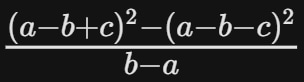
is equal to :
- A.
b - c
- B.
c - a
- C.
-4c
- D.
2c
Correct answer: C
Solution
Concept
For two quantities X and Y, X2 - Y2 factorises as (X + Y)(X - Y) - the difference-of-squares identity. This lets a difference of two squared expressions be rewritten as a product of their sum and their difference, which is often easier to simplify or cancel with other factors.
Application
Let X = (a - b + c) and Y = (a - b - c), so the numerator is X2 - Y2.
Sum: X + Y = (a - b + c) + (a - b - c) = 2(a - b).
Difference: X - Y = (a - b + c) - (a - b - c) = 2c.
By the identity, the numerator = (X + Y)(X - Y) = 2(a - b) x 2c = 4c(a - b).
The denominator is (b - a) = -(a - b), so the expression = 4c(a - b) / [-(a - b)] = -4c, valid whenever a is not equal to b.
Cross-check
Substituting a = 5, b = 2, c = 1: numerator = (5-2+1)2 - (5-2-1)2 = 42 - 22 = 16 - 4 = 12; denominator = (2-5) = -3; so the expression = 12 / (-3) = -4, which equals -4c for c = 1 - confirming the result independently.
Result
So the given expression simplifies to -4c.
- A.
- Question 86.CTET 2024
Area of a right triangle is 240 cm². If its one side other than the hypotenuse is 30 cm, then perimeter (in cm) of the triangle is :
- A.
80
- B.
84
- C.
92
- D.
100
Correct answer: A
Solution
Concept: For a right triangle with legs a and b and hypotenuse c, the area is ½ × a × b, and the Pythagorean theorem gives c2 = a2 + b2. The perimeter is the sum of all three sides: a + b + c.
Let the two legs be a = 30 cm and b (unknown), with hypotenuse c. From the area formula: ½ × 30 × b = 240.
Solving for b: 15 × b = 240, so b = 16 cm.
Apply the Pythagorean theorem for the hypotenuse: c2 = 302 + 162 = 900 + 256 = 1156, so c = √1156 = 34 cm.
Perimeter = a + b + c = 30 + 16 + 34 = 80 cm.
Cross-check: 30, 16, and 34 form a scaled Pythagorean triple — twice 15, 8, and 17 — and 152 + 82 = 225 + 64 = 289 = 172, confirming the hypotenuse of 34 cm and hence the perimeter of 80 cm.
- A.
- Question 87.CTET 2024
A teacher distributes different types of triangle shaped paper cuttings to the learners and tells them to measure and tabulate the angles in order to find the sum of angles. He tells them to note the result in each case.
This method of teaching is an example of :
- A.
Discovery method
- B.
Teacher centered approach
- C.
Deductive method
- D.
Analytical approach
Correct answer: A
Solution
Teaching methods are classified by how learners arrive at a rule or principle. In discovery learning — an inductive, activity-based method — learners are given materials and a task, then investigate directly, collecting and analysing their own data, to arrive at the underlying rule themselves rather than being told it.
Here, each learner receives several different triangular paper cut-outs, measures the three angles in every triangle, and tabulates the results. No one gives the angle-sum rule beforehand — the learners infer it purely from the pattern in their own recorded measurements. This self-directed, activity-based route to a generalisation is exactly what discovery learning describes.
Teacher centered approach: the teacher actively explains or demonstrates the rule while learners mainly receive it; here the teacher only sets up the activity and never states the relationship being investigated.
Deductive method: teaching moves from an already-stated general rule to specific examples that apply it; here no general rule is given first — the sequence runs the opposite way, from individual measurements toward a generalisation.
Analytical approach: an existing complex whole is broken down into its component parts to examine how they relate; here there is no given whole being decomposed — learners are instead generating fresh data across independent cases to build up a pattern.
So the activity described is best classified as discovery learning.
- A.
- Question 88.CTET 2024
Which of the following is NOT true?
- A.
3 + 4 × 5 is not a mathematical expression
- B.
Operations of multiplication can be done on mathematical expressions
- C.
The expression (x^2 + 10x + 25) cannot be simplified further
- D.
The value of the variable in an equation which satisfy the equation is called a solution of the equation
Correct answer: A
Solution
Concept: A mathematical expression is any combination of numbers and/or variables joined by operations such as +, −, ×, ÷, with no equals sign. Simplifying an expression means writing it in its reduced standard (expanded) form; rewriting it as a product of factors (factorisation) is a related but separate operation. A solution (or root) of an equation is a value of the variable that satisfies that equation.
Application: Check the claim about "3 + 4 × 5" against the definition above. It is built from the numbers 3, 4, 5 and the operations + and × — that is exactly what a mathematical expression is, so it certainly IS one. The statement claiming it is "not a mathematical expression" is therefore false, and since the question asks for the statement that is NOT true, this is the one being asked for.
Contrast (the other three statements are all true):
"(x2 + 10x + 25) cannot be simplified further" — true; the expression is already in its simplified, standard expanded polynomial form. Rewriting it as (x + 5)2 is factorisation, a distinct operation from simplification, so the statement about simplification still stands.
"Operations of multiplication can be done on mathematical expressions" — true; × is one of the basic operations expressions are built from, exactly as seen inside "3 + 4 × 5" itself.
"The value of the variable in an equation which satisfies the equation is called a solution of the equation" — true; this is exactly the standard definition of a solution (root) of an equation.
Cross-check: Apply the same expression-definition test to any similar combination, such as 2 + 3 or 6 × 7 — none of these fail to qualify as an expression either, confirming that calling "3 + 4 × 5" not an expression is the one false claim among the four statements.
- A.
- Question 89.CTET 2024
The ratio of two numbers is 3 : 7 and their LCM is 630. Then, sum of the LCM and HCF of these numbers is :
- A.
30
- B.
300
- C.
600
- D.
660
Correct answer: D
Solution
Concept: For two numbers whose ratio is a : b with a and b co-prime (no common factor other than 1), the numbers can be written as ax and bx. Because a and b share no common factor, the HCF of the two numbers is x, and their LCM is a times b times x. Also, for any two numbers, the product of the LCM and the HCF always equals the product of the two numbers itself, which gives a useful independent check.
Application:
The ratio of the two numbers is 3 : 7, and 3 and 7 are co-prime, so the numbers can be written as 3x and 7x.
Since 3 and 7 share no common factor, the LCM of 3x and 7x is 3 times 7 times x, which is 21x.
The LCM is given as 630, so 21x = 630, which gives x = 30.
The HCF of 3x and 7x is x itself, so the HCF is 30.
The two numbers are 3x = 90 and 7x = 210.
Sum of the LCM and the HCF = 630 + 30 = 660.
Cross-check: The product of the two numbers is 90 times 210 = 18900. The product of their LCM and HCF is 630 times 30 = 18900. Since both match, the values of the LCM and HCF used above are confirmed correct.
So, the sum of the LCM and HCF of these two numbers is 660.
- A.
- Question 90.CTET 2024
In a physical map of India if you have to locate the Deccan Plateau, it will be represented by the colour :
- A.
orange
- B.
brown
- C.
green
- D.
yellow
Correct answer: D
Solution
Physical (relief) maps use a standard hypsometric colour convention to show elevation bands: green marks low-lying plains, yellow marks plateaus and moderate-elevation land, and brown marks high mountain ranges.
The Deccan Plateau is a plateau region, with elevation roughly between 300 m and 900 m — squarely in the moderate-elevation band of this convention. On a physical map of India, that moderate band is shaded yellow, so the Deccan Plateau is depicted in yellow.
This is consistent with how the rest of the same map is shaded:
The Northern Plains, being low-lying, are shaded green.
The Himalayas, being the highest range, are shaded brown.
Orange does not form part of this standard elevation-band scheme on Indian physical maps.
Therefore, the Deccan Plateau on a physical map of India is represented by the colour yellow.
- A.
- Question 91.CTET 2024
Choose the measures to control soil erosion and depletion from the following.
(a) Mulching
(b) Over grazing
(c) Terrace farming
(d) Inter cropping
Choose the correct option:
- A.
(a), (b), (c) only
- B.
(a), (c), (d) only
- C.
(a), (b), (d) only
- D.
(b), (c), (d) only
Correct answer: B
Solution
Concept
Soil-conservation practices protect topsoil from being carried away by wind and water — they work by keeping the ground covered with vegetation or organic matter, or by slowing the speed of water flow across a slope. Mulching (covering the surface with organic material), terrace farming (levelling a slope into steps to slow runoff), and inter cropping (keeping the field covered with more than one crop through the season) all achieve this. Over grazing, by contrast, strips away plant cover and compacts the soil, which exposes it directly to wind and rain — it is a CAUSE of erosion and depletion, not a control measure.
Application
Checking each of the four listed practices against this idea: Mulching, Terrace farming, and Inter cropping all preserve or restore ground cover and reduce runoff, so each is a genuine control measure. Over grazing does the opposite — removing cover and compacting soil — so it must be excluded from any list of erosion-control measures. The set that keeps only the three genuine protective practices is Mulching, Terrace farming, and Inter cropping.
Cross-check
Any grouping that pairs over grazing with protective practices fails the test, because over grazing degrades cover instead of preserving it.
The only internally consistent grouping is the one containing exclusively cover-preserving, runoff-slowing practices — confirming the same result reached above.
- A.
- Question 92.CTET 2024
Consider the following sentences (A) and (B) about motions of the Earth and choose the correct option:
(A) Rotation is the movement of the earth on its axis.
(B) The axis of the Earth which is an imaginary line, makes an angle of 33 1/2° with its orbital plane.
Choose the correct option:
- A.
Only (A) is correct
- B.
Only (B) is correct
- C.
Both (A) and (B) are correct
- D.
Both (A) and (B) are incorrect
Correct answer: A
Solution
Earth has two primary motions: rotation, its spin about its own axis (producing day and night, one rotation taking about 24 hours), and revolution, its orbit around the Sun (producing the seasons, one revolution taking about 365¼ days). The Earth's rotational axis is not perpendicular to its orbital plane — by standard convention it makes an angle of about 66½° with the plane of the orbit, equivalently about 23½° with the perpendicular (normal) to that plane. These two figures are complementary (66½° + 23½° = 90°), and this fixed inclination of the axis is what produces the seasonal variation as the Earth revolves.
Statement (A), ‘Rotation is the movement of the earth on its axis,’ is exactly this standard definition, so (A) holds. Statement (B) gives the angle between the axis and the orbital plane as 33½°, but the accepted figure is 66½° (or 23½° measured from the perpendicular), not 33½°; the number in (B) does not match either of the two standard complementary figures, so (B) does not hold.
‘Only (B) is correct’ would require the wording of (A) to be flawed, but “movement of the earth on its axis” is precisely the standard definition of rotation, so there is no basis to rule (A) out.
‘Both (A) and (B) are correct’ accepts the 33½° figure at face value without checking it against the standard 66½°/23½° pair, so it misses that the number quoted in (B) is wrong.
‘Both (A) and (B) are incorrect’ additionally rejects (A), which is a standard, accurate definition, so ruling it out as well is unjustified.
So (A) is a correct, standard definition while the specific angle in (B) is a factual error — only (A) is correct.
- A.
- Question 93.CTET 2024
Watan Jagirs were given by Akbar to which of the following chiefs?
- A.
Sikhs
- B.
Marathas
- C.
Sisodiya Rajputs
- D.
Indian Muslims
Correct answer: C
Solution
Under the Mughal administrative system, a mansabdar was normally assigned a transferable jagir — revenue rights over territory that could be reassigned periodically. A watan jagir was the exception: when a Rajput ruling chief entered Mughal service, his own ancestral homeland (watan) was confirmed to him as his hereditary jagir instead of being transferred elsewhere, in return for loyalty and military service to the empire.
Akbar pioneered this Rajput-integration policy, most clearly documented with houses such as the Kachhwaha rulers of Amber, whose homeland was confirmed to them as a watan jagir once they entered Mughal service. The Sisodiya house of Mewar is a distinct case: under Rana Pratap, Mewar resisted Akbar through virtually his entire reign, and its ruler Amar Singh reached a settlement with the Mughals only under Akbar's successor, Jahangir, in 1615. This question is an official CTET Paper 2 (2024) PYQ, and its officially keyed answer is 'Sisodiya Rajputs' — among the offered options, that is the only Rajput ruling house, and it is specifically Rajput ruling houses (not Sikhs, Marathas, or a religious community) that Akbar's watan jagir policy of confirming a chief's own homeland as his hereditary jagir was built around.
Akbar's dealings with the Sikh Panth took the form of religious patronage — visiting and granting land to the Sikh Gurus — rather than the induction of a ruling chief's ancestral kingdom into Mughal service on the specific watan jagir arrangement of homeland-as-hereditary-jagir.
Maratha political-military organisation under a unified leadership only developed from the mid-seventeenth century, some five to six decades after Akbar's reign (1556-1605) had ended, placing any Mughal-Maratha jagir dealings well outside Akbar's own timeframe.
Watan jagir was tied to one ruling chief's own ancestral territory as an individual, family arrangement, so a broad demographic label like 'Indian Muslims' describes a different kind of category altogether from the specific ruling-chief mechanism this term refers to.
So, going by the option that fits the watan jagir mechanism and matches this PYQ's official key, the answer is Sisodiya Rajputs — while noting that Mewar's own settlement with the Mughals specifically dates to Jahangir's reign rather than Akbar's.
- A.
- Question 94.CTET 2024
Consider the statements (A) and (B) about Paramountcy and choose the correct answer:
(A) The Company claimed that its authority was not supreme.
(B) In order to protect Company interests it was justified in annexing or threatening to annexe any Indian Kingdom.
- A.
Both (A) and (B) are true
- B.
Both (A) and (B) are false
- C.
(A) is true but (B) is false
- D.
(A) is false but (B) is true
Correct answer: D
Solution
Concept
The Doctrine of Paramountcy was the British colonial principle that East India Company (and later Crown) authority was paramount — that is, supreme over every Indian princely state. Under this doctrine, the British treated protection of their own political and economic interests as sufficient justification to intervene directly in a kingdom's affairs, including annexing it outright or threatening annexation.
Application
Statement (A) claims the Company held that its own authority was NOT supreme. This is the reverse of what paramountcy actually asserted — the doctrine's entire premise was a claim of supreme, overriding Company authority over Indian states. So statement (A) does not match the historical claim and is false.
Statement (B) states the Company considered itself justified in annexing, or threatening to annex, a kingdom to protect its own interests. This matches how paramountcy operated in practice — administrative annexations such as those under the Doctrine of Lapse (e.g., Satara, Jhansi, Nagpur) and the 1856 annexation of Awadh were episodes where the Company expanded control on the strength of its claimed paramount authority, with protecting Company interests as an underlying motive even where the formal grounds cited (such as lapse of succession or alleged misgovernment) varied case by case. So statement (B) is true.
Cross-check
A further check: contemporary British justifications for annexation during this period typically invoked the Company's own paramount status rather than a denial of its authority, and many such annexations — including under the Doctrine of Lapse — were driven by stated Company interests rather than external attack, reinforcing that (A) is false and (B) is true.
Why the other combinations fail
Treating the Company's stance as a claim of non-supremacy does not fit the doctrine, whose entire basis was a claim of supreme authority.
Treating the annexation clause as an overstatement ignores repeated, openly justified interventions like the Doctrine of Lapse annexations.
Combining a claim of non-supremacy with a denial of the annexation practice inverts both parts of the historical record at once.
Since (A) is false and (B) is true, the combination describing exactly that pairing is correct.
- A.
- Question 95.CTET 2024
Match the following concepts in Column - I with their examples in Column - II and choose the appropriate option :
Column - I
Column - II
Concepts
Examples
(a) Discrimination
(i) Differential pay for same work
(b) Inequality
(ii) Villagers are superstitious
(c) Stereotype
(iii) Woman not allowed to be hired since she is starting a family
(d) Prejudice
(iv) Girls are good at cooking
- A.
(a)-(iii), (b)-(i), (c)-(ii), (d)-(iv)
- B.
(a)-(iv), (b)-(ii), (c)-(i), (d)-(iii)
- C.
(a)-(iv), (b)-(iii), (c)-(i), (d)-(ii)
- D.
(a)-(iii), (b)-(i), (c)-(iv), (d)-(ii)
Correct answer: D
Solution
Concept: NCERT-based sociology/pedagogy material (the basis for this CTET item) illustrates four related ideas about social bias. Discrimination is the resulting unfair ACTION -- treating a person differently in practice because of their social identity. Inequality is the resulting unequal OUTCOME -- unequal access to resources, opportunities, or reward between groups. A stereotype is conventionally illustrated through a generalised skill or role assumption fixed onto an entire group (e.g. a gender-linked ability claim). Prejudice is conventionally illustrated through a negative, dismissive opinion held about an entire community (e.g. branding a community as backward). This is the standard classification used in the NCERT/CTET framework and confirmed by the official answer key for this item, even though the two ideas are closely related in general sociology.
Application: Matching each concept to the example that illustrates it in this framework --
Discrimination (a) is illustrated by a concrete biased ACT against a person: the woman not being hired because she is starting a family (iii) is exactly that -- an actual decision taken against her.
Inequality (b) is illustrated by an unequal OUTCOME between groups doing the same work: differential pay for the same work (i) is an unequal result, not a belief or an act.
Stereotype (c) is illustrated by a generalised skill/role assumption fixed onto an entire group: girls are good at cooking (iv) generalises an ability onto all members of a group.
Prejudice (d) is illustrated by a dismissive opinion held about an entire community: villagers are superstitious (ii) brands a community's outlook as backward.
So the correct match is (a)-(iii), (b)-(i), (c)-(iv), (d)-(ii) -- this is also the mapping confirmed by the official CTET July 2024 Paper II answer key.
Cross-check against the other combinations: (a)-(iii), (b)-(i), (c)-(ii), (d)-(iv) keeps discrimination and inequality matched as above but swaps the stereotype and prejudice examples, so two of its four pairings are wrong. (a)-(iv), (b)-(ii), (c)-(i), (d)-(iii) mismatches all four concepts. (a)-(iv), (b)-(iii), (c)-(i), (d)-(ii) matches only prejudice with "villagers are superstitious" correctly and mismatches the other three. Only (a)-(iii), (b)-(i), (c)-(iv), (d)-(ii) matches every concept to the example that illustrates it in this framework.
- A.
- Question 96.CTET 2024
Match the following pairs and choose the appropriate option :
Rocks Origin/formation
(a) Igneous Rocks (i) Change under great heat and pressure
(b) Sedimentary Rocks (ii) Molten Magma
(c) Metamorphic Rocks (iii) Deposition by wind and water
Choose the correct option :
- A.
(a)-(i), (b)-(ii), (c)-(iii)
- B.
(a)-(ii), (b)-(iii), (c)-(i)
- C.
(a)-(iii), (b)-(i), (c)-(ii)
- D.
(a)-(i), (b)-(iii), (c)-(ii)
Correct answer: B
Solution
Rocks are classified into three major types based on how they form: igneous rocks form when molten magma or lava cools and solidifies; sedimentary rocks form when sediments carried by agents such as wind and water are deposited and then compacted and cemented over time; metamorphic rocks form when an existing rock is altered by great heat and pressure without completely melting.
Rock type
Formation process (as listed in the question)
(a) Igneous Rocks
(ii) Molten Magma — cooling and solidification
(b) Sedimentary Rocks
(iii) Deposition by wind and water
(c) Metamorphic Rocks
(i) Change under great heat and pressure
Each of the three formation processes — melting-and-cooling, external deposition, and heat-and-pressure alteration — is unique to exactly one rock type, so the pairing is unambiguous. This confirms the combination (a)-(ii), (b)-(iii), (c)-(i) as the correct match.
- A.
- Question 97.CTET 2024
Which of the following statements are correct about Amazon basin ?
(a) This region is characterized by hot and wet climate throughout the year.
(b) People practice 'slash and burn' agriculture.
(c) People mainly grow paddy.
(d) Aircrafts and helicopters are also used for reaching various places in the basin.
Choose the correct option :
- A.
Only (a), (b) and (c)
- B.
Only (b), (c) and (d)
- C.
Only (a), (c) and (d)
- D.
Only (a), (b) and (d)
Correct answer: D
Solution
The Amazon basin lies on the equator and is a classic equatorial tropical-rainforest biome: it stays hot and wet in every month with no distinct dry season, its heavily leached soils lose fertility quickly, making continuous cultivation on one plot difficult, and its dense forest cover with limited road connectivity means aircraft and helicopters play an important role in reaching many settlements, alongside the basin's extensive river transport. These three traits — climate, soil-driven farming method, and transport — decide whether each statement about life in the basin holds.
(a) Hot and wet climate throughout the year holds: sitting in the equatorial low-pressure belt, the basin gets convectional rainfall in every month, so there is no winter or dry season.
(b) Slash-and-burn agriculture holds: because the leached soils lose fertility quickly and make continuous cropping on one plot difficult, communities clear and burn a patch, farm it for a few seasons, then move to a fresh patch.
(c) Paddy as the main crop fails: cassava (manioc) is the staple crop of Amazonian shifting cultivators — alongside crops such as maize and pineapple — not paddy; paddy is instead the dominant crop of the fertile, monsoon-fed Ganga–Brahmaputra plains that most textbooks contrast the Amazon basin with.
(d) Aircraft and helicopters for transport holds: dense forest cover and limited road connectivity make aircraft and helicopters a useful way to reach many settlements, alongside the basin's extensive river transport.
This matches the standard textbook contrast: the Ganga–Brahmaputra basin's monsoon-fed alluvial plains grow paddy as the dominant crop, while the Amazon basin's shifting cultivators rely on cassava (manioc) — confirming that the paddy claim, and only the paddy claim, is false here.
So only (a), (b) and (d) are correct.
- A.
- Question 98.CTET 2024
The Indian National Congress in the early years raised a number of economic issues against the British. Choose the correct option.
(i) The Congress declared that the British rule had led to poverty and famines.
(ii) It demanded reduction of revenue and cut in military expenditure.
(iii) Congress demanded more funds for irrigation.
(iv) It raised the voice against entertainment tax.
- A.
Only (i) and (ii) are correct
- B.
Only (ii) and (iii) are correct
- C.
Only (i), (ii) and (iii) are correct
- D.
Only (ii), (iii) and (iv) are correct
Correct answer: C
Solution
The Moderate phase of the Indian National Congress (1885 to around 1905) built its critique of British rule chiefly as an economic one, most famously articulated through Dadabhai Naoroji's "Drain of Wealth" theory. Its recurring economic charges against colonial administration centred on the impoverishment of India, the burden of land revenue and military spending on the exchequer, and the government's neglect of productive investment such as irrigation.
Checking each statement against this record: (i) the Congress did hold British economic policy responsible for the poverty and recurring famines of the period -- a core plank of the Drain of Wealth critique -- so this is correct. (ii) it demanded a reduction in land revenue and a cut in the disproportionately high military expenditure funded from Indian revenues -- also correct. (iii) it pressed the government to spend more on irrigation to support agriculture and reduce vulnerability to famine -- correct as well. (iv) a campaign against "entertainment tax" has no basis in this economic programme -- entertainment tax is a much later taxation issue, not a grievance the early Congress raised against British rule.
The combination limited to statements (i) and (ii) leaves out the irrigation-funding demand, so it is incomplete.
The combination limited to statements (ii) and (iii) leaves out the poverty-and-famines charge, so it too is incomplete.
The combination of statements (i), (ii) and (iii) covers every genuine demand and adds nothing false.
The combination of statements (ii), (iii) and (iv) is incomplete in the other direction: it drops the poverty-and-famines charge and adds the unsupported entertainment-tax claim on top.
Cross-check: this reading matches NCERT's account of the early nationalist programme (Our Pasts-III, "The Making of a Nation") and the official CTET July 2024 Paper II answer key, both of which support statements (i), (ii) and (iii) and record the salt tax -- not an entertainment tax -- as the tax-related protest of this period.
Hence exactly (i), (ii) and (iii) are correct.
- A.
- Question 99.CTET 2024
Which of the following is true about Ashoka's dhamma?
(a) It did not involve worship of a god.
(b) It did not involve performance of a sacrifice.
(c) The ideas of dhamma were inspired by the teachings of Buddha.
(d) Ashoka appointed Buddhist monks to teach people about dhamma.
Choose the correct option:
- A.
All (a), (b), (c) and (d)
- B.
Only (a) and (b)
- C.
Only (b) and (c)
- D.
Only (a), (b) and (c)
Correct answer: D
Solution
Concept
Ashoka's dhamma, as understood from his edicts and the standard historical account, was not devotion to a particular god or a set of ritual observances; it was a code of everyday moral conduct - respect for elders, non-violence, tolerance of other faiths, and concern for the welfare of subjects - propagated through Ashoka's own edicts and a dedicated cadre of officials, not through priests or monastic teachers. Historians trace its ethical core to Buddhist teaching on compassion and restraint, which shaped Ashoka's own outlook after the Kalinga war.
Application
Checking each statement in turn:
Statement (a) holds: the edicts frame dhamma as right conduct, not devotion to any specific deity, so no worship of a god was required under it.
Statement (b) holds: the edicts discourage ritual sacrifice as a mark of piety, so performing a sacrifice was not required either.
Statement (c) holds under the standard historical account: dhamma's emphasis on non-violence, compassion and moral restraint is understood to trace to Buddhist ethical teaching that shaped Ashoka's own outlook.
Statement (d) fails: to spread dhamma among the people, the edicts describe Ashoka creating a new class of officials called dhamma-mahamatta, drawn from his administration - not Buddhist monks.
Cross-check
Ashoka's own rock edicts, which record his instructions to the dhamma-mahamattas in his own words, confirm (a), (b) and (d) directly - they describe administrative officers touring the empire to explain dhamma, with no mention of monks being deputed for the purpose. The further link between dhamma's ethical content and Buddhist teaching, statement (c), is the standard historical reading of those same edicts. Together this supports (a), (b) and (c), and not (d).
A grouping that keeps all four statements wrongly treats the dhamma-mahamatta appointment as though it were a monastic one.
A grouping that drops statement (c) ignores dhamma's well-documented debt to Buddhist ethical teaching.
A grouping that drops statement (a) ignores that dhamma set out a conduct code rather than devotion to a deity.
The set of statements that survives every check is (a), (b) and (c).
- A.
- Question 100.CTET 2024
Below are two statements (A) and (B) in the context of Shri Narayan Guru.
(A) He held that all human beings belong to a single common caste.
(B) He inspired all of them to have faith in all gurus.
Choose the correct option:
- A.
Both (A) and (B) are true
- B.
Both (A) and (B) are false
- C.
(A) is true but (B) is false
- D.
(A) is false but (B) is true
Correct answer: C
Solution
Colonial-era socio-religious reform movements (Brahmo Samaj, Arya Samaj, and Kerala's SNDP Yogam among them) challenged caste hierarchy by asserting that all human beings belong to a single common community deserving equal treatment. Many of these reformers also stressed direct self-inquiry and inner realization of truth over blind faith placed in external religious authorities.
Sree Narayana Guru, founder of the SNDP Yogam and the Sivagiri Ashram in Kerala, is best known for the teaching "Oru Jathi, Oru Matham, Oru Daivam Manushyanu" — "One caste, one religion, one God for mankind." This directly supports statement (A): he advocated equality of all people within a single community, dissolving caste-based distinctions. His broader philosophy, however, centred on self-realization and rational self-inquiry ("know thyself") as the route to truth — not on urging followers to place faith in every guru. So statement (B) does not hold.
Both (A) and (B) true — requires (B) to also hold, which his philosophy does not support.
Both (A) and (B) false — requires (A) to be false, which contradicts his own founding teaching of equality.
(A) false, (B) true — inverts both claims against the historical record.
(A) true, (B) false — matches both his social-equality teaching and his self-realization emphasis.
Since (A) holds and (B) does not, the correct combination is "(A) is true but (B) is false" — consistent with the official CTET July 2024 Paper-II answer key and independent accounts of Guru's teachings.
- A.
- Question 101.CTET 2024
Match the following in the context of people and objects in ancient times and choose the appropriate option.
Column A
Column B
(a) Barygaza
(i) Stamped red-glazed pottery
(b) Shrenis
(ii) Bharuch
(c) Arretine ware
(iii) Independent farmers
(d) Grihapatis
(iv) Associations of crafts persons and merchants
- A.
(a)-(ii), (b)-(iv), (c)-(i), (d)-(iii)
- B.
(a)-(ii), (b)-(iv), (c)-(iii), (d)-(i)
- C.
(a)-(iv), (b)-(iii), (c)-(i), (d)-(ii)
- D.
(a)-(i), (b)-(ii), (c)-(iv), (d)-(iii)
Correct answer: A
Solution
Concept:
In ancient Indian history, technical terms fall into distinct categories — geographical identifications, guild/organizational names, artefact types, and agrarian social classes. Correctly matching such terms requires first placing each term in its own category, then recalling its specific referent within that category.
Application:
Barygaza — the ancient port city on the Gujarat coast recorded by Greco-Roman sources such as the Periplus of the Erythraean Sea; it is identified with modern Bharuch, so (a) pairs with (ii).
Shrenis — organized associations of craftspersons and merchants that regulated production and trade and often functioned as guild-banks in early historic India, so (b) pairs with (iv).
Arretine ware — a distinctive stamped, red-glazed Roman pottery whose presence at Indian coastal sites is used as archaeological evidence of Indo-Roman trade, so (c) pairs with (i).
Grihapatis — the term for substantial landholding cultivators, i.e. independent farmers/householders who controlled land and labour in the agrarian economy, so (d) pairs with (iii).
Cross-check:
The combination (a)-(ii), (b)-(iv), (c)-(iii), (d)-(i) swaps the artefact-type referent with the agrarian-class referent: Arretine ware is a pottery style, not a class of farmers, and grihapatis is a class of cultivators, not a pottery style.
The combination (a)-(iv), (b)-(iii), (c)-(i), (d)-(ii) swaps the geographic identification with the guild-organization referent: Barygaza is a port city, not an association of craftspersons, and shrenis is a guild, not a class of cultivators.
The combination (a)-(i), (b)-(ii), (c)-(iv), (d)-(iii) shifts the referents of the first three terms in a cycle: Barygaza (a port city) takes the pottery description, Shrenis (a guild) takes the place identification, and Arretine ware (a pottery type) takes the guild description.
Hence the fully correct combination is (a)-(ii), (b)-(iv), (c)-(i), (d)-(iii).
- A.
- Question 102.CTET 2024
Which layer of the atmosphere has a very thin layer of air?
- A.
Thermosphere
- B.
Exosphere
- C.
Stratosphere
- D.
Mesosphere
Correct answer: B
Solution
Earth's atmosphere is divided into five broad layers based on temperature and altitude — troposphere, stratosphere, mesosphere, thermosphere, and exosphere — and the density of air, that is, the amount of gas actually present, keeps falling as altitude increases, becoming lowest in the layer that lies farthest from the surface.
The exosphere is this outermost layer, stretching from roughly 700 km above the surface out to about 10,000 km, where it gradually fades into outer space. Gas molecules here are spread so far apart that they rarely collide with one another and can drift off into space entirely, so the exosphere holds by far the least amount of air of all the layers.
Checking the other layers by their own defining features:
Thermosphere: this layer directly absorbs solar ultraviolet and X-ray radiation, which speeds up its gas particles enough to register temperatures beyond 1500°C — here, 'hot' describes particle speed, not the total amount of matter present.
Stratosphere: this layer holds the ozone layer, which absorbs solar UV radiation so that temperature rises steadily with altitude here; it is stable enough that weather balloons operate within it and commercial flights typically cruise close to its lower boundary.
Mesosphere: this is Earth's coldest atmospheric layer, with temperatures falling to about −90°C, and it is where friction with atmospheric gas burns up most meteoroids entering from space before they can reach the ground.
So, the atmospheric layer with the thinnest air is the Exosphere.
- A.
- Question 103.CTET 2024
Who coined the phrase, ‘Unity in Diversity’ ?
- A.
Pt. Jawaharlal Nehru
- B.
Mohandas Karamchand Gandhi
- C.
Subhash Chandra Bose
- D.
Sardar Vallabh Bhai Patel
Correct answer: A
Solution
GK questions about who 'coined' or 'popularised' a phrase test documented authorship — credit goes to the person a standard textbook, archive, or their own recorded speech/writing names as its source, not merely to anyone who championed the idea it expresses.
Pt. Jawaharlal Nehru is the leader credited with coining and popularising 'Unity in Diversity' to describe India's pluralistic culture. NCERT/SCERT civics material and IGNOU study material both name it as his phrase, and Nehru delivered a documented address titled 'Unity in Diversity' (19 October 1952) making the same case for India's composite national character.
Why the other leaders do not fit:
Mohandas Karamchand Gandhi worked for communal harmony and non-violent unity throughout his life, but standard references do not credit him with coining this specific phrase — his broader unity work is often mistaken for authorship of this quote.
Subhash Chandra Bose is remembered for leading the Indian National Army and for the 'Jai Hind' greeting, a different strand of the freedom movement from the authorship of this cultural phrase.
Sardar Vallabh Bhai Patel's defining legacy is the political and administrative integration of over 500 princely states into the Indian Union — a structural unity achievement, distinct from coining this cultural phrase.
Note on 'coined': strictly speaking, the exact wording had already been used earlier — for example in an 1896 lecture by Swami Vivekananda — so Nehru was not literally the first person ever to utter it. However, in the Indian civics/history curriculum this question is drawn from, Nehru is the specific figure officially credited with coining and popularising this exact description of India: SCERT's civics textbook states that Nehru coined the phrase to describe the country, and IGNOU study material calls it his catch-phrase, anchored further by his own documented 1952 address titled 'Unity in Diversity'. Among the four leaders offered here, only Nehru carries this documented credit — Gandhi, Bose, and Patel are each credited with other, distinct legacies of their own, as explained above.
- A.
- Question 104.CTET 2024
Which of the following statements is/are true about technological development in temple construction from the twelfth century?
(a) The weight of the superstructure was carried by the shikhara.
(b) Sandstone mixed with stone chips was increasingly used in construction.
- A.
Only (a) is correct
- B.
Only (b) is correct
- C.
Both (a) and (b) are correct
- D.
Both (a) and (b) are incorrect
Correct answer: D
Solution
Concept: For a “which statements are true” history item on medieval Indian temple architecture, two separate technical claims are usually being tested together — (i) which structural element actually transmits the superstructure's weight over an opening, and (ii) which binding material was increasingly used to hold masonry together. Each claim must be checked independently against the specific textbook account for the period named in the question; a claim is not true merely because it sounds plausible or matches a general trend.
Application: The standard account of building technique (NCERT, Class 7, Our Pasts–II, Ch. 5, “Rulers and Buildings”) describes this specific development — the superstructure's weight being carried over doors and windows — as noticeable from the twelfth century, and attributes it to the arch form, not to the shikhara, so statement (a) misidentifies the structural element responsible for this particular load-transmission role. The same account names a lime-based cement — not sandstone — as the material increasingly combined with stone chips into a hardening, mortar-like bond, so statement (b) misidentifies the material.
“Only (a) is correct” would require the load-transmission claim alone to hold, which the source does not support.
“Only (b) is correct” would require the material claim alone to hold, which the source does not support either.
“Both (a) and (b) are correct” would require both claims to hold at once — neither does.
Cross-check: The CTET July 2024 Paper II official answer key independently marks this same combination as correct across its shuffled sets, corroborating the source-based evaluation above.
Since neither statement matches the documented technique, both (a) and (b) are incorrect.
- A.
- Question 105.CTET 2024
Which one of the following is not correct for grama-bhojaka?
- A.
Usually, men from the same family held the position for generations.
- B.
He had slaves and hired workers to cultivate the land.
- C.
The king often used him to collect taxes from the village.
- D.
He did not function as a Judge and policeman.
Correct answer: D
Solution
Concept: The NCERT account of ancient Indian villages describes a category of village-level functionaries called gramabhojakas — headmen who typically held large, often hereditary, landholdings. A gramabhojaka combined economic, fiscal, and administrative authority at the village level: he employed slaves and hired labourers to work his land, helped the king collect village taxes, and also exercised local judicial and policing functions to settle disputes and maintain order.
Application: Check each statement about the grama-bhojaka against this historical record, one at a time.
Position usually held by men of the same family for generations: matches the record — the position was typically hereditary.
Kept slaves and hired workers to cultivate his land: matches the record — as a large landholder he depended on such labour.
Was often used by the king to collect village taxes: matches the record — tax collection was one of his recognised fiscal duties.
Did not function as a judge and policeman: contradicts the record — a gramabhojaka also exercised local judicial and policing functions within the village.
Cross-check: three of the statements — hereditary succession, the use of slave and hired labour, and tax collection for the king — line up with the gramabhojaka's attested economic-cum-administrative role; only the statement denying his judicial and policing role reverses that pattern, which is why it is the one that is 'not correct'.
Result: the statement claiming he did not function as a judge and policeman is the incorrect one, since gramabhojakas did carry out these judicial and policing duties in their villages.
- A.
- Question 106.CTET 2024
Which of the following is/are correctly matched?
Crop - Required Climatic Condition
(a) Coffee - Cool and dry climate
(b) Tea - Warm climate and high rainfall
Choose the correct option:
- A.
Only (a)
- B.
Only (b)
- C.
Both (a) and (b)
- D.
Neither (a) nor (b)
Correct answer: B
Solution
Plantation crops such as tea and coffee each have a specific, well-defined temperature and rainfall requirement. Correctly matching a crop to a climatic description means checking that crop's actual, established requirement rather than assuming similar warm/wet or cool/dry conditions apply to every plantation crop.
Statement (a) claims Coffee needs a cool and dry climate. Coffee is in fact a warm, humid-climate crop: it grows best around 15°C-24°C with heavy, well-distributed rainfall (roughly 150-250 cm a year) and is usually grown under shade for protection from direct sun. A cool, dry climate would stunt its growth, so statement (a) does not hold.
Statement (b) claims Tea needs a warm climate and high rainfall. Tea is indeed grown in a warm climate (roughly 20°C-30°C) with high, well-distributed rainfall (about 200-300 cm a year) on well-drained hill slopes, so statement (b) holds.
Since (a) does not hold and (b) does, only statement (b) is correctly matched — consistent with the officially published CTET Paper-II (2024) answer key for this item.
- A.
- Question 107.CTET 2024
The category 'erstwhile princely states' was applicable:
- A.
at the time of Independence around 1947-48 only.
- B.
between 1947-48 and 1956 when they were recognised as administrative units
- C.
in the post-1956 when they were no longer retained as administrative units.
- D.
to none as no such category existed in India.
Correct answer: B
Solution
From 1947 to 1949, princely states acceded to and integrated with the Indian Union through Instruments of Accession and Merger Agreements; in this process, a number of smaller princely territories were absorbed directly into the neighbouring former British provinces. When the Constitution came into force on 26 January 1950, its First Schedule formally classified the remaining territories into four categories: Part A states (the former Governors' provinces, now including those merged smaller princely territories), Part B states (former princely states and unions of princely states, each headed by a Rajpramukh), Part C states (former Chief Commissioners' provinces and a few smaller retained princely states), and Part D (the Andaman and Nicobar Islands). This four-part scheme was replaced by the twin 1956 enactments — the States Reorganisation Act and the Constitution (Seventh Amendment) Act — which reorganised the country into linguistic states and abolished the Part A/B/C/D distinction.
Applying this to the item: the category the question names, the 'erstwhile princely states', refers to this constitutional classification — chiefly the Part B states, with a smaller number as Part C — which existed as a distinct, formally recognised administrative class from the 1950 Constitution until the twin 1956 enactments dissolved it. Taking the whole span together, from accession/integration (1947-48) through the 1956 reorganisation, this class of territories was consistently treated apart from the ordinary former-British provinces; this is the sense in which the category was 'recognised as administrative units' through this period.
Confining the category to “around 1947-48 only” treats accession/integration and constitutional classification as the same moment, when the classification into Part B/Part C units was a separate, later (1950) constitutional step that remained in force until the twin 1956 enactments.
Placing it “post-1956” reverses the sequence: the twin 1956 enactments are precisely when this classification was dissolved, not when it began or continued.
Denying that any such category existed overlooks that these territories were explicitly given distinct constitutional categories — Part B, and in some cases Part C — in the First Schedule from 1950 onward.
Hence the category was applicable between 1947-48 (accession/integration) and 1956 (the twin Reorganisation/Seventh Amendment enactments), when these territories were treated as a distinct administrative class.
- A.
- Question 108.CTET 2024
Women were taught at home in nineteenth century colonial India because:
(a) they could study as well as do domestic duties.
(b) people believed that going out in public places would corrupt them.
(c) people wanted to hide the fact of their education from relatives and friends.
Choose the correct option:
- A.
(a) and (b)
- B.
(a) and (c)
- C.
(b) and (c)
- D.
(a), (b) and (c)
Correct answer: A
Solution
In nineteenth-century colonial India, most social reformers and orthodox families alike treated women's schooling instrumentally: education was valued mainly insofar as it made a woman a better wife, mother, and homemaker, not as preparation for public or professional life. At the same time, prevailing patriarchal norms treated the public sphere -- streets, marketplaces, schools outside the home -- as morally unsafe for women and girls, since it meant contact with strangers, loss of seclusion (purdah), and possible damage to family honour. These two forces together -- the domestic purpose given to women's education, and the fear of the corrupting public sphere -- explain why home tutoring (by private tutors, older male relatives, or self-study) was preferred over sending girls to public schools.
Applying this to the statement: statement (a) matches the domestic-purpose view -- home instruction let girls study while still being trained in household duties, i.e. education was folded into domestic life rather than replacing it. Statement (b) matches the corrupting-public-space fear -- reformers and families genuinely worried that girls stepping into public places such as schools and streets would be exposed to bad influences and lose their moral standing. Both reasons are well documented in the standard NCERT account of this period (the chapter on women, caste, and social reform).
Statement (c) does not fit this history: the reform-era debate over women's education was carried out openly -- reformers wrote, lectured, and published about it, and families that arranged home tuition for their daughters were not trying to conceal the fact from relatives or friends; concealment is not a motive the sources give for home tutoring. Since (c) is unsupported, every combination that includes it must be rejected, leaving only the pair resting on the two well-attested reasons -- studying while managing domestic duties, and staying away from a public sphere seen as morally corrupting. This also matches the official CTET (July 2024, Paper II) answer key for this item.
- A.
- Question 109.CTET 2024
Who among the following edited newspaper Kesari which became one of the strongest critics of the British rule?
- A.
Jyotirao Phule
- B.
Balgangadhar Tilak
- C.
Mahatma Gandhi
- D.
Lala Lajpat Rai
Correct answer: B
Solution
Concept
During the Indian freedom struggle, newspapers were a primary tool political leaders used to build public opinion and organise opposition to British rule. Every major nationalist paper of the era is tied to the specific person who edited it during its politically defining years, so identifying that person means matching the paper's name, language, and politics to its actual editor rather than guessing from the general period.
Application
Kesari (Marathi, "The Lion") was launched in January 1881 by Bal Gangadhar Tilak together with Gopal Ganesh Agarkar and Vishnushastri Chiplunkar, with Agarkar serving as its first editor while Tilak initially edited the allied English paper Mahratta. In 1887, after a rift over priorities -- Agarkar favoured social reform first, Tilak favoured political freedom first -- Agarkar left to start his own paper, and Tilak took over as Kesari's editor, a position he held (with N. C. Kelkar standing in during Tilak's own imprisonments, notably in 1897 and 1908-1914) until his death in 1920. Under Tilak, Kesari attacked repressive British policies, opposed the Age of Consent Bill as colonial interference in Indian social custom, faced sedition prosecution over articles linked to the 1897 Chapekar-brothers episode, and popularised his slogan "Swaraj is my birthright and I shall have it" -- making it one of the most influential and most frequently prosecuted nationalist papers of its time.
Contrast
Jyotirao Phule is remembered for nineteenth-century social reform -- founding the Satyashodhak Samaj and campaigning for women's and lower-caste education -- not for editing a nationalist political newspaper; his written legacy lies in works such as Gulamgiri, a different genre altogether.
Mahatma Gandhi's editorial work is tied to journals he personally founded decades later -- Young India, Navajivan, and Harijan -- as vehicles for his own satyagraha campaigns; he had no editorial role in this earlier Extremist-era Marathi paper.
Lala Lajpat Rai built his own journalistic platform in Punjab rather than editing this Maharashtra-based paper.
Result
Kesari's editor, as described in the question, was Bal Gangadhar Tilak, who took charge of the paper in 1887 and led it -- bar brief interim stints by N. C. Kelkar during his imprisonments -- until 1920.
- A.
- Question 110.CTET 2024
Match the following columns and choose the appropriate option:
Sphere of the Earth Feature
(a) Lithosphere (i) Plant and Animal Kingdom
(b) Hydrosphere (ii) Made up of rocks and minerals
(c) Atmosphere (iii) Various sources of water
(d) Biosphere (iv) Thin layer of Air
- A.
(a)-(i), (b)-(ii), (c)-(iii), (d)-(iv)
- B.
(a)-(ii), (b)-(iii), (c)-(iv), (d)-(i)
- C.
(a)-(iii), (b)-(iv), (c)-(i), (d)-(ii)
- D.
(a)-(iv), (b)-(i), (c)-(ii), (d)-(iii)
Correct answer: B
Solution
The Earth is commonly divided into four spheres based on what each one is made of: the Lithosphere is the solid outer layer built of rocks and minerals; the Hydrosphere is the sum of all the water sources; the Atmosphere is the thin envelope of air surrounding the planet; and the Biosphere is the zone that supports living things, the plant and animal kingdom.
Sphere of the Earth
Defining feature
(a) Lithosphere
(ii) Made up of rocks and minerals
(b) Hydrosphere
(iii) Various sources of water
(c) Atmosphere
(iv) Thin layer of air
(d) Biosphere
(i) Plant and animal kingdom
Reading the four listed features against these definitions gives the pairing (a)-(ii), (b)-(iii), (c)-(iv), (d)-(i).
Each of the four features (i)-(iv) is used exactly once, and every sphere is matched only to the feature that actually defines it, so this is the one arrangement that satisfies all four pairs at the same time. The other three arrangements are built by rotating this order by one or two steps, which breaks at least one definition in each case.
- A.
- Question 111.CTET 2024
Below are two statements (A) and (B) in the context of leather workers in colonial India.
(A) During the First World War there was a huge demand for shoes for the armies.
(B) The poor people from ordinary castes saw this as an opportunity and were ready to supply shoes for the army.
Choose the correct option:
- A.
Both (A) and (B) are true
- B.
Both (A) and (B) are false
- C.
(A) is true but (B) is false
- D.
(A) is false but (B) is true
Correct answer: C
Solution
A historical claim about an economic opportunity (like wartime demand) must be checked against the social structures that governed who could actually access it. In colonial India, caste rigidly determined occupational access: a trade regarded as ritually polluting was confined to specific hereditary communities, and this restriction did not loosen just because outside demand for that trade's output suddenly rose.
Applying this to the two statements: the First World War did create a huge surge in demand for army footwear, so statement (A) holds. But the claim in statement (B) — that poor people from ordinary castes saw this as an opportunity and were ready to supply shoes — does not hold. Leather work was treated as a stigmatised, "polluting" occupation and remained confined to the traditional leather-working communities throughout the war; caste prejudice kept people outside those communities from entering the trade. It was these existing leather workers, not new entrants from ordinary castes, who supplied the army and could charge high prices for their goods, earning impressive profits from the surge in demand.
Check "both true": fails, because (B) wrongly assumes caste barriers did not restrict who could supply the army.
Check "both false": fails, because the wartime demand for army shoes described in (A) is a well-documented fact.
Check "(A) false, (B) true": fails on both counts — the demand was real, and access remained caste-restricted.
Only "(A) true, (B) false" is consistent with the historical record: a real wartime demand, met exclusively by the traditional leather-working communities.
This matches the official CTET July 2024 Paper-II answer key for this question.
- A.
- Question 112.CTET 2024
The Mughal revenue system with its own schedule of revenue rates for individual crop was called :
- A.
Jagir
- B.
Zabt
- C.
Zat
- D.
Iqta
Correct answer: B
Solution
Concept
Mughal administrative-cum-revenue terms fall into distinct categories: some assign territorial revenue rights to a noble or officer (Jagir, Iqta), one grades a noble's personal rank/status within the Mansabdari hierarchy (Zat), and one specifically fixes a cash revenue rate for each crop based on measured land and average produce/price data (Zabt).
Application
The stem asks for the system with “its own schedule of revenue rates for individual crop” — this is exactly the defining feature of Zabt: land was measured, and a cash rate was fixed per crop using the dahsala method (the average yield and price of that crop over the preceding ten years), organised under Akbar by Raja Todar Mal.
Cross-check
Jagir and Iqta both name a territorial revenue assignment held by a person, not a crop-wise rate schedule.
Zat grades a Mansabdar's personal rank/salary status — it has nothing to do with assessing crop revenue.
Only the crop-rate-schedule system fits the stem, confirming the identification above.
- A.
- Question 113.CTET 2024
The opening time of Central Government Offices in India is 9:00 a.m. IST, what will be the local time of opening of the Central Government Offices located at 80° East Longitude near Chennai and 92°45' East Longitude near Itanagar, respectively:
- A.
09:10 a.m. and 08:19 a.m. respectively
- B.
08:19 a.m. and 09:10 a.m. respectively
- C.
08:50 a.m. and 09:41 a.m. respectively
- D.
09:41 a.m. and 08:50 a.m. respectively
Correct answer: C
Solution
India follows a single standardised clock (IST) referenced to one fixed meridian — 82°30′ East (82.5°E), which passes near Mirzapur, Uttar Pradesh — instead of each place keeping its own local solar time. Because Earth rotates 360° in 24 hours, every 1° of longitude corresponds to a time difference of 4 minutes (1440 minutes ÷ 360°). A place lying east of the standard meridian experiences sunrise earlier, so its local time runs ahead of IST by that amount; a place lying west of the standard meridian experiences sunrise later, so its local time runs behind IST by that amount.
Find each location's longitude difference from the standard meridian (82°30′E = 82.5°E).
Chennai: 82.5° − 80° = 2.5°, and Chennai lies west of the standard meridian.
Itanagar: 92°45′E = 92.75°E; 92.75° − 82.5° = 10.25°, and Itanagar lies east of the standard meridian.
Convert each longitude difference to a time offset using 4 minutes per degree.
Chennai: 2.5° × 4 minutes/degree = 10 minutes.
Itanagar: 10.25° × 4 minutes/degree = 41 minutes.
Apply the offset in the correct direction relative to IST (9:00 a.m.).
Chennai (west of standard meridian, so behind IST): 9:00 a.m. − 10 minutes = 8:50 a.m.
Itanagar (east of standard meridian, so ahead of IST): 9:00 a.m. + 41 minutes = 9:41 a.m.
Cross-check: the longitude gap directly between Chennai (80°E) and Itanagar (92°45′E) is 12°45′ = 12.75°, which should correspond to a time gap of 12.75° × 4 = 51 minutes between their local times. Checking: 9:41 a.m. − 8:50 a.m. = 51 minutes — this matches, confirming the two computed local times are mutually consistent.
Result: the Central Government Offices open at 8:50 a.m. local time in Chennai and 9:41 a.m. local time in Itanagar.
- A.
- Question 114.CTET 2024
The Government has passed laws that made it mandatory for organisations with more than _______ women employees to provide creche facilities.
- A.
10
- B.
15
- C.
25
- D.
30
Correct answer: D
Solution
Indian labour law protects women workers by requiring an employer to provide certain welfare facilities once the female workforce at a workplace crosses a fixed statutory headcount — one such facility is an on-site creche for the children of these workers.
Section 48 of the Factories Act, 1948, fixes that headcount at more than 30 women workers ordinarily employed in a factory: once a factory crosses this number, it must provide a creche facility for children below six years of age. This CTET item (July 2024, Paper 2) reproduces this exact provision as covered in the NCERT Class 7 ‘Social and Political Life’ textbook, so the number the question is asking for is 30.
Cross-check against a related but distinct provision, to avoid confusing the two:
The Maternity Benefit (Amendment) Act, 2017 (Section 11A) fixes a different headcount — more than 50 employees of any gender — for the same creche obligation at an establishment; that number is not offered among this item's options, so it cannot be mistaken for the answer here.
None of the smaller counts offered corresponds to any statutory headcount fixed by either law for the mandatory creche-facility requirement.
So the number of women employees the law (and this question) requires is more than 30.
- A.
- Question 115.CTET 2024
The rocks that were formed 300 million years after the earth was formed, is:
- A.
considered as youngest rocks in the world
- B.
located in Western Australia
- C.
located in Eastern Europe
- D.
located in the Himalayan region
Correct answer: B
Solution
Earth formed as a molten body roughly 4,600 million years ago. As it cooled, a solid crust began to differentiate within the first few hundred million years. Geologists date this earliest crust using radiometric methods, chiefly uranium-lead dating of durable zircon crystals, which lets them pinpoint when a particular rock or mineral sample first solidified relative to Earth's formation.
Applying this to the rock and mineral material described in the question: geological surveys of the Jack Hills region in Western Australia have recovered some of the oldest known crustal material on Earth, zircon-bearing rock dated via radiometric (uranium-lead) methods to around 4,300 million years old, that is, only about 300 million years after Earth's own formation (about 4,600 million years ago). This matches the age given in the question, so the material described is located in Western Australia.
considered as youngest rocks in the world - this describes very young material. Radiometric dating instead places the Jack Hills find among the oldest known crustal material on the planet, about 4,300 million years old, the reverse of what this description states.
located in Eastern Europe - this option names a region that is not documented as the site of the early-Earth rock and mineral record described in the question; that record comes specifically from the Jack Hills area of Western Australia, not from Eastern Europe.
located in the Himalayan region - the Himalayas are a young mountain belt raised by relatively recent tectonic collision; this region is not documented as the source of the early-Earth rock and mineral record described in the question, which instead comes from Western Australia's Jack Hills area.
- A.
- Question 116.CTET 2024
Archaeologists play an important role in deciphering history. Which one of the following choices is incorrect about their nature of work?
- A.
Study the remains of buildings, paintings and sculpture
- B.
Explore and excavate tools, weapons, pots, pan, etc.
- C.
Look for bones of animals, birds and fish
- D.
Examine the written records
Correct answer: D
Solution
Concept: Archaeology and history are related but distinct disciplines for reconstructing the past. Archaeology primarily reconstructs past human life through physical, material remains -- structures, artefacts, tools, and biological remains -- recovered and studied through excavation and scientific analysis. History, by contrast, is characteristically built on the systematic reading and interpretation of written and documentary records (texts, chronicles, literary and administrative sources) as its primary method.
Application: The question asks which listed activity does NOT belong to an archaeologist's nature of work. Checking each activity against the concept above:
Studying the remains of buildings, paintings and sculpture is standard archaeological fieldwork on physical structures and art.
Exploring and excavating tools, weapons, pots and pans is the core artefact-recovery method of archaeology.
Examining animal, bird and fish bones (faunal remains) is also physical-remains analysis archaeologists use to reconstruct past diet and environment.
Examining written records is textual analysis -- the primary method of a historian, not the physical-remains method that defines archaeological work.
Cross-check: comparing the four activities against the concept above, examining buildings/art, excavating artefacts, and analysing bones are all physical-remains fieldwork -- an archaeologist's characteristic method. Systematically reading and interpreting written records, however, is the historian's characteristic method, which is why this activity misdescribes an archaeologist's nature of work among the choices given. (Archaeologists may at times consult inscriptions or other written finds, but material remains -- not documentary reading -- remain their defining, characteristic method.)
- A.
- Question 117.CTET 2024
Project method in Social Sciences involves __________.
(a) Activity
(b) Discussion
(c) Experiment
(d) Narration
Choose the correct option:
- A.
(a), (b) and (c)
- B.
(a), (c) and (d)
- C.
(a) and (b) only
- D.
(c) and (d) only
Correct answer: A
Solution
The Project Method (developed by W. H. Kilpatrick) is a learner-centred pedagogical approach in which students learn through purposeful, real-life projects rather than through passive reception of information from a teacher. It weaves together several interconnected classroom processes — planning and carrying out a task (Activity), collaborating and reasoning together (Discussion), and testing or investigating ideas (Experiment/inquiry) — while deliberately setting aside one-way, teacher-led explanation (Narration), which belongs to older, teacher-centred methods.
Applied to Social Sciences, a project — say, a study of a local market, a historical monument, or a community issue — requires students to actually do something (Activity), talk it through and plan collaboratively (Discussion), and investigate or verify what they find (Experiment/inquiry). These three processes together define how the method unfolds in the classroom; Narration plays no defining role in it.
Checking each offered combination of these four elements against this description:
Activity, Experiment and Narration: substitutes Narration for Discussion, pulling a one-way, teacher-led explanation into a method that is defined by students working and reasoning things out together.
Activity and Discussion only: stops after planning and discussing, leaving out the investigative, testing dimension that carries a project to completion.
Experiment and Narration only: keeps the investigative element but drops the hands-on activity that gives the method its name, while adding Narration, which the method's philosophy sets aside.
So the Project Method in Social Sciences involves Activity, Discussion and Experiment together — the doing, the collaborative reasoning, and the investigation — while Narration has no place in it.
- A.
- Question 118.CTET 2024
A Social Science teacher asked students to make rules for their class. These were then written on a chart paper. All the students gave their consent to follow these. The chart paper was pasted in class, so that it can be referred by the students. This can be an introductory activity for which of the following topics?
- A.
Diversity
- B.
Marginalisation
- C.
Democracy
- D.
Markets
Correct answer: C
Solution
In social science pedagogy, the concept of ‘Democracy’ is built around two defining features: rules and decisions are arrived at through the participation of the people they govern, rather than imposed by a single authority, and those rules hold because people have given their consent to follow them, not because they are compelled to. An activity is used to introduce this concept when it lets students directly experience participatory rule-making and consent, rather than only describing government structures in the abstract.
In this activity, the teacher does not hand down ready-made class rules; the students themselves frame the rules together, and every student consents to abide by them before the rules are pasted up for reference. This is exactly the participation-plus-consent experience used to introduce democratic government at an early stage — the class becomes a small self-governing community that makes and accepts its own rules.
Diversity is introduced through activities that get students to notice or compare differences among themselves — in language, religion, festivals, or ability. Framing and adopting classroom rules involves no such comparison of backgrounds.
Marginalisation is introduced through activities that show a group being denied a fair share of participation or resources, often through role-play of unequal access. Drafting shared class rules is not built around unequal access to anything — every student takes part equally.
Markets are introduced through activities involving buying, selling, bargaining, or the pricing of goods and services. Framing classroom rules involves none of these exchange elements.
Because the activity is built entirely around collective rule-framing and consent to follow those rules, it is best used as an introductory activity for the concept of Democracy.
- A.
- Question 119.CTET 2024
Which of the following questions assess the analytical aspect of the cognitive process?
(a) What are national curricular objectives which can be achieved through heritage projects?
(b) How are methods of history useful in the research of (a) science; (b) art and management studies?
(c) In how many regional languages and local dialects 'VividhBharati' programmes are broadcasted?
(d) Write a review on two historical serials you have watched.
(e) What are Bharuds? In which region / State this is popular?
Choose the correct option:
- A.
(a), (b), (c) and (d) only
- B.
(b), (c), (d) and (e) only
- C.
(a), (b) and (d) only
- D.
(c) and (e) only
Correct answer: C
Solution
This question belongs to the broader theme of classifying assessment questions by Bloom's-taxonomy-style cognitive demand — CTET/NCERT-aligned teacher-training material distinguishes questions that call for going beyond simple recall (examining a relationship, applying an idea to a new context, comparing usefulness across disciplines, or forming and justifying a judgement) from questions that test only recall (retrieving a specific stored fact, term, or figure). The stem asks which items test this broader 'analytical aspect', as opposed to the plain recall aspect.
Applying this to each part of the question:
(a) asks how a specific classroom activity (heritage projects) can be linked to broader national curricular objectives — answering it means working out a relationship between a teaching activity and policy goals, which goes beyond recall and falls under the analytical aspect.
(b) asks how the methods used in the discipline of history are useful for research in science, art, and management studies — this requires comparing the applicability of one discipline's methods across several other disciplines, again going beyond recall.
(c) simply asks for a number — the count of regional languages and dialects in which a named radio programme is broadcast. This is a single stored fact that is either known or looked up; it does not require examining any relationship, so it sits at the recall level, not the analytical level.
(d) asks the student to write a review of two historical serials — writing a review means forming and justifying a judgement about the content, which goes beyond recall and falls under the analytical aspect.
(e) asks for the meaning of a named term and the region where it is popular — both parts are direct definitional and locational facts to be recalled, not relationships to be worked out, so this sits at the recall level.
Checking the other combinations by what they actually contain:
The combination '(a), (b), (c) and (d) only' correctly keeps the three analytical items but also folds in (c), a pure recall item, so it no longer isolates only the analytical questions.
The combination '(b), (c), (d) and (e) only' folds in both recall items, (c) and (e), while dropping (a), so it mixes recall-level and analytical-level questions instead of isolating the analytical ones.
The combination '(c) and (e) only' consists of exactly the two recall-level items — a count and a definition/location — which is the opposite of what the question asks for.
The combination that contains only questions requiring the student to examine a relationship, compare applicability, or form a judgement — and excludes both pure recall items — is '(a), (b) and (d) only'.
- A.
- Question 120.CTET 2024
Which of the following are essential elements of a fair trial?
(a) The trial is held in an open court.
(b) A copy of charge sheet and all other evidence that the prosecution presents to the court are given to the accused.
(c) The defence lawyer is not allowed to cross-examine the prosecution witnesses.
(d) Judges decide the matter on the basis of the statements articulated by lawyers.
Choose the correct option:
- A.
All (a), (b), (c) and (d)
- B.
Only (a), (b) and (c)
- C.
Only (a), (b) and (d)
- D.
Only (b), (c) and (d)
Correct answer: C
Solution
A fair trial is a criminal proceeding conducted under the due process of law. It guarantees the accused a fixed set of non-negotiable safeguards: the proceeding must be transparent (held in an open court, in public view); the accused must be told the entire case against them (given a copy of the charge sheet and all the evidence the prosecution will rely on); the accused must be able to challenge that case (chiefly by cross-examining the prosecution’s witnesses through a defence lawyer); and an impartial judge must decide the outcome only on what is placed and argued before the court, in accordance with the law.
Testing each statement against these guarantees:
Holding the trial in an open court states the transparency safeguard directly — a genuine essential element.
Giving the accused a copy of the charge sheet and all the prosecution’s evidence states the disclosure safeguard — a genuine essential element.
Deciding on the basis of the statements articulated by the lawyers describes impartial adjudication confined to the court record: in an adversarial trial all evidence is led and every point is argued before the judge through the two sides’ lawyers, so a judge who decides on what the lawyers place and argue before the court is deciding the case exactly as it was presented — a genuine essential element.
Saying the defence lawyer is not allowed to cross-examine the prosecution witnesses is the reverse of the actual guarantee. The defence’s right to cross-examine prosecution witnesses is itself a core element of a fair trial, so denying it describes a failure of a fair trial, not one of its elements — this is the one false statement.
Because the cross-examination statement is the only false one, every option that carries it must be rejected: the set of all four, the set that keeps it with the open-court and disclosure statements, and the set that keeps it with the disclosure and adjudication statements each include that false statement. The single option that drops the cross-examination statement and keeps the three genuine safeguards — open court, disclosure, and adjudication on what is argued before the court — is the essential-elements set.
Therefore the essential elements of a fair trial among the statements given are the open-court, disclosure, and adjudication statements: (a), (b) and (d).
- A.
- Question 121.CTET 2024
Which of the following resources are relevant to discuss the theme ‘discrimination’?
- A.
Text of Ashokan inscriptions.
- B.
Universal Declaration of Human Rights.
- C.
Narrative of B.R. Ambedkar’s experiences of looking for a place to stay after returning to India.
- D.
Advertisement of a woman washing clothes in a commercial.
Correct answer: C
Solution
In Social Science teaching, a resource works best for classroom discussion of a social theme when it presents a concrete, first-hand account of that phenomenon in practice — a personal narrative or lived experience makes an otherwise abstract idea like discrimination relatable and analysable for learners, unlike a resource that merely states a general rule, records unrelated administrative content, or is aimed at a different theme altogether.
Applying this principle here: the account of B.R. Ambedkar's search for a place to stay after returning to India describes a specific, lived instance of being denied housing on account of caste — it hands students a concrete case they can examine and discuss to understand how discrimination actually operates. This is also the option marked correct in the official CTET (2024) Paper 2 answer key.
The Ashokan inscriptions record the emperor's administrative policies and moral edicts on non-violence and welfare — they contain no account of social exclusion, so they do not serve this theme.
The Universal Declaration of Human Rights does state the general legal principle against discrimination and is related to the same broad theme; however, being an abstract international declaration, it does not give students a specific, discussable instance of the phenomenon the way a personal account does, which is why the official key treats the narrative rather than the Declaration as the intended resource.
The advertisement of a woman washing clothes reflects gendered stereotyping in domestic labour, which can itself be a form of bias — but it is conventionally used to discuss the theme of gender roles rather than the theme of discrimination named in this question, so it is not the resource the item is asking for.
Because the Declaration's articles on non-discrimination address the same broad idea, and gender stereotyping can also be read as a form of bias, this item is sometimes debated across more than one option — but the official CTET (2024) Paper 2 key marks the Ambedkar narrative as correct, since it alone gives a concrete, lived case for the specific theme named in the question.
- A.
- Question 122.CTET 2024
Match the following and choose the appropriate option :
Indicators of assessment Skills/Abilities
(a) Discussion (i) Sensitivity towards differently abled, showing concern for environment
(b) Observation (ii) Making logical connections
(c) Normative concerns (iii) Reporting, narrating, picture-reading and drawing
(d) Explanation (iv) Listening, expressing opinions and finding out from others
- A.
(a)-(iv), (b)-(iii), (c)-(i), (d)-(ii)
- B.
(a)-(iv), (b)-(ii), (c)-(i), (d)-(iii)
- C.
(a)-(iv), (b)-(iii), (c)-(ii), (d)-(i)
- D.
(a)-(ii), (b)-(iii), (c)-(iv), (d)-(i)
Correct answer: A
Solution
Continuous and Comprehensive Evaluation (CCE) uses several classroom indicators to assess different learner abilities: discussion is a dialogic indicator (it assesses listening, expressing opinions, and exchanging views with others); observation is a descriptive/recording indicator (it assesses reporting, narrating, picture-reading and drawing what is seen); normative concerns are a values-based indicator (they assess sensitivity and attitudes, such as concern for the environment or for differently abled peers); and explanation is a reasoning indicator (it assesses the ability to make logical, cause-effect connections).
Applying this to the given indicators:
Indicator
Skill/Ability it assesses
(a) Discussion
(iv) Listening, expressing opinions and finding out from others
(b) Observation
(iii) Reporting, narrating, picture-reading and drawing
(c) Normative concerns
(i) Sensitivity towards differently abled, showing concern for environment
(d) Explanation
(ii) Making logical connections
Cross-check: each of the four skills is used exactly once, and no indicator plausibly fits a different skill — discussion is not values-based, observation is not reasoning-based, normative concerns are not reasoning-based, and explanation is not descriptive/recording-based. This confirms the mapping is unique.
The other offered sequences each misassign two or more indicators' roles:
(a)-(iv), (b)-(ii), (c)-(i), (d)-(iii) swaps Observation and Explanation — it treats the descriptive/recording indicator as reasoning-based and the reasoning indicator as descriptive, reversing their actual roles.
(a)-(iv), (b)-(iii), (c)-(ii), (d)-(i) swaps Normative concerns and Explanation — it treats the values-based indicator as reasoning-based and the reasoning indicator as values-based.
(a)-(ii), (b)-(iii), (c)-(iv), (d)-(i) cyclically rotates the skills among Discussion, Normative concerns and Explanation (Discussion receives Explanation's skill, Explanation receives Normative concerns' skill, and Normative concerns receives Discussion's skill), while leaving Observation correctly paired — a three-way misassignment rather than a simple two-way swap.
Therefore, the correct match is (a)-(iv), (b)-(iii), (c)-(i), (d)-(ii).
- A.
- Question 123.CTET 2024
Lata sells tea at 5.00 am. She then goes to fetch water from a far away well. After reaching home she cooks food, washes clothes, cleans the house, sweeps and then goes off to purchase items for her tea shop. All this can be referred to as:
- A.
Care giving
- B.
Double burden
- C.
Housework
- D.
Paid work
Correct answer: B
Solution
The "double burden" (also called the "dual burden" or "second shift") is a sociological term for a situation in which a person — most often a woman — carries out unpaid domestic or reproductive labour (such as cooking, cleaning, or fetching water) together with paid, income-generating work, so that neither role replaces the other and both add up as a combined workload.
In the scenario, Lata performs unpaid domestic work — fetching water from a far-away well, cooking food, washing clothes, cleaning the house, and sweeping — and also carries out paid economic activity — selling tea and purchasing supplies for her shop. Because both kinds of labour occur together within her single day, her situation matches the term for this combined load.
Each of the other options names only one part of Lata's day:
Care giving — names only the nurturing or tending of dependents such as children, the sick, or the elderly; it does not cover Lata's tea-selling business at all.
Housework — covers only the unpaid domestic chores (fetching water, cooking, washing, cleaning, sweeping) and leaves out her paid tea-selling activity.
Paid work — covers only the income-generating tea-selling and purchasing activity and leaves out her unpaid domestic chores.
Only the term naming the combined load of unpaid domestic work together with paid work captures the whole of Lata's day.
- A.
- Question 124.CTET 2024
Read the Assertion (A) and Reason (R) statements and choose the correct option.
Assertion (A): Students should be encouraged to ask questions in the classroom.
Reason (R): It will help the introvert students to open up.
- A.
Both (A) and (R) are true and (R) is the correct explanation of (A).
- B.
Both (A) and (R) are true but (R) is not the correct explanation of (A).
- C.
(A) is true but (R) is false.
- D.
Both (A) and (R) are false.
Correct answer: A
Solution
In an Assertion-Reason item, the Assertion (A) and the Reason (R) are first judged true or false independently. Only once both are found true does a further question arise: does R state the actual mechanism that makes A hold, or is it merely an unrelated fact that also happens to be true?
Encouraging students to ask questions in the classroom is a core active-learning and inquiry-based teaching practice, so (A) is true. Welcoming questions specifically lowers the barrier to speaking up for introverted or reticent learners, so (R) is also true — and it names the exact participation benefit the practice is designed to produce, not an incidental side effect. Because (R) identifies the direct mechanism through which (A) operates, (R) is a genuine explanation of (A).
Both true but (R) not the explanation of (A) would require (R) to be an unrelated true fact about students with no bearing on why the practice is recommended — but (R) names the specific benefit the practice targets.
(A) true, (R) false would require that welcoming questions does not help quieter students participate — contrary to established classroom-communication findings on participation barriers.
Both false would require that encouraging classroom questioning is itself poor practice — contrary to basic inquiry-based, active-learning pedagogy.
This item is from CTET Paper II (July 2024); the exam's official final answer key corroborates this reading.
- A.
- Question 125.CTET 2024
Fundamental Rights and Duties of Indian Constitution are written on the walls of social science classroom. This will make children learn primarily through __________.
- A.
Observation
- B.
Imagination
- C.
Memorisation
- D.
Reasoning
Correct answer: A
Solution
Educational psychology distinguishes several distinct channels through which a learner takes in new information. Learning through observation means acquiring information by directly perceiving a stimulus that is already present in the surroundings, without deliberate study or rehearsal. This is different from memorisation (deliberately repeating material until it is retained by rote), imagination (mentally constructing ideas or images that are not directly given), and reasoning (deriving new conclusions by logically analysing given facts).
Here, the Fundamental Rights and Duties are permanently displayed on the classroom wall. Children take in this text simply by looking around the room during ordinary classroom activity, with no teacher-led repetition drill, no need to invent new content, and no logical derivation built into the act of reading a wall chart. Perceiving material that the environment itself has already made fully visible, without any separate rehearsal or inferential step, is exactly what learning through observation means, so the display's primary learning effect is observation.
A wall chart might seem linked to memorisation, since both concern retaining information, but memorisation specifically means a deliberate rehearsal routine -- repeating, reciting, or drilling content on purpose. This does NOT match the scenario, because a fixed display that a child merely glances at in passing does not by itself set up such a repetition exercise.
Content that goes beyond a plain textbook line might seem to call for imagination, but imagination specifically means constructing scenes or ideas that go beyond what is actually given. This does NOT match the scenario, because a wall chart is not an incomplete prompt -- it is the complete message already spelled out, leaving nothing to mentally invent.
Classroom input might seem to always call for reasoning, but reasoning specifically means deriving a new conclusion from given premises through logical steps. This does NOT match the scenario, because a posted chart states the Rights and Duties directly, leaving no gap that needs to be logically bridged.
Since only observation matches learning that happens purely through perceiving material already present and visible in the environment, Observation is the correct response.
- A.
- Question 126.CTET 2024
Which of the following may be acquired by learners in a project work that involves engaging students in authentic, real-world problem-solving tasks?
- A.
Development of critical thinking skills
- B.
Improvement of content knowledge and skills
- C.
Enhancement of creativity and innovation
- D.
Promotion of collaboration and team work
Correct answer: A
Solution
Concept: The project method engages learners with authentic, real-world, often ill-structured problems rather than routine textbook exercises. Because learners must diagnose the situation, gather and weigh evidence, and evaluate competing solutions before acting, this kind of task is understood in pedagogic theory to build critical thinking above all else.
Application: The stem anchors the acquired outcome specifically to "authentic, real-world problem-solving tasks." It is exactly this feature -- reasoning through an open, real situation instead of a routine drill -- that builds the reasoning skills described as critical thinking, so "Development of critical thinking skills" is the outcome the item is testing for.
Cross-check -- why the other options do not fit as well:
Improvement of content knowledge and skills: subject-matter gain is a routine byproduct of any research assignment; it does not specifically depend on the task being an authentic, real-world problem.
Enhancement of creativity and innovation: creativity is built mainly through open-ended designing or idea-generation activities, not through the specific demand of resolving a real situation.
Promotion of collaboration and team work: collaboration comes from how the project is organised -- learners working together in a group -- not from the problem-solving nature of the task itself.
Hence, "Development of critical thinking skills" is the correct answer.
- A.
- Question 127.CTET 2024
A well-designed portfolio assessment in social sciences should be:
(a) purposeful and systematic
(b) reflect regular assignments and activities of student
(c) focus mainly on the preparation of report card
(d) accumulation of student’s work over a long period of time
Choose the correct option:
- A.
(a), (b) and (c)
- B.
(b), (c) and (d)
- C.
(a), (c) and (d)
- D.
(a), (b) and (d)
Correct answer: D
Solution
Portfolio assessment is a technique of continuous and comprehensive evaluation: a purposeful and systematic collection of a student's work, compiled over time, that captures effort, progress, and achievement in the process of learning. Its aim is to document how learning develops, not to generate an administrative record such as a report card.
Testing each listed characteristic against this definition: being purposeful and systematic is a genuine requirement, since a portfolio must be deliberate about what is collected and why; reflecting the student's regular assignments and ongoing activities is genuine too, because these form the evidence of learning; and accumulating that work over an extended period is genuine, as growth becomes visible only across time. The remaining characteristic — treating the preparation of a report card as the main focus — does not fit, because report-card preparation is a summative, administrative task, whereas portfolio assessment centres on the learning process itself.
The combination of purposeful/systematic design, reflection of the student's regular work, and report-card focus carries the administrative report-card claim, so it is not fully accurate.
The combination of reflection of the student's regular work, report-card focus, and long-term accumulation likewise carries the report-card claim, so it is not fully accurate.
The combination of purposeful/systematic design, report-card focus, and long-term accumulation again carries the report-card claim, so it is not fully accurate.
The combination of purposeful/systematic design, reflection of the student's regular work, and long-term accumulation carries no such claim and lists only genuine features of portfolio assessment.
Hence the correct characteristics are purposeful and systematic; reflecting the student's regular assignments and activities; and accumulation of work over a long period — the combination read as (a), (b) and (d).
- A.
- Question 128.CTET 2024
Which method would you use to collect information about the actual and correct status of earthquake victims in your area?
- A.
Inquiry method
- B.
Survey method
- C.
Project method
- D.
Problem-solving method
Correct answer: B
Solution
In research methodology, different techniques serve different purposes: the survey method is the tool used to collect standardized, factual information from a large number of people in a defined population, usually through structured questionnaires or interviews, so that a broad and comparable picture of everyone's current situation can be obtained.
Here, the requirement is to find out the actual, correct, current status of every earthquake victim across an area — a large population, not a single case. That calls for a structured way of reaching many people at once and recording comparable status information from each of them, which is exactly the role the survey method is designed for. So the survey method is the appropriate choice.
As a cross-check: does the task call for deep study of one unit, open-ended exploratory questioning, a hands-on constructive task, or a step-by-step fix to one difficulty? None of those match "systematically record status information from many people across an area" — only a structured, population-wide data-collection tool does, confirming the survey method.
Inquiry method centers on open-ended, exploratory questioning to build understanding of a topic; it has no structured mechanism for uniformly canvassing a large population for status information.
Project method involves an extended, hands-on investigation of a single theme or task carried out over time; it suits deep learning-by-doing, not quickly gathering status data from an entire population.
Problem-solving method applies a structured reasoning process to resolve one specific difficulty; it targets fixing an issue, not canvassing many people to learn each one's current status.
- A.
- Question 129.CTET 2024
According to Indian Constitution this kind of reservation is not a violation of the right to equality.
- A.
To give special treatment to someone in order to ensure equal opportunity.
- B.
To ensure jobs to people from States where an elected representative or Minister comes from.
- C.
To ensure jobs based on nepotism.
- D.
To give jobs to close kith and kin of political leaders.
Correct answer: A
Solution
Article 14 guarantees equality before the law and equal protection of the laws -- understood as substantive, not merely formal, equality. Article 15(4) enables the State to make special provisions for the advancement of socially and educationally backward classes (including SC/ST) in matters such as education, while Article 16(4) separately enables the State to reserve appointments or posts in favour of any backward class of citizens that, in the State's opinion, is not adequately represented in the services under the State. Both are enabling provisions that give concrete shape to genuine equality of opportunity for groups that would otherwise be unable to compete on an equal footing -- not exceptions carved out of the equality guarantee.
Because every option here concerns reservation in jobs/appointments, Article 16(4) is the operative provision. It recognises exactly this kind of measure -- special treatment given to a backward class of citizens inadequately represented in State services so that its members can genuinely compete on an equal footing -- as advancing equality of opportunity rather than violating it. Reservation described in this general character is therefore held to be consistent with the Right to Equality, not a violation of it.
CROSS-CHECK (contrasting the other descriptions on their own terms):
Job reservation tied to the State a sitting representative or minister happens to come from has no basis in Article 16(4) at all -- it describes regional favoritism, not reservation for an inadequately represented backward class, and would itself unsettle equal treatment of citizens from other States.
Allocating jobs through nepotism replaces merit and the backward-class criterion with personal connections -- the opposite of the group-based, criteria-driven provision Article 16(4) actually enables.
Reserving jobs for the relatives of political leaders is patronage based on family ties to power, not membership of a backward class inadequately represented in State services -- it would itself amount to unequal treatment among similarly placed candidates.
Only the description of special treatment for a backward class aimed at equal opportunity in employment matches the enabling provision under Article 16(4); the others describe forms of favoritism that Article 16(4) does not cover and that would themselves run counter to the Right to Equality.
- A.
- Question 130.CTET 2024
Which of the following provide scope to develop critical thinking skills?
(a) What role did the Yamuna play in the layout of the Mughal city at Shahjahanabad?
(b) What is the purpose of press conference? How does the press conference help you get information on what the government is doing?
(c) Differentiate markets with illustrative examples.
(d) It is necessary for the civil servants to be politically neutral. Explain.
(e) Availability of water is a major factor affecting the settlement pattern. Discuss.
Choose the correct option:
- A.
Only (a), (b), (c) and (d)
- B.
Only (b), (c), (d) and (e)
- C.
Only (a), (b), (d) and (e)
- D.
Only (a), (c), (d) and (e)
Correct answer: C
Solution
Bloom's Taxonomy separates lower-order thinking -- remembering, understanding, and applying an already-known fact or classification -- from higher-order, critical thinking, which requires analysing a cause-effect relationship, justifying a claim with reasons, or evaluating how something functions. A question builds critical thinking only when answering it demands analysis, justification, or evaluation; a question that only asks for recall or illustration of a known classification stays at the comprehension/application level.
Applying this to each part of the question:
Item
What it asks the learner to do
Cognitive demand
(a) Yamuna's role in Shahjahanabad's layout
Explain the cause-effect link between a geographic feature and an urban planning decision
Critical thinking -- analysis
(b) Purpose and use of a press conference
Explain a mechanism and evaluate how it helps citizens learn what the government is doing
Critical thinking -- analysis
(c) Differentiate markets with examples
Recall an existing classification of markets and illustrate it with examples
Comprehension / application, not analysis
(d) Political neutrality of civil servants
Justify a normative requirement with reasons
Critical thinking -- analysis/evaluation
(e) Water availability and settlement patterns
Discuss the cause-effect link between resource availability and settlement choice
Critical thinking -- analysis
So (a), (b), (d) and (e) each require analysing a cause-effect relationship or justifying a claim with reasons, which is what builds critical thinking. Item (c) only asks the learner to recall a market classification already taught and illustrate it with examples -- a comprehension-level task, not an analytical one.
Checking the other combinations offered confirms the same gap in each:
Only (a), (b), (c) and (d): correctly keeps three genuine analysis items -- (a), (b) and (d) -- but still treats the market-differentiation recall task (c) as if it needed the same critical thinking.
Only (b), (c), (d) and (e): correctly keeps three genuine analysis/discussion items -- (b), (d) and (e) -- but again carries the market-differentiation recall task (c) along with them.
Only (a), (c), (d) and (e): correctly keeps three genuine analysis items -- (a), (d) and (e) -- but still folds in the market-differentiation recall task (c) as though it were equivalent.
The questions that provide scope to develop critical thinking skills are (a), (b), (d) and (e) -- confirmed by the CBSE/CTET Paper 2 (July 2024) official final answer key.
- A.
- Question 131.CTET 2024
A large number of people in rural India who are landless, although their main livelihood source is agriculture are called as :
(a) Marginal farmers
(b) Migrant labourers
(c) Agricultural labourers
(d) Small farmers
Choose the correct option :
- A.
(a) and (b) only
- B.
(b) and (c) only
- C.
(a), (b) and (c) only
- D.
(b), (c) and (d) only
Correct answer: B
Solution
In India's rural workforce, people are often classified by whether they own agricultural land. Those who own land — however small — are farmers: a 'marginal farmer' holds under 1 hectare and a 'small farmer' holds between 1 and 2 hectares. Those who own no land, and instead earn wages by working on someone else's agricultural land, are agricultural labourers. Landless rural workers who additionally move from place to place — commonly following the seasonal harvest cycle in search of this same wage work — are described as migrant (agricultural) labourers. Unlike the two farmer categories, neither of these two labourer categories owns any land.
Among the four categories named in the question, only marginal farmers and small farmers are defined by owning land; migrant labourers and agricultural labourers are, by contrast, defined by the absence of land ownership and by dependence on agricultural wage-work. So the landless group whose main livelihood is agriculture is captured exactly by migrant labourers and agricultural labourers, while marginal and small farmers are excluded because they own land.
A combination that pairs migrant labourers with marginal farmers brings in a category that owns land, alongside one that does not.
A combination that keeps both landless categories alongside marginal farmers still carries a land-owning category among them.
A combination that keeps both landless categories alongside small farmers likewise carries a land-owning category among them.
The combination that keeps only migrant labourers and agricultural labourers has no land-owning category among them.
So, among the four categories named, the landless people whose main livelihood is agriculture are captured only by migrant labourers and agricultural labourers.
- A.
- Question 132.CTET 2024
The ideas of Liberty, Equality and Fraternity of the Indian Constitution are borrowed from ___________.
- A.
American Revolution
- B.
French Revolution
- C.
Russian Revolution
- D.
Magna Carta
Correct answer: B
Solution
The Preamble to the Indian Constitution is not an original invention. While drafting India's foundational text, the Constituent Assembly consciously borrowed the language and spirit of several revolutionary and constitutional ideas from around the world. The triad "Liberty, Equality, Fraternity" is one of history's most recognisable revolutionary slogans, so its appearance in a constitution points to a specific external source rather than an independent Indian coinage.
The words "Liberty, Equality, Fraternity" were the rallying cry of the French Revolution (1789) and were later adopted as the national motto of France. When the framers of the Indian Constitution wrote the Preamble, they consciously borrowed this exact triad from the French Revolution to express India's own commitment to individual freedom, social equality, and fraternal unity among its citizens.
Checking the other events confirms none of them is the source of this specific triad:
American Revolution (1775-83) — centred on independence from colonial rule and individual liberty, but it did not produce this three-part slogan.
Russian Revolution (1917) — centred on ending czarist rule and establishing a socialist order built on class struggle, not this democratic triad.
Magna Carta (1215) — significant for limiting the English monarch's power and establishing the rule of law, but it predates and does not contain this triad.
Hence, the ideas of Liberty, Equality and Fraternity in the Indian Constitution are borrowed from the French Revolution.
- A.
- Question 133.CTET 2024
Which of the following should be considered as gender neutral atmosphere in a school?
(a) A group of girls are making Rangoli
(b) A group of boys are volunteering in annual function.
(c) A group of girls are preparing for dance competition.
(d) A group of boys are arranging refreshments for guests.
Choose the correct option:
- A.
(a) and (b)
- B.
(b) and (c)
- C.
(a) and (c)
- D.
(b) and (d)
Correct answer: D
Solution
Concept: A gender-neutral school atmosphere is one where an activity is not treated as belonging naturally to one gender. A group performing a task that runs counter to that task's conventional gender-coding is evidence AGAINST gender-based typecasting; a group performing a task that matches its conventional gender-coding is, on its own, not such evidence -- it is simply consistent with the existing stereotype and does not by itself show the school has moved away from it.
Application: Rangoli-making and preparing for a dance competition are cultural/artistic activities conventionally coded as suited to girls in Indian schools; a group of girls performing these activities is consistent with that existing coding and does not by itself demonstrate a gender-neutral practice. Arranging refreshments for guests is a hospitality/service task conventionally coded as suited to girls or women; here it is a group of boys performing it, alongside volunteering in the annual function -- so this depicts boys taking up a task that runs counter to its conventional gender-coding, which is what counts as evidence of a gender-neutral practice.
Cross-check -- reading each combination on this test:
(a) and (b): pairs an activity that matches its conventional gender-coding (girls doing Rangoli) with one where boys take up an event duty (volunteering) -- a mixed picture, not a consistent instance of gender-neutral practice.
(b) and (c): again mixes boys taking up an event duty (volunteering) with an activity that matches its conventional gender-coding (girls preparing for the dance competition) -- also a mixed picture.
(a) and (c): both activities depict girls performing tasks that match their conventional gender-coding (Rangoli and dance) -- consistent with, rather than counter to, the existing stereotype.
(b) and (d): both activities depict boys performing tasks, including the hospitality-type duty of arranging refreshments, which runs counter to that task's conventional gender-coding -- so together this is the pair that counters gender-based typecasting.
Result: The pairing of boys volunteering in the annual function with boys arranging refreshments for guests is the combination that runs counter to conventional gender-coding, making (b) and (d) the option that reflects a gender-neutral school atmosphere.
- A.
- Question 134.CTET 2024
Which region in India has the highest concentration of Adivasi communities?
- A.
North India
- B.
South India
- C.
East India
- D.
West India
Correct answer: C
Solution
Adivasi (Scheduled Tribe) settlement in India is governed by terrain rather than by administrative boundaries. Forested hill and plateau country — much of it later notified as Scheduled Areas under the Fifth Schedule — sustained tribal communities over long periods, while the open alluvial plains and the urbanised coast largely did not. A question asking which region has the highest concentration is therefore asking where the tribal population is clustered most densely and most continuously on the ground: which broad zone contains the country's principal tribal belt — not merely which zone has tribal communities present, and not which zone has the largest absolute headcount.
Applying that test means first locating India's principal tribal belts: the Central belt of Madhya Pradesh and Chhattisgarh, the Eastern belt centred on the Chotanagpur plateau (Jharkhand, Odisha, adjoining West Bengal and southern Bihar), the Western belt along the Satpura, Vindhya and Aravalli slopes, and the North-Eastern hill states. Of these, the Chotanagpur plateau and the forested uplands beside it form the single largest continuous, densely tribal tract in the country, home to the Santhal, Munda, Oraon, Ho, Kondh and Bhumij.
North India: Scheduled Tribe communities such as the Gujjar and Bakarwal of the Pir Panjal and the Gaddi of the Himachal hills occupy narrow Himalayan margins, while the alluvial plains that form most of this zone carry very small tribal populations — Uttar Pradesh records about 0.6% Scheduled Tribes in Census 2011. The heavily tribal North-Eastern hill states form a separate zone in this scheme and are not counted here.
South India: the Toda, Irula, Chenchu and Paniya occupy separated pockets along the Western and Eastern Ghats rather than one continuous tract, and the southern states record low Scheduled Tribe shares — about 1.1% in Tamil Nadu and about 1.5% in Kerala in Census 2011.
East India: this zone contains that Chotanagpur plateau tract, and its two plateau states record the highest Scheduled Tribe population shares of any state in the four zones offered — Jharkhand about 26.2% and Odisha about 22.8% in Census 2011.
West India: the Bhil form the largest single tribal group in India by headcount, but the western tribal country is spread along the Satpura, Vindhya and Aravalli slopes across three large, heavily populated states — Gujarat records about 14.8% and Rajasthan about 13.5% Scheduled Tribes in Census 2011 — so a large headcount here does not produce the densest tribal tract.
One caution about that state-level comparison: a zone-wide arithmetic average would be a different and much blunter measure, because the eastern zone also contains low-share Bihar (about 1.3%) and West Bengal (about 5.8%). The item turns on where the country's principal tribal belt lies under the exam's own four-region convention, not on a zone-wide average.
Among the four zones offered, then, East India is the region with the highest concentration of Adivasi communities. The Central Indian belt of Madhya Pradesh and Chhattisgarh, frequently described as the country's foremost tribal region, is not among the options here. CBSE's official CTET July 2024 Paper II answer key keys this item to East India.
- A.
- Question 135.CTET 2024
Consider the following statements and choose the correct option.
Statement (A): Investment in non-farm activities in rural areas can reduce the rural-urban migration.
Statement (R): Migration increases during particular season when there are no agricultural activities in rural areas.
- A.
Both (A) and (R) are true and (R) is the correct explanation of (A)
- B.
Both (A) and (R) are true but (R) is not the correct explanation of (A)
- C.
(A) is true but (R) is false
- D.
Both (A) and (R) are false
Correct answer: A
Solution
Concept: An assertion-reason item is settled by three separate judgements — whether the assertion is true on its own, whether the reason is true on its own, and whether the reason states the cause on which the assertion depends. Two independently true sentences do not by themselves form a valid explanation; the reason must supply the mechanism the assertion relies on. The second idea in play is that rural out-migration in India is largely push-driven and seasonal: households leave when local work disappears, not because urban life is preferred.
Application to this item:
Statement A stands. Rural non-farm activity — agro-processing, dairying, handicrafts, rural construction, transport and local services — creates wage work that does not follow the crop calendar, and expanding it is the standard policy lever for retaining workers inside the village economy.
Statement R stands. Indian agriculture is seasonal, so between the sowing and harvest peaks there is a slack or lean period with no field work, and seasonal or circular out-migration rises in exactly those months.
The link holds. The reason names the cause of the movement, namely the disappearance of work during the agricultural slack period, and the remedy in the assertion works precisely because non-farm activity fills that same lean-season employment gap.
Alternative-cause check: ask what else could be driving the movement. If migration were mainly a pull from permanently higher urban wages, independent of the farm season, then adding local lean-season work would leave most of it untouched and the remedy would not follow from the reason given. Because the observed surge is concentrated in the agricultural slack months, the seasonal work gap is the mechanism actually doing the explanatory work here.
Result: both statements are true, and the seasonal work gap named in the reason is exactly why the non-farm investment remedy in the assertion reduces rural-urban migration.
- A.
- Question 136.CTET 2024
A teacher wants to divide 30 students of her class in small groups for a task on diversity. Which will be the most relevant way to make small groups of students?
- A.
As per students comfort
- B.
Benchwise from front to back
- C.
According to students marks in last exam from high to low
- D.
Heterogeneous random groups based on a game
Correct answer: D
Solution
A group's usefulness for a task depends on matching its composition to the task's purpose. When the goal is to build understanding of diversity, the groups themselves must be heterogeneous — deliberately mixing students across backgrounds, abilities and social circles — because a homogeneous group, formed by comfort, seating order or exam rank, mainly reproduces a student's existing circle and gives no exposure to people unlike themselves.
Here the task is specifically about diversity, so the students in each group need to differ from one another. Assigning heterogeneous groups at random through a game mixes students who would not otherwise team up, giving every group members with different backgrounds, viewpoints and ways of thinking — while the random, game-based method keeps the process fair and avoids singling anyone out by ability or background.
Checking each alternative against this goal shows why it falls short:
Letting students group by comfort mostly reproduces existing friend circles, which is the opposite of the mix a diversity task needs.
Grouping benchwise, front to back, only reflects where students happen to sit — a seating arrangement, not a deliberate mix of backgrounds.
Ranking students by their last exam marks clusters similar academic performers together, producing academic sameness rather than diversity.
- A.
- Question 137.CTET 2024
Which one of the following statements accurately reflects the concept of plurality in social science curriculum? Choose the correct option:
- A.
Dominance of a single ideology
- B.
Inclusion of multiple perspectives and diverse viewpoints
- C.
Exclusion of certain perspectives from social science
- D.
Use of complex language in social science curricular materials
Correct answer: B
Solution
Concept
Plurality, as a curricular principle, means that a subject's knowledge is built from multiple, sometimes differing, perspectives, voices, and interpretations rather than from a single fixed narrative. India's National Curriculum Framework (NCF) 2005 embeds this principle specifically in the Social Science curriculum: teaching should move away from one 'authorised' version of history, society, or economy and instead expose learners to contested viewpoints, varied sources, and more than one reading of the same event or issue.
Application to this question
The stem asks which statement accurately reflects this concept of plurality in the social science curriculum. Only 'inclusion of multiple perspectives and diverse viewpoints' matches the definition above: it describes bringing in several viewpoints rather than settling on one, which is exactly what plurality in curriculum design means.
Why the other options do not fit
Dominance of a single ideology describes uniformity in the material presented — the opposite of plurality, which is precisely about not letting one viewpoint dominate.
Exclusion of certain perspectives from social science describes narrowing the range of viewpoints presented — again the opposite of plurality, which is about widening that range.
Use of complex language in social science curricular materials is a comment on linguistic register or readability, unrelated to how many perspectives a curriculum presents.
Cross-check
NCF 2005's Social Science position paper explicitly recommends presenting multiple, even conflicting, accounts of the same social phenomenon so learners can compare and evaluate them, rather than presenting a single official account — confirming that inclusion of diverse viewpoints, not their dominance, exclusion, or linguistic complexity, is what plurality means here.
- A.
- Question 138.CTET 2024
Read the passage given below and answer the questions that follow :
On 15 January 2009, several interesting things happened. A plane crash landed into the Hudson River, right in the middle of New York City. The pilot, crew and 155 passengers escaped safely. But then, something else happened... Jim was nearby and watched the event happen. He immediately tweeted that he had just seen a plane crash in the Hudson. From there the news spread quickly. People contacted him immediately and asked him what was happening, and other people on the street took photos and videos with their phones and posted them online. Ordinary people suddenly became journalists. It was 15 minutes before the news broke on official news channels.
Photos, videos and tweets from ordinary people at the scene of dramatic events now provide the words and images that describe events in the news. When a meteor exploded over a Russian city in 2013, millions of people around the world watched videos and photos of the event on Facebook and YouTube. Social media can also save lives. In January 2010, an earthquake hit the Caribbean island of Haiti. The government said that there had been an earthquake, but they didn’t give many details at first. Meanwhile, people living in the disaster area were posting photos and eye witness accounts on Twitter and Facebook and telling the world that it was an emergency and houses were collapsing. A local radio presenter used this information to help people find family members, and people even phoned his program to ask if their relatives were safe.
News travels fast on social media, but false stories spread just as quickly as the truth. Some of these “facts” are erroneous, others are deliberate hoaxes. Hoaxes remind us that not everything people post and publish is reliable. But social media can change our lives for the better.
The meteor explosion in 2013 in Russia was watched by people on :
- A.
Twitter
- B.
YouTube
- C.
All social media handles
- D.
Facebook and YouTube
Correct answer: D
Solution
Concept: A literal-comprehension question is answered by locating the exact fact the passage states about the specific event asked about — not a fact from a different part of the passage, not a partial match, and not a claim broader than what the text actually says.
Application: The passage’s second paragraph states: “When a meteor exploded over a Russian city in 2013, millions of people around the world watched videos and photos of the event on Facebook and YouTube.” This sentence names exactly two platforms for the meteor event.
Cross-check: Checking each option against this exact sentence:
Twitter is tied elsewhere in the passage to Jim's tweet about the Hudson River plane crash and to the Haiti earthquake reports — not to the meteor sentence.
YouTube alone names only one of the two platforms the sentence gives together.
“All social media handles” sweeps in social media at large, whereas the sentence names two specific services for this event.
“Facebook and YouTube” reproduces the sentence’s own wording exactly, naming both platforms together.
- Question 139.CTET 2024
Read the passage given below and answer the questions that follow :
On 15 January 2009, several interesting things happened. A plane crash landed into the Hudson River, right in the middle of New York City. The pilot, crew and 155 passengers escaped safely. But then, something else happened... Jim was nearby and watched the event happen. He immediately tweeted that he had just seen a plane crash in the Hudson. From there the news spread quickly. People contacted him immediately and asked him what was happening, and other people on the street took photos and videos with their phones and posted them online. Ordinary people suddenly became journalists. It was 15 minutes before the news broke on official news channels.
Photos, videos and tweets from ordinary people at the scene of dramatic events now provide the words and images that describe events in the news. When a meteor exploded over a Russian city in 2013, millions of people around the world watched videos and photos of the event on Facebook and YouTube. Social media can also save lives. In January 2010, an earthquake hit the Caribbean island of Haiti. The government said that there had been an earthquake, but they didn’t give many details at first. Meanwhile, people living in the disaster area were posting photos and eye witness accounts on Twitter and Facebook and telling the world that it was an emergency and houses were collapsing. A local radio presenter used this information to help people find family members, and people even phoned his program to ask if their relatives were safe.
News travels fast on social media, but false stories spread just as quickly as the truth. Some of these “facts” are erroneous, others are deliberate hoaxes. Hoaxes remind us that not everything people post and publish is reliable. But social media can change our lives for the better.
‘Some of these facts are erroneous'. The antonym for the underlined word in the given sentence is:
- A.
faultless
- B.
inaccurate
- C.
invalid
- D.
surprising
Correct answer: A
Solution
An antonym is a word that expresses the exact opposite meaning of a given word — not a related idea, and not a word that simply sounds similar in feeling. To find an antonym among a set of options, first pin down the core meaning of the given word, then pick the option whose meaning is its direct opposite.
‘Erroneous’ means containing an error, incorrect, or mistaken. Its direct opposite must therefore mean ‘without error, correct, exact.’ Among the four options, ‘faultless’ means completely free from faults or mistakes — stating precisely that opposite meaning.
‘Faultless’ = free from any fault or error — the direct opposite of ‘erroneous’.
‘Inaccurate’ = not exact, containing errors — this sits in the same sense-family as ‘erroneous’ (both mean something is wrong), so it is a near-synonym, not an antonym.
‘Invalid’ = unsound, illogical, or not legitimate — it still carries the sense of being flawed, so like ‘erroneous’ it points toward an error rather than away from one.
‘Surprising’ = unexpected — this has nothing to do with whether something is true, exact, or correct, so it is simply unrelated to ‘erroneous’ rather than being its opposite.
Cross-checking: an antonym pair must sit at opposite ends of the SAME scale (here, the accuracy/correctness scale). ‘Inaccurate’ and ‘invalid’ sit on the SAME end of that scale as ‘erroneous’ (all mean ‘wrong’ in some sense), and ‘surprising’ is not even on that scale. Only ‘faultless’ sits at the opposite end. Therefore, ‘faultless’ is the correct antonym.
- Question 140.CTET 2024
Read the passage given below and answer the questions that follow :
On 15 January 2009, several interesting things happened. A plane crash landed into the Hudson River, right in the middle of New York City. The pilot, crew and 155 passengers escaped safely. But then, something else happened... Jim was nearby and watched the event happen. He immediately tweeted that he had just seen a plane crash in the Hudson. From there the news spread quickly. People contacted him immediately and asked him what was happening, and other people on the street took photos and videos with their phones and posted them online. Ordinary people suddenly became journalists. It was 15 minutes before the news broke on official news channels.
Photos, videos and tweets from ordinary people at the scene of dramatic events now provide the words and images that describe events in the news. When a meteor exploded over a Russian city in 2013, millions of people around the world watched videos and photos of the event on Facebook and YouTube. Social media can also save lives. In January 2010, an earthquake hit the Caribbean island of Haiti. The government said that there had been an earthquake, but they didn’t give many details at first. Meanwhile, people living in the disaster area were posting photos and eye witness accounts on Twitter and Facebook and telling the world that it was an emergency and houses were collapsing. A local radio presenter used this information to help people find family members, and people even phoned his program to ask if their relatives were safe.
News travels fast on social media, but false stories spread just as quickly as the truth. Some of these “facts” are erroneous, others are deliberate hoaxes. Hoaxes remind us that not everything people post and publish is reliable. But social media can change our lives for the better.
Why should we not take news on social media lightly?
- A.
The facts are erroneous.
- B.
Strangers can call you to seek information.
- C.
They can change our lives for the better.
- D.
News posted are hoax and confusing.
Correct answer: C
Solution
Concept: In reading-comprehension “why” questions, the correct choice restates the passage’s own general, concluding reason — not a narrower supporting detail, an isolated caveat about only some cases, or an over-generalised version of one example. Locate the sentence carrying the author’s overall point and match the option to that exact reason.
Application: The passage’s third paragraph opens with a caution (some posted facts are erroneous, some are deliberate hoaxes) but then states its general, concluding reason in the final line: social media can change our lives for the better — as shown earlier by the Haiti earthquake account, where real-time posts helped a local radio presenter connect people with family members, with callers phoning in to ask whether their relatives were safe. This closing statement is the passage’s own answer to why social-media news should be taken seriously rather than dismissed.
Cross-check: Each remaining option captures only a narrower detail or an overstatement, not the passage’s stated general reason:
“The facts are erroneous.” — describes a caveat about only some posts, not the passage’s overall concluding reason.
“Strangers can call you to seek information.” — a specific incident from the Haiti radio anecdote, not the passage’s general stated reason.
“News posted are hoax and confusing.” — generalises “some hoaxes” into “all posted news,” which the passage never claims.
- Question 141.CTET 2024
Read the passage given below and answer the questions that follow :
On 15 January 2009, several interesting things happened. A plane crash landed into the Hudson River, right in the middle of New York City. The pilot, crew and 155 passengers escaped safely. But then, something else happened... Jim was nearby and watched the event happen. He immediately tweeted that he had just seen a plane crash in the Hudson. From there the news spread quickly. People contacted him immediately and asked him what was happening, and other people on the street took photos and videos with their phones and posted them online. Ordinary people suddenly became journalists. It was 15 minutes before the news broke on official news channels.
Photos, videos and tweets from ordinary people at the scene of dramatic events now provide the words and images that describe events in the news. When a meteor exploded over a Russian city in 2013, millions of people around the world watched videos and photos of the event on Facebook and YouTube. Social media can also save lives. In January 2010, an earthquake hit the Caribbean island of Haiti. The government said that there had been an earthquake, but they didn’t give many details at first. Meanwhile, people living in the disaster area were posting photos and eye witness accounts on Twitter and Facebook and telling the world that it was an emergency and houses were collapsing. A local radio presenter used this information to help people find family members, and people even phoned his program to ask if their relatives were safe.
News travels fast on social media, but false stories spread just as quickly as the truth. Some of these “facts” are erroneous, others are deliberate hoaxes. Hoaxes remind us that not everything people post and publish is reliable. But social media can change our lives for the better.
Arrange the following events as mentioned in para 1 in the correct sequential order.(a) Jim watched the crash and tweeted.
(b) People started contacting Jim for updated news.
(c) A plane crashed into the Hudson River.
(d) The news of the crash was broadcast 15 minutes later
- A.
(c) → (b) → (d) → (a)
- B.
(b) → (c) → (a) → (d)
- C.
(d) → (c) → (a) → (b)
- D.
(c) → (a) → (b) → (d)
Correct answer: D
Solution
Concept: In passage-based event-ordering questions, the correct sequence is fixed by the explicit temporal signals stated in the passage itself (words such as "then", "immediately", "from there", "X minutes before/after") -- never by the order in which an option happens to list the events.
Application: Paragraph 1 gives four temporal anchors in this order:
"A plane crash landed into the Hudson River" -- the triggering event, (c), which every later event depends on.
"Jim was nearby and watched the event happen. He immediately tweeted" -- Jim's tweet, (a), tied to the crash by the word "immediately".
"From there the news spread quickly. People contacted him immediately and asked him what was happening" -- the public reaching out to Jim, (b), which follows his tweet becoming known.
"It was 15 minutes before the news broke on official news channels" -- the official broadcast, (d), explicitly placed last with a stated 15-minute gap.
Cross-check: Re-reading the paragraph confirms none of these four anchors can be swapped: the crash must precede everything (nothing can trigger it retroactively), Jim's own tweet is marked "immediately" after he watches the crash, the public's contact with Jim is described only after his tweet spreads the news, and the official broadcast is explicitly the last, delayed event.
Result: The correct sequential order is (c) → (a) → (b) → (d).
- Question 142.CTET 2024
Read the passage given below and answer the questions that follow :
On 15 January 2009, several interesting things happened. A plane crash landed into the Hudson River, right in the middle of New York City. The pilot, crew and 155 passengers escaped safely. But then, something else happened... Jim was nearby and watched the event happen. He immediately tweeted that he had just seen a plane crash in the Hudson. From there the news spread quickly. People contacted him immediately and asked him what was happening, and other people on the street took photos and videos with their phones and posted them online. Ordinary people suddenly became journalists. It was 15 minutes before the news broke on official news channels.
Photos, videos and tweets from ordinary people at the scene of dramatic events now provide the words and images that describe events in the news. When a meteor exploded over a Russian city in 2013, millions of people around the world watched videos and photos of the event on Facebook and YouTube. Social media can also save lives. In January 2010, an earthquake hit the Caribbean island of Haiti. The government said that there had been an earthquake, but they didn’t give many details at first. Meanwhile, people living in the disaster area were posting photos and eye witness accounts on Twitter and Facebook and telling the world that it was an emergency and houses were collapsing. A local radio presenter used this information to help people find family members, and people even phoned his program to ask if their relatives were safe.
News travels fast on social media, but false stories spread just as quickly as the truth. Some of these “facts” are erroneous, others are deliberate hoaxes. Hoaxes remind us that not everything people post and publish is reliable. But social media can change our lives for the better.
Read the following statements :
(a) A plane crashed on 15 January, 2009
(b) 155 passengers escaped, but the pilot lost his life.
(c) Jim, an onlooker, posted pictures on Facebook
- A.
(a) and (b) are correct, but (c) is incorrect
- B.
(c) is correct, but (a) and (b) are incorrect
- C.
(a) is correct, but (b) and (c) are incorrect
- D.
(a), (b) and (c) are all incorrect
Correct answer: C
Solution
In a fact-verification (true/false) passage question, each given statement is checked purely against what the passage explicitly states — a statement holds only when the text directly supports it, and fails when the text reports something different, even a small substituted detail such as a merged action or a reversed outcome.
Statement (a) — the crash date: the passage's opening line places the Hudson River crash precisely on 15 January 2009, so this statement matches the text.
Statement (b) — the pilot's fate: the passage reports that the pilot, the crew, and all 155 passengers escaped the crash safely, so the claim that the pilot lost his life contradicts the text.
Statement (c) — who posted what: the passage assigns tweeting about the crash to Jim specifically, and assigns taking and posting photos and videos to other bystanders on the street — the statement wrongly merges these two separate actions onto Jim.
Pairing (a) with (b) as both matching the passage overlooks that the text explicitly reports everyone, including the pilot, escaping safely.
Treating (c) alone as matching the passage overlooks that the tweeting action belongs to Jim while the photo-and-video-posting action belongs to other onlookers in the passage.
Rejecting all three statements overlooks that the crash date in statement (a) is stated directly in the passage's first line.
Since only statement (a) is fully supported by the passage while (b) and (c) each contradict or misattribute a specific detail, the combination in which (a) alone matches the passage is the one the text supports.
- Question 143.CTET 2024
Read the passage given below and answer the questions that follow :
On 15 January 2009, several interesting things happened. A plane crash landed into the Hudson River, right in the middle of New York City. The pilot, crew and 155 passengers escaped safely. But then, something else happened... Jim was nearby and watched the event happen. He immediately tweeted that he had just seen a plane crash in the Hudson. From there the news spread quickly. People contacted him immediately and asked him what was happening, and other people on the street took photos and videos with their phones and posted them online. Ordinary people suddenly became journalists. It was 15 minutes before the news broke on official news channels.
Photos, videos and tweets from ordinary people at the scene of dramatic events now provide the words and images that describe events in the news. When a meteor exploded over a Russian city in 2013, millions of people around the world watched videos and photos of the event on Facebook and YouTube. Social media can also save lives. In January 2010, an earthquake hit the Caribbean island of Haiti. The government said that there had been an earthquake, but they didn’t give many details at first. Meanwhile, people living in the disaster area were posting photos and eye witness accounts on Twitter and Facebook and telling the world that it was an emergency and houses were collapsing. A local radio presenter used this information to help people find family members, and people even phoned his program to ask if their relatives were safe.
News travels fast on social media, but false stories spread just as quickly as the truth. Some of these “facts” are erroneous, others are deliberate hoaxes. Hoaxes remind us that not everything people post and publish is reliable. But social media can change our lives for the better.
Complete the given word analogy :
dramatic : exciting : : hoax : ?.
- A.
media posts
- B.
deception
- C.
example
- D.
excuse
Correct answer: B
Solution
Concept: A word analogy asks you to find the exact relationship linking the first pair of words and then reproduce that same relationship for the second pair. One common relation type is the defining-characteristic (near-synonym) relation, where the second word states the essential quality that defines the first word.
Application:
In "dramatic : exciting", identify the relation first: something dramatic is, by its own meaning, exciting -- the second word restates the essential quality of the first, so this is a defining-characteristic relation, not a means-of-doing-something or a category relation.
Carry the same relation to "hoax : ?": the missing word must state the essential quality that defines a hoax, in the same way "exciting" defines "dramatic".
The passage itself frames a hoax this way: "Some of these facts are erroneous, others are deliberate hoaxes," i.e. a hoax is a deliberately fabricated falsehood meant to mislead. The word that states this defining quality is deception.
Cross-check -- why the other options break the same relation:
media posts describes the channel through which dramatic events reach an audience (photos, tweets, videos) -- a means-of-communication relation, not a defining-quality relation, so it does not mirror dramatic : exciting.
example expresses a category-membership relation (one instance belonging to a broader class), which is a different logical relation from the defining-quality/near-synonym pairing the analogy requires.
excuse names a justification offered for one's behaviour -- a core meaning unrelated to the deliberate falsehood that defines a hoax, so it does not complete the intended relation.
Since only deception restates the essential defining quality of a hoax the way exciting restates the essential quality of dramatic, the analogy is completed by deception.
- Question 144.CTET 2024
Read the passage given below and answer the questions that follow :
On 15 January 2009, several interesting things happened. A plane crash landed into the Hudson River, right in the middle of New York City. The pilot, crew and 155 passengers escaped safely. But then, something else happened... Jim was nearby and watched the event happen. He immediately tweeted that he had just seen a plane crash in the Hudson. From there the news spread quickly. People contacted him immediately and asked him what was happening, and other people on the street took photos and videos with their phones and posted them online. Ordinary people suddenly became journalists. It was 15 minutes before the news broke on official news channels.
Photos, videos and tweets from ordinary people at the scene of dramatic events now provide the words and images that describe events in the news. When a meteor exploded over a Russian city in 2013, millions of people around the world watched videos and photos of the event on Facebook and YouTube. Social media can also save lives. In January 2010, an earthquake hit the Caribbean island of Haiti. The government said that there had been an earthquake, but they didn’t give many details at first. Meanwhile, people living in the disaster area were posting photos and eye witness accounts on Twitter and Facebook and telling the world that it was an emergency and houses were collapsing. A local radio presenter used this information to help people find family members, and people even phoned his program to ask if their relatives were safe.
News travels fast on social media, but false stories spread just as quickly as the truth. Some of these “facts” are erroneous, others are deliberate hoaxes. Hoaxes remind us that not everything people post and publish is reliable. But social media can change our lives for the better.
News on social media:
- A.
are reliable
- B.
travel fast
- C.
are deliberate hoaxes
- D.
are insignificant
Correct answer: B
Solution
Concept: In a reading-comprehension fill-in-the-blank question, the correct completion must be an explicit statement made in the passage itself — not an inference, an exaggeration, or a detail the passage actually contradicts. The task is to locate the sentence in the passage that states the fact being tested and match the blank to its exact meaning.
Application: The third paragraph opens with: “News travels fast on social media, but false stories spread just as quickly as the truth.” This sentence directly states the speed of news on social media. The first paragraph also demonstrates this: Jim's tweet about the Hudson River plane crash spread so quickly that ordinary people had photos and videos online well before official news channels broke the story 15 minutes later. This is exactly what the sentence “News on social media: ___” is testing — how fast news spreads on these platforms.
Cross-check (why the other options fail):
“Are reliable” is contradicted by the passage, which states that false stories and deliberate hoaxes spread just as quickly as the truth — the opposite of a claim that everything posted is reliable.
“Are deliberate hoaxes” over-generalises one detail: the passage says only some stories are hoaxes, not that social media news in general consists of hoaxes.
“Are insignificant” is contradicted by the Haiti earthquake example, where a radio presenter used eyewitness posts to help people find family members, and listeners phoned in to check on their relatives’ safety — a clearly significant use of social media news.
Since only the speed of news spread is explicitly and consistently supported across the whole passage, the sentence is correctly completed as “News on social media: travel fast.”
- Question 145.CTET 2024
Read the passage given below and answer the questions that follow :
On 15 January 2009, several interesting things happened. A plane crash landed into the Hudson River, right in the middle of New York City. The pilot, crew and 155 passengers escaped safely. But then, something else happened... Jim was nearby and watched the event happen. He immediately tweeted that he had just seen a plane crash in the Hudson. From there the news spread quickly. People contacted him immediately and asked him what was happening, and other people on the street took photos and videos with their phones and posted them online. Ordinary people suddenly became journalists. It was 15 minutes before the news broke on official news channels.
Photos, videos and tweets from ordinary people at the scene of dramatic events now provide the words and images that describe events in the news. When a meteor exploded over a Russian city in 2013, millions of people around the world watched videos and photos of the event on Facebook and YouTube. Social media can also save lives. In January 2010, an earthquake hit the Caribbean island of Haiti. The government said that there had been an earthquake, but they didn’t give many details at first. Meanwhile, people living in the disaster area were posting photos and eye witness accounts on Twitter and Facebook and telling the world that it was an emergency and houses were collapsing. A local radio presenter used this information to help people find family members, and people even phoned his program to ask if their relatives were safe.
News travels fast on social media, but false stories spread just as quickly as the truth. Some of these “facts” are erroneous, others are deliberate hoaxes. Hoaxes remind us that not everything people post and publish is reliable. But social media can change our lives for the better.
Identify Parts of Speech of the underlined words in the sentence given below :
‘But social media can change our lives for the better.’
- A.
noun, adverb
- B.
verb, adjective
- C.
verb, adverb
- D.
noun, adjective
Correct answer: D
Solution
Parts of speech are grammatical categories assigned by the FUNCTION a word performs in a sentence, not by its dictionary form alone. A noun names a person, thing, or idea and typically fills a subject or object slot; a verb expresses the clause’s action; an adjective describes a noun — including a nominalized adjective used in a noun’s slot, as happens after “the” (“the poor”, “for the better”); an adverb modifies a verb, an adjective, or another adverb.
In “But social media can change our lives for the better,” the predication of the clause is carried by “can change” (subject “social media”). “Our lives,” directly following that verb, occupies the position governed by “change” — what is being changed — so “lives,” the plural of “life” after the possessive determiner “our,” functions as a NOUN there, not a second verb. Separately, “for the better” is a fixed idiomatic phrase (parallel to “for the worse”) meaning “in a way that improves matters.” “Better,” the comparative form of the adjective “good,” is preceded by the definite article “the” and sits as the object of the preposition “for” — a nominal slot — but it keeps its ADJECTIVE word class there (a substantivized adjective), the same pattern as “the rich” or “the poor.”
“noun, adverb” — requires “better” to modify an action the way a true adverb would (as in “she sings better”); here, following “the” as the object of “for,” it is not functioning adverbially.
“verb, adjective” — requires “lives” to carry the clause’s own predication, but that predication is already carried by “can change”; “our lives” instead occupies the position governed by that verb.
“verb, adverb” — repeats both mismatches above: “lives” does not carry a second predication (the clause’s predication is already “can change”), and “better” is not functioning adverbially in this nominal slot.
So “lives” is a noun and “better” is an adjective — the “noun, adjective” combination.
- Question 146.CTET 2024
Read the passage given below and answer the questions that follow :
On 15 January 2009, several interesting things happened. A plane crash landed into the Hudson River, right in the middle of New York City. The pilot, crew and 155 passengers escaped safely. But then, something else happened... Jim was nearby and watched the event happen. He immediately tweeted that he had just seen a plane crash in the Hudson. From there the news spread quickly. People contacted him immediately and asked him what was happening, and other people on the street took photos and videos with their phones and posted them online. Ordinary people suddenly became journalists. It was 15 minutes before the news broke on official news channels.
Photos, videos and tweets from ordinary people at the scene of dramatic events now provide the words and images that describe events in the news. When a meteor exploded over a Russian city in 2013, millions of people around the world watched videos and photos of the event on Facebook and YouTube. Social media can also save lives. In January 2010, an earthquake hit the Caribbean island of Haiti. The government said that there had been an earthquake, but they didn’t give many details at first. Meanwhile, people living in the disaster area were posting photos and eye witness accounts on Twitter and Facebook and telling the world that it was an emergency and houses were collapsing. A local radio presenter used this information to help people find family members, and people even phoned his program to ask if their relatives were safe.
News travels fast on social media, but false stories spread just as quickly as the truth. Some of these “facts” are erroneous, others are deliberate hoaxes. Hoaxes remind us that not everything people post and publish is reliable. But social media can change our lives for the better.
Ordinary people suddenly became journalists means :
- A.
they started posting news-bits, pictures, and videos on social media
- B.
they headed towards media houses to seek employment
- C.
they started contacting Jim to know the details
- D.
they left the jobs where they were employed
Correct answer: A
Solution
Concept: In literal reading comprehension, a phrase describing someone's sudden change of role ("suddenly became ...") is explained by finding the exact action the passage narrates immediately around that phrase — the correct option must be a direct paraphrase of what the text says people actually DID, not an inference about their profession, income, or personal contacts.
Application: The passage narrates other people on the street taking photos and videos with their phones and posting them online right where the phrase appears. The line right after this generalises it: photos, videos, and tweets from ordinary people at the scene of dramatic events now provide the words and images used to describe events in the news. So the phrase is the passage's own description of ordinary people posting news-bits, pictures, and videos on social media — the act of taking and sharing photos, videos, and tweets about an unfolding event.
Cross-check: Elsewhere the passage shows Haiti's eyewitnesses posting photos and accounts on social media, and people phoning an existing radio programme to ask about relatives; millions elsewhere only watched footage of the Russian meteor rather than posting it themselves. None of these later examples describes anyone travelling to seek a media job or changing employer — and the passage's one mention of contacting Jim is a separate, earlier reaction to his tweet, distinct from the phrase's own meaning generalised in the very next paragraph.
- Question 147.CTET 2024
Read the poem given below and answer the questions that follow:
Great, wide, beautiful, wonderful world,
With the wonderful water round you curled.
And the wonderful grass upon your breast
World, you are beautifully drest.The wonderful air is over me,
And the wonderful wind is shaking the tree,
It walks on the water, and whirls the mills,
And talks to itself on the tops of the hills.You friendly Earth! How far do you go,
With the wheat-fields that nod and the rivers that flow.
With cities and gardens, and cliffs, and isles,
And people upon you for thousands of miles ?Ah, you are so great, and I am so small,
I tremble to think of you, World, at all;
And yet, when I said my prayers today,
A whisper inside me seemed to say,
‘You are more than the Earth, though you are such a dot,
You can love and think, and the Earth cannot!'
What does the underlined word refer to?
'It walks on the water, ....'- A.
river
- B.
grass
- C.
wind
- D.
Earth
Correct answer: C
Solution
Concept: In a passage, a pronoun such as it, he, or they stands in for a noun already introduced — its antecedent. A strong contextual clue is the noun made the subject of the clause immediately before the pronoun, since a pronoun subject commonly continues describing the subject just introduced (though a pronoun can, in general, also point back to a noun that was an object rather than a subject).
Application: The lines around the underlined word read: "And the wonderful wind is shaking the tree, It walks on the water, and whirls the mills, And talks to itself on the tops of the hills." The clause right before "it" makes "the wonderful wind" its subject, and the pronoun continues as the subject of the verbs that follow — walks, whirls, talks — a personified but consistent description of what moving air does.
river — the noun inside the phrase "the rivers that flow," one item in a list of the Earth's features (wheat-fields, rivers, cities, gardens, cliffs, isles), not the subject of a clause of its own.
grass — named once, as the object of "upon" in "the wonderful grass upon your breast," part of a description of the Earth's surface, not the subject of a clause of its own.
Earth / World — the poem's overall addressee across the surrounding stanzas ("You friendly Earth," "I tremble to think of you, World"), a role set up outside the specific stanza the underlined pronoun belongs to, which does not name Earth or World at all.
The noun made the subject of the clause immediately before the underlined pronoun is wind — the strongest contextual match for its antecedent.
- A.
- Question 148.CTET 2024
Read the poem given below and answer the questions that follow:
Great, wide, beautiful, wonderful world,
With the wonderful water round you curled.
And the wonderful grass upon your breast
World, you are beautifully drest.The wonderful air is over me,
And the wonderful wind is shaking the tree,
It walks on the water, and whirls the mills,
And talks to itself on the tops of the hills.You friendly Earth! How far do you go,
With the wheat-fields that nod and the rivers that flow.
With cities and gardens, and cliffs, and isles,
And people upon you for thousands of miles ?Ah, you are so great, and I am so small,
I tremble to think of you, World, at all;
And yet, when I said my prayers today,
A whisper inside me seemed to say,
‘You are more than the Earth, though you are such a dot,
You can love and think, and the Earth cannot!'
In the line, ‘with the wonderful water round you curled’, the word ‘curled’ means:- A.
arched
- B.
surrounded
- C.
mounted
- D.
turbulent
Correct answer: B
Solution
CONCEPT: In poetry, an everyday word often carries a figurative sense rather than its most common literal one — the preposition it pairs with and the surrounding imagery point to which sense is meant. Here, "curled round" pairs with "you" (the world), so the word must describe a spatial relationship of encircling, not a shape, a position on top, or a state of motion.
APPLICATION: The poem addresses the "world" and describes the natural features that dress it — the line reads "the wonderful water round you curled." Read together, "round you curled" says the water wraps all the way around the globe, exactly as an ocean encircles the Earth. Among the choices, only "surrounded" names this complete encircling action.
"arched" describes a curved, bow-like shape rising over a single point, like a bridge or a rainbow — it does not capture wrapping all the way around, which "round you" describes.
"mounted" describes something fixed or placed on top of a surface — the opposite of wrapping all the way around.
"turbulent" describes the water's own rough, churning motion, not its position relative to the earth — nothing in the line suggests roughness.
RESULT: So "curled round you" means the water surrounds (encircles) the world — the keyed answer, "surrounded," is correct.
- A.
- Question 149.CTET 2024
Read the poem given below and answer the questions that follow:
Great, wide, beautiful, wonderful world,
With the wonderful water round you curled.
And the wonderful grass upon your breast
World, you are beautifully drest.The wonderful air is over me,
And the wonderful wind is shaking the tree,
It walks on the water, and whirls the mills,
And talks to itself on the tops of the hills.You friendly Earth! How far do you go,
With the wheat-fields that nod and the rivers that flow.
With cities and gardens, and cliffs, and isles,
And people upon you for thousands of miles ?Ah, you are so great, and I am so small,
I tremble to think of you, World, at all;
And yet, when I said my prayers today,
A whisper inside me seemed to say,
‘You are more than the Earth, though you are such a dot,
You can love and think, and the Earth cannot!'
In this poem, the poet describes the :- A.
the Earth, its present and past
- B.
the plants that grow on the Earth
- C.
beauty and vastness of Earth
- D.
life in the cities
Correct answer: C
Solution
The theme of a poem is the single idea that every stanza points back to - an image, quality, or feeling that keeps recurring - not one fact mentioned only once. To find it, scan every stanza for the description that is repeated and built upon throughout, and reject any option that accounts for only one isolated detail.
This poem addresses the Earth as a 'great, wide, beautiful, wonderful world' in its very first line, and every stanza afterwards adds another feature to that same picture: water curled around it, grass on its breast, the air and wind moving over it, wheat-fields, rivers, cities, gardens, cliffs and isles, and 'people upon you for thousands of miles.' The poet's questions - 'How far do you go?' and 'Ah, you are so great' - both underline scale, while the repeated word 'wonderful' and the phrase 'beautifully drest' underline how attractive the Earth appears. Read together, every stanza contributes to one composite impression: the Earth's enormous size and its beauty.
Checking this against the other options confirms it:
'the Earth, its present and past' - nothing in the poem refers to an earlier time or history; every image describes the Earth exactly as it is now.
'the plants that grow on the Earth' - grass is named only once, alongside water, air, wind, rivers, cities and more, so a single plant reference cannot carry the whole poem.
'life in the cities' - cities appear in a single line together with gardens, cliffs and isles, one detail among many, not the poem's overall subject.
The option built from every recurring image together - the Earth's size and its appearance - is the one that matches the whole poem.
- A.
- Question 150.CTET 2024
Read the poem given below and answer the questions that follow:
Great, wide, beautiful, wonderful world,
With the wonderful water round you curled.
And the wonderful grass upon your breast
World, you are beautifully drest.The wonderful air is over me,
And the wonderful wind is shaking the tree,
It walks on the water, and whirls the mills,
And talks to itself on the tops of the hills.You friendly Earth! How far do you go,
With the wheat-fields that nod and the rivers that flow.
With cities and gardens, and cliffs, and isles,
And people upon you for thousands of miles ?Ah, you are so great, and I am so small,
I tremble to think of you, World, at all;
And yet, when I said my prayers today,
A whisper inside me seemed to say,
‘You are more than the Earth, though you are such a dot,
You can love and think, and the Earth cannot!'
The wind in the poem talks to:- A.
itself
- B.
trees
- C.
clouds
- D.
hills
Correct answer: A
Solution
In a literal/direct-comprehension question, the answer is whatever word or phrase grammatically completes the verb asked about, exactly as it appears in the passage — not something inferred beyond the sentence.
The relevant stanza reads: “And the wonderful wind is shaking the tree, It walks on the water, and whirls the mills, And talks to itself on the tops of the hills.” The verb in the stem is “talks to”, and its grammatical object in that same clause — the word telling us whom it talks to — is “itself” — the poem describes the wind as talking to itself.
“trees” is the object of the earlier verb “is shaking”, not of “talks to” — shaking and talking are two separate actions named in the same stanza.
“clouds” does not appear anywhere in this stanza's description of the wind's actions.
“the tops of the hills” is a place phrase telling WHERE the wind talks, not WHOM it talks to.
- A.
- Question 151.CTET 2024
Read the poem given below and answer the questions that follow:
Great, wide, beautiful, wonderful world,
With the wonderful water round you curled.
And the wonderful grass upon your breast
World, you are beautifully drest.The wonderful air is over me,
And the wonderful wind is shaking the tree,
It walks on the water, and whirls the mills,
And talks to itself on the tops of the hills.You friendly Earth! How far do you go,
With the wheat-fields that nod and the rivers that flow.
With cities and gardens, and cliffs, and isles,
And people upon you for thousands of miles ?Ah, you are so great, and I am so small,
I tremble to think of you, World, at all;
And yet, when I said my prayers today,
A whisper inside me seemed to say,
‘You are more than the Earth, though you are such a dot,
You can love and think, and the Earth cannot!'
Identify the figures of speech in line 1 and line 4.- A.
anaphora, personification
- B.
alliteration, metaphor
- C.
alliteration, personification
- D.
simile, alliteration
Correct answer: C
Solution
Concept: Alliteration is the repetition of the same initial consonant sound in nearby words within a line. Personification gives a non-human thing — an object, animal, or abstract idea — human qualities, feelings, or actions. These differ from anaphora (repeating the same word or phrase at the start of successive clauses or sentences), metaphor (an implied equation stating one thing IS a distinct other thing, e.g. ‘the world is a stage’, without using ‘like’ or ‘as’), and simile (an explicit comparison using ‘like’ or ‘as’).
Application: Line 1 — “Great, wide, beautiful, wonderful world,” — repeats the initial /w/ sound across “wide,” “wonderful,” and “world” within the same line, which is alliteration. Line 4 — “World, you are beautifully drest.” — addresses the Earth directly as “you” and describes it as being “drest” (dressed), a human action given to an inanimate object, which is personification.
Cross-check: Each remaining option fails on at least one of its two claimed devices:
“anaphora, personification” — anaphora needs the SAME word or phrase repeated at the START of successive clauses or sentences; line 1 does not repeat an opening word or phrase across successive clauses or sentences, so anaphora does not fit.
“alliteration, metaphor” — metaphor asserts an implied equation between two distinct things (X is Y); line 4 does not equate the Earth with a different noun — it simply grants the Earth a human action (getting “drest”), which is personification, a different device from metaphor.
“simile, alliteration” — simile needs an explicit comparison word such as “like” or “as”; line 1 has no such comparison word, so simile does not fit.
Result: Line 1 uses alliteration and line 4 uses personification.
- A.
- Question 152.CTET 2024
Read the poem given below and answer the questions that follow:
Great, wide, beautiful, wonderful world,
With the wonderful water round you curled.
And the wonderful grass upon your breast
World, you are beautifully drest.The wonderful air is over me,
And the wonderful wind is shaking the tree,
It walks on the water, and whirls the mills,
And talks to itself on the tops of the hills.You friendly Earth! How far do you go,
With the wheat-fields that nod and the rivers that flow.
With cities and gardens, and cliffs, and isles,
And people upon you for thousands of miles ?Ah, you are so great, and I am so small,
I tremble to think of you, World, at all;
And yet, when I said my prayers today,
A whisper inside me seemed to say,
‘You are more than the Earth, though you are such a dot,
You can love and think, and the Earth cannot!'
List the 3 different things (in stanza 3) found on Earth that make it great.- A.
rivers, gardens, cliffs
- B.
isles, oceans, people
- C.
wheatfields, trees, whisper
- D.
cities, grass, mills
Correct answer: A
Solution
This is a "find items from one specific stanza" comprehension question: an answer choice is correct only when every single item it lists genuinely appears within that exact stanza of the poem — a word that sounds familiar from elsewhere in the text does not count, even when it is a real word used somewhere else in the poem.
Stanza 3 of the poem reads:
You friendly Earth! How far do you go, with the wheat-fields that nod and the rivers that flow. With cities and gardens, and cliffs, and isles, and people upon you for thousands of miles?
So the things found on Earth that this stanza names are: wheat-fields, rivers, cities, gardens, cliffs, isles, and people — seven items in total. Checking each option's three words against this stanza-3 list, and against where else in the poem a word actually belongs, gives:
Words offered
Where each word actually appears
rivers, gardens, cliffs
stanza 3, stanza 3, stanza 3
isles, oceans, people
stanza 3, nowhere in the poem, stanza 3
wheat-fields, trees, whisper
stanza 3, stanza 2 ("the wind is shaking the tree"), stanza 4 ("a whisper inside me")
cities, grass, mills
stanza 3, stanza 1 ("the wonderful grass upon your breast"), stanza 2 ("whirls the mills")
Cross-checking the full set: only one of the four combinations draws all three words from stanza 3 with nothing borrowed from elsewhere — every other combination either mixes in a word that belongs to a different stanza, or (for "oceans") a word that is not in the poem at all.
So the three things found on Earth in stanza 3 are rivers, gardens, and cliffs.
- A.
- Question 153.CTET 2024
The impact of tests and assessments on teachers, learners, and materials is called __________.
- A.
Corpus effect
- B.
Washback effect
- C.
Classroom effect
- D.
Reinforcement
Correct answer: B
Solution
Concept: In language testing and educational assessment theory, the washback effect (also called the backwash effect) refers to the influence that a test exerts on teaching and learning - shaping what teachers teach, how they teach it, what materials get used, and how learners study - as a direct consequence of the test's design, content, and stakes. Washback can be positive (the test encourages sound teaching practice) or negative (the test narrows teaching to rote drilling of test formats).
Application: The stem describes exactly this mechanism - a test's impact reaching teachers (their instructional choices), learners (their study behavior), and materials (textbooks/resources built around the test) - which is the textbook definition of the washback effect.
Contrast (why the other options don't fit):
Corpus effect is not an established term in assessment theory; a "corpus" is a large structured collection of text used in corpus linguistics for studying word frequency and usage patterns, unrelated to how a test shapes teaching and learning.
Classroom effect is not the standard name for this phenomenon; it is not a recognized technical term in test theory covering the specific teacher-learner-materials impact chain that a test produces.
Reinforcement is a concept from behaviorist psychology describing how a response is strengthened by a rewarding consequence - punishment, not reinforcement, is what weakens a response; it explains how individual behaviors are conditioned, not how a test's design shapes wider teaching and learning practice.
Result: The term precisely matching the stem is the washback effect.
- A.
- Question 154.CTET 2024
Schools should follow additive bilingualism because it:
- A.
values the culture and language of the child
- B.
gives importance to teaching English as a second language
- C.
promotes the child’s language but not the culture
- D.
hinders the development of the first language
Correct answer: A
Solution
Additive bilingualism (a term from Wallace Lambert) describes a language-learning approach in which a second language is added on top of a child's first language, with the first language and its associated culture continuing to be used, valued, and developed — the opposite is subtractive bilingualism, where a dominant second language gradually displaces and weakens the first language and the culture tied to it.
Applying this to the item: the question asks why schools should adopt the additive approach, so the correct rationale must affirm that the child's original language AND culture continue to be valued as the child gains an additional language — that is exactly what the keyed option states.
Checking the other options against the same concept:
Emphasising English instruction speaks only to which language is taught, and says nothing about whether the first language and culture are preserved.
Supporting language while leaving out culture treats the two as separable, which is not how additive bilingualism defines the child's identity.
First-language decline is precisely the outcome subtractive bilingualism produces — the reverse of what schools following an additive approach are trying to achieve.
- A.
- Question 155.CTET 2024
The linguistic feature that encompasses intonation, tone, stress, and rhythm in speech is known as:
- A.
Poetry
- B.
Prosody
- C.
Phonetics
- D.
Pragmatics
Correct answer: B
Solution
In linguistics, suprasegmental features are properties of speech that extend over more than a single sound segment. They include intonation (the rise and fall of pitch), tone, stress (emphasis on particular syllables), and rhythm (the timing pattern of speech). The term that collectively names these features is prosody.
The question names exactly these four properties, intonation, tone, stress, and rhythm, so together they define prosody.
Why the other options do not fit:
Poetry names a literary genre that can employ rhythmic and rhyming devices, not the linguistic term for these speech features themselves.
Phonetics is the broader branch of linguistics that studies how individual speech sounds are produced and perceived; prosody is the specific term for the intonation, tone, stress, and rhythm pattern that phonetics can describe but does not itself name as a single concept.
Pragmatics is the branch of linguistics that studies how context and social use shape meaning; although prosody can carry pragmatic effects such as emphasis or implied stance, it is prosody, not pragmatics, that specifically names the intonation, tone, stress, and rhythm pattern in the question.
Hence, prosody is the term for intonation, tone, stress, and rhythm in speech.
- A.
- Question 156.CTET 2024
Which of the following statements is NOT true about languages in India?
- A.
According to the Indian Constitution, English is an Associate Official Language.
- B.
According to the list of Eighth schedule of the Constitution of India, there are 22 languages.
- C.
Sanskrit is a Modern Indian Language.
- D.
Hindi is the lingua franca of the Indian sub-continent.
Correct answer: C
Solution
Concept: The Indian Constitution treats languages in three distinct ways: the Eighth Schedule, which gives constitutional recognition to a specific list of languages (currently 22, after additions by later amendments); the Union's official-language framework under Article 343, where Hindi is the official language and English continues to be used for Union purposes under the Official Languages Act, 1963 -- commonly described as English's "Associate Official Language" status; and a linguistic classification, widely used in general-knowledge and civil-services material, that separates classical/ancient languages -- those with an independent ancient literary tradition and little everyday vernacular use today, such as Sanskrit and Pali -- from Modern Indian Languages (MILs), the living vernacular languages such as Hindi, Bengali, and Marathi that developed over time and are widely spoken today.
Application: Checking each statement against this framework: English continuing to be used for Union purposes alongside Hindi -- its widely used "Associate Official Language" description -- holds; the Eighth Schedule does currently list 22 languages; and the statement crediting Hindi with a widely used link-language role is accepted as true under the standard exam-context reading -- these three statements hold up as true. Sanskrit, however, is classified as a classical/ancient language, not a Modern Indian Language, even though it has influenced many modern languages -- so the statement calling it a "Modern Indian Language" does not hold.
Cross-check: Cross-checking each statement by its own content confirms this:
English continuing to serve alongside Hindi for Union purposes -- true, per Article 343(2) and the Official Languages Act, 1963, commonly described as its Associate Official Language status.
22 languages under the Eighth Schedule -- true, the schedule's present count after successive constitutional amendments.
Hindi's link-language role -- accepted as true under the standard exam-context reading of the statement, given Hindi's widely recognised use as a link language in India.
Sanskrit as a Modern Indian Language -- false, since Sanskrit belongs to the classical/ancient language group, not the modern vernacular group.
Since the question asks for the statement that is NOT true, the statement about Sanskrit is the one that fails to hold, making it the answer.
- A.
- Question 157.CTET 2024
In a language class, students form groups under the guidance of a teacher and present an advertisement on a given topic. Learning a language in this way is called __________.
- A.
Collaborative learning
- B.
Competition and rivalry
- C.
Language games
- D.
Guidance and counseling
Correct answer: A
Solution
Concept: Collaborative learning is a teaching approach in which students work together in small groups on a shared task, pooling their individual skills and perspectives to construct understanding or produce an outcome jointly. The teacher's role shifts from being the sole source of information to a facilitator who structures the task and guides peer interaction.
Application: In the scenario, students form groups under the teacher's guidance and jointly research and present an advertisement on a given topic. Every defining feature of collaborative learning is present: a shared group task, peer-to-peer interaction to produce one output, and a teacher who structures and guides rather than dictates the work. This is why "Collaborative learning" is the outcome being tested.
Cross-check -- why the other options do not fit as well:
Competition and rivalry: this describes individuals or groups being pitted against one another toward a comparative, winner/loser outcome. The scenario has students working jointly toward one shared presentation, not competing against each other, so this does not match.
Language games: these are short, rule-bound activities designed to drill a specific vocabulary item or grammatical structure in a playful format. An open-ended, teacher-guided group project culminating in a presentation is a different kind of activity from a bounded practice game.
Guidance and counseling: this refers to personal, academic, or career advisory support given to a student, not a method of classroom language instruction, so it is unrelated to the teaching technique the stem describes.
Hence, "Collaborative learning" is the correct answer.
- A.
- Question 158.CTET 2024
A teacher gives a task to familiarise the learners with the vocabulary used in restaurants. What among the following should be the objective of the lesson?
- A.
To acquaint the learner with the lexical items
- B.
To familiarise with the grammatical items
- C.
To introduce the text about a holiday destination
- D.
To develop critical thinking
Correct answer: A
Solution
Concept: A lesson objective must be framed in terms of the specific type of language content the task targets. Vocabulary (lexical) teaching aims at words and their meanings, and is distinct from grammar teaching (sentence structure and rules), a reading-comprehension task on unrelated content, or a general cognitive skill such as critical thinking.
Application: Here the teacher's task is to familiarise learners with the vocabulary used in restaurants — that is, restaurant-related words such as menu, order, waiter, and bill. Since the task is vocabulary-based, the objective must correspondingly be to acquaint the learner with these lexical items.
Cross-check by elimination:
Grammatical items concern sentence structure and rules, a different teaching goal from building a word-level vocabulary.
A text about a holiday destination introduces unrelated reading content, not restaurant-related words.
Developing critical thinking is a general cognitive skill, not tied to acquiring a specific set of words.
So the objective that correctly matches a vocabulary-familiarisation task is to acquaint the learner with the lexical items.
- A.
- Question 159.CTET 2024
Which school of learning believed that language, whether verbal or non-verbal, takes place through the process of habit formation ?
- A.
Functionalist
- B.
Behaviourist
- C.
Cognitivist
- D.
Interactionalist
Correct answer: B
Solution
Different schools of learning explain language acquisition through different underlying mechanisms — some emphasise the communicative purpose language serves, some emphasise internal cognitive structures and mental processing, some emphasise social interaction, and one school, Behaviourism, explains it purely through stimulus-response conditioning: a learner's verbal or non-verbal response is repeated and reinforced until it becomes a fixed habit, with no separate innate faculty required.
The phrase 'takes place through the process of habit formation' is the defining signature of the Behaviourist school, associated with B.F. Skinner's account of verbal behaviour — language, whether spoken (verbal) or gestural (non-verbal), is learned exactly like any other behaviour: through repeated stimulus-response-reinforcement cycles that build it into a habit. This directly identifies the school being described as Behaviourist.
The other three schools describe a different mechanism:
Functionalist: explains language through the communicative purpose or function it serves (requesting, informing), not through conditioned habit formation.
Cognitivist: attributes language to internal mental structures and processing — active mental construction rather than externally conditioned habit — explicitly opposing a pure habit-formation account.
Interactionalist: attributes language development to social interaction and exchange between the learner and the environment, not to a conditioned habit.
None of these three describe language as arising purely from habit formation, so Behaviourist is the school the question describes.
- A.
- Question 160.CTET 2024
The time and place of the story are called the __________.
- A.
Theme
- B.
Setting
- C.
Plot
- D.
Climax
Correct answer: B
Solution
A narrative is analysed through several distinct literary elements, each of which answers a different question about the story: theme addresses what central idea or message the story conveys, plot addresses what sequence of events takes place, climax addresses which moment carries the highest tension, and setting addresses when and where the action unfolds.
The blank asks specifically for the term that names the time and place in which a story occurs. That is precisely the definition of setting -- it establishes the temporal period and physical location that frame the narrative's characters and events.
Theme is the underlying idea or message the story conveys, not its time or place.
Plot is the chain of events and their cause-and-effect connections, not its time or place.
Climax is the peak moment of tension in the action, not its time or place.
Matching this description against each option: theme is about idea, plot is about sequence, and climax is about tension -- none of those describes an era or a locale. Setting is the element defined by era and locale, so setting completes the blank.
- A.
- Question 161.CTET 2024
In a language class, a teacher asks a group of students to act as purchasers, property sellers, landlords and tenants while other students are asked to watch them and enjoy their conversation. This activity is called __________.
- A.
Roleplay
- B.
Drama
- C.
Acting class
- D.
Guidance
Correct answer: A
Solution
Concept: Roleplay is a communicative language-teaching technique in which learners are assigned specific real-world social or functional identities (for example, customer-shopkeeper, doctor-patient, or landlord-tenant) and use the target language to carry out an interaction tied to that identity. Unlike free improvisation, the identities and situation are set in advance, but the exact words are not scripted; the goal is functional practice of everyday communication, not performance for an audience.
Application: In this item, the teacher assigns one group of students the functional identities of purchasers, property sellers, landlords and tenants, and has them converse in these roles while the rest of the class watches. This is exactly the structure of a roleplay task: real-world transactional roles are assigned in advance, and students use the target language to negotiate within that scenario.
Cross-check: each near-miss label describes a different classroom activity:
Drama usually means rehearsing or performing a scripted or literary piece for an audience's aesthetic experience, not students spontaneously transacting in assigned everyday social roles.
An acting class trains performance skills, such as voice projection, expression and stagecraft, as an end in themselves, rather than functional communication between assigned social roles.
Guidance refers to advisory or counselling support given to students and has no connection to a speaking activity built around assigned transactional roles.
Since the activity assigns real-world functional roles for a language-practice interaction, it is best described as Roleplay.
- A.
- Question 162.CTET 2024
A language teacher brings everyday objects such as newspapers, menu cards and train tickets to teach the students of class V. What is she doing to make learning happen ?
- A.
She is using authentic materials to make her teaching more realistic and useful.
- B.
She is trying to help her students to learn multiple languages.
- C.
She wants her students to learn English through real life like situations.
- D.
She is creating awareness in the students.
Correct answer: A
Solution
In language pedagogy, authentic materials are real-world texts and objects — newspapers, menus, tickets, forms, advertisements and the like — created for genuine everyday communicative purposes rather than manufactured for classroom teaching. Using such materials in class exposes learners to language exactly as it functions in real life, making instruction more meaningful and practically useful.
Here, the teacher brings a newspaper, a menu card and a train ticket into a Class V lesson — three ordinary printed documents that were never designed as teaching aids. By working with them directly, she lets students engage with real headlines, menu items and ticket details in the exact form these appear outside school, rather than through simplified textbook versions. This is the defining move of the authentic-materials approach.
Contrasting this with the other options offered:
Bringing three different kinds of printed document does not by itself mean teaching in three different languages — item-type variety and language variety are independent choices, and nothing here points to multiple languages being used.
Reading a genuine newspaper or ticket is a decision about which printed resource to bring into the room; staging a role-play or a constructed scenario for students to act out is a different technique built around an invented situation, not a real printed document.
Building general awareness targets knowledge of, or sensitivity toward, some issue or topic at large; picking a specific kind of printed resource for a language lesson is a narrower, resource-specific classroom decision, not an awareness-building activity.
Because the teacher's specific action is bringing genuine, unmodified real-world print resources into the classroom to make language use concrete and relatable, this is the authentic-materials technique.
- A.
- Question 163.CTET 2024
Multilingualism in India intends teachers to understand :
- A.
communication happens, and social cohesion is maintained
- B.
minority languages should be clubbed with dominant languages
- C.
'a language' policy should be framed in a diverse society
- D.
language, identity and culture are separate entities
Correct answer: A
Solution
India is a linguistically diverse country, and mainstream teacher-education theory (as in NCF 2005 and NCFTE 2009) treats this multilingualism as a resource rather than a problem: a teacher's role in a multilingual classroom is to make sure learners can communicate across their different mother tongues, and that this diversity strengthens, rather than fractures, the social fabric of the classroom.
Applied to this item, that is exactly what is being tested: multilingualism in India intends teachers to understand that education must ensure communication happens across language differences and that social cohesion is maintained despite them — this is the idea captured by 'communication happens, and social cohesion is maintained'.
Each of the other statements reverses this pluralistic view:
Clubbing minority languages with dominant ones is an assimilationist move that erases linguistic diversity rather than valuing it — the opposite of what multilingual pedagogy recommends.
Framing a single, uniform language policy for a diverse society ignores that India's linguistic plurality is precisely why approaches like the three-language formula exist, instead of one uniform language policy.
Claiming that language, identity and culture are separate entities denies the well-established link between a learner's mother tongue and their sense of identity and culture — a link multilingual pedagogy is built around, not against.
So the statement that captures what multilingualism intends teachers to understand is the one about ensuring communication and social cohesion.
- A.
- Question 164.CTET 2024
Read the passage given below and answer the questions that follow:
Chocoholics no longer need to feel guilty about their desire for chocolate. They are simply the victim of the genes, scientists have found. The so called “sweet-tooth gene” has been identified by separate teams of researchers and helps explain why some find it harder to resist chocolate bars and cream cakes. It also raises the possibility of designing a drug which could “switch off” the gene and help people resist sugary foods. Children, in particular, risk their health by eating too many sweets and chocolates
To identify the gene, research teams conducted almost identical experiments using mice which have differences in their ability to taste sweet foods. One of the team members said “A sweet taste receptor recognises the sweet content of food and initiates a cascade of events which signals to the brain that a sweet food has been eaten.” He further added, “The same gene exists in humans, so it means that if your parents have a sweet tooth then you probably will as well”.
He said, “We have always known that some people have a sweeter tooth than others. But it has also been proved that if you are gradually exposed to less sugar, then the body becomes accustomed to less. They will be satisfied with a lower level of sweetness. Doctors warn against any form of gene therapy which seeks to deactivate the sweet gene. “We have produced this gene through evolution because sweet foods in nature are not poisonous, they give us energy. We all need to have some sugar in our diet,” claim scientists. US researchers are using this discovery to develop artificial sweeteners without any after-taste.
Complete the given word analogy :
accustomed : habitual : : initiate : ?
- A.
halt
- B.
complicate
- C.
start off
- D.
hinder
Correct answer: C
Solution
Concept: A word-analogy question is built on a specific relationship between the first pair of words; the missing word must reproduce that same relationship with the second pair. The most common relationship tested is synonymy — two words that carry essentially the same meaning.
Application: In "accustomed : habitual", both words describe something that has become usual or customary through repetition — they are synonyms. The second pair must therefore also be a pair of synonyms. "Initiate" means to begin, start, or set something in motion, so the missing word must carry that same sense of beginning.
Cross-check — each option by its own meaning:
"halt" means to stop or bring something to a standstill — the opposite sense of beginning, so it breaks the required synonym relationship.
"complicate" means to make something more complex or difficult — an unrelated action that shares no meaning overlap with beginning something.
"start off" means to begin or set out on something — this carries the same sense as "initiate", exactly mirroring the synonym relationship of "accustomed : habitual".
"hinder" means to obstruct, delay, or hold something back — again the opposite of beginning, not a matching synonym.
Since only one option preserves the synonym relationship established by "accustomed : habitual", that option correctly completes the analogy.
- Question 165.CTET 2024
Read the passage given below and answer the questions that follow:
Chocoholics no longer need to feel guilty about their desire for chocolate. They are simply the victim of the genes, scientists have found. The so called “sweet-tooth gene” has been identified by separate teams of researchers and helps explain why some find it harder to resist chocolate bars and cream cakes. It also raises the possibility of designing a drug which could “switch off” the gene and help people resist sugary foods. Children, in particular, risk their health by eating too many sweets and chocolates
To identify the gene, research teams conducted almost identical experiments using mice which have differences in their ability to taste sweet foods. One of the team members said “A sweet taste receptor recognises the sweet content of food and initiates a cascade of events which signals to the brain that a sweet food has been eaten.” He further added, “The same gene exists in humans, so it means that if your parents have a sweet tooth then you probably will as well”.
He said, ”We have always known that some people have a sweeter tooth than others. But it has also been proved that if you are gradually exposed to less sugar, then the body becomes accustomed to less. They will be satisfied with a lower level of sweetness. Doctors warn against any form of gene therapy which seeks to deactivate the sweet gene. ”We have produced this gene through evolution because sweet foods in nature are not poisonous, they give us energy. We all need to have some sugar in our diet,” claim scientists. US researchers are using this discovery to develop artificial sweeteners without any after-taste.
Having a sweet tooth means :
- A.
buying sweet food items from shops
- B.
being fond of sweets and chocolates
- C.
teeth being sweet to taste
- D.
teeth becoming decayed due to sugary food items
Correct answer: B
Solution
When a comprehension question asks what an idiom or phrase means as it is used in a passage, the correct reading comes from how the passage itself explains, exemplifies, or develops that phrase — not from the literal, word-for-word sense of the individual words in it.
Here, the passage builds up the meaning of 'sweet tooth' step by step: people who cannot resist chocolate are called 'the victim of the genes'; a 'sweet-tooth gene' is said to 'help explain why some find it harder to resist chocolate bars and cream cakes'; and it adds that 'if your parents have a sweet tooth then you probably will as well'. Together these lines define having a sweet tooth as a strong, often inherited, liking for sweet foods such as chocolate and cakes.
Each of the other statements breaks down under this same context check:
Describing it as buying sweet items from a shop turns a liking into a shopping action — the passage never talks about how or where sweets are obtained, only about the pull towards eating them.
Reading it as the teeth themselves tasting sweet takes 'tooth' in its literal, physical sense, when the passage only ever uses 'sweet tooth' as a fixed phrase for a liking, never as a description of how teeth taste.
Treating it as teeth decaying from sugar confuses the idiom with one possible downstream health effect of eating too many sweets — a separate point the passage raises about children's health, not a definition of the phrase itself.
So the passage's own description of the 'sweet-tooth gene' and of the craving running in families pins the meaning of 'having a sweet tooth' down to being fond of sweets and chocolates.
- Question 166.CTET 2024
Read the passage given below and answer the questions that follow:
Chocoholics no longer need to feel guilty about their desire for chocolate. They are simply the victim of the genes, scientists have found. The so called “sweet-tooth gene” has been identified by separate teams of researchers and helps explain why some find it harder to resist chocolate bars and cream cakes. It also raises the possibility of designing a drug which could “switch off” the gene and help people resist sugary foods. Children, in particular, risk their health by eating too many sweets and chocolates
To identify the gene, research teams conducted almost identical experiments using mice which have differences in their ability to taste sweet foods. One of the team members said “A sweet taste receptor recognises the sweet content of food and initiates a cascade of events which signals to the brain that a sweet food has been eaten.” He further added, “The same gene exists in humans, so it means that if your parents have a sweet tooth then you probably will as well”.
He said, ”We have always known that some people have a sweeter tooth than others. But it has also been proved that if you are gradually exposed to less sugar, then the body becomes accustomed to less. They will be satisfied with a lower level of sweetness. Doctors warn against any form of gene therapy which seeks to deactivate the sweet gene. ”We have produced this gene through evolution because sweet foods in nature are not poisonous, they give us energy. We all need to have some sugar in our diet,” claim scientists. US researchers are using this discovery to develop artificial sweeteners without any after-taste.
Doctors are not in favour of gene therapy because:
- A.
Sweet foods give energy to the body.
- B.
Sweet foods are poisonous.
- C.
People will feel guilty after going through it.
- D.
It will enhance sugar levels in the body.
Correct answer: A
Solution
In a reading-comprehension "why" question, the correct choice is the passage’s own explicitly stated reason — not an idea that merely appears somewhere else in the passage, and not something the reader infers beyond what the text says.
The passage gives the doctors’ reason directly: they oppose any gene therapy that deactivates the sweet-sensing gene because that gene evolved for a purpose — sweet foods are not poisonous and they give the body energy, and the passage separately notes that everyone needs some sugar in their diet. The option stating that sweet foods give the body energy restates this exact reason.
Checking each remaining option against the passage:
Sweet foods are poisonous — nothing in the passage describes sweet foods this way; the text never supports characterizing them as poisonous.
People will feel guilty after going through it — this reuses the passage’s opening remark about chocoholics feeling self-conscious about their cravings, a separate point from the doctors’ later scientific objection to gene therapy.
It will enhance sugar levels in the body — the passage never claims gene therapy would raise sugar levels; this is not among the reasons the text gives for the doctors’ objection.
So the doctors’ stated reason — that sweet foods are not poisonous and give the body energy — is exactly what the correct option restates from the passage.
- Question 167.CTET 2024
Read the passage given below and answer the questions that follow:
Chocoholics no longer need to feel guilty about their desire for chocolate. They are simply the victim of the genes, scientists have found. The so called “sweet-tooth gene” has been identified by separate teams of researchers and helps explain why some find it harder to resist chocolate bars and cream cakes. It also raises the possibility of designing a drug which could “switch off” the gene and help people resist sugary foods. Children, in particular, risk their health by eating too many sweets and chocolates.
To identify the gene, research teams conducted almost identical experiments using mice which have differences in their ability to taste sweet foods. One of the team members said “A sweet taste receptor recognises the sweet content of food and initiates a cascade of events which signals to the brain that a sweet food has been eaten.” He further added, “The same gene exists in humans, so it means that if your parents have a sweet tooth then you probably will as well”.
He said, “We have always known that some people have a sweeter tooth than others. But it has also been proved that if you are gradually exposed to less sugar, then the body becomes accustomed to less. They will be satisfied with a lower level of sweetness. Doctors warn against any form of gene therapy which seeks to deactivate the sweet gene. “We have produced this gene through evolution because sweet foods in nature are not poisonous, they give us energy. We all need to have some sugar in our diet,” claim scientists. US researchers are using this discovery to develop artificial sweeteners without any after-taste.
According to doctors, sweet foods are:
- A.
dangerous
- B.
energy boosters
- C.
poisonous
- D.
deactivated genes
Correct answer: B
Solution
In a passage-based ‘according to X’ question, the answer is fixed by the specific claim the passage attaches to the named subject — not by any other true-sounding idea found elsewhere in the text. This is literal comprehension, so the method is fixed:
Locate the sentence in which the passage actually states what the thing being asked about is.
Match the meaning of that sentence to an option, without importing ideas from other parts of the passage.
The question asks what sweet foods are. Only one sentence in the passage says this directly, and it comes in the closing discussion of gene therapy: doctors caution against any therapy that would deactivate the sweet gene, and the quotation given there — which the passage attributes to scientists — reads, ‘We have produced this gene through evolution because sweet foods in nature are not poisonous, they give us energy. We all need to have some sugar in our diet.’ It makes two linked claims about sweet foods: they are not poisonous, and they supply energy. Together these describe sweet foods as a source of energy.
Value offered
What the passage attaches to it
dangerous
the warning that children in particular risk their health by eating too many sweets and chocolates
energy boosters
the closing quotation that sweet foods in nature give us energy, and that everyone needs some sugar in the diet
poisonous
the same closing quotation, which states that sweet foods in nature are not poisonous
deactivated genes
the gene therapy that seeks to deactivate the sweet gene, which doctors caution against
Only one of these matches a statement about what sweet foods themselves are: the passage describes them as giving us energy. Sweet foods are therefore best described as energy boosters.
- Question 168.CTET 2024
Read the passage given below and answer the questions that follow:
Chocoholics no longer need to feel guilty about their desire for chocolate. They are simply the victim of the genes, scientists have found. The so called “sweet-tooth gene” has been identified by separate teams of researchers and helps explain why some find it harder to resist chocolate bars and cream cakes. It also raises the possibility of designing a drug which could “switch off” the gene and help people resist sugary foods. Children, in particular, risk their health by eating too many sweets and chocolates
To identify the gene, research teams conducted almost identical experiments using mice which have differences in their ability to taste sweet foods. One of the team members said “A sweet taste receptor recognises the sweet content of food and initiates a cascade of events which signals to the brain that a sweet food has been eaten.” He further added, “The same gene exists in humans, so it means that if your parents have a sweet tooth then you probably will as well”.
He said, ”We have always known that some people have a sweeter tooth than others. But it has also been proved that if you are gradually exposed to less sugar, then the body becomes accustomed to less. They will be satisfied with a lower level of sweetness. Doctors warn against any form of gene therapy which seeks to deactivate the sweet gene. ”We have produced this gene through evolution because sweet foods in nature are not poisonous, they give us energy. We all need to have some sugar in our diet,” claim scientists. US researchers are using this discovery to develop artificial sweeteners without any after-taste.
The phrase ‘. . . . initiates a cascade of events’, means :
- A.
to put a stop to orderly events
- B.
to halt and hinder sequential events
- C.
signals given to the brain
- D.
to start a series of occurrences
Correct answer: D
Solution
Concept: In an in-context-meaning question, the correct choice must paraphrase BOTH the key verb and the key noun-phrase of the quoted words in the sense the passage actually uses them — not just re-use wording borrowed from a nearby, different clause in the same sentence.
Application: The quoted words are "initiates a cascade of events." "Initiates" carries the sense of beginning or triggering something. "A cascade of events" denotes a chain or series of interconnected occurrences that follow one after another. Put together, the receptor is described as setting off a sequence of biological signals — that is, starting a series of occurrences.
Cross-check — contrasting the other readings by value:
"To put a stop to orderly events" reverses "initiates" into stopping something, and adds an "orderly" quality the phrase never states.
"To halt and hinder sequential events" again reverses "initiates" into blocking a sequence, rather than beginning one.
"Signals given to the brain" borrows the wording of a different clause later in the same sentence — where the receptor "signals to the brain" — instead of defining what "initiates a cascade of events" itself means.
Result: only the reading that preserves both senses together — beginning (initiates) plus a connected series (cascade of events) — captures the phrase's meaning: to start a series of occurrences.
- Question 169.CTET 2024
Read the passage given below and answer the questions that follow:
Chocoholics no longer need to feel guilty about their desire for chocolate. They are simply the victim of the genes, scientists have found. The so called “sweet-tooth gene” has been identified by separate teams of researchers and helps explain why some find it harder to resist chocolate bars and cream cakes. It also raises the possibility of designing a drug which could “switch off” the gene and help people resist sugary foods. Children, in particular, risk their health by eating too many sweets and chocolates.
To identify the gene, research teams conducted almost identical experiments using mice which have differences in their ability to taste sweet foods. One of the team members said “A sweet taste receptor recognises the sweet content of food and initiates a cascade of events which signals to the brain that a sweet food has been eaten.” He further added, “The same gene exists in humans, so it means that if your parents have a sweet tooth then you probably will as well”.
He said, “We have always known that some people have a sweeter tooth than others. But it has also been proved that if you are gradually exposed to less sugar, then the body becomes accustomed to less. They will be satisfied with a lower level of sweetness. Doctors warn against any form of gene therapy which seeks to deactivate the sweet gene.” “We have produced this gene through evolution because sweet foods in nature are not poisonous, they give us energy. We all need to have some sugar in our diet,” claim scientists. US researchers are using this discovery to develop artificial sweeteners without any after-taste.
Read the statements given below :
(a) Doctors have favoured gene therapy to control sweet gene.
(b) A sweet taste receptor recognizes the amount of sweetness in food.
(c) Heredity factors have absolutely no role to play in inheriting the sweet gene.
- A.
(a) and (c) are incorrect, (b) is correct
- B.
(a) and (b) are incorrect, (c) is correct
- C.
(b) and (c) are incorrect, (a) is correct
- D.
(a), (b) and (c) are all incorrect
Correct answer: A
Solution
Concept: In a reading-comprehension ‘evaluate the statements’ question, each statement must be checked strictly against what the passage explicitly says, not against outside knowledge or an assumption the reader brings in. A statement is true only if the passage supports it, directly or as a clear paraphrase; it is false if the passage says something different or opposite. Absolute wording such as ‘favoured’, ‘no role’, ‘always’, or ‘never’ is a signal to look for an equally absolute statement in the passage before accepting it; if the passage instead states the opposite or a qualified claim, the absolute statement is false.
Application: Checking each of the three given statements against the passage:
Statement (a), ‘Doctors have favoured gene therapy to control sweet gene’: the passage states that doctors warn against any form of gene therapy that seeks to deactivate the sweet gene, the direct opposite of favouring it. So statement (a) does not hold.
Statement (b), ‘A sweet taste receptor recognizes the amount of sweetness in food’: the passage states that a sweet taste receptor recognises the sweet content of food and signals the brain, which is exactly what statement (b) describes. So statement (b) holds.
Statement (c), ‘Heredity factors have absolutely no role to play in inheriting the sweet gene’: the passage states that the same gene exists in humans, so a parent with a sweet tooth is likely to pass the trait on to their child, a direct hereditary link that contradicts the claim that heredity plays absolutely no role. So statement (c) does not hold.
Cross-check: Putting the three results together, (a) false, (b) true, (c) false, matches only the combination that marks (a) and (c) as incorrect and (b) as correct. Every other combination gets at least one of the three assessments backwards, so it is inconsistent with the passage.
Hence, the combination ‘(a) and (c) are incorrect, (b) is correct’ is the answer.
- Question 170.CTET 2024
Read the passage given below and answer the questions that follow:
Chocoholics no longer need to feel guilty about their desire for chocolate. They are simply the victim of the genes, scientists have found. The so called “sweet-tooth gene” has been identified by separate teams of researchers and helps explain why some find it harder to resist chocolate bars and cream cakes. It also raises the possibility of designing a drug which could “switch off” the gene and help people resist sugary foods. Children, in particular, risk their health by eating too many sweets and chocolates
To identify the gene, research teams conducted almost identical experiments using mice which have differences in their ability to taste sweet foods. One of the team members said “A sweet taste receptor recognises the sweet content of food and initiates a cascade of events which signals to the brain that a sweet food has been eaten.” He further added, “The same gene exists in humans, so it means that if your parents have a sweet tooth then you probably will as well”.
He said, ”We have always known that some people have a sweeter tooth than others. But it has also been proved that if you are gradually exposed to less sugar, then the body becomes accustomed to less. They will be satisfied with a lower level of sweetness. Doctors warn against any form of gene therapy which seeks to deactivate the sweet gene. ”We have produced this gene through evolution because sweet foods in nature are not poisonous, they give us energy. We all need to have some sugar in our diet,” claim scientists. US researchers are using this discovery to develop artificial sweeteners without any after-taste.
‘Chocoholics’ are people :
- A.
who hate chocolates
- B.
who enjoy both chocolates and alcohol
- C.
who are fond of chocolates
- D.
who are makers of chocolates
Correct answer: C
Solution
Concept
A meaning-in-context question in reading comprehension is answered from clues inside the passage itself, not from a guess at the word's other everyday senses — the surrounding sentences fix what the term means here.
Application
The passage opens with people who no longer need to feel guilty about their desire for chocolate, and later explains that the identified gene helps explain why some find it harder to resist chocolate bars and cream cakes. Both clues describe people who crave chocolate and struggle to resist it — that is, people who are fond of chocolate.
Cross-check
who hate chocolates — contradicted by the passage, which describes craving chocolate and finding it hard to resist, the opposite of hatred.
who enjoy both chocolates and alcohol — the passage's genetic explanation is limited to a sweet/chocolate-taste receptor; alcohol is never mentioned anywhere in the text.
who are makers of chocolates — the passage is about people affected by a craving-related gene, i.e. consumers, never about anyone who manufactures chocolate.
So ‘Chocoholics’ are people who are fond of chocolates.
- Question 171.CTET 2024
Read the passage given below and answer the questions that follow :
Every now and then we would speed through a village lined with waving Tibetan children. Their villages looked wonderful and so inviting that Dorje was not showing any signs of slowing down. Small clusters of single and double storey buildings with walk-in courtyards jostled together in the foothills to gain maximum exposure to the sun. The houses looked solid, built for the harsh environment. Walls are made up of stone to waist height and finished off with mud bricks to the roof. Tin cans lined the window ledges, with the bright orange of marigolds in full bloom livening up the black-and-white of the houses.
Branches of trees adorned with colourful prayer flags stood high into the wind from the top of the flat roofs. The auspicious blue, white, red, green and yellow colours of the fabrics stood out against the rich blue of the Tibetan sky. Each prayer flag carries a picture of Lungta, the jewelled dragon horse, who carries the owner’s prayers up to the divine every time the flag flaps in the wind.
The larger villages have healthy trees, usually willows or poplars which look quite out of place in the generally treeless landscape. Wood is a precious commodity in the highland areas of Tibet and is never wasted. The few shrubs which grow wild on the hillsides are harvested for use as brushwood and each courtyard wall is piled high with sticks gathered from the mountains to get a fire started. The lack of solid fuel in the shape of wood is not a problem for the Tibetans, who have an ingenious wood substitute : yak dung.
Why do the willows and poplars look absurd in the landscape ?
- A.
They are stunted shrubs.
- B.
They have minimum branches and leaves.
- C.
Because the landscape is generally treeless.
- D.
The other trees camouflage them.
Correct answer: C
Solution
Concept: A literal-comprehension question asks you to locate the exact reason or detail the passage itself states — the correct choice restates a cause-effect or descriptive relationship given directly in the text, not something inferred or brought in from outside knowledge.
Application: The passage says the willows and poplars are “healthy trees … which look quite out of place in the generally treeless landscape.” This sentence directly pairs the effect (looking out of place, i.e. absurd) with its stated cause: the landscape around them generally has no trees. So the reason they look absurd is that the surrounding landscape is generally treeless.
Contrast:
“They are stunted shrubs” confuses the willows/poplars with the wild hillside shrubs the passage separately describes as brushwood — the text calls the willows/poplars healthy trees, not shrubs.
“They have minimum branches and leaves” is never stated in the passage at all.
“The other trees camouflage them” is not supported either — the passage never describes any surrounding trees or a camouflage effect.
Result: Only the treeless-landscape reason is the one the passage itself gives.
- Question 172.CTET 2024
Read the passage given below and answer the questions that follow :
Every now and then we would speed through a village lined with waving Tibetan children. Their villages looked wonderful and so inviting that Dorje was not showing any signs of slowing down. Small clusters of single and double storey buildings with walk-in courtyards jostled together in the foothills to gain maximum exposure to the sun. The houses looked solid, built for the harsh environment. Walls are made up of stone to waist height and finished off with mud bricks to the roof. Tin cans lined the window ledges, with the bright orange of marigolds in full bloom livening up the black-and-white of the houses.
Branches of trees adorned with colourful prayer flags stood high into the wind from the top of the flat roofs. The auspicious blue, white, red, green and yellow colours of the fabrics stood out against the rich blue of the Tibetan sky. Each prayer flag carries a picture of Lungta, the jewelled dragon horse, who carries the owner’s prayers up to the divine every time the flag flaps in the wind.
The larger villages have healthy trees, usually willows or poplars which look quite out of place in the generally treeless landscape. Wood is a precious commodity in the highland areas of Tibet and is never wasted. The few shrubs which grow wild on the hillsides are harvested for use as brushwood and each courtyard wall is piled high with sticks gathered from the mountains to get a fire started. The lack of solid fuel in the shape of wood is not a problem for the Tibetans, who have an ingenious wood substitute : yak dung.
Identify the underlined words in the given sentence :
The lack of solid fuel in the shape of wood is not a problem for the Tibetans.
- A.
noun, adjective
- B.
adjective, noun
- C.
noun, noun
- D.
verb, noun
Correct answer: C
Solution
Concept: A word's part of speech is decided by the grammatical slot it fills in a specific sentence, not by its most common dictionary category. A determiner such as 'the' introduces a noun phrase whose head word is a noun (a modifier may sit in between); a preposition such as 'in' takes a noun (or noun phrase) as its object. The same word can therefore function as a noun in one sentence and as a verb or an adjective in another.
Application: In "The lack of solid fuel in the shape of wood is not a problem for the Tibetans," the determiner 'the' directly introduces 'lack' (with no modifier in between) as the head noun of that phrase, and 'lack' is also the subject of the verb 'is' — both mark 'lack' as a noun here, naming an absence. The preposition 'in' introduces 'the shape of wood', and 'shape' is the head noun of that phrase — the object of 'in' — naming a form. Both underlined words therefore function as nouns in this sentence.
Cross-check: Substituting each word with an unambiguous noun keeps the sentence grammatical — "The absence of solid fuel in the form of wood is not a problem" reads identically — while substituting a verb or an adjective in either slot breaks the sentence, confirming the noun reading for both words.
Contrast (why the other combinations fail):
In this position, an adjective would need to modify a noun placed immediately after it; here nothing follows 'lack' except the prepositional phrase 'of solid fuel', so 'lack' is the head word introduced by 'the', not a modifier before a noun.
The same reasoning rules out reading 'shape' as an adjective: there is no noun directly after 'shape' for it to modify; 'shape' is the head word of the phrase introduced by the preposition 'in'.
Reading 'lack' as a verb fails because 'the lack' is a determiner-plus-noun-phrase unit here — 'the' directly introduces 'lack' as its head noun, leaving no separate subject for a verb to act on in that slot, so 'lack' functions as a noun rather than an action word.
Hence, both underlined words — 'lack' and 'shape' — function as nouns in this sentence.
- Question 173.CTET 2024
Read the passage given below and answer the questions that follow :
Every now and then we would speed through a village lined with waving Tibetan children. Their villages looked wonderful and so inviting that Dorje was not showing any signs of slowing down. Small clusters of single and double storey buildings with walk-in courtyards jostled together in the foothills to gain maximum exposure to the sun. The houses looked solid, built for the harsh environment. Walls are made up of stone to waist height and finished off with mud bricks to the roof. Tin cans lined the window ledges, with the bright orange of marigolds in full bloom livening up the black-and-white of the houses.
Branches of trees adorned with colourful prayer flags stood high into the wind from the top of the flat roofs. The auspicious blue, white, red, green and yellow colours of the fabrics stood out against the rich blue of the Tibetan sky. Each prayer flag carries a picture of Lungta, the jewelled dragon horse, who carries the owner’s prayers up to the divine every time the flag flaps in the wind.
The larger villages have healthy trees, usually willows or poplars which look quite out of place in the generally treeless landscape. Wood is a precious commodity in the highland areas of Tibet and is never wasted. The few shrubs which grow wild on the hillsides are harvested for use as brushwood and each courtyard wall is piled high with sticks gathered from the mountains to get a fire started. The lack of solid fuel in the shape of wood is not a problem for the Tibetans, who have an ingenious wood substitute : yak dung.
Read the following two statements :Assertion (A) : Wood and sticks are piled high against the courtyard walls in the houses
Reasoning (R) : Wood is found in abundance across Tibet
- A.
(A) is incorrect, but (R) is correct
- B.
(A) is correct and (R) is not the reason for it
- C.
(A) and (R) are both incorrect
- D.
(A) is correct and (R) is the reason for it.
Correct answer: B
Solution
Concept
In an Assertion–Reason question, the Assertion (A) and the Reasoning (R) are checked independently against the source passage. Each is first judged true or false purely on whether the passage supports it. Only when BOTH are independently true does it make sense to ask whether R is the correct explanation of A; if either statement conflicts with the passage, that statement is false regardless of what the other one says.
Application
Check Assertion (A): "Wood and sticks are piled high against the courtyard walls." The passage states "each courtyard wall is piled high with sticks gathered from the mountains to get a fire started." This directly matches the assertion, so (A) is TRUE.
Check Reasoning (R): "Wood is found in abundance across Tibet." The passage instead says wood "is a precious commodity in the highland areas of Tibet and is never wasted," and that the lack of wood fuel is exactly why Tibetans rely on yak dung as a substitute. This directly contradicts the claim of abundance, so (R) is FALSE.
Since (R) is false, it cannot correctly explain why the walls are piled with wood — a false statement cannot serve as a valid reason, regardless of whether (A) itself is true.
Cross-check
"(A) is incorrect, but (R) is correct" — reverses both established facts; fails.
"(A) and (R) are both incorrect" — wrongly dismisses (A), which the passage confirms directly; fails.
"(A) is correct and (R) is the reason for it" — correctly accepts (A) but wrongly treats the false claim of abundance as valid support; fails.
"(A) is correct and (R) is not the reason for it" — matches both established facts: (A) holds, and the false (R) cannot be the reason; holds up.
Result: (A) is correct and (R) is not the reason for it.
- Question 174.CTET 2024
Read the passage given below and answer the questions that follow :
Every now and then we would speed through a village lined with waving Tibetan children. Their villages looked wonderful and so inviting that Dorje was not showing any signs of slowing down. Small clusters of single and double storey buildings with walk-in courtyards jostled together in the foothills to gain maximum exposure to the sun. The houses looked solid, built for the harsh environment. Walls are made up of stone to waist height and finished off with mud bricks to the roof. Tin cans lined the window ledges, with the bright orange of marigolds in full bloom livening up the black-and-white of the houses.
Branches of trees adorned with colourful prayer flags stood high into the wind from the top of the flat roofs. The auspicious blue, white, red, green and yellow colours of the fabrics stood out against the rich blue of the Tibetan sky. Each prayer flag carries a picture of Lungta, the jewelled dragon horse, who carries the owner’s prayers up to the divine every time the flag flaps in the wind.
The larger villages have healthy trees, usually willows or poplars which look quite out of place in the generally treeless landscape. Wood is a precious commodity in the highland areas of Tibet and is never wasted. The few shrubs which grow wild on the hillsides are harvested for use as brushwood and each courtyard wall is piled high with sticks gathered from the mountains to get a fire started. The lack of solid fuel in the shape of wood is not a problem for the Tibetans, who have an ingenious wood substitute : yak dung.
Yak dung is used by the Tibetans as a substitute for :
- A.
buildings
- B.
marigolds
- C.
fire
- D.
wood
Correct answer: D
Solution
Concept: In a literal-comprehension question, the correct answer is the exact fact the passage states — not an inference and not merely a nearby detail on the same topic. When a passage links a scarce resource to the way it is used, the question usually asks the reader to identify the specific item explicitly labelled a “substitute”, rather than a related but different detail mentioned close to it.
Application: Paragraph 3 states that “Wood is a precious commodity in the highland areas of Tibet and is never wasted” and that villagers pile up sticks “to get a fire started.” It then adds: “The lack of solid fuel in the shape of wood is not a problem for the Tibetans, who have an ingenious wood substitute: yak dung.” This sentence directly names what yak dung replaces — wood, the scarce solid fuel.
Cross-check — why the other options don't fit:
The construction material the passage describes for houses is stone (to waist height) finished with mud bricks; yak dung is discussed only in the fuel paragraph, never in connection with building houses.
Marigolds appear only as the bright flowers livening up window ledges in paragraph 1; the passage never links them to fuel or to yak dung at all.
Getting a fire started is the purpose the fuel serves, not the material being replaced — the passage names the scarce raw material itself, immediately after describing how sticks are gathered to start fires, as the thing yak dung substitutes for.
So the passage's own wording identifies wood as what yak dung substitutes for.
- Question 175.CTET 2024
Read the passage given below and answer the questions that follow :
Every now and then we would speed through a village lined with waving Tibetan children. Their villages looked wonderful and so inviting that Dorje was not showing any signs of slowing down. Small clusters of single and double storey buildings with walk-in courtyards jostled together in the foothills to gain maximum exposure to the sun. The houses looked solid, built for the harsh environment. Walls are made up of stone to waist height and finished off with mud bricks to the roof. Tin cans lined the window ledges, with the bright orange of marigolds in full bloom livening up the black-and-white of the houses.
Branches of trees adorned with colourful prayer flags stood high into the wind from the top of the flat roofs. The auspicious blue, white, red, green and yellow colours of the fabrics stood out against the rich blue of the Tibetan sky. Each prayer flag carries a picture of Lungta, the jewelled dragon horse, who carries the owner’s prayers up to the divine every time the flag flaps in the wind.
The larger villages have healthy trees, usually willows or poplars which look quite out of place in the generally treeless landscape. Wood is a precious commodity in the highland areas of Tibet and is never wasted. The few shrubs which grow wild on the hillsides are harvested for use as brushwood and each courtyard wall is piled high with sticks gathered from the mountains to get a fire started. The lack of solid fuel in the shape of wood is not a problem for the Tibetans, who have an ingenious wood substitute : yak dung.
The phrase ‘courtyards jostling together’ implies :
- A.
being very far apart
- B.
being in different sizes and dimensions
- C.
being one on top of the other
- D.
being in close proximity
Correct answer: D
Solution
Concept
In reading comprehension, a word or phrase used in a passage is interpreted using its standard dictionary sense combined with how it functions in that sentence, not in isolation. The verb “jostle” means to push, shove, or crowd against something else, typically because there isn’t enough room — it is a word about closeness and contact, not distance.
Application
The passage describes small clusters of single- and double-storey buildings with courtyards as “jostled together in the foothills to gain maximum exposure to the sun.” Combining the dictionary sense of “jostle” with this picture, the buildings are packed very near one another on the hillside, forming a tight cluster positioned to catch the sun.
Contrast
being very far apart contradicts the sentence, since it already says the buildings are jostled “together” — an idea of separation cannot sit inside a sentence that pairs “jostled” with “together”.
being in different sizes and dimensions confuses “jostle” (a description of how the buildings stand relative to each other) with the earlier detail about buildings being single- or double-storey (a description of individual building height).
being one on top of the other misreads “storey” (floors inside one building) as though it meant whole buildings stacked above one another, when the passage is describing separate buildings on the same hillside, not a vertical stack.
being in close proximity matches the sentence exactly: substituting it in — “clusters of buildings in close proximity in the foothills to gain maximum exposure to the sun” — keeps the meaning intact.
Result
So “courtyards jostling together” means the buildings are in close proximity.
- Question 176.CTET 2024
Read the passage given below and answer the questions that follow :
Every now and then we would speed through a village lined with waving Tibetan children. Their villages looked wonderful and so inviting that Dorje was not showing any signs of slowing down. Small clusters of single and double storey buildings with walk-in courtyards jostled together in the foothills to gain maximum exposure to the sun. The houses looked solid, built for the harsh environment. Walls are made up of stone to waist height and finished off with mud bricks to the roof. Tin cans lined the window ledges, with the bright orange of marigolds in full bloom livening up the black-and-white of the houses.
Branches of trees adorned with colourful prayer flags stood high into the wind from the top of the flat roofs. The auspicious blue, white, red, green and yellow colours of the fabrics stood out against the rich blue of the Tibetan sky. Each prayer flag carries a picture of Lungta, the jewelled dragon horse, who carries the owner’s prayers up to the divine every time the flag flaps in the wind.
The larger villages have healthy trees, usually willows or poplars which look quite out of place in the generally treeless landscape. Wood is a precious commodity in the highland areas of Tibet and is never wasted. The few shrubs which grow wild on the hillsides are harvested for use as brushwood and each courtyard wall is piled high with sticks gathered from the mountains to get a fire started. The lack of solid fuel in the shape of wood is not a problem for the Tibetans, who have an ingenious wood substitute : yak dung.
Complete the given word analogy :
precious : valuable : : ingenious : ?
- A.
theoretical
- B.
inventive
- C.
genuine
- D.
practical
Correct answer: B
Solution
Concept: A word analogy states a relationship between one pair of words and asks you to complete a second pair with the same relationship. Here the given pair, precious : valuable, are synonyms — two words that carry essentially the same meaning. So the missing word must be a synonym of the second given word.
Application: The second pair is ingenious : ?. “Ingenious” means clever, resourceful, or marked by original invention — exactly the quality the passage highlights when it calls the Tibetans’ use of yak dung an “ingenious wood substitute.” A word carrying that same sense of clever, original thinking is needed to preserve the synonym relationship — and “inventive” (describing someone or something skilled at devising new, original ideas) supplies it directly.
Cross-check — contrasting the other choices:
“Theoretical” means concerned with theory or abstract ideas rather than practice — it describes a type of knowledge, not cleverness, so it is not a synonym of “ingenious.”
“Genuine” means authentic or real — a completely different meaning from cleverness or original invention, so it breaks the synonym relationship.
“Practical” means useful or suited to actual use — the yak-dung substitute happens to be practical too, but “practical” itself describes usefulness, not the cleverness/originality that “ingenious” specifically conveys, so it does not match the synonym pattern.
Since the required relationship is synonymy and only one option preserves the clever/original-thinking sense of “ingenious,” that option completes the analogy.
- Question 177.CTET 2024
Which is a tool that allows for a number of synchronous and asynchronous online teaching opportunities?
- A.
Textbook
- B.
Railway ticket
- C.
Television
- D.
Padlet
Correct answer: D
Solution
Concept: Digital tools used in teaching are classed by how learners engage with them in time. A synchronous tool needs the teacher and students present and interacting at the same moment (live video, live chat, a shared board being edited together in real time). An asynchronous tool lets learners access and contribute to material at their own pace, at different times, without everyone being online together. A tool that is described as supporting BOTH must therefore act as a live, real-time collaboration space during a session AND remain a persistent, editable record students can revisit or add to later.
Application: A shared online board — the kind of tool Padlet is — lets a teacher and students post text, images, links, and short audio/video clips instantly during a live class, with everyone seeing new posts appear in real time (the synchronous use). The very same board stays open afterward, so a student who was absent, or one who wants to add a response later, can visit it whenever convenient and contribute or review content at their own pace (the asynchronous use). This dual capability — live collaboration plus anytime-later access — is exactly the requirement in the question.
Cross-check — why each other option fails the same test:
Textbook: a printed resource whose content is fixed at the time of printing. Unlike a shared online collaboration space, it has no digital, jointly-editable page that can be updated during a live session.
Railway ticket: a travel document authorising a passenger's seat for a scheduled train journey — it carries no teaching content and has no connection to a classroom exchange of any kind.
Television: content is produced by a broadcaster and delivered on the channel's fixed schedule, one-way, from broadcaster to audience. Unlike a shared online collaboration space, it has no persistent, jointly editable page that a teacher and students can update and revisit together within the same tool.
Because a shared online collaboration board is the only option here that works as both a live, real-time space and a flexible, anytime-later resource, it is the correct choice.
- A.
- Question 178.CTET 2024
Which tool is not ideal for formative assessment?
- A.
Assignment
- B.
Paper pencil test
- C.
Project
- D.
Class presentation
Correct answer: B
Solution
Concept: Formative assessment is an ongoing, in-process form of evaluation used during learning to track progress and give timely feedback so students and teachers can adjust as they go. Because of this, formative tools are typically interactive, repeatable, and revision-friendly, unlike summative assessment, which measures learning at a single fixed end point.
Note: whether a specific instance of these tools is formative or summative can, in principle, depend on how and when it is used rather than the tool itself. In standard teaching-assessment practice (and in official teaching-eligibility exam answer keys), however, paper-pencil tests are conventionally classified as summative instruments, while assignments, projects, and presentations are conventionally classified as formative tools - this question is answered under that standard convention.
Application: Checking each option against this idea:
Assignment - reviewed and returned with feedback over the course of a unit, letting the learner revise before a final grade; fits the ongoing formative pattern.
Project - built up over several stages with teacher guidance at each checkpoint, supporting continuous feedback.
Class presentation - delivered live, so the teacher and classmates can question, clarify, and respond in real time as it happens.
Paper-pencil test - a single, timed, fixed-format check administered at one point in time, with no built-in scope for revision or interaction while it is underway.
Cross-check: Assignment, project, and class presentation all share the same trait - they unfold over time and allow a feedback loop mid-process. The paper-pencil test breaks that pattern: it captures one snapshot of performance instead of supporting the day-to-day feedback cycle that formative assessment is built around.
Result: The tool that is not ideal for formative assessment is the paper-pencil test.
- A.
- Question 179.CTET 2024
Using everyday objects to teach language is called __________.
- A.
Realia
- B.
Language games
- C.
Teaching aid
- D.
Text
- E.
Both Realia and Teaching aid
Correct answer: E
Solution
Concept: A teaching aid is the broad category for any classroom resource — visual, audio, print, or physical — that supports instruction. Realia is a specific type of teaching aid: genuine, everyday real-life objects (tickets, coins, fruit, menus, and the like) brought into the classroom to make language and concepts concrete by connecting them to real-world use.
Application: The technique described — using everyday objects such as tickets or fruit to teach language — is precisely realia, and because realia is itself one form of teaching aid, the broader label applies to it as well. The officially credited response for this item recognises both terms together, since naming only one of the two undersells the full description.
Language games are rule-based interactive activities (guessing games, information-gap tasks) that build engagement through play; they do not require any physical object at all, so this term does not name the technique.
Text refers to written material — passages, worksheets, printed dialogues — which is the opposite of a physical, tangible object.
Realia and teaching aid each capture only part of the picture on their own: one names the specific resource type, the other names the general category it belongs to — the complete credited description needs both together.
So the technique of teaching through everyday, real-life objects is best identified by combining both terms — realia and teaching aid — matching the credited response for this item.
- A.
- Question 180.CTET 2024
India’s language in education policy (Three Language Formula) attempts to promote:
- A.
Multi language education
- B.
Monolingual education
- C.
Bilingual education with the focus on Hindi
- D.
Mother-tongue based multilingualism
Correct answer: D
Solution
Concept: India's language-in-education policy — the Three Language Formula, first recommended in 1968 and reaffirmed by the National Education Policy (NEP) 2020 — is built to promote multilingualism among students. Its core design links two ideas together: (a) students learn three languages (their mother tongue/regional language, Hindi, and English or another modern Indian language) instead of only one or two, and (b) wherever possible, early instruction happens in the child's own mother tongue or home/regional language, since learning in a familiar language strengthens foundational understanding. This second idea — grounding instruction in the mother tongue while building competence across languages — is what NEP 2020 itself labels "mother-tongue based multilingualism", not just "teaching several languages".
Application: Reading the stem against this design, the policy is best captured by the specific, named principle — mother-tongue based multilingualism — rather than by a generic "many languages" label, a single-language approach, or a two-language approach centred on one particular language. A generic "multi language education" label describes only the surface outcome (several languages taught) and misses the defining anchor the policy is built around — WHICH language grounds early learning and how the formula is structured. This reading is also the one confirmed by the exam itself: the official CTET July 2024 Paper 2 answer key keys this exact item to "Mother-tongue based multilingualism", so it is not just the more textbook-accurate reading but the exam's own confirmed key.
Cross-check — Cross-check — why each other option falls short:
"Multi language education" only names a broad outcome (many languages) without reflecting the specific, named principle the policy is built around or how that principle is structured — it is too generic to match the exact policy design being tested.
"Monolingual education" describes learning through a single language, which runs opposite to a "formula" whose whole point is structuring learning around multiple languages together.
"Bilingual education with the focus on Hindi" undercounts the languages involved (the formula is a three-language structure, not two) and wrongly centres the policy on one particular language rather than treating the learner's own regional/home language, Hindi, and another modern Indian language or English as parallel components.
Result: The Three Language Formula in India's language-in-education policy promotes mother-tongue based multilingualism — the exam-confirmed key for this item.
- A.
- Question 181.CTET 2024
When is International Mother Language Day celebrated?
- A.
1st January
- B.
14th February
- C.
21st February
- D.
13th April
Correct answer: C
Solution
International observance days such as those proclaimed by UNESCO or the United Nations carry a fixed calendar date tied to a specific historical or thematic reason; once an international body proclaims the date, it is commemorated on that same day every year worldwide.
UNESCO's General Conference proclaimed International Mother Language Day in November 1999 to promote linguistic and cultural diversity and multilingualism. The date chosen, 21st February, commemorates the Bengali Language Movement: on 21st February 1952, students in Dhaka (then East Pakistan, now Bangladesh) were killed while demonstrating for official recognition of the Bengali language. Since 2000, 21st February has been observed globally as International Mother Language Day, and the United Nations General Assembly later welcomed the observance as part of its efforts to promote multilingualism.
1st January marks the Gregorian New Year and carries no UNESCO language-related proclamation.
14th February is widely observed as Valentine's Day, unconnected to any language-rights observance.
13th April falls within the mid-April window of several regional South Asian solar New Year and harvest festivals (such as Vaisakhi), not with any UNESCO-designated language observance.
The United Nations' own official list of international days and weeks corroborates the UNESCO proclamation by listing 21st February as International Mother Language Day.
- A.
- Question 182.CTET 2024
Assessment done throughout the teaching-learning process to clarify student learning and understanding is called __________.
- A.
Assessment for learning
- B.
Assessment of learning
- C.
Assessment in learning
- D.
Assessment as learning
Correct answer: A
Solution
Concept: Classroom assessment is classified by its purpose and timing relative to instruction. Assessment for learning is formative — it runs continuously alongside teaching to clarify where a learner currently stands, so the teacher can adjust the lesson in real time. Assessment of learning is summative — a judgment made at the end of a defined instructional period (a unit, term, or course), evaluating achievement after that period rather than continuously. Assessment as learning shifts the monitoring role onto the learner's own self-reflection and metacognition.
Application: The stem describes assessment carried out throughout the teaching-learning process, not at its end, and aimed at clarifying student understanding so instruction can be adapted. Both features — ongoing timing and a teacher-driven diagnostic purpose — are the defining markers of the formative category, assessment for learning.
Cross-check: Testing the other three values against the same two features rules each out.
A judgment made at the end of a defined instructional period describes assessment of learning, a summative check, not the stem's continuous timing.
Wording built around "in" learning is not part of the standard three-way classification of assessment purposes at all, so it cannot be the intended category.
Monitoring driven by the learner's own self-regulation matches assessment as learning, a different category built around the learner's self-reflection, not the stem's teacher-clarification framing.
- A.
- Question 183.CTET 2024
Creativity in language education is:
- A.
open-ended classroom tasks which allow for different interpretations and answers.
- B.
merging elements from different subjects to understand something.
- C.
classroom activity using new methods of teaching.
- D.
classroom material using communicative language teaching.
Correct answer: A
Solution
In language pedagogy, creativity is understood as divergent thinking -- the capacity to generate multiple, equally valid responses or interpretations rather than a single fixed answer. A task is creative when it is open-ended: it invites the learner to interpret, respond to, or construct meaning in more than one way.
Among the four choices, only the description of open-ended classroom tasks that allow different interpretations and answers matches this core feature of creativity -- the absence of one single correct response and room for the learner's own interpretation.
This reading is confirmed by contrasting it with the other options:
Merging elements from different subjects to understand something describes interdisciplinary or cross-curricular teaching -- connecting content across subjects -- a different pedagogical goal from generating open-ended, multiple-interpretation responses.
Classroom activity using new methods of teaching describes methodological novelty in how a lesson is delivered, not the open-endedness of the learner's response, which is what defines creative thinking.
Classroom material using communicative language teaching names a specific teaching approach (CLT) built around structured interaction and communicative tasks -- distinct from the multiple-interpretation feature that defines creativity.
Hence, creativity in language education is best described as open-ended classroom tasks which allow for different interpretations and answers.
- A.
- Question 184.CTET 2024
The view that learners should be exposed to language, and that errors are evidence that learning is taking place, is advocated by:
- A.
Behaviourists
- B.
Cognitivist
- C.
Humanist
- D.
Psychoanalyst
Correct answer: B
Solution
Concept
Theories of language learning differ mainly in what they treat as the mechanism of learning and how they interpret learner errors. In cognitive accounts, learners actively build and revise an internal system from language input; systematic errors can therefore reveal the rules the learner is currently testing.
Application
The statement joins two ideas: learners need exposure to language input, and their errors show that rule formation is in progress. That combination describes active hypothesis formation and revision, which is the cognitivist account of language learning.
Contrast
Behaviourists explain learning through stimulus, response, repetition, reinforcement, and habit formation; errors are responses to be reshaped through corrective practice.
Humanists centre learning on emotional security, self-esteem, autonomy, and personal growth rather than on a theory of internal rule construction.
Psychoanalytic accounts focus on unconscious drives and conflicts and do not provide the language-learning mechanism described in the stem.
Result
Therefore, the view described is advocated by the Cognitivist school.
- A.
- Question 185.CTET 2024
Which of the following statements are correct ?
(a) Dyslexia is a reading disorder.
(b) Dysgraphia is a writing disorder.
(c) Dysgraphia is a reading disorder.
(d) Dyslexia is a writing disorder.
- A.
Only (a) is correct
- B.
Only (b) and (d) are correct
- C.
Both (a) and (b) are correct
- D.
Both (c) and (d) are correct
Correct answer: C
Solution
Concept: The Child Development and Pedagogy syllabus classifies certain learning difficulties as Specific Learning Disabilities (SLDs), where each named disorder maps to ONE distinct academic-skill domain — Dyslexia to reading (word recognition, decoding, fluency), Dysgraphia to written expression (handwriting, spelling, organising ideas on paper), and Dyscalculia to numerical/mathematical processing. These names are not interchangeable: a learner can show a reading difficulty without any writing difficulty, and vice versa.
Application: Statement (a), ‘Dyslexia is a reading disorder,’ matches Dyslexia's defined domain, so it holds. Statement (b), ‘Dysgraphia is a writing disorder,’ matches Dysgraphia's defined domain, so it also holds. Statements (c) and (d) reverse these domains — (c) calls Dysgraphia a reading disorder and (d) calls Dyslexia a writing disorder — so both fail, since each swaps which disorder maps to which skill.
Cross-check — contrasting every option against the domain mapping:
Only (a) is correct — incomplete: it drops the equally valid writing-disorder statement about Dysgraphia.
Only (b) and (d) are correct — keeps the correct Dysgraphia statement but pairs it with a Dyslexia statement that wrongly reassigns writing to Dyslexia’s domain.
Both (a) and (b) are correct — matches the standard domain mapping exactly: reading with Dyslexia, writing with Dysgraphia.
Both (c) and (d) are correct — the mirror-image error: both domains are fully swapped.
Result: The statements that keep the domains straight — (a) and (b) — are the correct ones.
- A.
- Question 186.CTET 2024
Rita, a government school teacher, uses visual devices and language games to teach English to class VII students.
Which principle of teaching is Rita applying?- A.
Principle of natural process
- B.
Principle of practice and habit formation
- C.
Principle of motivation and interest
- D.
Principle of correlating with life
Correct answer: C
Solution
Concept
Teacher-education pedagogy classifies teaching approaches under distinct principles. The Principle of Motivation and Interest holds that a teacher must first capture and sustain a learner's willing attention -- typically through stimulating devices such as visual aids, activities, or games -- before content can be absorbed effectively. This is distinct from the Principle of Natural Process (pacing instruction to the child's own developmental/maturational stage), the Principle of Practice and Habit Formation (building automatic responses through repeated drilling), and the Principle of Correlating with Life (explicitly linking lesson content to learners' everyday experiences or other subjects).
Application
Rita introduces visual devices and language games while teaching English to Class VII students. Both tools are external, stimulating aids whose sole pedagogical purpose in this context is to make the lesson enjoyable and hold the class's attention -- there is no mention of pacing content to developmental stages, of repeated drilling to build automatic habits, or of linking the lesson to students' daily-life situations or other subjects. This squarely places Rita's approach under the Principle of Motivation and Interest.
Contrast
Principle of natural process concerns sequencing learning according to a child's own biological/psychological readiness and pace -- the stem describes a deliberate instructional tool, not stage-based pacing.
Principle of practice and habit formation concerns repeated rehearsal until a response becomes automatic -- a single instructional choice of aids and games in one lesson is not repetition-based drilling.
Principle of correlating with life concerns explicitly linking lesson content to learners' everyday experiences or other subject areas -- the stem gives no such linkage, only the use of visual aids and games.
Result
Rita is applying the Principle of Motivation and Interest. This is also confirmed by the official CTET July 2024 Paper II answer key for this item.
- A.
- Question 187.CTET 2024
What is a short story that has animals as the main characters and teaches an explicit moral called?
- A.
Fantasy
- B.
Fable
- C.
Science Fiction
- D.
Travelogue
Correct answer: B
Solution
A fable is a short narrative, in prose or verse, in which animals, plants, or other non-human characters are given human speech and behaviour, and the story closes with an explicit moral lesson stated directly for the reader. Both traits together — non-human protagonists acting like people, and a stated moral — are what mark a story out as a fable rather than any other narrative genre.
The story described in the question is built around animal characters and is written specifically to teach an explicit moral. That exact combination — animal main characters plus an explicit moral — is the defining signature of the fable form, so the story type being asked about is a fable.
Checking this against the other genres offered confirms the choice: fantasy stories are defined by magical or supernatural elements, not specifically by animal characters teaching a moral; science fiction centres on futuristic technology or scientific speculation; and a travelogue is a non-fiction record of a real journey, not a fictional narrative at all. None of these three share the fable's defining combination of animal characters and an explicit moral, so fable is the only genre that fits both conditions in the question.
- A.
- Question 188.CTET 2024
निर्देश : नीचे दिए गए गद्यांश को पढ़कर पूछे गए प्रश्नों के सबसे उपयुक्त उत्तर वाले विकल्प को चुनिए :
साहित्य सदैव समाज को निरंतरता प्रदान करता है। यह साहित्य और समाज का गहरा संबंध ही है कि साहित्य में समाज के विश्रृंखलित होते सिद्धांतों और टूटते-बिखरते मूल्यों की चिंता बराबर बनी रहती है। वही साहित्य कालों के बंधन को तोड़कर, उसकी सीमाओं से परे जाकर कालजयी बन पाता है, जिसमें मानवीय सत्य की व्याख्या हो और संवेदनाओं के सहारे आस्था जगाने का प्रयास हो। समय-समय पर साहित्यकारों ने समाज के बदतर होने की स्थिति को पहचाना है। कुछ रचनाकार हमारे साहित्य पटल पर ऐसी गहरी छाप छोड़ जाते हैं, जिनकी आवश्यकता हर युग में बनी रहती है, जिनके विचार सदैव तरोताज़ा ही रहते हैं और जिनकी रचनाएँ समाज को दीप्त करने का दायित्व निभाती चलती हैं। उनका साहित्यकार व्यक्तित्व केवल समस्याओं को ही नहीं परखता बल्कि मनुष्यता में विश्वास को बचाए रखने की कोशिश करता है।
कौन-सा साहित्य कालजयी साहित्य बन पाता है?
- A.
जो पाठकों का मनोरंजन करे।
- B.
जो समाज का दर्पण हो।
- C.
जो मानवीय सत्य की व्याख्या करे।
- D.
जो बिखरते सिद्धांतों की चिंता करे।
Correct answer: C
Solution
अपठित गद्यांश आधारित प्रश्नों में सही उत्तर सदैव गद्यांश में स्पष्ट रूप से दी गई कसौटी या परिभाषा पर आधारित होता है; प्रश्न में पूछी गई विशेषता से जुड़ा वाक्य ढूँढकर उसी के अनुसार विकल्प चुनना होता है, बाहरी सामान्य ज्ञान या निजी अनुमान के आधार पर नहीं।
गद्यांश में स्पष्ट रूप से कहा गया है — 'वही साहित्य कालों के बंधन को तोड़कर, उसकी सीमाओं से परे जाकर कालजयी बन पाता है, जिसमें मानवीय सत्य की व्याख्या हो और संवेदनाओं के सहारे आस्था जगाने का प्रयास हो।' इस वाक्य में कालजयी साहित्य की कसौटी के रूप में मानवीय सत्य की व्याख्या करने की बात कही गई है, जो सीधे इसी कसौटी से मेल खाने वाले विकल्प की ओर संकेत करती है।
पाठकों का मनोरंजन करने की बात गद्यांश में साहित्य के कालजयी होने की शर्त के रूप में कहीं नहीं आई; गद्यांश साहित्य का उद्देश्य समाज को निरंतरता देना और मूल्यों की चिंता करना बताता है।
समाज का दर्पण होने की बात गद्यांश में साहित्य-समाज संबंध के सामान्य संदर्भ में है, कालजयी बनने की विशिष्ट कसौटी के रूप में नहीं।
बिखरते सिद्धांतों की चिंता करने का उल्लेख गद्यांश में साहित्य की निरंतर प्रवृत्ति के रूप में हुआ है, कालजयी बनने की परिभाषा में नहीं।
अतः वही विकल्प सही है जो मानवीय सत्य की व्याख्या करने की बात कहता है, क्योंकि यही गद्यांश में बताई गई कालजयी साहित्य की स्पष्ट कसौटी है।
- A.
- Question 189.CTET 2024
निर्देश : नीचे दिए गए गद्यांश को पढ़कर पूछे गए प्रश्नों के सबसे उपयुक्त उत्तर वाले विकल्प को चुनिए :
साहित्य सदैव समाज को निरंतरता प्रदान करता है। यह साहित्य और समाज का गहरा संबंध ही है कि साहित्य में समाज के विश्रृंखलित होते सिद्धांतों और टूटते-बिखरते मूल्यों की चिंता बराबर बनी रहती है। वही साहित्य कालों के बंधन को तोड़कर, उसकी सीमाओं से परे जाकर कालजयी बन पाता है, जिसमें मानवीय सत्य की व्याख्या हो और संवेदनाओं के सहारे आस्था जगाने का प्रयास हो। समय-समय पर साहित्यकारों ने समाज के बदतर होने की स्थिति को पहचाना है। कुछ रचनाकार हमारे साहित्य पटल पर ऐसी गहरी छाप छोड़ जाते हैं, जिनकी आवश्यकता हर युग में बनी रहती है, जिनके विचार सदैव तरोताज़ा ही रहते हैं और जिनकी रचनाएँ समाज को दीप्त करने का दायित्व निभाती चलती हैं। उनका साहित्यकार व्यक्तित्व केवल समस्याओं को ही नहीं परखता बल्कि मनुष्यता में विश्वास को बचाए रखने की कोशिश करता है।
किस तरह के साहित्यकारों की आवश्यकता हर युग में बनी रहती है?
- A.
जो समाज को जागरूक करते हैं।
- B.
जो समाज का मनोरंजन करते हैं।
- C.
जो समाज को नैतिक बनाते हैं।
- D.
जो समाज का विकास करते हैं।
Correct answer: A
Solution
अपठित गद्यांश पर आधारित प्रश्नों में सही उत्तर केवल उसी सूचना या भाव पर आधारित होना चाहिए जो पाठ में स्पष्ट रूप से कहा या संकेतित किया गया हो — सामान्य ज्ञान या सुनने में प्रशंसनीय लगने वाला किंतु पाठ में असमर्थित कथन सही नहीं माना जा सकता। इसके लिए प्रश्न से संबंधित पाठ के ठीक उसी वाक्य/अंश को खोजना होता है और प्रत्येक विकल्प के भाव की उससे तुलना करनी होती है।
प्रश्न में पूछा गया है कि किस तरह के साहित्यकारों की आवश्यकता हर युग में बनी रहती है। पाठ में कहा गया है कि कुछ रचनाकार ऐसे होते हैं 'जिनकी रचनाएँ समाज को दीप्त करने का दायित्व निभाती चलती हैं' और जो 'मनुष्यता में विश्वास को बचाए रखने की कोशिश करते' हैं तथा जो 'समस्याओं को परखते' हैं। यहाँ 'दीप्त करना' का अर्थ है समाज को जागरूक और सचेत बनाना — अर्थात् पाठ के अनुसार यही साहित्यकार हर युग में आवश्यक बताए गए हैं।
शेष तीन विकल्पों की जाँच पाठ में उपलब्ध कथनों से करने पर:
मनोरंजन: पाठ में साहित्यकारों की भूमिका मनोरंजन करने वाले के रूप में कहीं वर्णित नहीं है; पाठ इसके विपरीत सामाजिक मूल्यों और चिंता पर बल देता है।
नैतिक बनाना: पाठ में नैतिकता या नैतिक शिक्षा का कोई उल्लेख नहीं है; यह विकल्प पाठ में न कहे गए एक भाव को जोड़ता है।
समाज का विकास: पाठ साहित्य को समाज को 'निरंतरता' देने वाला बताता है, विकास करने वाला नहीं; यह भाव पाठ में व्यक्त नहीं हुआ है।
अतः पाठ के कथन के अनुसार सही उत्तर है — जो समाज को जागरूक करते हैं।
- A.
- Question 190.CTET 2024
निर्देश : नीचे दिए गए गद्यांश को पढ़कर पूछे गए प्रश्नों के सबसे उपयुक्त उत्तर वाले विकल्प को चुनिए :
साहित्य सदैव समाज को निरंतरता प्रदान करता है। यह साहित्य और समाज का गहरा संबंध ही है कि साहित्य में समाज के विश्रृंखलित होते सिद्धांतों और टूटते-बिखरते मूल्यों की चिंता बराबर बनी रहती है। वही साहित्य कालों के बंधन को तोड़कर, उसकी सीमाओं से परे जाकर कालजयी बन पाता है, जिसमें मानवीय सत्य की व्याख्या हो और संवेदनाओं के सहारे आस्था जगाने का प्रयास हो। समय-समय पर साहित्यकारों ने समाज के बदतर होने की स्थिति को पहचाना है। कुछ रचनाकार हमारे साहित्य पटल पर ऐसी गहरी छाप छोड़ जाते हैं, जिनकी आवश्यकता हर युग में बनी रहती है, जिनके विचार सदैव तरोताज़ा ही रहते हैं और जिनकी रचनाएँ समाज को दीप्त करने का दायित्व निभाती चलती हैं। उनका साहित्यकार व्यक्तित्व केवल समस्याओं को ही नहीं परखता बल्कि मनुष्यता में विश्वास को बचाए रखने की कोशिश करता है।
साहित्यकारों ने समाज की किस स्थिति की पहचान करने का प्रयास किया है?
- A.
विकास की ओर अग्रसर समाज
- B.
पतन की ओर जाता हुआ समाज
- C.
उन्नतशील समाज
- D.
बिखरता हुआ समाज
Correct answer: B
Solution
अपठित गद्यांश आधारित प्रश्नों में सही विकल्प वही होता है जो गद्यांश की किसी विशिष्ट पंक्ति के भावार्थ से पूर्णतः मेल खाए, केवल शब्दों की सतही समानता से नहीं। उत्तर देने से पहले प्रश्न से जुड़ी सटीक पंक्ति गद्यांश में खोजना आवश्यक है।
गद्यांश की पंक्ति — 'समय-समय पर साहित्यकारों ने समाज के बदतर होने की स्थिति को पहचाना है' — सीधे बताती है कि साहित्यकारों ने समाज की स्थिति को बदतर होते हुए, अर्थात पतन या अवनति की ओर बढ़ते हुए पहचाना। यही भाव 'पतन की ओर जाता हुआ समाज' विकल्प में सटीक रूप से व्यक्त होता है।
प्रत्येक विकल्प की गद्यांश से तुलना:
'विकास की ओर अग्रसर समाज' गद्यांश की पंक्ति की विपरीत दिशा दर्शाता है, इसलिए यह पंक्ति के भावार्थ से मेल नहीं खाता।
'पतन की ओर जाता हुआ समाज' गद्यांश में वर्णित समाज की बदतर होती स्थिति के भावार्थ से पूर्णतः मेल खाता है।
'उन्नतशील समाज' भी समाज की प्रगति दर्शाता है, जो गद्यांश की उक्त पंक्ति की दिशा से मेल नहीं खाता।
'बिखरता हुआ समाज' गद्यांश के एक भिन्न अंश (मूल्यों के बिखरने) से जुड़ा भाव है, समाज की समग्र स्थिति से नहीं, अतः यह प्रश्न से जुड़ी पंक्ति का सटीक प्रतिनिधित्व नहीं करता।
अतः गद्यांश में वर्णित समाज की बदतर होती स्थिति को सबसे सटीक रूप से 'पतन की ओर जाता हुआ समाज' विकल्प दर्शाता है।
- A.
- Question 191.CTET 2024
निर्देश : नीचे दिए गए गद्यांश को पढ़कर पूछे गए प्रश्नों के सबसे उपयुक्त उत्तर वाले विकल्प को चुनिए :
साहित्य सदैव समाज को निरंतरता प्रदान करता है। यह साहित्य और समाज का गहरा संबंध ही है कि साहित्य में समाज के विश्रृंखलित होते सिद्धांतों और टूटते-बिखरते मूल्यों की चिंता बराबर बनी रहती है। वही साहित्य कालों के बंधन को तोड़कर, उसकी सीमाओं से परे जाकर कालजयी बन पाता है, जिसमें मानवीय सत्य की व्याख्या हो और संवेदनाओं के सहारे आस्था जगाने का प्रयास हो। समय-समय पर साहित्यकारों ने समाज के बदतर होने की स्थिति को पहचाना है। कुछ रचनाकार हमारे साहित्य पटल पर ऐसी गहरी छाप छोड़ जाते हैं, जिनकी आवश्यकता हर युग में बनी रहती है, जिनके विचार सदैव तरोताज़ा ही रहते हैं और जिनकी रचनाएँ समाज को दीप्त करने का दायित्व निभाती चलती हैं। उनका साहित्यकार व्यक्तित्व केवल समस्याओं को ही नहीं परखता बल्कि मनुष्यता में विश्वास को बचाए रखने की कोशिश करता है।
गद्यांश के अनुसार साहित्य में किस तरह की चिंता झलकती है?
- A.
समाज के आधुनिक होने की
- B.
मूल्यों के बिखरने की
- C.
नए सिद्धांतों के बनने की
- D.
सामाजिक विघटन की
Correct answer: B
Solution
अवधारणा: अपठित गद्यांश पर आधारित प्रश्नों में सही उत्तर वह विकल्प होता है जो गद्यांश की किसी विशिष्ट पंक्ति के भाव का प्रत्यक्ष पैराफ़्रेज़ (शब्दांतर) हो, न कि पाठक के बाहरी ज्ञान, अनुमान या सामान्यीकरण पर आधारित कोई कथन। अतः उत्तर खोजने के लिए प्रश्न के मुख्य शब्द को गद्यांश की मूल पंक्तियों से मिलाना आवश्यक है।
अनुप्रयोग: गद्यांश की दूसरी पंक्ति में स्पष्ट रूप से कहा गया है — 'साहित्य में समाज के विश्रृंखलित होते सिद्धांतों और टूटते-बिखरते मूल्यों की चिंता बराबर बनी रहती है।' इस कथन में दो चिंताएँ एक साथ व्यक्त हुई हैं — सिद्धांतों का विश्रृंखलित (अव्यवस्थित) होना, और मूल्यों का टूटना-बिखरना। प्रश्न में पूछी गई चिंता में से 'मूल्यों के बिखरने की' यह विकल्प सीधे 'टूटते-बिखरते मूल्यों की चिंता' वाक्यांश से मेल खाता है, इसलिए यही गद्यांश-आधारित सही उत्तर है।
क्रॉस-चेक: शेष विकल्पों की गद्यांश की मूल पंक्ति से तुलना करने पर वे मेल नहीं खाते —
'समाज के आधुनिक होने की' — गद्यांश में समाज के 'आधुनिक' होने की कोई सीधी चर्चा नहीं है; यह विकल्प गद्यांश में न कहे गए विचार को थोपता है।
'नए सिद्धांतों के बनने की' — गद्यांश सिद्धांतों के विश्रृंखलित (अव्यवस्थित) होने की बात करता है, नए सिद्धांतों के निर्माण की नहीं; यह विकल्प परिवर्तन की दिशा को उलट देता है।
'सामाजिक विघटन की' — गद्यांश की चिंता विशेष रूप से सिद्धांतों और मूल्यों तक सीमित एक संकुचित बिंदु है, जबकि यह विकल्प एक व्यापक सामान्यीकृत शब्द का प्रयोग करता है जो गद्यांश की सटीक पंक्ति से मेल नहीं खाता।
अतः गद्यांश के अनुसार साहित्य में झलकने वाली चिंता 'मूल्यों के बिखरने की' है।
- A.
- Question 192.CTET 2024
निर्देश : नीचे दिए गए गद्यांश को पढ़कर पूछे गए प्रश्नों के सबसे उपयुक्त उत्तर वाले विकल्प को चुनिए :
साहित्य सदैव समाज को निरंतरता प्रदान करता है। यह साहित्य और समाज का गहरा संबंध ही है कि साहित्य में समाज के विश्रृंखलित होते सिद्धांतों और टूटते-बिखरते मूल्यों की चिंता बराबर बनी रहती है। वही साहित्य कालों के बंधन को तोड़कर, उसकी सीमाओं से परे जाकर कालजयी बन पाता है, जिसमें मानवीय सत्य की व्याख्या हो और संवेदनाओं के सहारे आस्था जगाने का प्रयास हो। समय-समय पर साहित्यकारों ने समाज के बदतर होने की स्थिति को पहचाना है। कुछ रचनाकार हमारे साहित्य पटल पर ऐसी गहरी छाप छोड़ जाते हैं, जिनकी आवश्यकता हर युग में बनी रहती है, जिनके विचार सदैव तरोताज़ा ही रहते हैं और जिनकी रचनाएँ समाज को दीप्त करने का दायित्व निभाती चलती हैं। उनका साहित्यकार व्यक्तित्व केवल समस्याओं को ही नहीं परखता बल्कि मनुष्यता में विश्वास को बचाए रखने की कोशिश करता है।
'विश्रृंखलित' में प्रत्यय है :
- A.
लित
- B.
त
- C.
इत
- D.
खलत
Correct answer: C
Solution
प्रत्यय (suffix) वे शब्दांश हैं जो किसी मूल शब्द (धातु/संज्ञा) के अंत में जुड़कर नया शब्द बनाते हैं और उसका अर्थ या रूप बदल देते हैं। संस्कृत-मूल शब्दों में 'इत' एक सुप्रचलित कृदंतीय प्रत्यय है, जो किसी पूर्ण संज्ञा/विशेषण मूल शब्द के बाद जुड़कर नया विशेषण बनाता है — जैसे चर्चा→चर्चित, प्रभाव→प्रभावित, संबंध→संबंधित।
'विश्रृंखलित' शब्द का विश्लेषण करने पर यह वि (उपसर्ग) + श्रृंखल (मूल शब्द, शृंखला अर्थात कड़ी/क्रम से संबंधित) + इत (प्रत्यय) में विभाजित होता है। पूर्ण मूल शब्द 'श्रृंखल' के बाद 'इत' जोड़ने पर 'श्रृंखलित' और उपसर्ग 'वि' लगाने पर 'विश्रृंखलित' (अर्थात क्रम/शृंखला से रहित, बिखरा हुआ) शब्द बनता है — जो गद्यांश के 'टूटते-बिखरते मूल्यों' प्रसंग से भी मेल खाता है। अतः इस शब्द में प्रयुक्त प्रत्यय 'इत' है।
यही 'इत' प्रत्यय अन्य समरूप शब्दों में भी देखा जा सकता है, जैसे प्रचलित (प्रचल+इत), चर्चित (चर्चा+इत) और संबंधित (संबंध+इत), जो इस विश्लेषण की पुष्टि करते हैं। शेष विकल्पों की जाँच करने पर:
'लित': इसमें मूल शब्द 'श्रृंखल' का अंतिम व्यंजन 'ल' प्रत्यय में सम्मिलित हो जाता है, जिससे यह मूल शब्द और प्रत्यय के बीच सही विभाजन नहीं दर्शाता — यह हिंदी में एक स्वतंत्र मान्य प्रत्यय नहीं है।
'त': इसमें केवल अकेला व्यंजन 'त' लिया गया है और साथ लगा स्वर 'इ' न तो मूल शब्द में और न ही प्रत्यय में गिना जाता, जिससे यह यहाँ जुड़े पूर्ण प्रत्यय को सही रूप से नहीं दर्शाता।
'खलत': शब्द 'विश्रृंखलित' की वास्तविक वर्तनी में इस स्थान पर एक स्वर-चिह्न (ि) भी सम्मिलित है, जिसे 'खलत' छोड़ देता है — अतः यह शब्द के अंत के सही अक्षर-क्रम (खलित) से मेल नहीं खाता, और साथ ही मूल शब्द 'श्रृंखल' के भीतर से भी अतिक्रमण करता है।
- A.
- Question 193.CTET 2024
निर्देश : नीचे दिए गए गद्यांश को पढ़कर पूछे गए प्रश्नों के सबसे उपयुक्त उत्तर वाले विकल्प को चुनिए :
साहित्य सदैव समाज को निरंतरता प्रदान करता है। यह साहित्य और समाज का गहरा संबंध ही है कि साहित्य में समाज के विश्रृंखलित होते सिद्धांतों और टूटते-बिखरते मूल्यों की चिंता बराबर बनी रहती है। वही साहित्य कालों के बंधन को तोड़कर, उसकी सीमाओं से परे जाकर कालजयी बन पाता है, जिसमें मानवीय सत्य की व्याख्या हो और संवेदनाओं के सहारे आस्था जगाने का प्रयास हो। समय-समय पर साहित्यकारों ने समाज के बदतर होने की स्थिति को पहचाना है। कुछ रचनाकार हमारे साहित्य पटल पर ऐसी गहरी छाप छोड़ जाते हैं, जिनकी आवश्यकता हर युग में बनी रहती है, जिनके विचार सदैव तरोताज़ा ही रहते हैं और जिनकी रचनाएँ समाज को दीप्त करने का दायित्व निभाती चलती हैं। उनका साहित्यकार व्यक्तित्व केवल समस्याओं को ही नहीं परखता बल्कि मनुष्यता में विश्वास को बचाए रखने की कोशिश करता है।
‘समाज के बदतर होने की स्थिति’ वाक्य में रेखांकित शब्द का अर्थ है :
- A.
अभिमानी
- B.
बेईमानी
- C.
अत्यधिक बुरा
- D.
दुराचारी
Correct answer: C
Solution
अपठित गद्यांश में रेखांकित शब्द का अर्थ पूछे जाने वाले प्रश्नों में सही विकल्प वही होता है जो उस शब्द के प्रसंग (context) के अनुरूप निकटतम भाव प्रकट करे — केवल शब्दकोशीय अर्थ ही नहीं, बल्कि वाक्य में प्रयुक्त शब्द के प्रकार (विशेषण, संज्ञा, स्थिति-सूचक आदि) से भी मेल खाना चाहिए।
'बदतर' शब्द 'बुरा' का तुलनात्मक रूप है, जिसका अर्थ है 'और अधिक बुरा' या 'अत्यधिक बुरा', और यह किसी स्थिति या दशा के बिगड़ने/खराब होने का वर्णन करने के लिए प्रयुक्त होता है। वाक्य 'समाज के बदतर होने की स्थिति' में यह समाज की दशा के लगातार बिगड़ते जाने को दर्शाता है — अर्थात् समाज की स्थिति पहले से अधिक खराब हो गई है।
शेष तीन विकल्पों की जाँच करने पर वे किसी स्थिति का नहीं, बल्कि व्यक्ति के स्वभाव या आचरण का वर्णन करते पाए जाते हैं:
अभिमानी: यह शब्द घमंड/गर्व से भरे स्वभाव को दर्शाता है, किसी स्थिति के बिगड़ने को नहीं।
बेईमानी: यह ईमानदारी की कमी अथवा छल-कपट के आचरण को दर्शाता है, स्थिति की खराबी को नहीं।
दुराचारी: यह बुरे आचरण वाले व्यक्ति के लिए प्रयुक्त शब्द है, न कि किसी दशा/स्थिति के लिए।
अतः प्रसंग एवं शब्द-प्रकार दोनों की दृष्टि से 'बदतर' का सबसे उपयुक्त अर्थ 'अत्यधिक बुरा' है।
- A.
- Question 194.CTET 2024
निर्देश : नीचे दिए गए गद्यांश को पढ़कर पूछे गए प्रश्नों के सबसे उपयुक्त उत्तर वाले विकल्प को चुनिए :
साहित्य सदैव समाज को निरंतरता प्रदान करता है। यह साहित्य और समाज का गहरा संबंध ही है कि साहित्य में समाज के विश्रृंखलित होते सिद्धांतों और टूटते-बिखरते मूल्यों की चिंता बराबर बनी रहती है। वही साहित्य कालों के बंधन को तोड़कर, उसकी सीमाओं से परे जाकर कालजयी बन पाता है, जिसमें मानवीय सत्य की व्याख्या हो और संवेदनाओं के सहारे आस्था जगाने का प्रयास हो। समय-समय पर साहित्यकारों ने समाज के बदतर होने की स्थिति को पहचाना है। कुछ रचनाकार हमारे साहित्य पटल पर ऐसी गहरी छाप छोड़ जाते हैं, जिनकी आवश्यकता हर युग में बनी रहती है, जिनके विचार सदैव तरोताज़ा ही रहते हैं और जिनकी रचनाएँ समाज को दीप्त करने का दायित्व निभाती चलती हैं। उनका साहित्यकार व्यक्तित्व केवल समस्याओं को ही नहीं परखता बल्कि मनुष्यता में विश्वास को बचाए रखने की कोशिश करता है।
‘विश्वास’ शब्द का अर्थ है :
- A.
विश्वमय
- B.
विश्व से संबंधित नियम
- C.
तत्वज्ञान संबंधी
- D.
निश्चित धारणा
Correct answer: D
Solution
शब्दार्थ-आधारित प्रश्नों में किसी शब्द का सही अर्थ शब्दकोश में उसके मानक अर्थ तथा गद्यांश में उसके प्रयोग-संदर्भ, दोनों के आधार पर तय किया जाता है। दिखने में मिलते-जुलते शब्द (जैसे 'विश्व' और 'विश्वास') प्रायः भिन्न-भिन्न अर्थ रखते हैं, इसलिए मूल शब्द तथा उसके शब्द-रूप को ध्यान से पहचानना आवश्यक होता है।
गद्यांश की अंतिम पंक्ति में साहित्यकार के व्यक्तित्व के विषय में कहा गया है कि वह 'मनुष्यता में विश्वास को बचाए रखने की कोशिश करता है' — अर्थात् मनुष्यता के प्रति भरोसा, आस्था या दृढ़ मान्यता बनाए रखने का प्रयास। मानक हिंदी शब्दकोश के अनुसार 'विश्वास' का अर्थ है भरोसा, यकीन या निश्चित धारणा। दिए गए विकल्पों में केवल 'निश्चित धारणा' ही इस अर्थ को सटीक रूप से व्यक्त करती है।
'विश्वमय' शब्द 'विश्व' मूल से बना है और इसका अर्थ 'संसारमय अथवा विश्व-व्यापी' होता है, जो भरोसे या आस्था के भाव से भिन्न है।
'विश्व से संबंधित नियम' भी 'विश्व' (संसार) से जुड़ी अवधारणा है, न कि किसी बात पर दृढ़ मान्यता से।
'तत्वज्ञान संबंधी' दर्शनशास्त्र या सैद्धांतिक ज्ञान की ओर संकेत करता है, जबकि 'विश्वास' आस्था और भरोसे का भाव है, तात्विक चिंतन का नहीं।
अतः गद्यांश के संदर्भ तथा शब्द के मानक अर्थ दोनों के आधार पर 'निश्चित धारणा' ही उपयुक्त उत्तर है।
- A.
- Question 195.CTET 2024
निर्देश : नीचे दिए गए गद्यांश को पढ़कर पूछे गए प्रश्नों के सबसे उपयुक्त उत्तर वाले विकल्प को चुनिए :
साहित्य सदैव समाज को निरंतरता प्रदान करता है। यह साहित्य और समाज का गहरा संबंध ही है कि साहित्य में समाज के विश्रृंखलित होते सिद्धांतों और टूटते-बिखरते मूल्यों की चिंता बराबर बनी रहती है। वही साहित्य कालों के बंधन को तोड़कर, उसकी सीमाओं से परे जाकर कालजयी बन पाता है, जिसमें मानवीय सत्य की व्याख्या हो और संवेदनाओं के सहारे आस्था जगाने का प्रयास हो। समय-समय पर साहित्यकारों ने समाज के बदतर होने की स्थिति को पहचाना है। कुछ रचनाकार हमारे साहित्य पटल पर ऐसी गहरी छाप छोड़ जाते हैं, जिनकी आवश्यकता हर युग में बनी रहती है, जिनके विचार सदैव तरोताज़ा ही रहते हैं और जिनकी रचनाएँ समाज को दीप्त करने का दायित्व निभाती चलती हैं। उनका साहित्यकार व्यक्तित्व केवल समस्याओं को ही नहीं परखता बल्कि मनुष्यता में विश्वास को बचाए रखने की कोशिश करता है।
समाज को गति कौन प्रदान करता है?
- A.
विज्ञान
- B.
तकनीकी विकास
- C.
शिक्षा
- D.
साहित्य
Correct answer: D
Solution
अपठित गद्यांश आधारित प्रश्नों में उत्तर सदैव गद्यांश में दी गई सामग्री से ही खोजा जाता है, न कि सामान्य ज्ञान से। सही विकल्प वह होता है जिसका सीधा प्रमाण गद्यांश की पंक्तियों में मिलता है।
गद्यांश की पहली पंक्ति में स्पष्ट कहा गया है — "साहित्य सदैव समाज को निरंतरता प्रदान करता है।" आगे गद्यांश में यह भी बताया गया है कि साहित्य समाज के बिखरते मूल्यों की चिंता करता है, कालों की सीमाओं को तोड़कर दिशा देता है और मनुष्यता में विश्वास बनाए रखने का प्रयास करता है। इस प्रकार गद्यांश में समाज को गति एवं दिशा देने वाला तत्व केवल साहित्य ही बताया गया है।
विज्ञान — गद्यांश में विज्ञान का कोई उल्लेख नहीं है, अतः यह गद्यांश-आधारित उत्तर नहीं हो सकता।
तकनीकी विकास — गद्यांश में तकनीकी विकास का कोई संदर्भ नहीं दिया गया है।
शिक्षा — गद्यांश शिक्षा के विषय में कुछ नहीं कहता; यह विकल्प गद्यांश से असंबद्ध है।
गद्यांश में केवल साहित्य को ही समाज को निरंतरता और दिशा प्रदान करने वाला तत्व बताया गया है, अतः सही उत्तर साहित्य है।
- A.
- Question 196.CTET 2024
निम्नलिखित पद्यांश को पढ़कर पूछे गए प्रश्नों के सबसे उपयुक्त उत्तर वाले विकल्प को चुनिए :
दिवसावसान का समय,
मेघमय आसमान से उतर रही है
वह संध्या सुंदरी परी-सी
धीरे-धीरे-धीरे।
तिमिरांचल में चंचलता का नहीं कहीं आभास,
मधुर मधुर हैं दोनों उसके अधर-
किंतु जरा गंभीर नहीं है उनमें हास-विलास
हँसता है तो केवल तारा एक
गुँथा हुआ उन घुँघराले काले-काले बालों से
हृदयराज की रानी का वह करता है अभिषेक।‘दिवसावसान’ का संधि विच्छेद है :
- A.
दिवस + अवसान
- B.
दिवा + अवसान
- C.
दिवसा + वसान
- D.
दिवस + आवसान
Correct answer: A
Solution
अवधारणा: हिंदी स्वर संधि के 'दीर्घ संधि' नियम के अनुसार, जब किसी शब्द के अंत में ह्रस्व/दीर्घ 'अ' या 'आ' ध्वनि हो और उसके ठीक बाद आने वाले शब्द के आरंभ में भी 'अ' या 'आ' ध्वनि हो, तो दोनों स्वर मिलकर एक दीर्घ 'आ' ध्वनि बनाते हैं (अ/आ + अ/आ = आ)। संधि-विच्छेद में इसी नियम को उलटकर संयुक्त शब्द से उसके दो मूल, वास्तविक शब्दों को पुनः प्राप्त किया जाता है।
अनुप्रयोग: पद्यांश में प्रयुक्त शब्द 'दिवसावसान' दो मूल शब्दों — 'दिवस' (दिन) और 'अवसान' (समाप्ति) — के मेल से बना है। 'दिवस' के अंत की 'अ' ध्वनि और 'अवसान' के आरंभ की 'अ' ध्वनि दीर्घ संधि द्वारा मिलकर 'आ' बनाती है, जिससे 'दिवस' + 'अवसान' = 'दिवसावसान' प्राप्त होता है।
जाँच: इस विच्छेद को दोनों पदों को पुनः जोड़कर परखा जा सकता है — 'दिवस' + 'अवसान' का दीर्घ-संधि-युक्त मेल ठीक वही नौ-अक्षर वाला रूप 'दिवसावसान' देता है, जो पद्यांश में दिया गया है, और दोनों पद स्वयं भी सार्थक, स्वतंत्र हिंदी शब्द हैं।
अतः 'दिवसावसान' का सही संधि विच्छेद 'दिवस + अवसान' है।
- A.
- Question 197.CTET 2024
निम्नलिखित पद्यांश को पढ़कर पूछे गए प्रश्नों के सबसे उपयुक्त उत्तर वाले विकल्प को चुनिए :
दिवसावसान का समय,
मेघमय आसमान से उतर रही है
वह संध्या सुंदरी परी-सी
धीरे-धीरे-धीरे।
तिमिरांचल में चंचलता का नहीं कहीं आभास,
मधुर मधुर हैं दोनों उसके अधर-
किंतु जरा गंभीर नहीं है उनमें हास-विलास
हँसता है तो केवल तारा एक
गुँथा हुआ उन घुँघराले काले-काले बालों से
हृदयराज की रानी का वह करता है अभिषेक।संध्या सुंदरी किस तरह के आकाश से उतर रही है?
- A.
तारों भरे आकाश से
- B.
बादलों से भरे आकाश से
- C.
चंद्रमा की रोशनी से भरे आकाश से
- D.
सूर्य लालिमा से भरे आकाश से
Correct answer: B
Solution
अपठित पद्यांश/गद्यांश पर आधारित प्रश्नों को हल करने का सिद्धांत यह है कि उत्तर सदैव पद्यांश में दी गई पंक्तियों के प्रत्यक्ष प्रमाण पर आधारित होना चाहिए, अनुमान या पद्यांश से बाहर के सामान्य ज्ञान पर नहीं। इसके लिए पद्यांश में प्रयुक्त शब्दों तथा उनके पर्यायवाची शब्दों को सही ढंग से पहचानना आवश्यक है।
प्रश्न में पूछा गया है कि संध्या सुंदरी किस प्रकार के आकाश से उतर रही है। पद्यांश की पंक्ति है — 'मेघमय आसमान से उतर रही है वह संध्या सुंदरी परी-सी।' यहाँ 'मेघमय' शब्द का अर्थ है 'मेघों/बादलों से भरा हुआ', क्योंकि हिंदी में 'मेघ' शब्द 'बादल' का पर्यायवाची है। अतः पद्यांश स्पष्ट रूप से बताता है कि संध्या सुंदरी बादलों से भरे आकाश से उतर रही है।
शेष विकल्पों की पद्यांश से तुलना करने पर:
तारों भरे आकाश से — पद्यांश में केवल एक तारे का उल्लेख है, जो संध्या सुंदरी के घुँघराले बालों में गुँथा हुआ बताया गया है, आकाश में अनेक तारों के वर्णन के रूप में नहीं।
चंद्रमा की रोशनी से भरे आकाश से — पद्यांश में चंद्रमा या चांदनी का कोई उल्लेख ही नहीं है।
सूर्य लालिमा से भरे आकाश से — 'दिवसावसान का समय' केवल दिन के अंत के समय को दर्शाता है; आकाश का वर्णन सूर्य की लालिमा से नहीं, बल्कि मेघों से भरे होने के आधार पर किया गया है।
अतः पद्यांश के प्रत्यक्ष प्रमाण के आधार पर सही उत्तर 'बादलों से भरे आकाश से' है।
- A.
- Question 198.CTET 2024
निम्नलिखित पद्यांश को पढ़कर पूछे गए प्रश्नों के सबसे उपयुक्त उत्तर वाले विकल्प को चुनिए :
दिवसावसान का समय,
मेघमय आसमान से उतर रही है
वह संध्या सुंदरी परी-सी
धीरे-धीरे-धीरे।
तिमिरांचल में चंचलता का नहीं कहीं आभास,
मधुर मधुर हैं दोनों उसके अधर-
किंतु जरा गंभीर नहीं है उनमें हास-विलास
हँसता है तो केवल तारा एक
गुँथा हुआ उन घुँघराले काले-काले बालों से
हृदयराज की रानी का वह करता है अभिषेक।‘हृदयराज की रानी’ किसके लिए प्रयुक्त हुआ है?
- A.
मेघ
- B.
आकाश
- C.
संध्या
- D.
तिमिर
Correct answer: C
Solution
हिंदी काव्य में मानवीकरण (personification) की शैली में किसी निर्जीव या प्राकृतिक तत्व — जैसे संध्या, रात्रि, नदी — को मानव जैसा रूप, अंग और भाव देकर चित्रित किया जाता है। ऐसी कविता में उसके बाद आने वाले सर्वनाम (‘उसके’, ‘उसका’) और वर्णनात्मक वाक्यांश तब तक उसी पूर्व-परिचित मानवीकृत पात्र की ओर संकेत करते रहते हैं, जब तक पद्यांश में कोई नया पात्र स्पष्ट रूप से सामने न लाया जाए।
दिए गए पद्यांश की तीसरी पंक्ति में ही ‘वह संध्या सुंदरी परी-सी’ कहकर संध्या को परी-सी सुंदरी के रूप में मानवीकृत किया गया है। इसके आगे ‘उसके अधर’ और ‘उन घुँघराले काले-काले बालों’ जैसे वाक्यांश इसी संध्या-रूपी पात्र के अंगों का वर्णन करते हुए चलते हैं। अंतिम पंक्ति में उन्हीं बालों में गुँथा तारा ‘हृदयराज की रानी’ का अभिषेक करता है — यह भी उसी निरंतर वर्णन-शृंखला का भाग है, इसलिए ‘हृदयराज की रानी’ पदवी संध्या के लिए ही प्रयुक्त हुई है।
अन्य विकल्पों की तुलना:
मेघ — पद्यांश की पहली पंक्तियों में केवल वह पृष्ठभूमि है जिससे संध्या धीरे-धीरे उतरती है; आगे उसे अधर या बाल जैसी कोई मानवीय विशेषता नहीं दी गई।
आकाश — केवल आरंभिक दृश्य-सन्दर्भ (मेघमय आसमान) के रूप में आता है; इसका आगे कोई मानवीकृत वर्णन नहीं होता।
तिमिर (तिमिरांचल) — केवल परिवेश में चंचलता के अभाव को बताने वाला एक विशेषण-वाक्यांश है; इसे भी अधर या बाल जैसी कोई विशेषता नहीं दी गई।
- A.
- Question 199.CTET 2024
निम्नलिखित पद्यांश को पढ़कर पूछे गए प्रश्नों के सबसे उपयुक्त उत्तर वाले विकल्प को चुनिए :
दिवसावसान का समय,
मेघमय आसमान से उतर रही है
वह संध्या सुंदरी परी-सी
धीरे-धीरे-धीरे।
तिमिरांचल में चंचलता का नहीं कहीं आभास,
मधुर मधुर हैं दोनों उसके अधर-
किंतु जरा गंभीर नहीं है उनमें हास-विलास
हँसता है तो केवल तारा एक
गुँथा हुआ उन घुँघराले काले-काले बालों से
हृदयराज की रानी का वह करता है अभिषेक।किसके हँसने की बात की गई है?
- A.
मेघ
- B.
तारा
- C.
संध्या
- D.
आकाश
Correct answer: B
Solution
किसी अपठित पद्यांश/गद्यांश पर आधारित प्रश्न में सही उत्तर उसी शब्द या पंक्ति से निकाला जाता है जहाँ पद्यांश स्पष्ट रूप से पूछी गई बात कहता है; आस-पास वर्णित अन्य तत्व केवल भ्रामक विकल्प (विकर्षण) होते हैं, जब तक पाठ स्वयं उस तत्व से पूछी गई क्रिया या विशेषता को न जोड़े।
प्रश्न पूछता है कि हँसने की बात किसके संदर्भ में कही गई है। पद्यांश में केवल एक पंक्ति में 'हँसना' क्रिया का प्रयोग हुआ है — 'हँसता है तो केवल तारा एक।' यहाँ प्रयुक्त शब्द 'केवल' यह स्पष्ट करता है कि वर्णित सभी तत्वों (संध्या, मेघ, आकाश) में से हँसने की क्रिया केवल तारे से जुड़ी है, जो घुँघराले काले बालों में गुँथा हुआ बताया गया है।
मेघ — मेघमय आसमान केवल संध्या के उतरने की पृष्ठभूमि के रूप में वर्णित है; मेघ कोई क्रिया नहीं करता।
संध्या — परी-सी, धीरे-धीरे उतरती और तिमिरांचल में चंचलता-रहित बताई गई है; उसका चरित्र-चित्रण शांत-गंभीर है, हँसने की क्रिया का नहीं।
आकाश — केवल पृष्ठभूमि तत्व के रूप में उल्लेखित है; उसे कोई भाव या क्रिया करते नहीं दिखाया गया।
तारा — 'केवल तारा एक' पंक्ति में प्रत्यक्ष रूप से हँसने की क्रिया से जुड़ा हुआ है।
अतः पद्यांश के अनुसार, हँसने की बात तारे की हँसने की है।
- A.
- Question 200.CTET 2024
निम्नलिखित पद्यांश को पढ़कर पूछे गए प्रश्नों के सबसे उपयुक्त उत्तर वाले विकल्प को चुनिए :
दिवसावसान का समय,
मेघमय आसमान से उतर रही है
वह संध्या सुंदरी परी-सी
धीरे-धीरे-धीरे।
तिमिरांचल में चंचलता का नहीं कहीं आभास,
मधुर मधुर हैं दोनों उसके अधर-
किंतु जरा गंभीर नहीं है उनमें हास-विलास
हँसता है तो केवल तारा एक
गुँधा हुआ उन घुँघराले काले-काले बालों से
हृदयराज की रानी का वह करता है अभिषेक।पद्यांश में किस अलंकार का प्रयोग अधिक मुखरित है?
- A.
अतिशयोक्ति
- B.
अनुप्रास
- C.
यमक
- D.
मानवीकरण
Correct answer: D
Solution
मानवीकरण अलंकार वहाँ होता है जहाँ निर्जीव वस्तुओं, प्राकृतिक तत्वों या समय के अमूर्त खंडों (जैसे संध्या, रात, नदी) को सजीव मानकर उन्हें मनुष्य के समान भाव, क्रिया और अंग प्रदान किए जाते हैं।
प्रस्तुत पद्यांश में संध्या को 'परी' कहकर उसे मानव-रूप दिया गया है; उसके 'अधर' बताए गए हैं, उसके व्यवहार में 'हास-विलास' का उल्लेख है, और तारे का 'हँसना' भी मानवीय क्रिया के रूप में वर्णित है। ये सभी प्रयोग किसी अमूर्त काल-खंड और प्राकृतिक वस्तु को सजीव मनुष्य की भाँति चित्रित करते हैं।
पद्यांश में अन्य अलंकारों के लक्षण प्रधान रूप से नहीं मिलते:
अतिशयोक्ति नहीं है, क्योंकि वर्णन में यथार्थ से बढ़ा-चढ़ाकर कोई असंभव कल्पना नहीं की गई।
अनुप्रास नहीं है, क्योंकि पद्यांश में किसी एक वर्ण/ध्वनि की सायास व सुनियोजित आवृत्ति सर्वत्र नहीं मिलती।
यमक नहीं है, क्योंकि कोई भी शब्द भिन्न-भिन्न अर्थों में दो या अधिक बार प्रयुक्त नहीं हुआ है।
अतः संध्या और तारे को मानव-सुलभ रूप, भाव व क्रिया देने के कारण इस पद्यांश में मानवीकरण अलंकार ही सर्वाधिक मुखरित है।
- A.