Alligation and Mixtures: Fast Ratio Methods with Worked Examples
Learn when the alligation cross works, how to turn its ratio into quantities, and when dilution or repeated replacement needs a different calculation.
KnowledgeGate Team
Exam prep & CS education
Updated 31 Aug 20265 min read
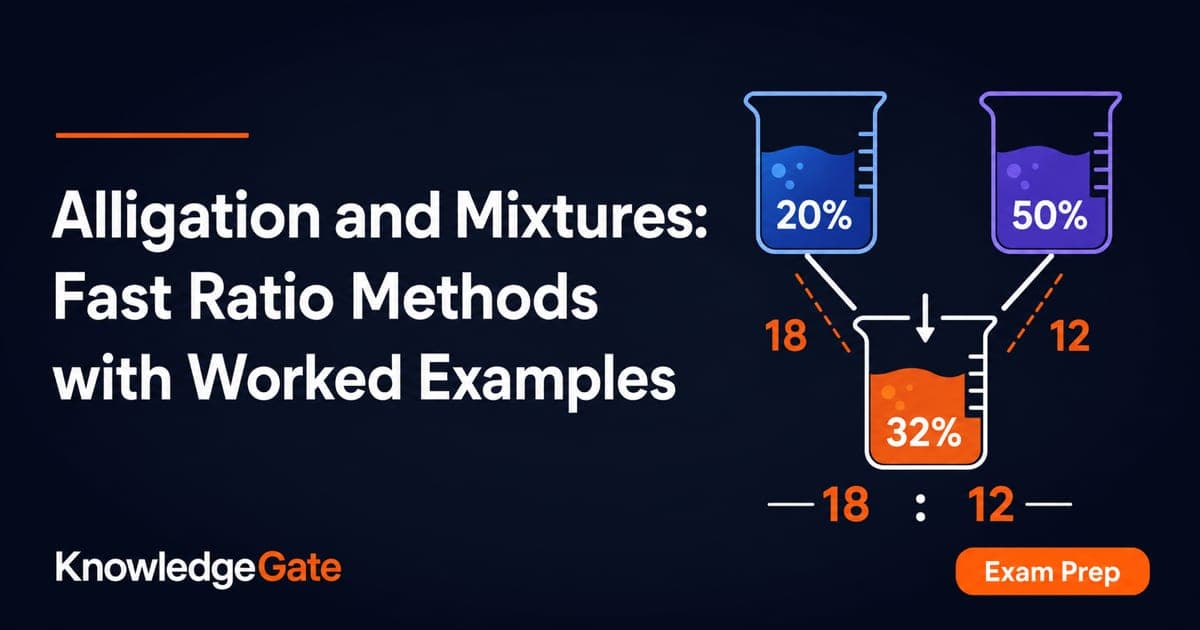
The crossed-difference picture is easy to remember, but it is also easy to reverse the ratio, use it for an impossible mean, or stop before converting the ratio into litres or kilograms. Use the weighted-average equation to derive alligation, apply it to concentration and cost-index blends, and check every answer against the original statement. The broader Aptitude Courses for Exams & Placements route can help you place this method inside a complete quantitative-aptitude study and practice plan.
Start with the weighted-average equation
Alligation is a shortcut for a linear weighted average. If amounts x and y have values L and H, their mean is:
M = (Lx + Hy)/(x + y)
With positive amounts and L < H, the mean must satisfy L < M < H. At an endpoint, the other ingredient has zero quantity. Outside the endpoints, the blend is impossible.
For 20% and 50% solutions making a 32% mixture:
0.20x + 0.50y = 0.32(x + y)
Expanding and rearranging gives 0.12x = 0.18y, hence x:y = 18:12 = 3:2.
The 20% amount receives the opposite difference 50 - 32 = 18; the 50% amount receives 32 - 20 = 12. Since 32% is closer to 20%, the mixture needs more 20% solution. This reasonableness check fits the method-first approach in Aptitude for Placements: Quant, Reasoning, Verbal.
Draw the alligation cross and convert the ratio
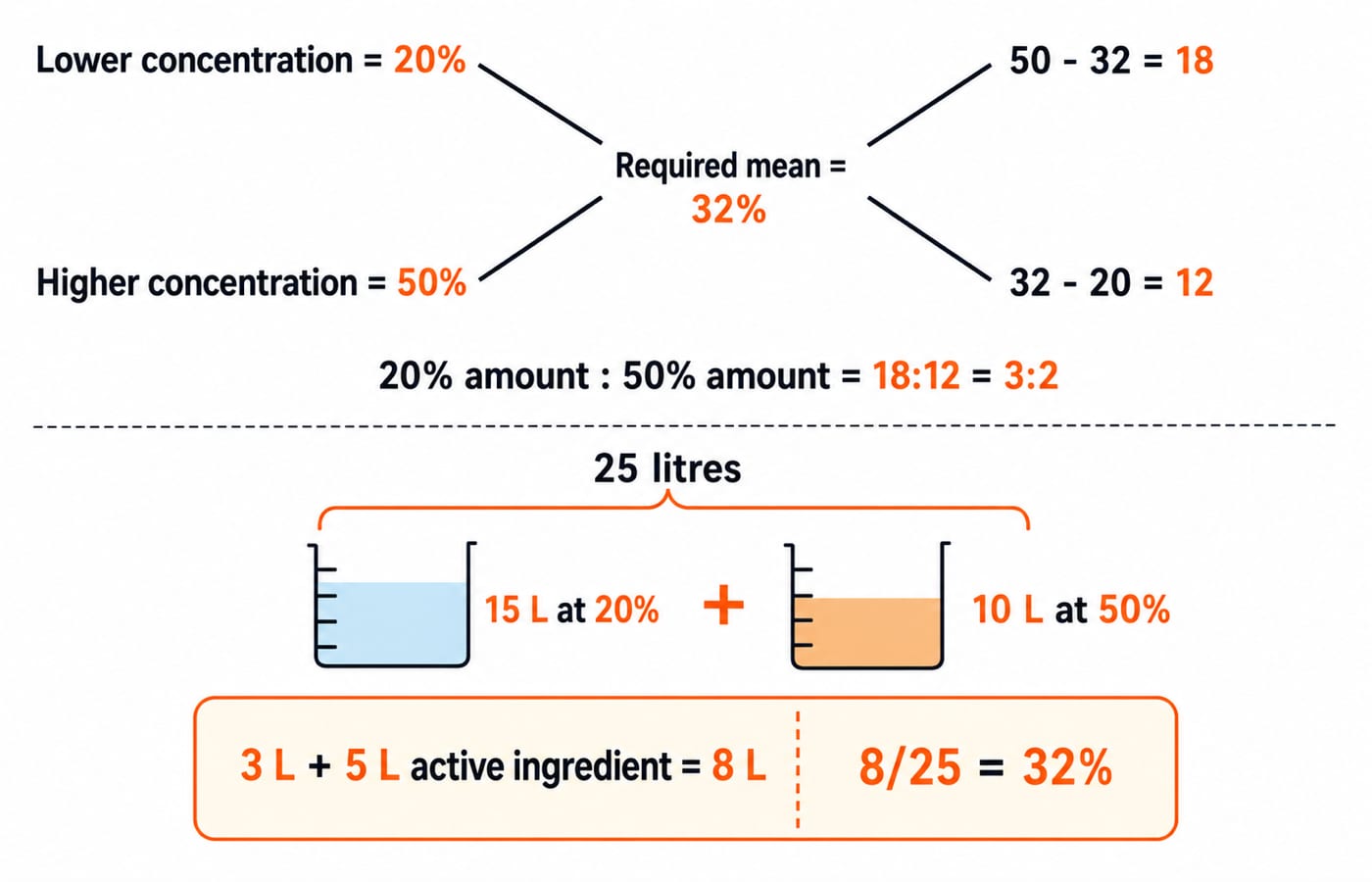
Question: how should 20% and 50% solutions be mixed to obtain 25 litres of 32% solution?
Place 20 and 50 on the left, 32 in the centre, and take positive diagonal differences:
20% solution : 50% solution = (50 - 32):(32 - 20) = 18:12 = 3:2
Five parts represent 25 litres, so each is 25/5 = 5 litres. Use 15 litres of the 20% solution and 10 litres of the 50% solution.
Check the active ingredient: 15 × 0.20 = 3 litres and 10 × 0.50 = 5 litres. That is 8 litres in 25, and 8/25 = 32%.
Apply the same method to a cost-index blend
The arithmetic is unchanged for a per-kilogram cost index. Suppose the lower and higher grades have indices 40 and 70 per kg, and the target is 52.
lower : higher = (70 - 52):(52 - 40) = 18:12 = 3:2
For 25 kg, one of the five parts is 5 kg. Take 15 kg of the lower-index grade and 10 kg of the higher-index grade. Check: (15 × 40 + 10 × 70)/25 = (600 + 700)/25 = 52.
This model works only when the target is the weighted average of the stated per-unit indices. If a question adds loss, tax, impurity removal or another operation, model that operation first.
Solve fixed-quantity and dilution questions
Suppose 10 litres of 60% solution is available. How much 20% solution makes a 35% mixture?
20% amount : 60% amount = (60 - 35):(35 - 20) = 25:15 = 5:3
The known 10 litres is the three-part high-strength amount. One part is 10/3 litres, so add 5 × 10/3 = 50/3 = 16 2/3 litres. Final volume is 80/3 = 26 2/3 litres. Check:
[(50/3 × 0.20) + (10 × 0.60)]/(80/3) = (10/3 + 6)/(80/3) = 35%
For dilution, treat water as 0%. Reducing 30 litres of 40% solution to 25% gives water : solution = (40 - 25):(25 - 0) = 3:5. Thirty litres represents five parts, so add 18 litres water. Active ingredient remains 30 × 0.40 = 12 litres; final volume is 48 litres; 12/48 = 25%.
Treat a pure ingredient as 100%. A 30% solution making 50% gives solution : pure ingredient = (100 - 50):(50 - 30) = 5:2. With 10 litres of solution, add 4 litres pure ingredient. Check: (3 + 4)/14 = 50%.
Use retained fraction for repeated replacement
Remove-and-replace cycles are not a single weighted-average target. Removing r from a well-mixed vessel of capacity V retains 1 - r/V of the original substance. After n cycles, the retained fraction is (1 - r/V)^n.
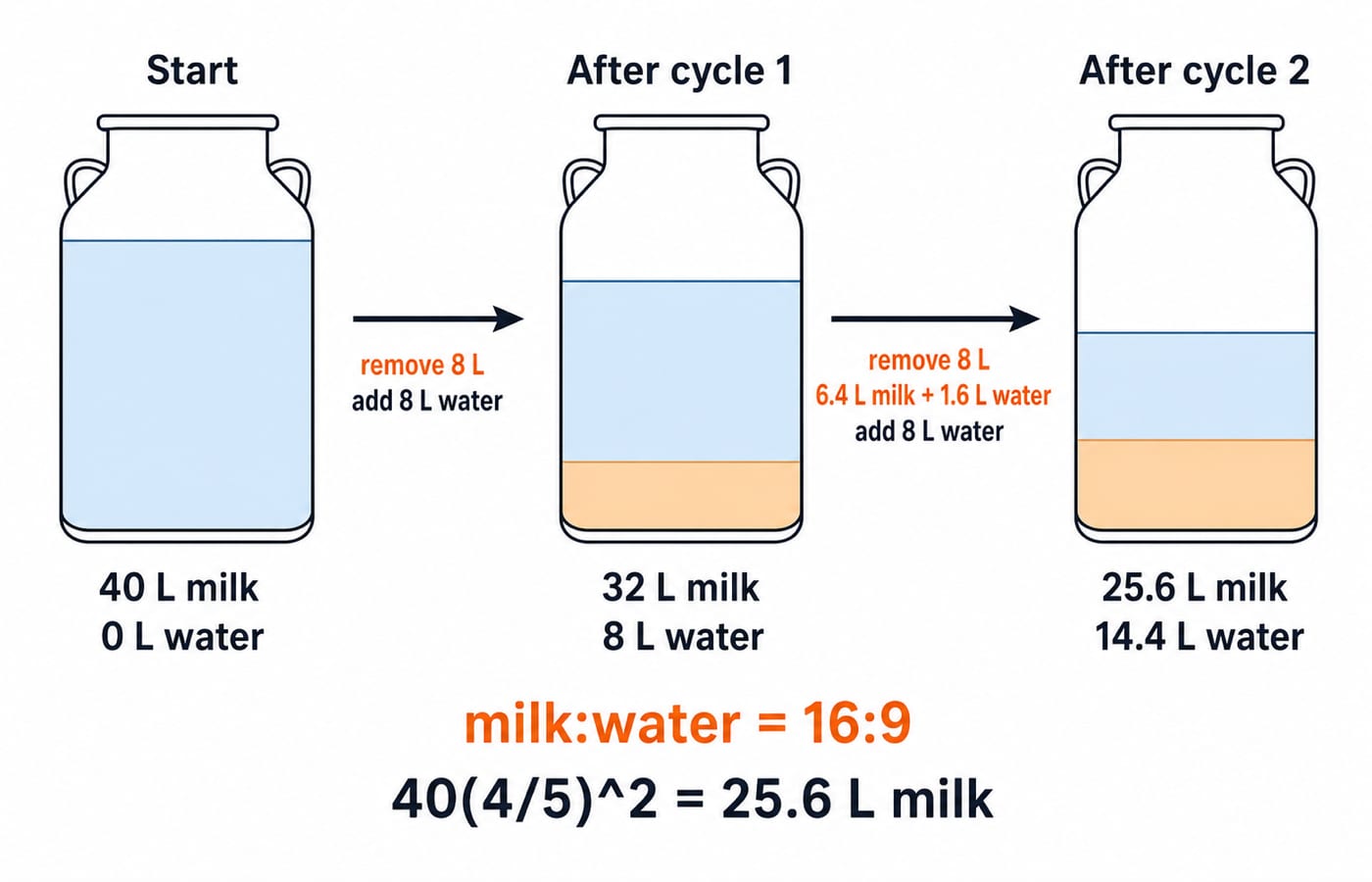
A 40-litre vessel initially contains pure milk. Remove 8 litres and refill with water twice. Milk left is 40(1 - 8/40)^2 = 40(4/5)^2 = 25.6 litres. Water is 40 - 25.6 = 14.4 litres, so milk:water = 25.6:14.4 = 16:9.
After cycle one, there are 32 litres milk and 8 litres water. The second removal takes 8 × 32/40 = 6.4 litres milk and 8 × 8/40 = 1.6 litres water. That leaves 25.6 litres milk and 6.4 litres water; the refill makes the water 14.4 litres.
Recognise what the question is asking
Choose the route before calculating:
Two values and target
20, 50, 32: use alligation for the ratio.Total 25 litres: divide by the ratio sum.
Fixed 10 litres of 60% solution: map it to its ratio part.
Repeated removal
40, 8, 2: use retained fraction.
Sometimes the ratio is known and the mean is missing. If quantities are in the ratio 2:3 and their strengths are 35% and 65%, the mean is (2 × 35 + 3 × 65)/5 = 265/5 = 53%. Alligation confirms it: (65 - 53):(53 - 35) = 12:18 = 2:3.
Questions may ask for a ratio, missing quantity, mean, impossible target, or amount left after replacement. The Permutations and Combinations for GATE CS method guide is a related lesson in choosing a method before calculating.
Repair the traps that make answers look plausible
Trap | Repair |
|---|---|
Reversing the cross | Write each component name beside its opposite difference. |
Getting a negative ratio | Confirm the target lies between the inputs, then use positive differences. |
Stopping at | If 25 litres is required, calculate |
Mixing units or models | Compare like units, and do not use one-shot alligation for replacement cycles. |
Two checks expose common failures immediately. A 60% target cannot come only from 20% and 50% solutions because their weighted mean cannot exceed 50%. A reversed 2:3 ratio for the 32% target gives (2 × 20 + 3 × 50)/5 = 38%, not 32%.
Keep percentages in the same form, and never treat 20% as 20 litres. Assume quantities are additive unless the statement says otherwise.
Short version, practice checks and the next step
Order the component values as low and high. Confirm the mean lies between them. Take opposite positive differences and attach each to the correct component. Convert the ratio into the requested quantity. Finally, verify by weighted average or conserved ingredient.
Try these before reading the answers:
For 15% and 45% solutions making 25%,
low:high = (45 - 25):(25 - 15) = 2:1.Diluting 24 litres of 50% solution to 30% gives
water:solution = (50 - 30):(30 - 0) = 2:3, so add 16 litres water.For indices 28 and 58, target 40 and total 20 kg,
low:high = 18:12 = 3:2, so use 12 kg and 8 kg.
For structured learning, placement-focused readers can continue with the Aptitude for Placement course, while GATE-focused readers can use the Aptitude for GATE Exam course. Pick your route, then practise until the final check becomes automatic.
Keep learning
Number System Concepts and Shortcuts: Solved Examples for Competitive Exams
Learn how to classify numbers, choose the right divisibility or prime-factor method, and verify remainders, factors, HCF, LCM, and unit digits.
Updated 22 Oct 20266 min readAptitude & Reasoning
Age Ratio-Based Problems: 12 Questions with Step-by-Step Solutions
Solve 12 age ratio-based questions from the KnowledgeGate practice bank. Each fresh solution shows how to form the equation, shift every age correctly, and verify the answer.
18 Oct 20267 min readAptitude & Reasoning

Mixture and Alligation: Rules, Shortcuts and Solved Examples for Exams
Learn how concentration, alligation and the retention factor solve the main mixture question types, with step-by-step examples and arithmetic checks.
Updated 14 Oct 20265 min readAptitude & Reasoning

Mental Ability Concepts and Shortcuts: Solved Examples for Competitive Exams
Learn a four-step reasoning process, then apply it to number patterns, mirror coding, directions, syllogisms, blood relations and ranking problems.
Updated 10 Oct 20267 min readAptitude & Reasoning