Arithmetic for Competitive Exams: Core Concepts, Safe Shortcuts and Solved Examples
Build arithmetic from relationships, not memorised tricks. Learn to choose the correct base, calculate step by step, and check answers across core topics.
KnowledgeGate Team
Exam prep & CS education
Updated 29 Aug 20266 min read

Arithmetic questions look varied because percentages, ratios, averages, profit and loss, work, and speed come wrapped in different stories. The stories change, but the mathematical structure usually does not. Underneath, most ask you to choose the correct base and translate one relationship before calculating. Use exact values, safe shortcuts, and a check after every solution. For the broader learning path, start with Aptitude Courses for Exams & Placements.
Build the arithmetic translation layer first
Organise arithmetic into four reusable relationships:
Part and whole questions use fractions or percentages.
Comparisons use ratios.
Combined groups use totals and averages.
Motion and work use rates.
Before using a shortcut, write required value = relationship x known base. The aptitude for placements guide places arithmetic in the wider quantitative, reasoning, and verbal preparation map.
Keep these conversions ready: 1/2 = 50%, 1/3 = 33 1/3%, 1/4 = 25%, 1/5 = 20%, 1/8 = 12.5%, and 3/8 = 37.5%. They are equivalent forms.
For 3/5 of 250 + 18% of 400 - 45, treat “of” as multiplication:
3/5 x 250 + 18/100 x 400 - 45 = 150 + 72 - 45 = 177.
Both positive components are smaller than their bases, so 1,770 fails a magnitude check.
Percentages: identify the base before using a shortcut
Percentage change is (change/original) x 100. From 750 to 600, change = 150, so decrease = 150/750 x 100 = 20%. Dividing by 600 uses the new value, not the original.
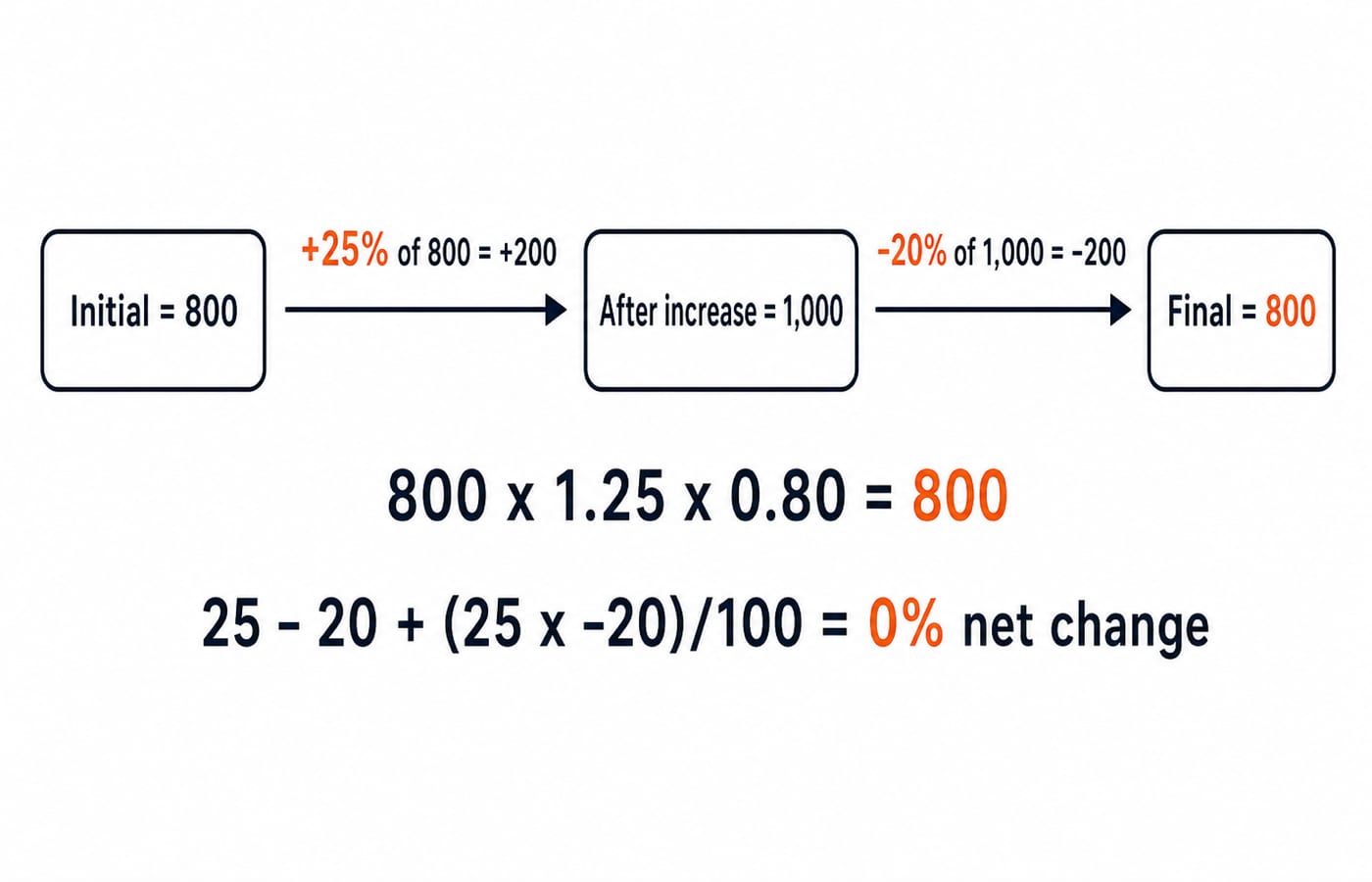
On 800, a 25% increase gives 800 x 1.25 = 1,000; a 20% decrease then gives 1,000 x 0.80 = 800. The signed shortcut a + b + ab/100, with a = 25 and b = -20, gives 25 - 20 - 5 = 0%. Direct addition is unsafe because the bases differ.
If the value after a 20% decrease is 480, it is 80% of the original. Original = 480/0.8 = 600. The tempting 480 x 1.20 = 576 does not reverse the decrease.
Ratios and proportion: scale units, not written numbers blindly
If A:B = 3:5 and the total is 96, there are 8 ratio units. One unit is 96/8 = 12, so A = 36 and B = 60. Check: 36 + 60 = 96 and 36:60 = 3:5.
If A alone rises by 12, the values become 48 and 60, and the new ratio is 48:60 = 4:5. A ratio stays fixed only when both quantities are scaled by the same factor.
In 30 litres with water to syrup 2:3, water is 12 litres and syrup is 18. For 1:1 by adding only water, 12 + x = 18, so x = 6 litres. Check: 18:18, total 36 litres.
Averages: restore the hidden total
Use total = average x count. The scores 68, 74, 76, 82, 90 total 390, so average = 390/5 = 78. Replacing 68 with 83 raises the total by 15 to 405; new average = 405/5 = 81. Thus change in average = change in total/count = 15/5 = 3.
Do not average group averages unless the groups are equal. If 30 learners average 68 and 20 learners average 82, their combined total is:
30 x 68 + 20 x 82 = 2,040 + 1,640 = 3,680.
For 50 learners, combined average = 3,680/50 = 73.6, not (68 + 82)/2 = 75. It lies between 68 and 82 and is closer to 68, the larger group's average.
Profit, discount, and interest: attach each percentage to its base
Let cost index be 100 and marked index 125. A 12% discount on 125 is 15, so selling index = 110. Profit is 10 on cost base 100, or 10%. Discount uses the marked base; profit uses cost.
For principal 5,000 units at 8% per year for 2 years, simple interest is 5,000 x 8 x 2/100 = 800, giving amount 5,800. Annual compound amount is 5,000 x 1.08² = 5,832, so compound interest is 832. The extra 32 is interest on the first year's interest.
Base-100 indexing is safe for linked percentages, but convert back if the question asks for an actual value. Never combine discount and profit percentages until both bases are explicit.
Time, work, and speed: solve with rates and units
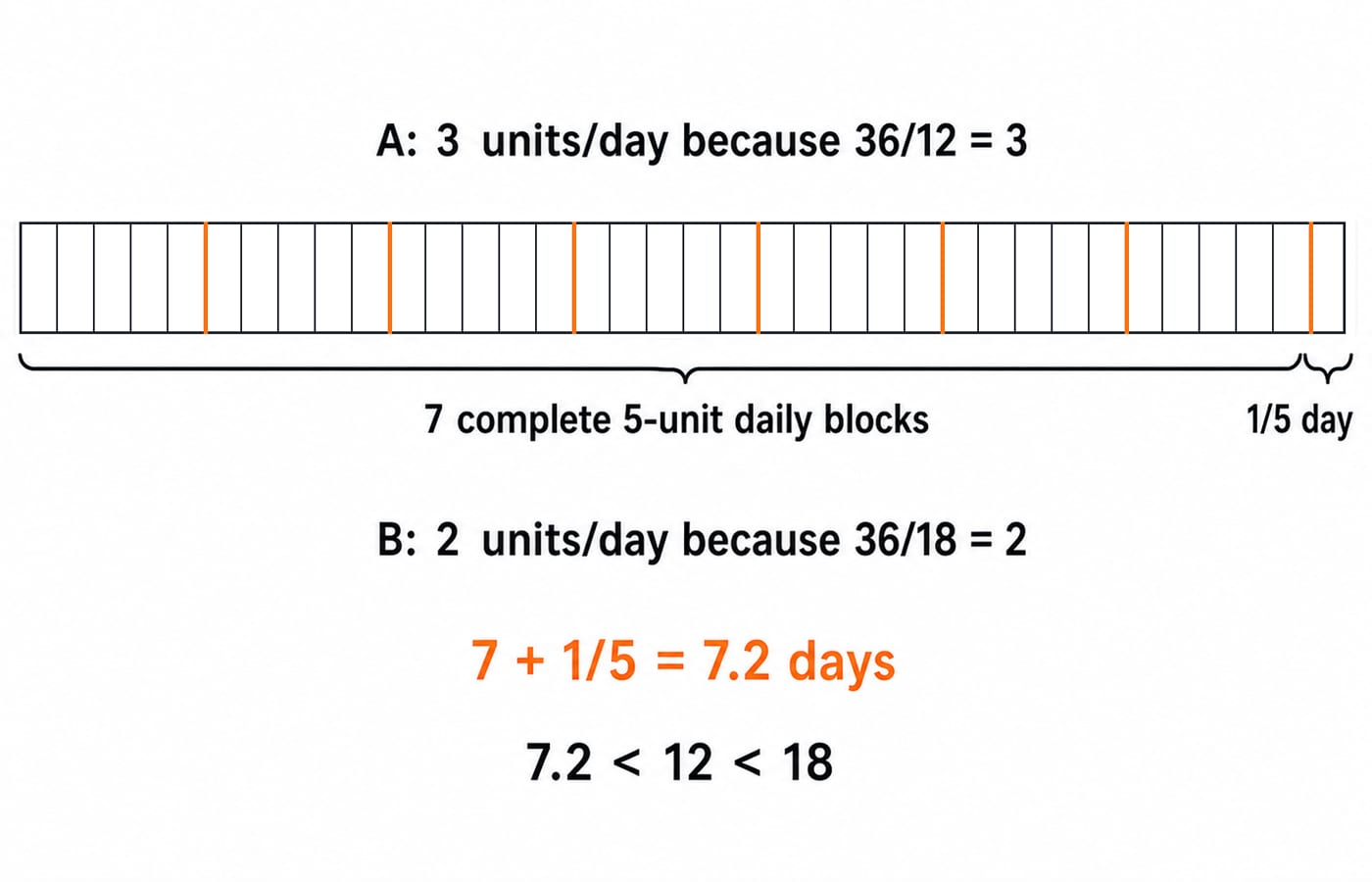
A finishes a job in 12 days and B in 18. Take the job as 36 units. Their rates are 36/12 = 3 and 36/18 = 2 units per day. Together they do 5 units per day, so time = 36/5 = 7.2 days. The check 7.2 < 12 < 18 confirms the result.
Travel 120 km at 40 km/h and return 120 km at 60 km/h. Times are 3 and 2 hours. Average speed is total distance over total time: 240/5 = 48 km/h. The simple average 50 km/h is wrong because the times differ.
Write units beside each rate: work rate is job/day, speed is km/hour, and distance = speed x time. Cancelling units can reveal an inverted fraction before it becomes a wrong answer.
Use shortcuts that preserve the mathematics
Three mental moves are reliable when their conditions fit:
12.5% of 640 = 1/8 of 640 = 80, because12.5% = 1/8.33 1/3% of 243 = 1/3 of 243 = 81, because the percentage is exactly one-third.19% of 50 = 50% of 19 = 9.5, usingx% of y = y% of x.
For 49.8 x 20.2, estimate 50 x 20 = 1,000, then calculate:
(50 - 0.2)(20 + 0.2) = 1,000 + 10 - 4 - 0.04 = 1,005.96.
Estimation rejects distant options; close options require the exact step.
Trap | Repair |
|---|---|
Wrong percentage denominator | Circle the original base, as in the fall from |
Adding successive percentages | Multiply the factors, as in |
Averaging averages or speeds directly | Rebuild total quantity and total count or time |
Treating an inverse relationship as direct | Test what happens when one quantity rises |
Rounding too early | Keep fractions or sufficient decimals until the final line |
Recognise exam forms and verify the answer
Arithmetic can appear as a missing base, a percentage joined to a ratio, a hidden total, or a job described through individual times. Recover 600 from 480 after a 20% decrease, then divide 600 in ratio 2:3. One of five units is 120, so shares are 240 and 360. Check: 240 + 360 = 600 and 240:360 = 2:3.
Do not assume a fixed mark value, frequency, or time limit for any form. Exam-specific patterns should come from the organising body's current official notice. A placement paper, GATE paper, and government exam may package the same relationship differently.
The short version
Name the base, translate the relationship, choose a fraction, ratio-unit, total, or rate method, and calculate. Then run a magnitude check and substitute the result back into the original conditions. Learners who want a daily structure can follow the 30-day aptitude practice routine.
For guided study, choose the course that matches your goal: Aptitude for Placement for placement-focused learning, or Aptitude for GATE Exam for GATE-focused learning. Shortcuts become safe only after the base and relationship are clear.
Keep learning

Number System Concepts and Shortcuts: Solved Examples for Competitive Exams
Learn how to classify numbers, choose the right divisibility or prime-factor method, and verify remainders, factors, HCF, LCM, and unit digits.
Updated 22 Oct 20266 min readAptitude & Reasoning

Age Ratio-Based Problems: 12 Questions with Step-by-Step Solutions
Solve 12 age ratio-based questions from the KnowledgeGate practice bank. Each fresh solution shows how to form the equation, shift every age correctly, and verify the answer.
18 Oct 20267 min readAptitude & Reasoning

Mixture and Alligation: Rules, Shortcuts and Solved Examples for Exams
Learn how concentration, alligation and the retention factor solve the main mixture question types, with step-by-step examples and arithmetic checks.
Updated 14 Oct 20265 min readAptitude & Reasoning

Mental Ability Concepts and Shortcuts: Solved Examples for Competitive Exams
Learn a four-step reasoning process, then apply it to number patterns, mirror coding, directions, syllogisms, blood relations and ranking problems.
Updated 10 Oct 20267 min readAptitude & Reasoning