Algebra for Competitive Exams: Concepts, Shortcuts and Solved Examples
Learn a method-first approach to algebra: translate the question, simplify accurately, choose an efficient method, and verify the result with solved examples.
KnowledgeGate Team
Exam prep & CS education
Updated 26 Aug 20266 min read
Algebra questions can look unrelated. One appears as a fraction, another as a word problem, and a third as a quadratic. Yet most reduce to a small set of transformations: translate the information, simplify it, and preserve the solution set. A fast move is useful only when an independent check confirms it, whether by substitution, root relations, a boundary test, or a contextual constraint.
Classify the algebraic object before choosing a transformation
In 3x^2 - 5x + 7, x is the variable, 3 and -5 are coefficients, and 7 is the constant. The three terms are 3x^2, -5x, and 7.
Without equality, it is an expression. 3x^2 - 5x + 7 = 0 is an equation, true only for its solutions. (a + b)^2 = a^2 + 2ab + b^2 is an identity, true for every permitted value of a and b.
Before calculating, scan in this order: remove brackets, combine only like terms, then check domain restrictions. For example:
2(3x - 4) - (x + 5) = 6x - 8 - x - 5 = 5x - 13
Do not turn 3x + 2x^2 into 5x^3. The powers are unlike, so the terms cannot be combined. A quick substitution can expose errors: at x = 4, both the original expression and 5x - 13 equal 7. Build a wider quantitative foundation with the Aptitude for Placement course.
Linear equations: preserve equality, clear fractions, and substitute back
Moving a term across = means applying the same operation to both sides. Consider:
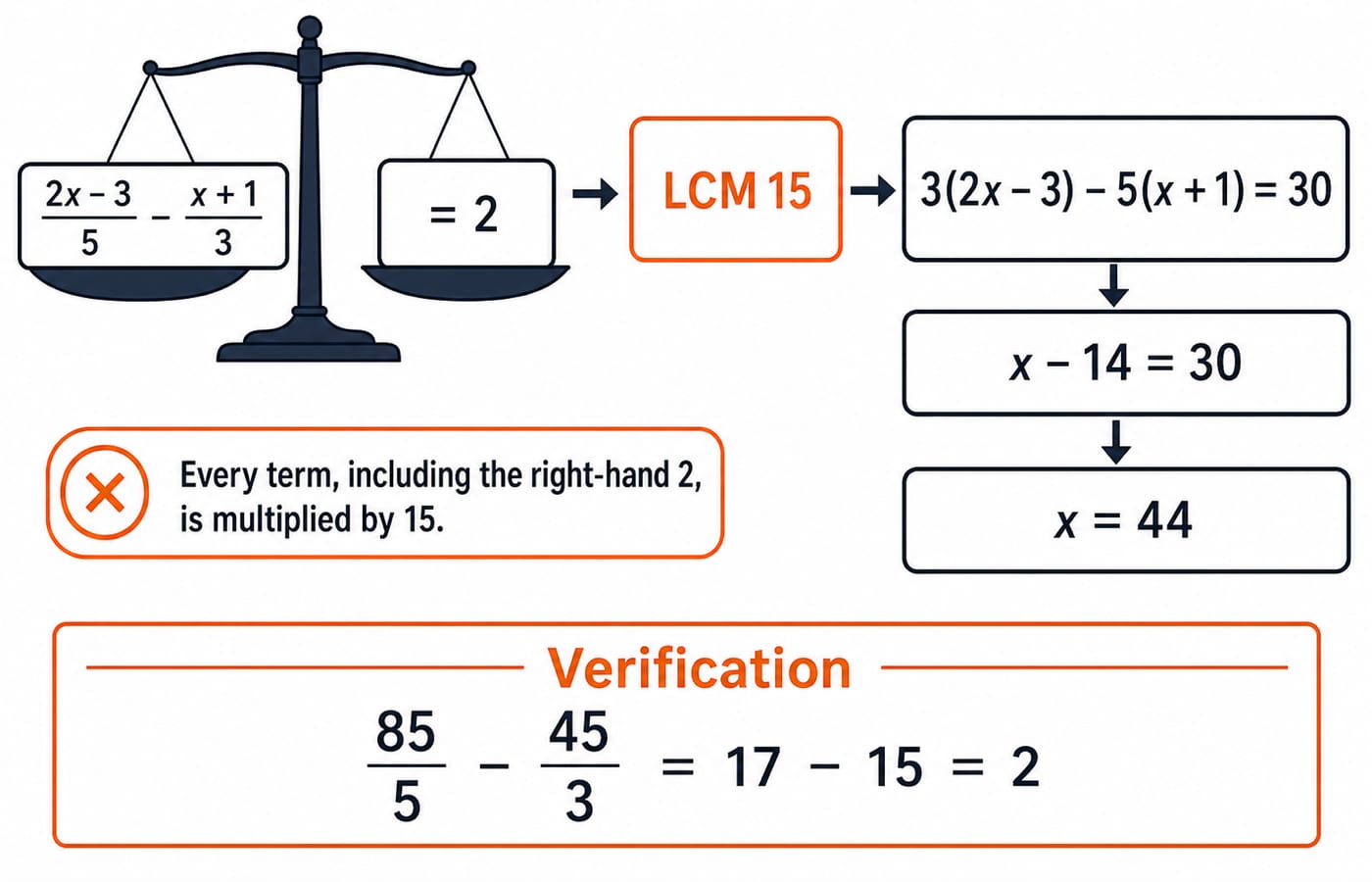
(2x - 3)/5 - (x + 1)/3 = 2
The LCM of 5 and 3 is 15. Multiply every term, including the right side, by 15:
3(2x - 3) - 5(x + 1) = 30
6x - 9 - 5x - 5 = 30
x - 14 = 30
x = 44
Now verify it in the original equation:
(88 - 3)/5 - (44 + 1)/3 = 85/5 - 45/3 = 17 - 15 = 2
The safe speed rule is to clear all denominators once. Never cancel terms across addition or subtraction.
For a shorter contrast, 4(x - 2) = 2x + 10 becomes 4x - 8 = 2x + 10, so 2x = 18 and x = 9. Dividing by a coefficient before opening brackets is safe only when the division applies to the entire side.
Simultaneous equations: eliminate once and check both originals
Solve 2x + 3y = 31 and x - y = 3. Multiply the second equation by 2:
2x - 2y = 6
Subtract it from the first equation. This gives 5y = 25, so y = 5. Substitution in x - y = 3 gives x = 8.
Check both originals: 2(8) + 3(5) = 16 + 15 = 31, and 8 - 5 = 3. Use the smallest multipliers that make coefficients equal or opposite.
Here, substitution starts with x = y + 3, so 2(y + 3) + 3y = 31, then 5y + 6 = 31. This again gives y = 5 and x = 8. The method changes the work, not the solution.
Quadratics: factor, compare root relations, and inspect the graph
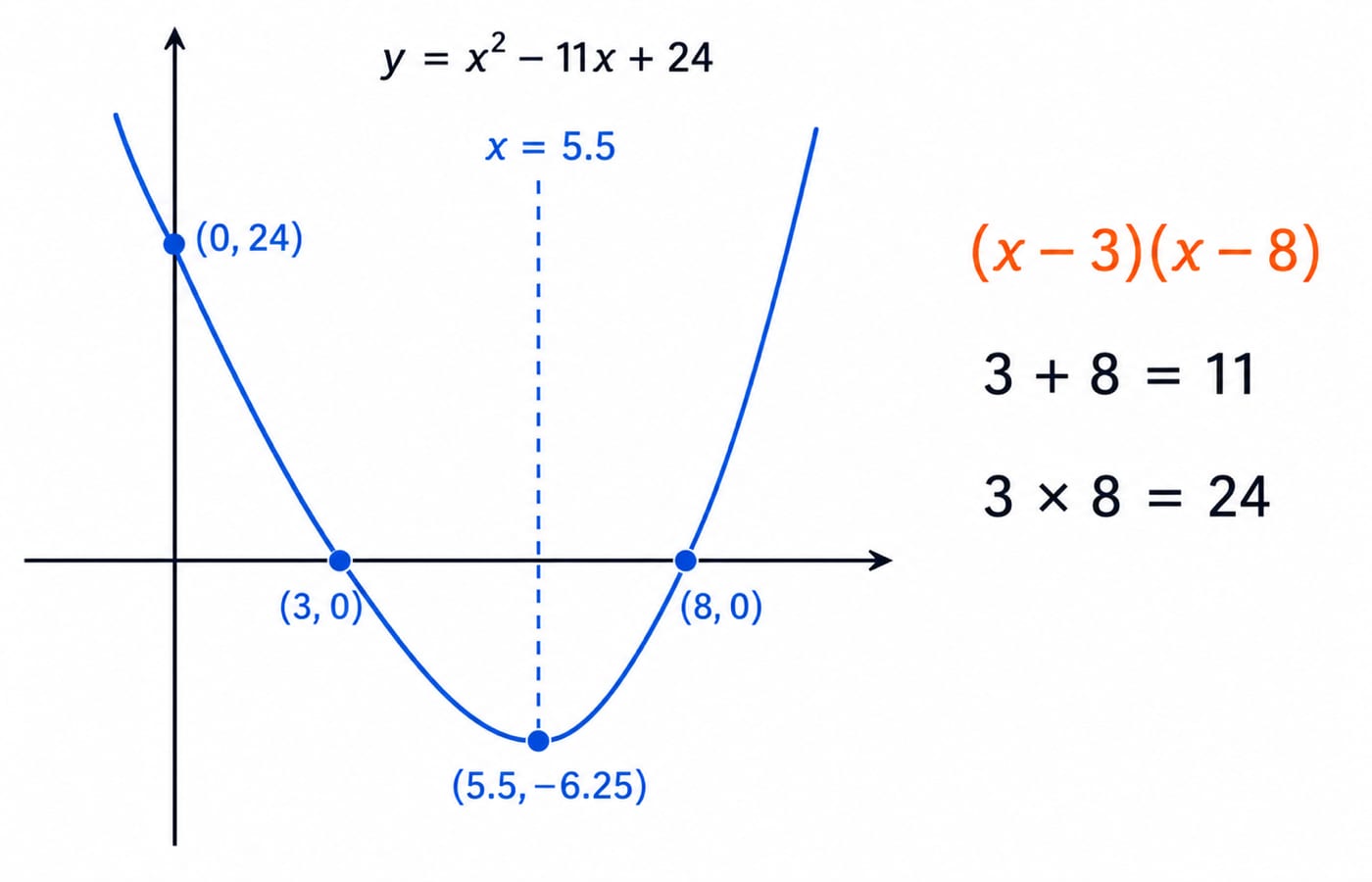
For x^2 - 11x + 24 = 0, seek two numbers with product 24 and sum -11. They are -3 and -8, so:
(x - 3)(x - 8) = 0
Therefore, the roots are x = 3 and x = 8. For ax^2 + bx + c = 0, the root sum is -b/a and the product is c/a. Here, 3 + 8 = 11 and 3 × 8 = 24. Substitution confirms it: 3^2 - 11(3) + 24 = 9 - 33 + 24 = 0.
If integer factors are not visible, use the quadratic formula instead of forcing a pattern. The discriminant here is (-11)^2 - 4(1)(24) = 121 - 96 = 25. Thus x = (11 ± 5)/2, giving 8 and 3.
Identities and inequalities: test the pattern and direction
The difference-of-squares identity turns a long calculation into a short one:
53^2 - 47^2 = (53 - 47)(53 + 47) = 6 × 100 = 600
The recognition cue is two squares joined by subtraction. It does not apply to 53^2 + 47^2.
For a number near a convenient base, use (a + b)^2 carefully:
103^2 = (100 + 3)^2 = 10000 + 600 + 9 = 10609
The middle term is 2ab. Leaving it out would produce the incorrect 10009.
Now solve -3(2x - 5) > 9. Expansion gives -6x + 15 > 9, then -6x > -6. Dividing by -6 reverses the sign, so x < 1. Check the boundary sides: x = 0 gives 15 > 9, true, while x = 2 gives 3 > 9, false.
Word problems: translate constraints and reject invalid roots
Use three columns mentally: unknown, relationship, equation. Suppose a two-digit number is four times the sum of its digits, and its units digit is 3 more than its tens digit. Let the tens digit be a and the units digit be b. The number is 10a + b, so:
10a + b = 4(a + b) and b = a + 3
The first equation reduces to 6a = 3b, or b = 2a. Combining 2a = a + 3 gives a = 3, then b = 6. The number is 36, and 4(3 + 6) = 36 verifies it.
Context can remove an algebraic answer. If two consecutive positive integers have product 156, let them be n and n + 1:
n(n + 1) = 156
n^2 + n - 156 = (n - 12)(n + 13) = 0
Algebra gives n = 12 or n = -13, but "positive" keeps only 12 and 13. Their product is 156. To see how such translation fits into a complete quant plan, read Aptitude for Placements: Quant, Reasoning, Verbal. Government-exam learners can use Bank PO Quant: High-Yield Topics First as a contextual next read, while confirming the current syllabus and test rules in the organising body's official notice.
Match each algebra error to an independent check
Trap | Repair and check |
|---|---|
Changing a sign while moving a term | Perform the same operation on both sides, then substitute the answer. |
Cancelling across | Factor the whole numerator or denominator first. |
Combining unlike powers | Combine only terms with identical variable parts and powers. |
Dividing an inequality by a negative | Reverse the inequality sign, then test values on both sides of the boundary. |
Keeping every quadratic root in a word problem | Apply conditions such as positive, integer, length, or digit range. |
Applying an identity to the wrong pattern | Expand once or substitute small values to test it. |
Match the check to the operation. Substitution tests an equation candidate, both original equations test a solved pair, root sum and product test a factorisation, small values test an identity, points on either side test an inequality boundary, and the wording of a problem tests whether a root is admissible. Different placement and government exams need not use the same pattern, so confirm the relevant syllabus and current rules on the organising body's official notice.
Algebra verification: the short version
Preserve the solution set at each step, then use a second check: substitution for an equation, both originals for a system, root relations for a quadratic, a boundary test for an inequality, and context for a word problem. Without looking back, verify x = 44, (x, y) = (8, 5), roots 3 and 8, and 53^2 - 47^2 = 600.
For adjacent lessons, browse Aptitude Courses for Exams and Placements. For a structured sequence across quantitative aptitude, reasoning, and verbal preparation, continue with the Aptitude for Placement course.
Keep learning
Number System Concepts and Shortcuts: Solved Examples for Competitive Exams
Learn how to classify numbers, choose the right divisibility or prime-factor method, and verify remainders, factors, HCF, LCM, and unit digits.
Updated 22 Oct 20266 min readAptitude & Reasoning
Age Ratio-Based Problems: 12 Questions with Step-by-Step Solutions
Solve 12 age ratio-based questions from the KnowledgeGate practice bank. Each fresh solution shows how to form the equation, shift every age correctly, and verify the answer.
18 Oct 20267 min readAptitude & Reasoning
Mixture and Alligation: Rules, Shortcuts and Solved Examples for Exams
Learn how concentration, alligation and the retention factor solve the main mixture question types, with step-by-step examples and arithmetic checks.
Updated 14 Oct 20265 min readAptitude & Reasoning
Mental Ability Concepts and Shortcuts: Solved Examples for Competitive Exams
Learn a four-step reasoning process, then apply it to number patterns, mirror coding, directions, syllogisms, blood relations and ranking problems.
Updated 10 Oct 20267 min readAptitude & Reasoning