Averages for Aptitude: Concepts, Shortcuts and Solved Examples
Learn one reliable approach to average questions: recover the total first. Work through weighted groups, deviations, replacements, corrections and speed examples.
KnowledgeGate Team
Exam prep & CS education
Updated 5 Sep 20266 min read50 views
You may know average = sum / number of observations and still get stuck when a member joins, two groups combine or a value is replaced. Use one consistent method: translate every average into a total, then choose the direct, weighted, deviation or change-in-total route. The same average methods apply across general aptitude practice, regardless of the exam pattern. The broader Aptitude category gives you the surrounding learning route.
Related reading: algebra shortcuts and placement aptitude.
1. Average means an equal share of the total
For values x1, x2, ..., xn, the arithmetic mean is:
A = (x1 + x2 + ... + xn) / n
Rearrange it as total = n x A. This shortcut handles joining, leaving, replacement and correction because each changes the total, n, or both. An average need not appear in the original data.
For scores 42, 48, 55, 51, 54 marks, 42 + 48 + 55 + 51 + 54 = 250 marks and n = 5. Therefore, A = 250 / 5 = 50 marks. Check: 5 x 50 = 250 marks.
If 8 employees average 26 years in age, their combined age is 8 x 26 = 208 years. No employee must be exactly 26 years old.
2. Weighted and combined averages: let group size control the answer
When contributions differ, use weighted average = sum(wi xi) / sum(wi). For scores 80, 70, 64 with weights 20%, 30%, 50%:
0.20(80) + 0.30(70) + 0.50(64) = 16 + 21 + 32 = 69
The plain mean (80 + 70 + 64) / 3 = 71.33 is wrong because the assessments do not carry equal weight.
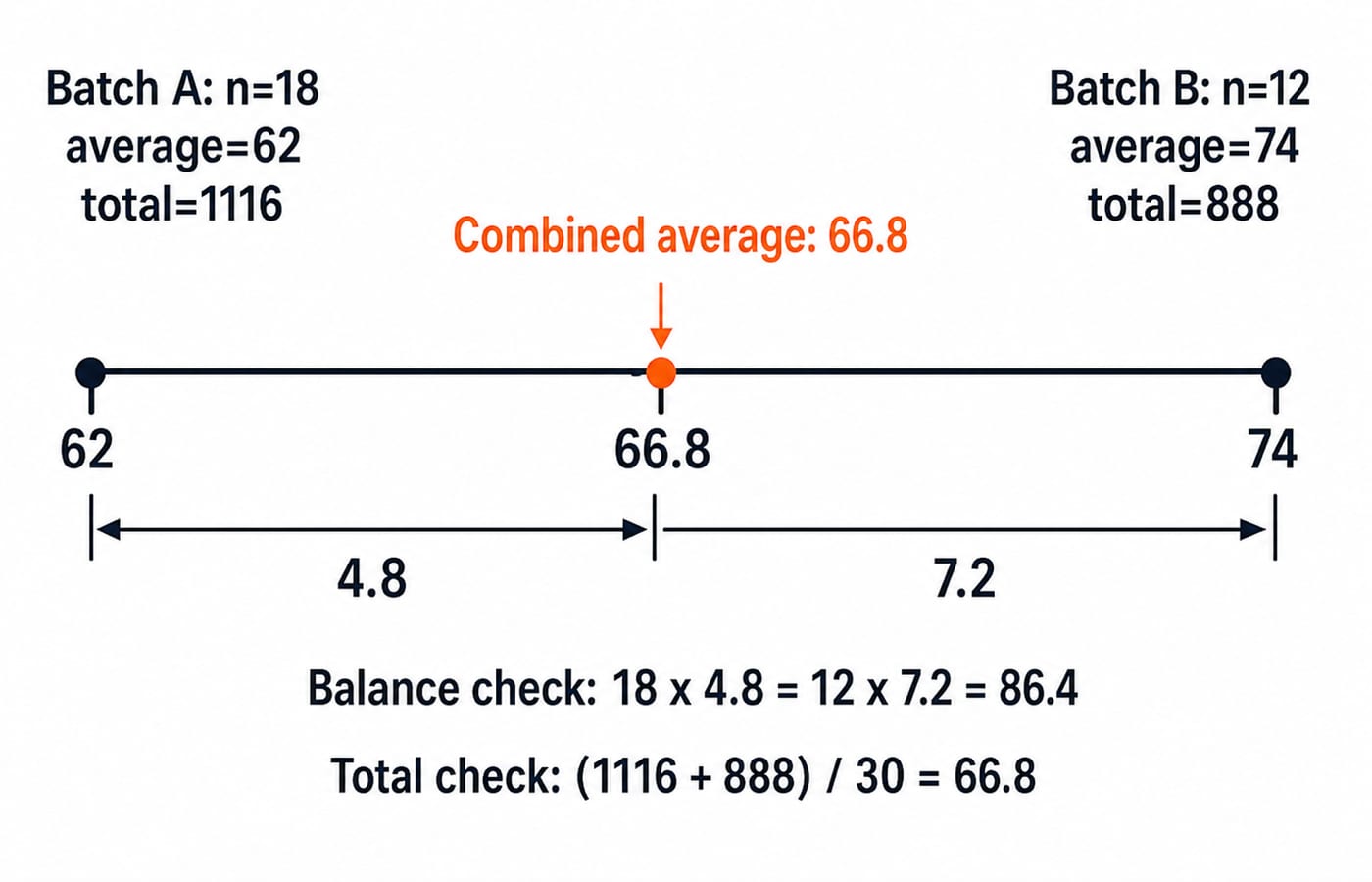
For two groups, Batch A has 18 candidates averaging 62, so its total is 18 x 62 = 1116. Batch B has 12 candidates averaging 74, so its total is 12 x 74 = 888. The combined average is:
(1116 + 888) / (18 + 12) = 2004 / 30 = 66.8
Cross-check from 62: Batch B adds 12 x (74 - 62) = 144. Across 30 candidates, the rise is 144 / 30 = 4.8, giving 62 + 4.8 = 66.8. The larger group pulls the answer closer to 62 than 74.
3. The deviation method: calculate around a convenient centre
An assumed mean is an arithmetic aid, not a new definition. Choose centre a, calculate di = xi - a, then use A = a + (sum di) / n.
For 47, 52, 49, 55, 57, choose a = 50. The deviations are -3, +2, -1, +5, +7, whose sum is +10. Thus, A = 50 + 10/5 = 52. A direct check gives the total 47 + 52 + 49 + 55 + 57 = 260, and 260 / 5 = 52.
Equally spaced values cancel neatly. In 22, 28, 34, 40, 46, 52, 58, pair 22 + 58 = 80, 28 + 52 = 80 and 34 + 46 = 80, leaving 40. The average is 40, also (first + last) / 2 = (22 + 58) / 2. This works because the terms are equally spaced, not merely sorted.
Use an assumed mean when deviations are small or cancel. Return to totals when weights differ or the number of members changes.
4. Joining, leaving and replacement: track the change in total
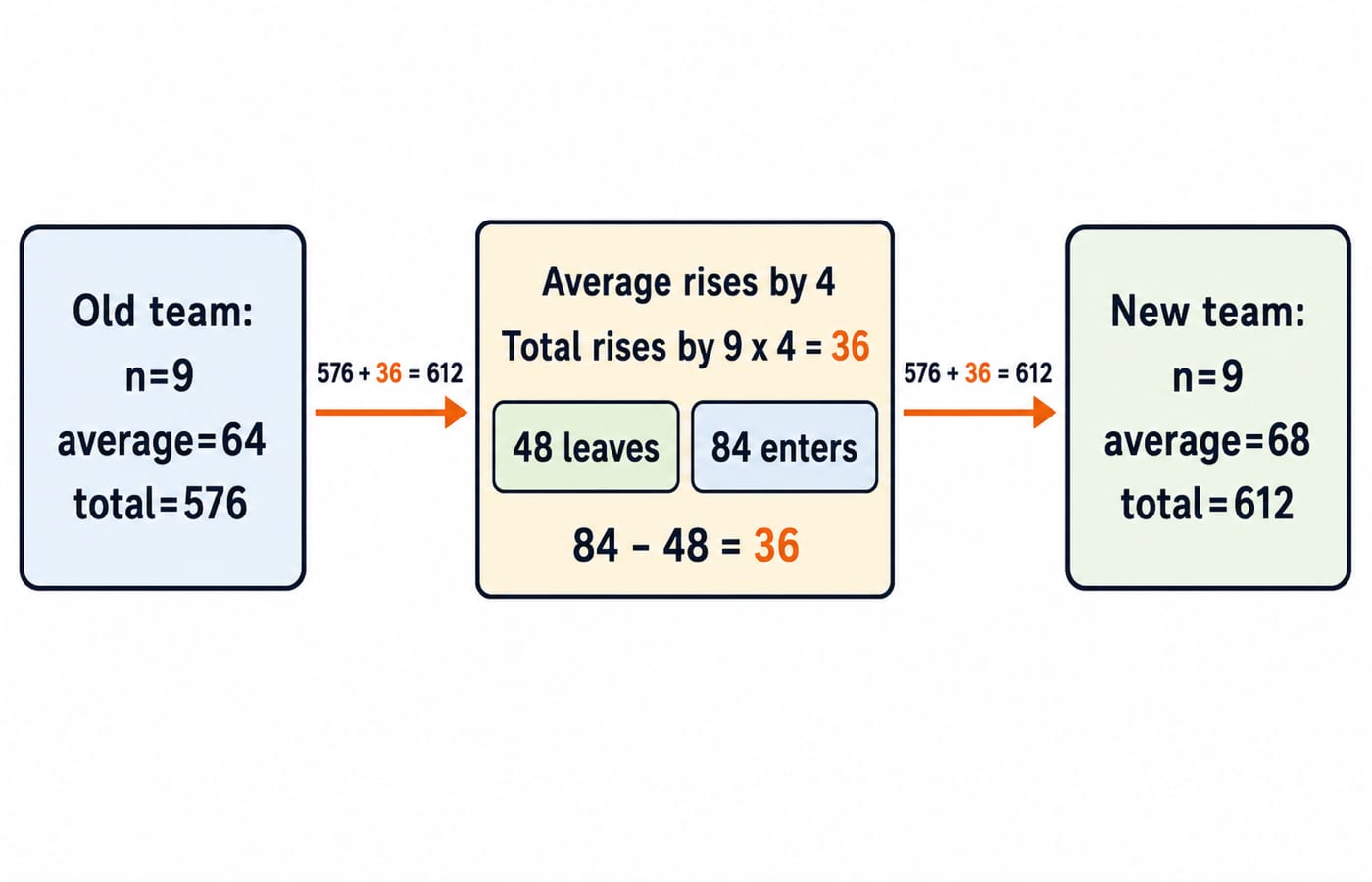
For fixed group size, new total - old total = n x (new average - old average). A team of 9 averages 64, so its total is 9 x 64 = 576. After one score is replaced, it averages 68, giving 9 x 68 = 612. The rise is 612 - 576 = 36. If 48 went out, incoming - 48 = 36, so 84 came in.
Joining and leaving change n. If 7 members average 23, the total is 7 x 23 = 161. After an eighth joins, the average is 25, so the total is 8 x 25 = 200. The new member's value is 200 - 161 = 39.
If 10 members average 42, their total is 420. After one leaves, 9 average 40, giving 360. The departing value was 420 - 360 = 60.
Replacement keeps n fixed, so use the average-change shortcut. Joining or leaving changes n, so rebuild both totals.
5. Common average traps and the exact repair for each
The average-of-averages trap ignores group size. Groups of 10 and 30 average 70 and 50. The tempting (70 + 50) / 2 = 60 is wrong. Use (10 x 70 + 30 x 50) / 40 = (700 + 1500) / 40 = 55. Speed without method selection creates avoidable errors, a broader issue in 7 Placement Preparation Mistakes to Avoid.
For a wrong entry, correct the total. If 25 entries were reported with mean 32, the total was 25 x 32 = 800. One value was 25 instead of 52, so add 52 - 25 = 27. The corrected total is 827, and the mean is 827 / 25 = 33.08. The sign check agrees: a larger correct value must raise the mean.
For equal legs of 120 km at 60 km/h and 40 km/h, total time is 120/60 + 120/40 = 2 + 3 = 5 hours. Average speed is 240/5 = 48 km/h, not (60 + 40)/2 = 50 km/h. Speed is weighted by time, or found as total distance divided by total time.
6. How aptitude questions signal the right method
A missing value asks for a total. Unequal groups signal weighting, clustered values favour deviations, replacement keeps the denominator fixed, joining or leaving changes it, and a wrong entry needs a total correction.
For example, five values average 34, while four values are 24, 28, 35, 41. The required total is 5 x 34 = 170; the known total is 24 + 28 + 35 + 41 = 128. The missing value is 170 - 128 = 42.
Use a ten-second triage: write n, old average and new average. If n is unchanged, translate average movement into total movement. If it changes, find both totals. For “average of 6 values rises by 3”, the total rises by 6 x 3 = 18, even without any value.
Use Aptitude for Placements: Quant, Reasoning, Verbal for the wider sequence. Use AMCAT, CoCubes, eLitmus: Aptitude Tests Compared only to choose a placement-test context. Check the relevant recruiter or exam authority's latest notice for marks, weightage, frequency and question counts.
7. Averages for aptitude: the short version and next step
Keep this retrieval card:
total = n x averagecombined average = sum(group size x group average) / total sizeaverage = assumed mean + mean deviationFor fixed-size replacement,
incoming - outgoing = n x change in averageFor a corrected entry,
change in mean = (correct - wrong) / n
One more check: with positive weights, a combined average must lie between the component averages.
Build speed through a focused practice set. Solve 10 direct or deviation questions untimed, then 10 combined or replacement questions in 15 minutes. Redo each error using old and new totals.
Placement learners can continue with Aptitude for Placement. Readers preparing for the banking route can use IBPS PO Prelims. When an average question looks complicated, recover the total first.
Keep learning
Number System Concepts and Shortcuts: Solved Examples for Competitive Exams
Learn how to classify numbers, choose the right divisibility or prime-factor method, and verify remainders, factors, HCF, LCM, and unit digits.
Updated 22 Oct 20266 min readAptitude & Reasoning
Age Ratio-Based Problems: 12 Questions with Step-by-Step Solutions
Solve 12 age ratio-based questions from the KnowledgeGate practice bank. Each fresh solution shows how to form the equation, shift every age correctly, and verify the answer.
18 Oct 20267 min readAptitude & Reasoning

Mixture and Alligation: Rules, Shortcuts and Solved Examples for Exams
Learn how concentration, alligation and the retention factor solve the main mixture question types, with step-by-step examples and arithmetic checks.
Updated 14 Oct 20265 min readAptitude & Reasoning

Mental Ability Concepts and Shortcuts: Solved Examples for Competitive Exams
Learn a four-step reasoning process, then apply it to number patterns, mirror coding, directions, syllogisms, blood relations and ranking problems.
Updated 10 Oct 20267 min readAptitude & Reasoning