Alphabet Series Reasoning Questions: Position, Gap and Reverse-Alphabet Methods
Learn a fixed method for alphabet-series questions, with forward and reverse positions, gap patterns, alternating streams, letter pairs, and checked examples.
KnowledgeGate Team
Exam prep & CS education
Updated 2 Sep 20266 min read50 views
A sequence such as B, E, J, Q, ? can look like a vocabulary test until you convert the letters into positions and see the gaps. Alphabet-series questions reward three habits: translate selectively, compare gaps, and split alternating streams before trying a complicated rule. Forward positions, reverse positions, and paired series become exact, checkable steps within broader aptitude preparation.
1. Turn letters into positions without writing the whole alphabet
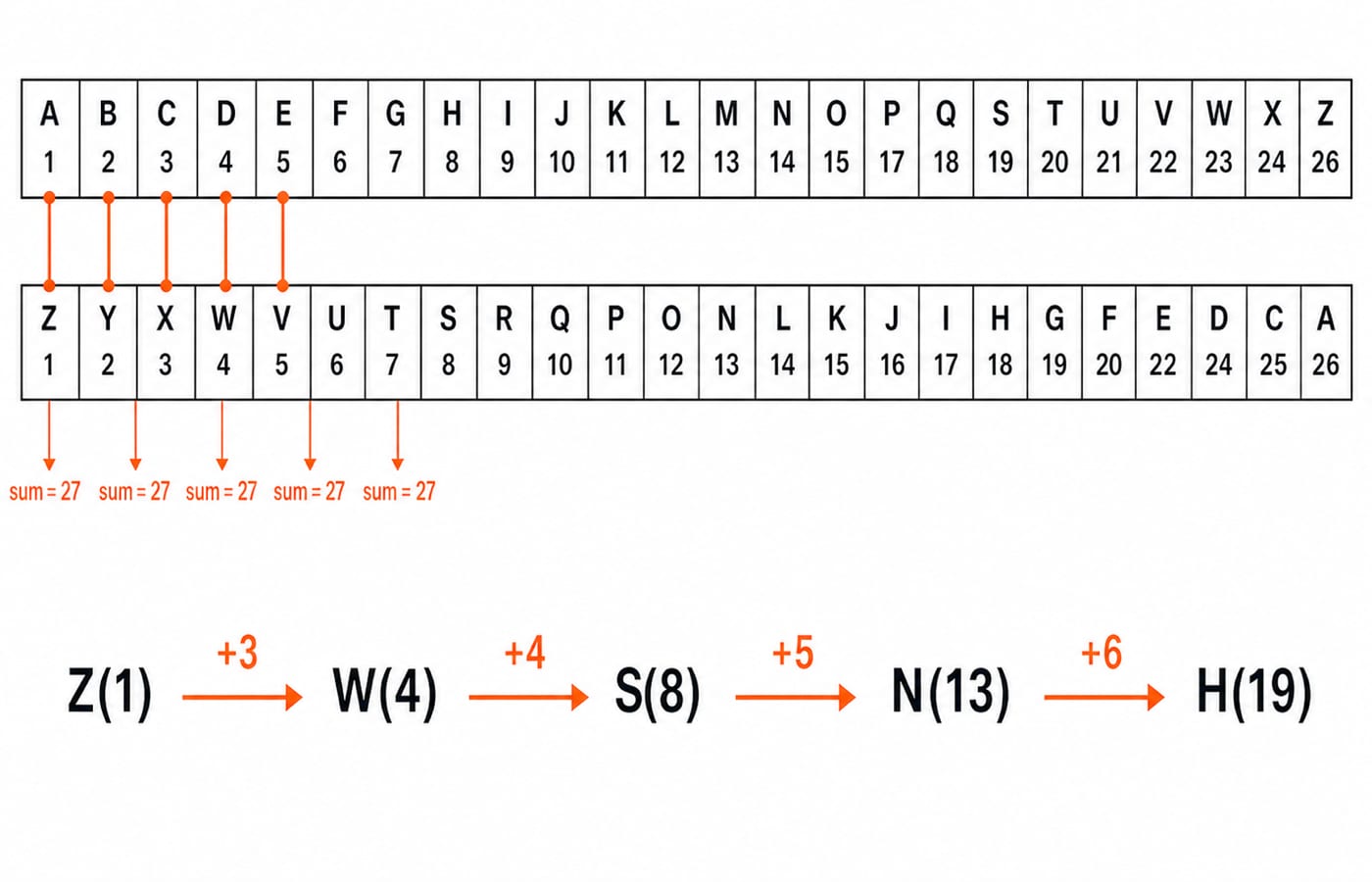
Use the forward map A=1, B=2, ..., Z=26. The reverse map starts from the other end: Z=1, Y=2, ..., A=26. You can calculate either value from the other:
reverse position = 27 - forward position
For D, the forward position is 4, so its reverse position is 27 - 4 = 23. The check is 4 + 23 = 27.
You do not need to write all 26 letters. Remember a few anchors: A=1, E=5, J=10, M=13, N=14, T=20, and Z=26. Since T=20, moving back two places gives R=18. Number only the letters needed for the calculation.
For C, F, I, L, ?, the positions are 3, 6, 9, 12. Each rises by +3, so the next position is 15, or O. The Aptitude for Placements guide places this method inside a wider weekly plan for reasoning, quantitative aptitude, and verbal ability.
2. Test common alphabet-series patterns in a fixed order
Start with a constant gap:
Letters: C F I L O
Positions: 3 6 9 12 15
The gap is +3 throughout. For a growing gap, consider:
Letters: D G K P V
Positions: 4 7 11 16 22
The gaps are +3, +4, +5, +6.
Next test repeating operations. In A, D, C, F, E, H, ?, the operations repeat +3, -1. The same pattern appears when the sequence is split: odd terms are A, C, E, G, and even terms are D, F, H. The missing seventh term is G, not K from extending only the last visible positive jump.
Use this diagnostic order: constant gap, growing or shrinking gaps, alternating operations, odd and even subsequences, then paired or reverse-alphabet structure. It limits overfitting and keeps scratch work short.
3. Worked example: reveal an odd-number gap pattern
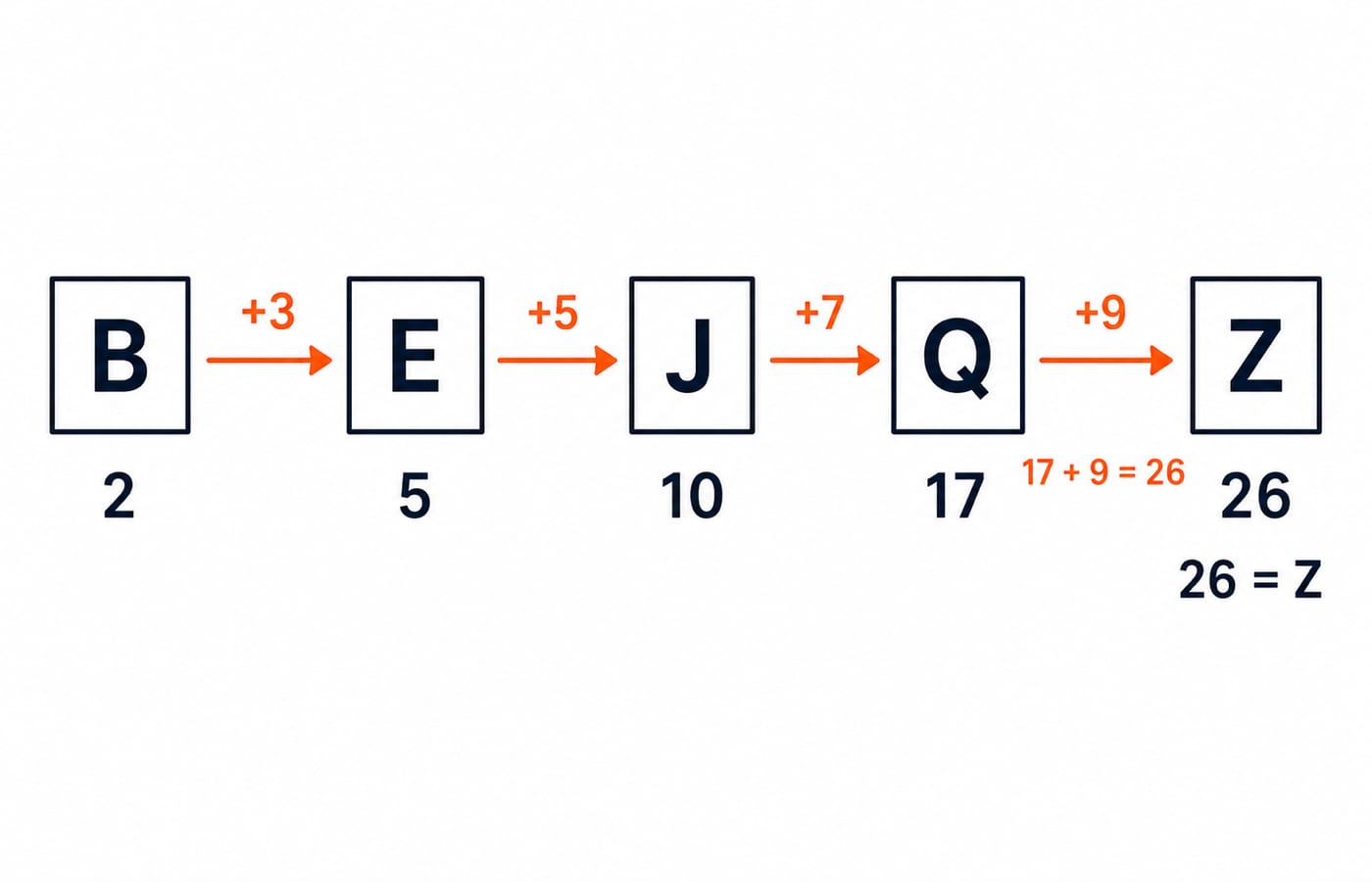
Find the next letter in B, E, J, Q, ?.
Convert the letters:
2, 5, 10, 17, ?.Subtract consecutive positions:
+3, +5, +7.These are consecutive odd gaps, rising by
2, so the next gap is+9.Calculate
17 + 9 = 26. Position26isZ.
Check by counting from Q: R(1), S(2), T(3), U(4), V(5), W(6), X(7), Y(8), Z(9). The answer is Z. As a second check, the positions follow n^2 + 1 for n=1,2,3,4,5: 2, 5, 10, 17, 26. That is verification, not another formula to memorise. The gap relationship is sufficient.
4. Use the reverse-alphabet trick for descending and mirror patterns
Opposite letters have forward positions that sum to 27: A-Z, B-Y, C-X, through M-N. If H=8, its opposite is at position 27 - 8 = 19, which is S.
Now solve Z, W, S, N, ?. Forward positions are 26, 23, 19, 14, ?, with gaps -3, -4, -5. The next gap is -6, so 14 - 6 = 8, which is H.
Recheck with reverse positions. Z, W, S, N, H becomes 1, 4, 8, 13, 19, whose gaps are +3, +4, +5, +6. Both maps give H.
The same shortcut reveals mirror pairs. In AZ, BY, CX, DW, ?, the first letters rise to E, while the second letters fall to V. Each pair's positions sum to 27, so the answer is EV.
5. Handle missing terms, wrong terms, and interleaved pairs
For a missing first term, work backwards. In _ , F, J, O, U, the known positions 6, 10, 15, 21 have gaps +4, +5, +6. The preceding gap should be +3, so 6 - 3 = 3. The missing letter is C. Backward subtraction is safer than guessing what looks evenly spaced.
For a wrong term, inspect every transition. In C, F, J, P, U, the intended gaps are +3, +4, +5, +6. Starting at 3 gives 6(F), 10(J), 15(O), and 21(U). Therefore P at position 16 is wrong and must be O.
For AZ, CX, EV, GT, ?, separate two columns. The first positions are 1, 3, 5, 7, 9, giving A, C, E, G, I. The second are 26, 24, 22, 20, 18, giving Z, X, V, T, R. The next pair is IR. Apply operations within each column, not between the letters of one pair.
6. Use a quick solve-and-check routine
First identify whether the answer is one letter or a pair. Write positions only for changing letters, calculate consecutive gaps, and test alternating terms if the gap row is inconsistent. Translate the numerical result back into a letter, then verify the exact requested slot.
Build a 20-second practice rhythm: use about 5 seconds to recognise the form, up to 10 seconds for positions and gaps, and 5 seconds to check. If the pattern remains unclear, mark it for a second pass instead of forcing an exotic rule.
The published GATE Verbal Aptitude and Reasoning overview introduces number and letter series alongside analogies, rearrangement, and syllogisms. The worked traces here extend its pattern-family step to missing terms, wrong terms, alternating streams, and letter pairs.
7. Avoid traps that turn a simple pattern into a wrong answer
Unless the question defines another code, use A=1, not A=0. Keep every calculated position within 1-26, and remember that 26 is Z, not Y.
If one gap rule breaks, inspect odd and even terms separately. A, D, C, F, E, H, G becomes the consistent streams A, C, E, G and D, F, H. Do not assume wrap-around past Z without repeated evidence, and do not mix forward and reverse values in one calculation. For Z, W, S, N, H, choose one map and use it consistently.
Never accept a rule after one match. It must explain every transition and the location of the missing or wrong term. This review habit also addresses the error-analysis problem discussed in common placement-preparation mistakes: find the cause of an error, not only the score.
8. The short version, practice checks, and next step
Remember: map, subtract, inspect gaps, split if needed, verify. For opposites, use opposite position = 27 - known position, but only after identifying the structure.
Try these before reading each answer:
H, K, O, T, ?Answer: gaps
+3, +4, +5, +6end at position26, so Z.Z, V, Q, K, ?Answer: gaps
-4, -5, -6, -7end at position4, so D.A, Z, D, W, G, T, ?Answer: split it into
A, D, G, JandZ, W, T, so J.
If you want to extend this method into broader quantitative aptitude, reasoning, and verbal-ability study, continue with the Aptitude for Placement course. Keep the process simple, and insist that the chosen rule explains the entire series.
Keep learning
Number System Concepts and Shortcuts: Solved Examples for Competitive Exams
Learn how to classify numbers, choose the right divisibility or prime-factor method, and verify remainders, factors, HCF, LCM, and unit digits.
Updated 22 Oct 20266 min readAptitude & Reasoning

Age Ratio-Based Problems: 12 Questions with Step-by-Step Solutions
Solve 12 age ratio-based questions from the KnowledgeGate practice bank. Each fresh solution shows how to form the equation, shift every age correctly, and verify the answer.
18 Oct 20267 min readAptitude & Reasoning

Mixture and Alligation: Rules, Shortcuts and Solved Examples for Exams
Learn how concentration, alligation and the retention factor solve the main mixture question types, with step-by-step examples and arithmetic checks.
Updated 14 Oct 20265 min readAptitude & Reasoning

Mental Ability Concepts and Shortcuts: Solved Examples for Competitive Exams
Learn a four-step reasoning process, then apply it to number patterns, mirror coding, directions, syllogisms, blood relations and ranking problems.
Updated 10 Oct 20267 min readAptitude & Reasoning