Digital Society Explained: Core Concepts, a Worked Inclusion Audit and Exam Patterns
Learn to separate access, skills and outcomes, audit digital inclusion with a worked funnel, apply data minimisation and solve common exam cases.
KnowledgeGate Team
Exam prep & CS education
Updated 15 Oct 20266 min read
Digital society sounds broad, so many aspirants memorise one definition but struggle with cases about access, skills, outcomes, privacy or participation. Computer fundamentals, the internet and e-learning provide the technical foundation; access, skills, outcomes, privacy and participation are the relevant social distinctions. Case questions can be analysed with a concept map, an inclusion audit and a practical method.
Digital society: meaning, boundaries and the concept ladder
A digital society is one in which communication, education, work, commerce, public services and civic participation are substantially mediated by digital networks, data and platforms. Device ownership alone is not enough; people must participate meaningfully, safely and fairly.
Four related terms describe different levels of change. Suppose a public office handles certificates:
Digitisation converts a paper certificate into a PDF.
Digitalisation lets a citizen submit that PDF through an online form.
Digital transformation redesigns the complete service around online verification, status tracking and coordinated records.
Digital society is the wider change in how citizens, institutions and communities behave once such systems become normal.
Its scope runs from infrastructure and affordability through skills and outcomes to rights, ethics, safety, trust and participation. A case may mention a device even when the real issue occurs later in this chain.
Digital divide: access, skills and outcomes are different gaps
The digital divide has three levels. The first-level divide concerns connectivity and devices. The second-level divide concerns skill and confidence. The third-level divide concerns unequal benefits after access and skills are present.
A village without a network has an infrastructure gap. A smartphone owner unable to complete a form has a skills gap. An inaccessible portal blocking a screen-reader user creates an accessibility and outcome gap. Affordability, language, accessibility and trust cut across all three levels.
This is why one percentage cannot serve as a complete digital inclusion index. The inclusion audit uses only the stated data; it is not an official index or a universal formula.
Digital inclusion audit: a worked 100-household example
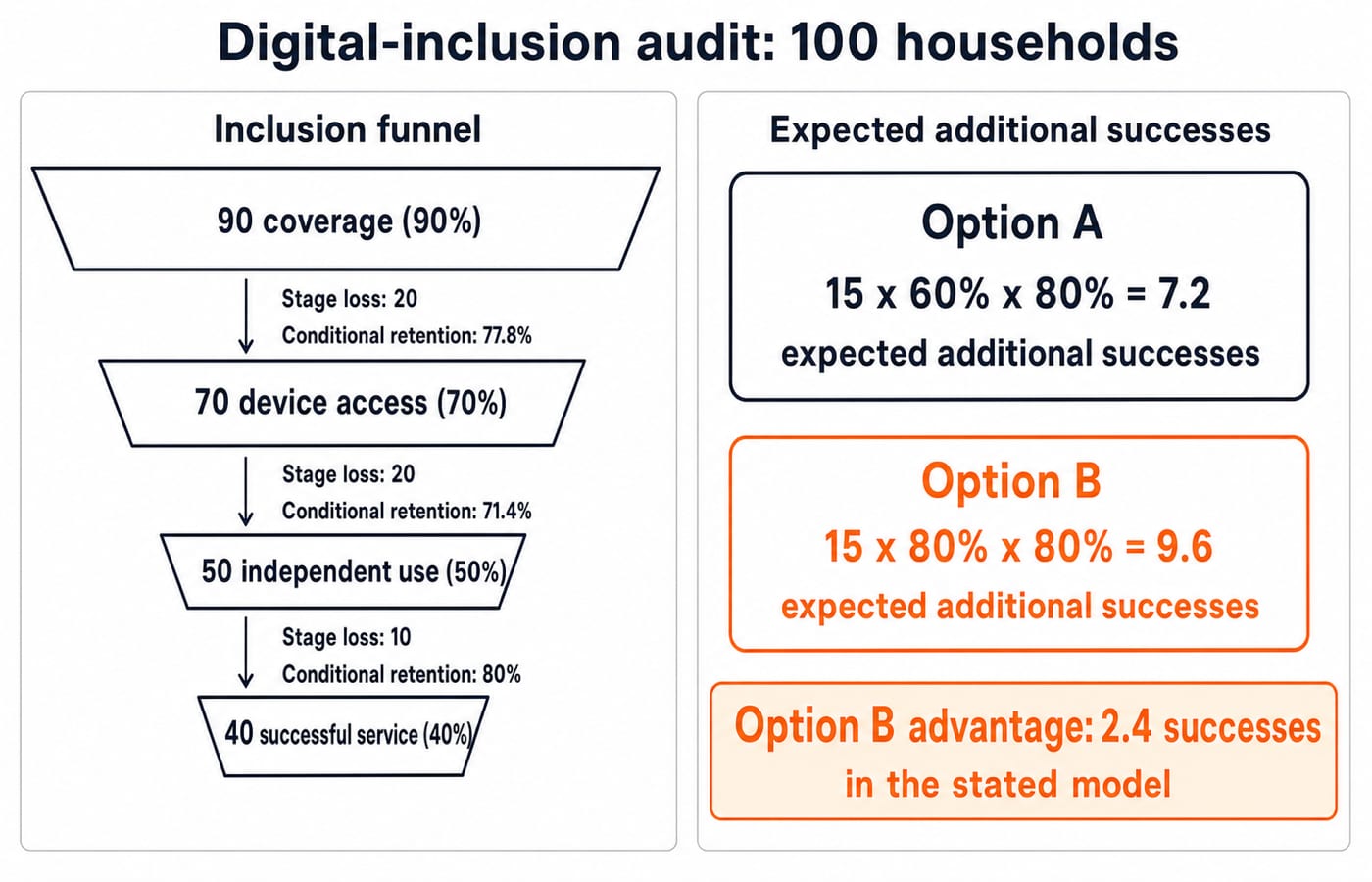
Assume 100 households are eligible for an online service. Of these, 90 have mobile-network coverage, 70 have an internet-capable device, 50 can complete the form independently, and 40 successfully receive the service.
The population rates use all 100 eligible households as the denominator:
Coverage rate = 90 / 100 = 90%.
Device-access rate = 70 / 100 = 70%.
Independent-use skill rate = 50 / 100 = 50%.
Successful-outcome rate = 40 / 100 = 40%.
Now measure retention from one stage to the next. Device access among covered households is 70 / 90 = 77.8%. Independent use among device-owning households is 50 / 70 = 71.4%. Success among independently capable households is 40 / 50 = 80%. The stage losses are 90 - 70 = 20, 70 - 50 = 20, and 50 - 40 = 10 households.
Saying that 90% are connected would therefore conceal the main result: only 40% obtain the intended service.
Compare interventions with capacity for 15 households. Option A lends devices to covered households without them. If 60% become independently capable and 80% of those succeed, expected additional successes are 15 × 0.60 × 0.80 = 7.2. Option B supports device-owning but unskilled households. With 80% completion and 80% subsequent success, 15 × 0.80 × 0.80 = 9.6 expected additional successes.
Option B produces 9.6 - 7.2 = 2.4 more expected successes in this short-term model. Expected values compare the interventions across repeated or probabilistic outcomes. They do not describe fractions of an actual household.
Digital rights and ethics: privacy, consent and accountability
Law creates enforceable duties. Ethics asks whether an action is fair, necessary and responsible when rules do not prescribe every decision. Key principles include privacy, informed consent, data minimisation, purpose limitation, security, accessibility, intellectual-property respect and accountability for automated decisions. Accountability requires a named person or institution to explain, review and correct an automated decision.
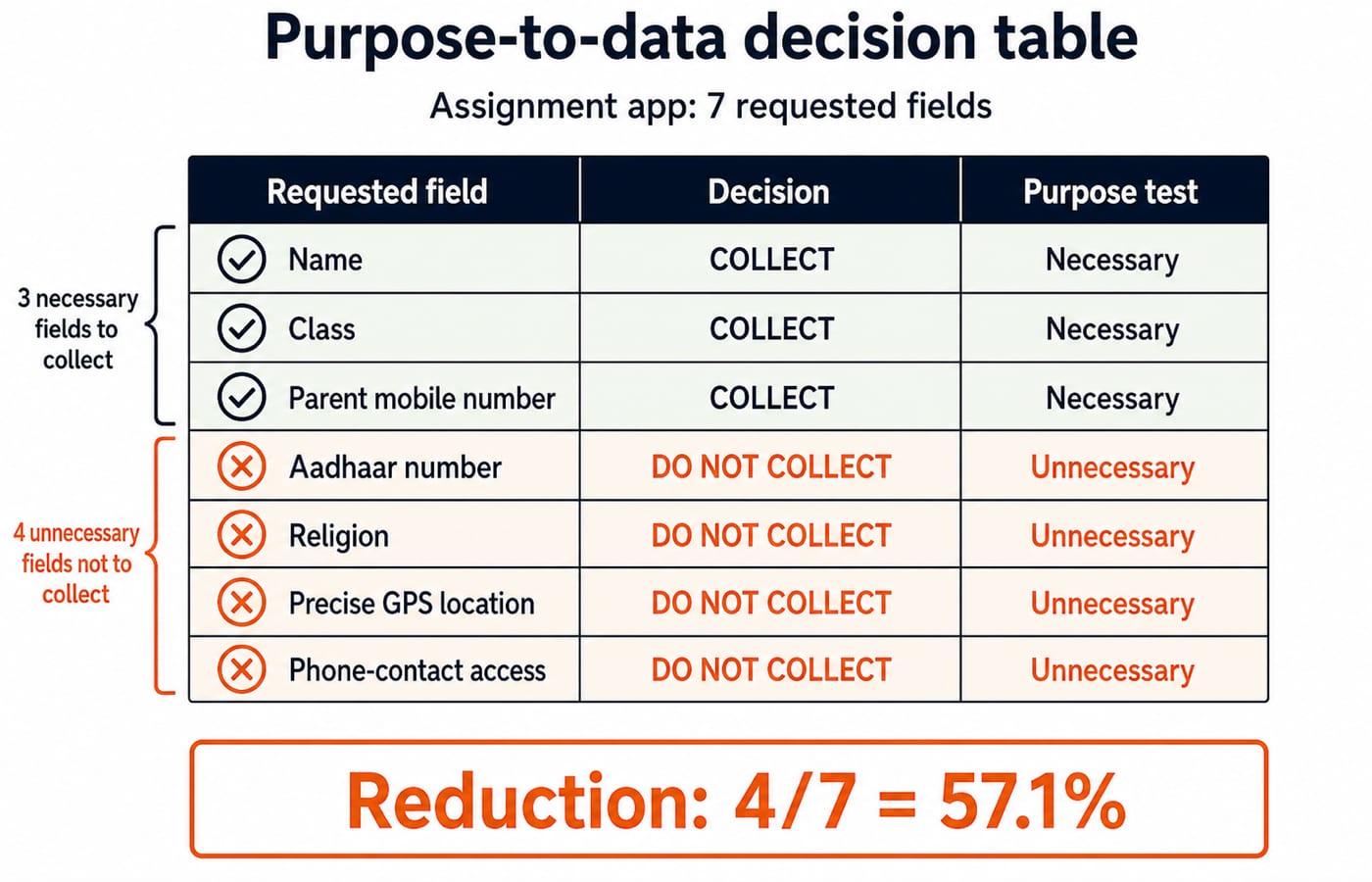
An assignment-delivery app requests seven fields: name, class, parent mobile number, Aadhaar number, religion, precise GPS location and phone-contact access. Retain the first three. Reject the other four unless a separate, necessary purpose is established.
The app keeps 3 necessary fields and removes 4 unnecessary fields. The reduction is 4 / 7 × 100 = 57.1%, without blocking assignment delivery. Collecting less data reduces exposure, but privacy and security are not synonyms. Privacy governs whether and why data should be collected and used, while security protects legitimately held data against unauthorised access.
Digital citizenship: rights, responsibilities and footprints
Digital citizenship is competent, safe, ethical and responsible online participation. Rights and responsibilities work together:
Digital rights | Digital responsibilities |
|---|---|
Access and accessibility | Use systems without excluding or harassing others |
Privacy | Seek consent before sharing another person's data |
Expression | Verify sources and accept responsibility for harmful conduct |
Fair participation | Use secure account habits and respect intellectual property |
An active digital footprint comes from deliberate actions such as posting a comment or photograph. A passive digital footprint includes background collection of browsing logs, device identifiers and location metadata. Passive means neither harmless nor invisible to a platform.
Tool knowledge supports participation but does not guarantee responsible use. MS Office and Digital Classroom Tools for CS Teaching Exams covers the tools; digital citizenship asks whether their use is ethical, secure and inclusive.
Digital society across services, education, work and community
Digital systems create benefits and risks across institutions:
Area | Possible benefit | Inclusion or ethics risk |
|---|---|---|
Public services | Wider reach and traceable status | Authentication and accessibility barriers |
Education | Flexible learning resources | Device, language and participation gaps |
Work | Remote collaboration | Surveillance and blurred personal boundaries |
Community | Fast, wide participation | Misinformation and harassment |
For each benefit, ask: who lacks access or skill, what data is collected, who is accountable, and what assisted or offline route remains? This turns description into analysis. The Govt Teaching Jobs category is a broader route for ICT and digital-society concepts, but recruiting bodies need not use an identical pattern.
Digital society exam patterns and common traps
Digital Society questions in these exams cluster into a small set of recurring shapes rather than a fixed weightage. Expect definition matching, three-level divide classification, privacy-versus-security cases, active-versus-passive footprints, and best-action ethics scenarios using necessity, consent, fairness and accessibility.
Common traps reverse the core distinctions:
Connectivity is not the same as meaningful inclusion.
Digitisation is not full digital transformation.
Privacy is not identical to secrecy or security.
Open source does not mean ownerless.
Freedom of expression does not remove responsibility for harm.
An online service is not automatically accessible.
For a case question, use four steps: identify the affected person, name the layer or principle, locate the harm, then choose the option that fixes the cause. The HPSC PGT Computer Science 2026 course covers Digital Society and Society, Law & Ethics for focused practice of these distinctions.
Digital society: the short version and next step
Remember the chain: infrastructure enables access; affordability and accessibility determine usable access; skills enable action; rights, ethics and security govern safe action; outcomes show whether inclusion happened. In the worked audit, the fall from 90 covered to 70 device-equipped to 50 independently capable to 40 successful households exposes what a coverage figure alone misses.
For DSSSB preparation, the DSSSB TGT Computer Science 2026 Section B course covers Society, Law & Ethics. On any other teaching-recruitment path, check your current syllabus and notification first, because exam structures differ.
Keep learning

Excel Functions and Charts Explained: Formulas, a Worked Sheet and Exam Traps
Learn how Excel formulas, references and charts work by building one mock-test worksheet from scratch. Every output is calculated and every common trap has a fix.
Updated 19 Oct 20265 min readTeaching Recruitment (Computer Science)

Common Editing Ctrl Keys Explained: Copy, Cut, Paste, Undo and Redo with Worked Examples
Learn what each common Ctrl key does, then trace the document, clipboard, cursor and edit history through precise examples without confusing Copy, Cut or Undo.
Updated 11 Oct 20266 min readTeaching Recruitment (Computer Science)
Browsers and Search Engines MCQs: 9 Solved Questions with Explanations
Solve nine published browser and search engine questions, check each answer, and rebuild the browser, cache, crawler and indexing distinctions that exam distractors blur.
Updated 6 Oct 20267 min readTeaching Recruitment (Computer Science)
IT Act, 2000 Explained: Key Sections, Digital Signatures and Worked Exam Examples
Build an exam-ready map of the IT Act, then apply it to an exact digital-signature walkthrough and a section 43, 66, 66C and 66D caselet.
Updated 2 Oct 20266 min readTeaching Recruitment (Computer Science)