IBPS Clerk Cutoff Trends: Set a Defensible Target Score
Turn comparable official cutoff values into a practical working target, then use mock accuracy and consistency to decide what to repair next.
KnowledgeGate Team
Exam prep & CS education
Updated 24 Oct 20264 min read
One viral IBPS Clerk cutoff number cannot tell you what to target. Prelims and mains, State/UT, category, cycle and score scale may refer to different buckets. Use this source-first method: collect like-for-like official values, measure their spread, add a planning buffer, then test the target across five mocks. Worked values are illustrative, not historical IBPS data, predictions or selection guarantees.
CRP-CSA-XV rules apply below. Recheck your cycle's notification, scorecard and provisional-allotment notice. Official documents control.
1. First identify which IBPS Clerk cutoff you are reading
Recent official pages call IBPS Clerk Customer Service Associate (CSA). Label every value by stage (prelims or mains), State/UT, category, cycle and reported score scale. Raw, corrected, equated and Total Weighted Scores differ.
The notification on the CRP-CSA-XV cycle page required qualification in each prelims test, then mains minimums in every test and overall. State/UT vacancies informed mains cutoffs. Final merit used mains marks alone. See the prelims-to-mains section map.
Reject Cycle C | prelims | State A | UR | 78.00 beside Cycle C | mains | State A | UR | 74.00. Their stages differ.
2. Build a like-for-like three-cycle cutoff sheet
Confirm choices with the IBPS Clerk eligibility guide. Copy official scorecards and the relevant allotment notice. The IBPS FAQ provides category and State cutoffs with results.
cycle | stage | State/UT | category | official value | score scale | source URL or saved scorecard date |
|---|---|---|---|---|---|---|
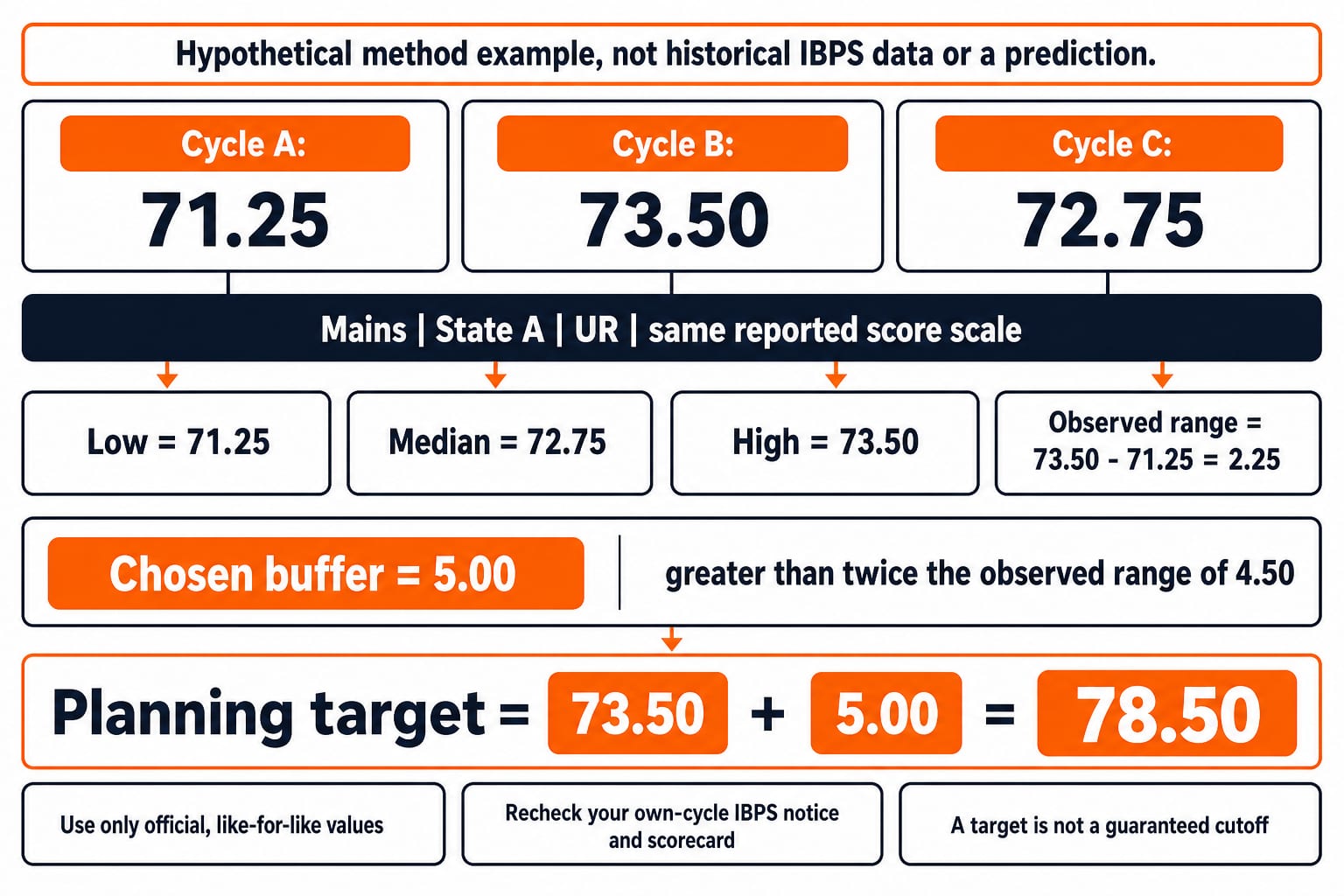
Cycle A | mains | State A | UR | 71.25 | same reported scale | hypothetical entry only |
Cycle B | mains | State A | UR | 73.50 | same reported scale | hypothetical entry only |
Cycle C | mains | State A | UR | 72.75 | same reported scale | hypothetical entry only |
These are hypothetical values for the method only. Sorted: 71.25, 72.75, 73.50. Low: 71.25. High: 73.50. Median: 72.75. Range: 73.50 - 71.25 = 2.25. Mean: (71.25 + 73.50 + 72.75) / 3 = 217.50 / 3 = 72.50.
The mean leaves no room above the high. Plan from the high and range.
3. Add a visible planning buffer
This rule is not an IBPS formula. Add a buffer larger than the observed variation to the highest comparable official value. Twice 2.25 is 4.50, so choose 5.00 points.
Planning target = 73.50 + 5.00 = 78.50
This is 78.50 - 72.50 = 6.00 over the mean and 78.50 - 73.50 = 5.00 over the high. It does not predict the next cutoff. Vacancies, difficulty, normalization, pattern or competition may change. Keep it provisional until five mocks support it.
4. Translate the target into mock-test decisions
CRP-CSA-XV penalised a wrong objective answer by one fourth, or 0.25, of its marks, with no penalty for a blank. This 100 one-mark questions scale is not IBPS normalization or mains weighting.
Start with 77 correct, 9 wrong, 14 blank: total 100.
Correct-answer marks:
77 x 1 = 77.00Penalty:
9 x 0.25 = 2.25Corrected mock score:
77.00 - 2.25 = 74.75Gap to target:
78.50 - 74.75 = 3.75
Repair 3 wrong answers. New counts: 80 correct, 6 wrong, 14 blank, totalling 100. Score: 80.00 - (6 x 0.25) = 80.00 - 1.50 = 78.50.
Moving one response from -0.25 to +1.00 adds 1.25. Three add 3 x 1.25 = 3.75.
5. Demand consistency across five mocks
Five comparable scores: 74.75, 76.25, 78.00, 80.25, 79.75.
(74.75 + 76.25 + 78.00 + 80.25 + 79.75) / 5 = 389.00 / 5 = 77.80
Only 2 of 5 reach 78.50, so the target is unstable although the latest two clear it. Seek 4 of the latest 5 at or above target, with no section repeatedly below your section floor. This is a coaching heuristic.
Record correct, wrong, blank, penalty, corrected score, weakest section, next repair. For English, do 20 minutes of rule review, 25 minutes of timed questions and 15 minutes of error analysis, totalling 60 minutes. See the IBPS Clerk English daily accuracy plan.
6. Five mistakes that make cutoff tables misleading
Mistake | What goes wrong | Replacement |
|---|---|---|
Mix prelims and mains | Different stages enter one trend | Keep one stage per bucket |
Mix State/UT or category | Competitive pools combine | Keep one State/UT and category per bucket |
Copy an unsourced coaching table | The value cannot be audited | Keep the official URL or scorecard date; leave gaps blank |
Average different score scales | Unlike values look comparable | Group by scale and scoring method |
Compare a raw mock with an official normalized or weighted score | It implies false precision | Use mocks for repair; recalibrate to official documents |
CRP-CSA-XV's score-process note says corrected scores were equated for session difficulty and final scores in each test rounded to two decimals. Mocks cannot reproduce IBPS equating. Rebuild after pattern or scoring changes.
7. The short version and your next action
Choose one comparable bucket.
Record only official values.
Use the observed high plus an explicit buffer.
Validate the working target across five mocks.
Current-cycle notification, scorecard and provisional-allotment notice outrank trends. Use the IBPS Clerk CSA Prelims course first and IBPS Clerk CSA Mains course next. See Banking & Insurance Exam Preparation.
A defensible target is a monitored preparation tool, not a forecast of the next IBPS cutoff.
Keep learning
IBPS SO IT Officer Syllabus: What to Study for Each Section
Separate the official IBPS exam structure from the detailed study map. See what to cover for English, Reasoning, Quantitative Aptitude, Professional Knowledge and Descriptive English.
Updated 21 Oct 20264 min readIBPS Exams
IBPS SO IT Officer Preparation Strategy: A 16-Week Phase-by-Phase Plan
Turn 18 weekly hours into a realistic IBPS SO IT Officer plan, from the first diagnostic to mock repair, tapering and a conditional next-stage bridge.
Updated 17 Oct 20266 min readIBPS Exams
IBPS SO IT Officer Exam Pattern and Marking Scheme: Prelims, Mains and Interview
Understand the CRP SPL-XVI stage sequence, section timings and marks, then use worked score calculations and a 12-hour study plan to prepare for each stage.
Updated 13 Oct 20264 min read129 viewsIBPS Exams
IBPS Clerk Eligibility and Selection Process: From Application to Allotment
Separate the eligibility gate from the selection gate using a dated checklist, three candidate profiles and a 124-to-62 Main-score example.
Updated 8 Oct 20264 min readIBPS Exams