IBPS SO IT Officer Computer Organization: professional knowledge topics
IBPS SO IT Officer Computer Organization: number systems, Boolean logic, CPU and memory organization, addressing modes and I/O for the Mains PK paper.
KnowledgeGate Team
Exam prep & CS education
Updated 18 Jul 20265 min read163 views
Computer Organization and digital logic sit at the hardware end of the IBPS SO IT Officer Mains professional-knowledge paper, and they are among the most computational areas on it. Number conversions, Boolean simplification, and addressing modes are all worked, not recalled, which makes them dependable marks for a prepared candidate. The area is also finite, which is why it repays an early pass: number systems, Boolean algebra, the combinational and sequential split, CPU and memory organization, then addressing modes and I/O. How it weighs against the other subjects sharing the paper is set out in the IBPS SO IT Officer Professional Knowledge subject topic map.
Number systems: the arithmetic foundation
Everything in a computer is binary, so fluency with number systems is the starting point. Be quick at converting between binary (base 2), octal (base 8), decimal (base 10), and hexadecimal (base 16).
Work one conversion by hand. To convert decimal 45 to binary, divide repeatedly by 2 and read the remainders upward: 45 gives 101101. Grouping those bits in fours from the right, 0010 1101, reads as hexadecimal 2D. Grouping in threes gives octal 55. That single worked chain, decimal to binary to hex and octal, answers most conversion questions, and the number systems learn module carries the drill set that makes it quick.
Also be ready for signed representation. Two's complement is the standard: to negate a binary number, invert every bit and add one. It lets the same adder handle subtraction, which is why hardware uses it.
Boolean algebra and logic gates
Digital logic is built from gates. Know the basic gates (AND, OR, NOT), the derived gates (NAND, NOR, XOR, XNOR), and the fact that NAND and NOR are universal, meaning any circuit can be built from either one alone. That universality is a favourite exam point.
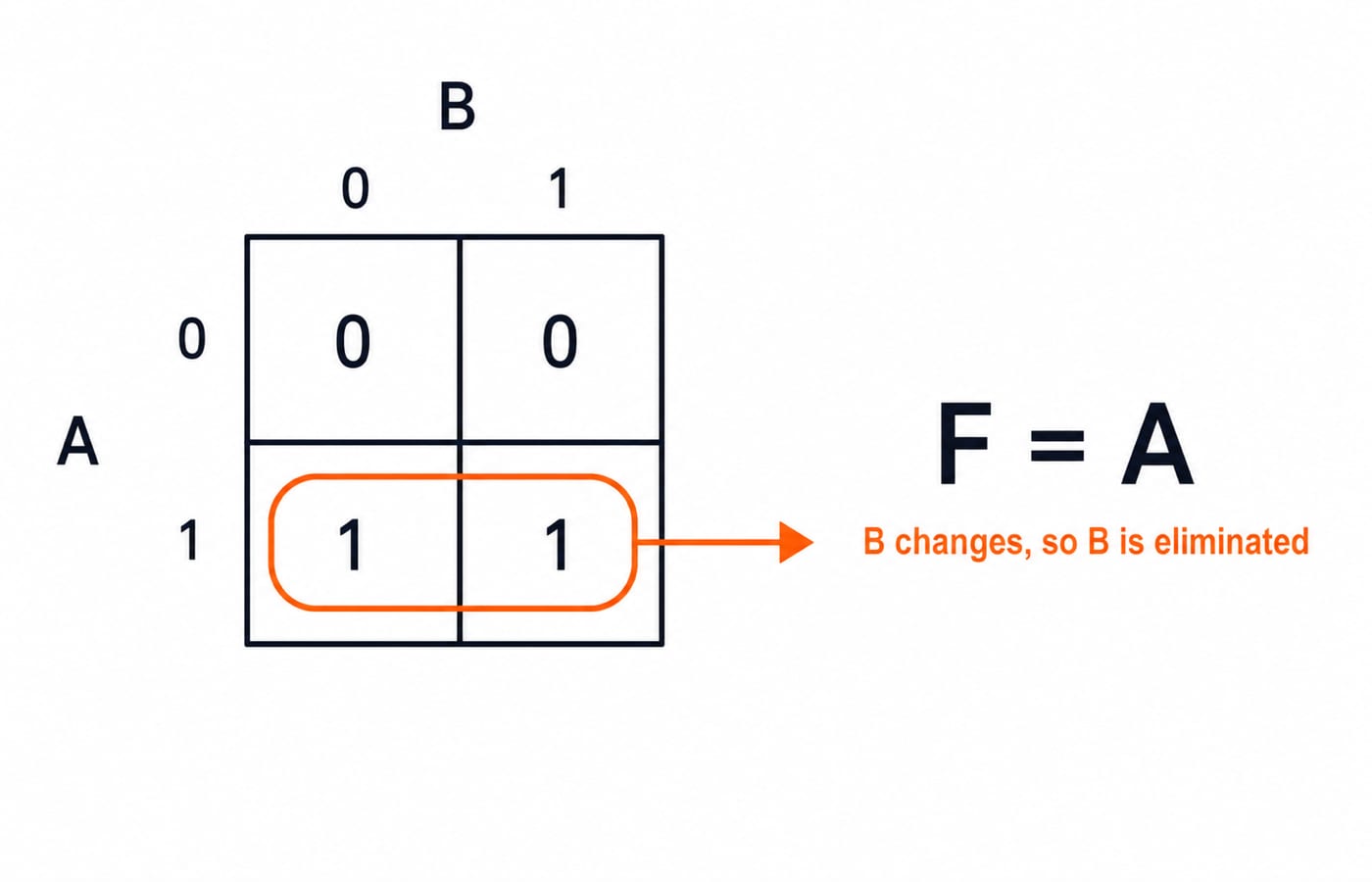
Boolean algebra simplifies logic expressions so a circuit uses fewer gates. Keep the key laws ready: the identity and null laws, De Morgan's theorems (the complement of a product is the sum of complements, and vice versa), and the distributive law. A Karnaugh map is the visual method for minimising an expression by grouping adjacent 1s. Take a two-variable map of A and B: if both cells of the A = 1 row hold 1, then B takes both values inside that group, so B drops out and the function simplifies to F = A. Every K-map reduction is that same move, repeated on larger groups.
Combinational and sequential circuits
Digital circuits divide into two families, and the exam expects you to tell them apart. A combinational circuit has an output that depends only on the current inputs, with no memory. Its standard building blocks are the multiplexer (selects one of several inputs), the demultiplexer, the decoder and encoder, and the adder. A sequential circuit has memory, so its output depends on the current inputs and the stored past state. Its building blocks are flip-flops (SR, D, JK, T), each storing a single bit, and larger units like registers and counters built from them. The clean test question is: does the output depend on past inputs? If yes it is sequential, if no it is combinational.
CPU and memory organization
The processor executes instructions in a cycle: fetch the instruction from memory, decode it, execute it, and store the result. The control unit sequences this, and it can be hardwired (fast, fixed logic) or microprogrammed (flexible, driven by microinstructions), a distinction the exam likes.
Memory is arranged as a hierarchy trading speed against cost and size: registers, then cache, then main memory (RAM), then secondary storage. This works because of locality of reference, the tendency of programs to reuse nearby data and instructions. Cache mapping (direct, associative, set-associative) decides where a memory block may sit in cache, and it is a common numerical topic.
Two performance ideas often appear together. Pipelining overlaps the stages of consecutive instructions so several are in progress at once, raising throughput, though hazards (data, control, structural) can stall it. Effective memory access time is computed from the cache hit ratio: if the hit ratio is h, the average access time is h times the cache time plus (1 minus h) times the memory time. That single formula answers a large share of memory-hierarchy numericals, so practise it until it is automatic.
Addressing modes and I/O
Addressing modes define how an instruction names its operand. Learn these five, and be able to say where the operand actually lives in each:
Immediate: the operand is in the instruction itself.
Direct: the instruction holds the operand's memory address.
Indirect: the instruction holds an address that points to the operand's address.
Register: the operand is in a named register.
Indexed: an address is formed by adding an index register to a base, useful for arrays.
Identification questions turn on exactly that difference, most often between direct and indirect, so read the operand field before the opcode. The addressing modes learn module works through them one mode at a time.
For input and output, know the three ways a CPU deals with devices: programmed I/O (the CPU polls, wasting cycles), interrupt-driven I/O (the device signals when ready), and direct memory access (DMA), where a controller moves data to memory without the CPU handling each word.
How this is tested in the IBPS SO IT Mains
Computer Organization and digital logic are well represented in the Professional Knowledge paper. Our question bank carries over 1,700 Computer Organization questions and more than 1,500 on digital electronics, so the practice pool for conversions, Boolean simplification, and addressing modes is deep. Expect a number-system conversion, a Boolean simplification or gate-count question, an addressing-mode identification, and a cache or memory-hierarchy numerical.
The official specifics of the Mains paper, its question count, timing, and any negative marking, live in the current notification at ibps.in, so check them there before you finalise your attempt plan.
Your next step
This area is mastered by working conversions and simplifications until they are automatic.
Prepare the core paper in the IBPS SO IT Officer Mains course, which sets this hardware core in the banking-IT context.
For all three stages together, use the IBPS SO IT Officer Scale-1 bundle.
Convert one number across all four bases, simplify one Boolean expression with a K-map, and identify five addressing modes from memory. Do that and this hardware section turns into reliable marks.
Keep learning
Pipelining Basics in Computer Architecture: Clock Cycle, Speedup and Hazard Worked Examples
Learn how to calculate a pipeline clock, fill and drain time, finite-batch speedup, latency, throughput, and the cost of a load-use stall.
Updated 23 Oct 20266 min readComputer Organization & Architecture
Data Manipulation Micro-Operations in COA: Arithmetic, Logic and Shift Operations Worked Step by Step
Learn a fixed-width method for tracing arithmetic, logic, and shift micro-operations. Every example tracks register values, result bits, carry, and overflow.
Updated 19 Oct 20265 min readComputer Organization & Architecture
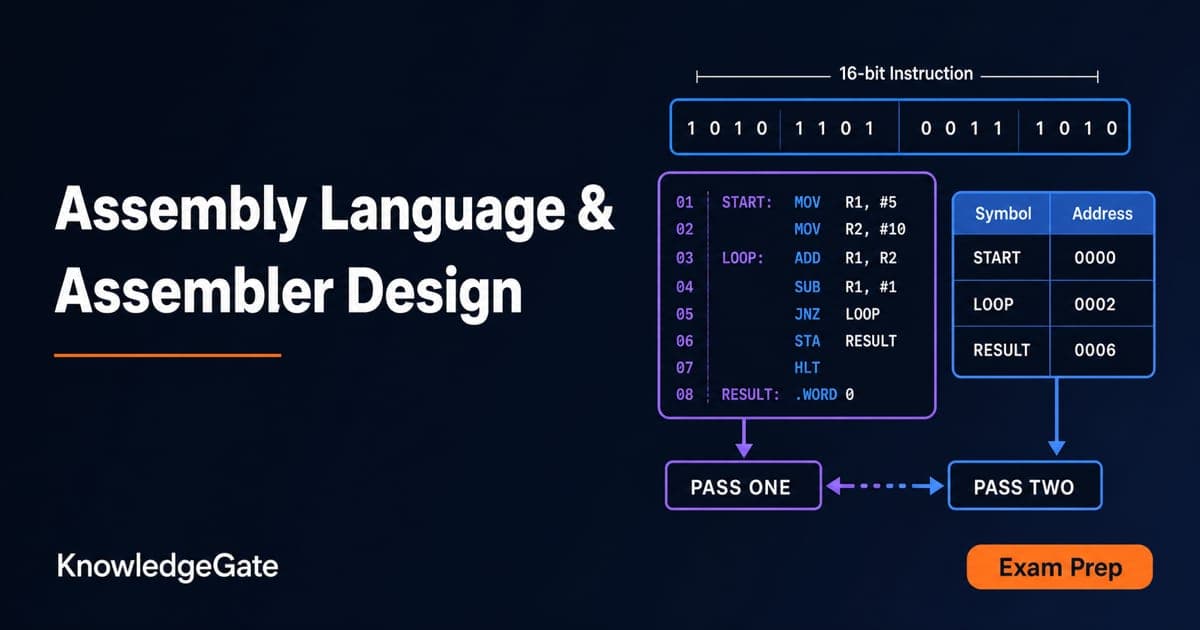
Assembly Language and Assembler Design: Two-Pass Translation with a Complete Worked Example
Follow a 16-bit Basic Computer program through pass one, pass two, hexadecimal encoding and execution, with every symbol, address and result shown.
Updated 15 Oct 20266 min readComputer Organization & Architecture
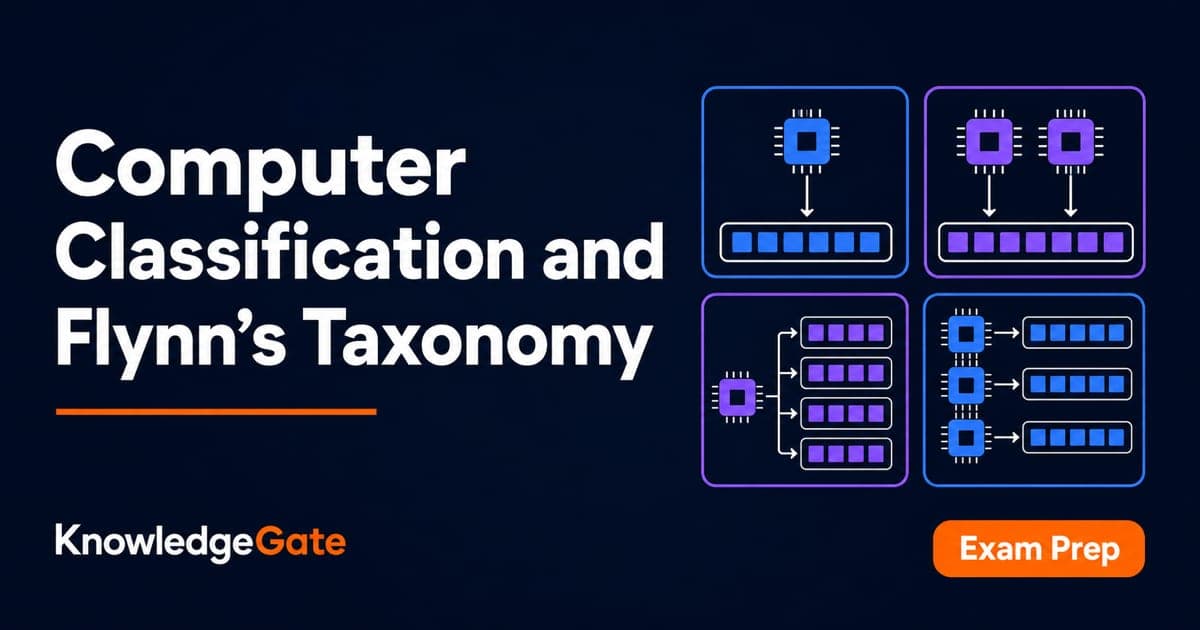
Computer Classification and Flynn’s Taxonomy: The Four Classes with a Worked Vector Example
A machine can belong to several computer classes at once. Learn the four classification axes, Flynn’s matrix, vector and multicore traces, and exam traps.
Updated 11 Oct 20266 min readComputer Organization & Architecture