NIMCET Previous-Year Analysis: How Questions Split Across Maths, Reasoning and Computers
Read NIMCET papers as a distribution map, not a collection of isolated questions. Use recurring chapter families to decide what to master first.
KnowledgeGate Team
Exam prep & CS education
2 Sep 20265 min read
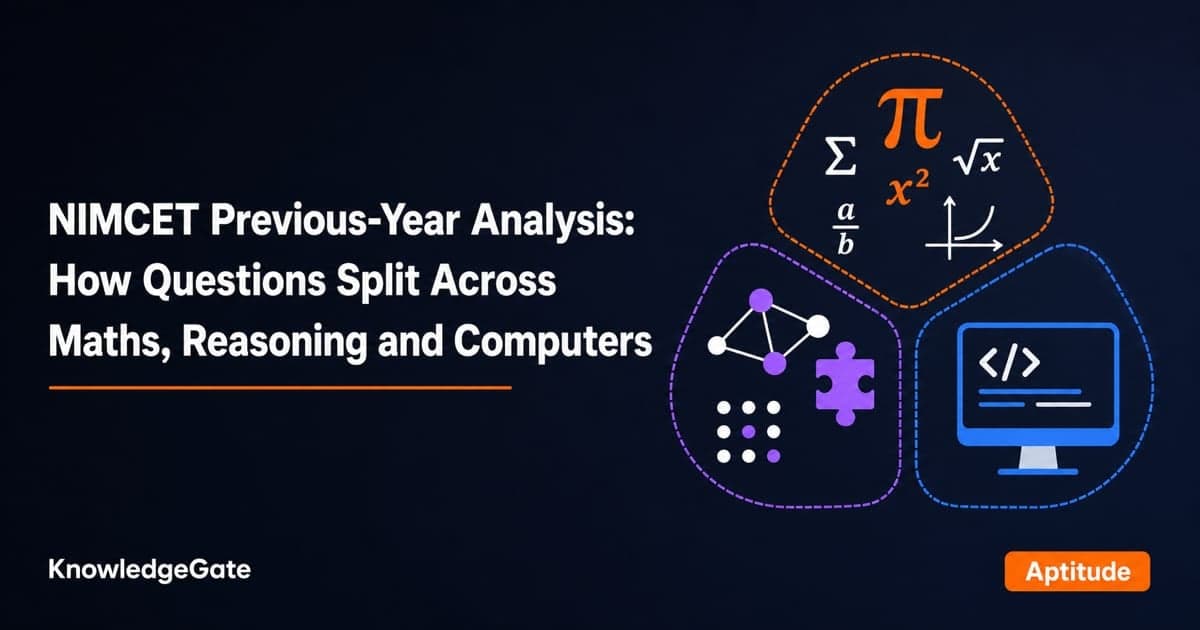
"What repeats in NIMCET?" is a better planning question than "What is in the syllabus?" A paper dominated by mathematics rewards chapter priority, not equal time for every line in the syllabus. Previous-year analysis helps you find that priority without pretending to predict the next paper.
Do not memorise old answers. Track where questions repeatedly come from, what kind of thinking each section demands, and where another hour of practice is most likely to improve your score.
Read a NIMCET past paper as a distribution map
Many students solve a previous paper, check the score, and move on. That gives practice, but it wastes the paper's planning value.
Tag every question by section and chapter. A useful label is specific enough to guide revision: "calculus, maxima and minima" is better than "mathematics". For reasoning, use labels such as coding-decoding, syllogism, seating arrangement, or series. For computer awareness, separate number systems from hardware, operating systems, and internet basics.
After tagging several authentic papers, ask three questions:
Which chapter families appear repeatedly?
Which recurring types still cost you time or accuracy?
Which syllabus areas appear less often but are easy enough to keep as breadth insurance?
Use papers released through the official NIMCET portal and check the current brochure before turning an old-paper pattern into this year's plan. Recent papers and brochures show the broad section hierarchy, but an old paper is not an official promise about a future one.
NIMCET section split: the official baseline and the PYQ layer
The 2026 official brochure makes the baseline concrete: 50 Mathematics questions, 40 Analytical Ability and Logical Reasoning questions, 20 Computer Awareness questions, and 10 General English questions. It also assigns more marks to each correct Mathematics answer than to each correct answer in the other sections. Use those official values to understand the paper structure, then use past papers to measure which chapters and question forms recur inside each section. The current official brochure remains the authority for counts, marks, timings, and negative marking.
This hierarchy changes how you should interpret a mock result. A weak mathematical base cannot usually be repaired by over-preparing the smaller awareness block. Equally, ignoring reasoning would leave a large, trainable part of the paper exposed.
Think in layers:
Mathematics is the core. It needs concept study, worked examples, and timed problem sets.
Reasoning is the reliable second block. Repeated pattern exposure can improve both speed and selection.
Computer Awareness and English are controlled top-ups. They deserve regular revision, but not at the cost of the mathematical core.
The same principle appears in other exam analyses, even when their section mix differs. The SSC CGL Tier 1 topic-wise distribution guide shows how section counts become a study order, while the IBPS PO previous-year paper analysis demonstrates why patterns should guide emphasis rather than act as predictions.
Mathematics chapter patterns that deserve priority
At chapter level, older NIMCET papers repeatedly pull from broad families such as algebra, calculus, coordinate geometry, trigonometry, and probability and statistics. Set theory, matrices and determinants also belong in a serious paper-analysis notebook.
Do not flatten that into a checklist where every chapter gets identical time. Use three priority bands:
Band 1: recurring and foundational
Start with algebra, calculus, coordinate geometry, trigonometry, and probability and statistics. These are not just labels to revise. Break each into question types. For calculus, that may mean limits, differentiation, maxima and minima, and integration. For coordinate geometry, separate lines, circles, and conics.
Band 2: steady contributors
Set theory, matrices, determinants, and related algebraic tools should stay active through short mixed sets. They can also support other problems, so treating them as isolated one-day topics is risky.
Older papers may contain material that a revised syllabus handles differently. Vectors are a good example of a topic that should be checked against the current official syllabus rather than copied automatically from an old-paper tracker. Previous-year presence and current-year eligibility are two separate questions.
Band 3: breadth insurance
Once the major families are stable, cover the remaining official topics well enough to identify and start a standard problem. Previous-year analysis sets emphasis, but it should never create a blind spot across the current syllabus.
Reasoning and Computer Awareness repeat types
Reasoning questions often return through recognisable forms: series, coding-decoding, syllogisms, puzzles, seating arrangements, directions, and blood relations. The surface story changes, but the underlying operation often does not.
This makes an error log unusually valuable. Do not write only "puzzle wrong". Record whether you missed a condition, built the wrong table, assumed an order, or spent too long before leaving the question. The fix depends on the error.
Computer Awareness is smaller, but it can be prepared cleanly. Number systems, data representation, basic computer organisation, memory, hardware, software, operating systems, internet use, and online safety are the kinds of fundamentals named in the current syllabus. Revise definitions, then practise quick application questions. A small section should become dependable, not consume the hours needed for mathematics.
Turn previous-year analysis into a study plan
Begin with a diagnostic paper under realistic conditions. Tag every miss by chapter and cause. Then build your next study cycle in this order:
Repair the highest-priority mathematics concepts you could not start.
Drill standard questions from those concepts until the method is automatic.
Train recurring reasoning types in timed sets.
Revise Computer Awareness and English in short, regular blocks.
Return to a mixed paper and compare the error categories, not just the total score.
Keep one breadth session in the cycle. That protects you from treating past frequency as certainty. If a chapter is in the current syllabus but rare in the papers you sampled, learn its standard forms before deciding how much deeper to go.
Map the pattern to practice
You can practise with well over 8,000 mathematics and quantitative-aptitude questions and 6,000+ reasoning questions in our practice bank. Those pools match the two blocks that should carry most of your practice, but the sequence matters: learn a method, solve a focused set, analyse errors, and only then move to mixed speed work.
The MCA Entrance Exam course is the primary route for the mathematical core and the wider entrance context. Use the Aptitude course for additional quantitative and reasoning practice. Source the papers themselves only from the official portal, so a coaching-site reconstruction does not become your ground truth.
The short version and next step
NIMCET previous papers tell a mathematics-first story. Prioritise the recurring mathematical families, make reasoning your dependable second block, and keep Computer Awareness and English controlled and regular. Use previous-year analysis to choose emphasis, not to guess the exact next paper.
Start with one authentic paper, tag every question, and turn the tags into your next revision cycle. For a broader view of the available preparation paths, use the PG Entrance Exams catalogue, then verify the current pattern on the official NIMCET portal before finalising your plan.
Keep learning
MS Word Basics: Editing, Formatting, a Worked Document and Exam Traps
Learn how Word applies commands to characters, paragraphs, pages and files. Build an ICT revision plan, audit every state change and avoid common exam traps.
Updated 23 Oct 20266 min readTeaching Recruitment (Computer Science)
Excel Functions and Charts Explained: Formulas, a Worked Sheet and Exam Traps
Learn how Excel formulas, references and charts work by building one mock-test worksheet from scratch. Every output is calculated and every common trap has a fix.
Updated 19 Oct 20265 min readTeaching Recruitment (Computer Science)
Digital Society Explained: Core Concepts, a Worked Inclusion Audit and Exam Patterns
Learn to separate access, skills and outcomes, audit digital inclusion with a worked funnel, apply data minimisation and solve common exam cases.
Updated 15 Oct 20266 min readTeaching Recruitment (Computer Science)
Common Editing Ctrl Keys Explained: Copy, Cut, Paste, Undo and Redo with Worked Examples
Learn what each common Ctrl key does, then trace the document, clipboard, cursor and edit history through precise examples without confusing Copy, Cut or Undo.
Updated 11 Oct 20266 min readTeaching Recruitment (Computer Science)